Showing posts with label India. Show all posts

Wednesday, December 8, 2021

America for Beginners - by Leah Franqui

Recently widowed Mrs. Pavil Sengupta of Kolkata, India decides to venture out of her bubble and travel to the United States in search of answers about her deceased gay son Rahi. She employs the First Class India USA Destination Tour Company to hire her a tour guide (Satya) and a traveling companion (Rebecca) for her trip. The three set off on a cross-country trip and learn not only about the United States, but some things about themselves as well.

One of the stops on their trip was the Corning Museum of Glass in New York. Mrs. Sengupta asks her guides if  there were "many places like this...places where things can be studied"? To which Rebecca responds "Oh, yeah. Tons. My dad always said growing up he learned more in museums and libraries than anywhere else".

Mrs. Sengupta does make a stop in a library at the end of her trip, at UC Berkeley, where she reverently "touched the pages of [Rahi's] thesis, printed, bound, and carefully stored in the university library".

I marked one other passage of this book while I was reading it, although it had nothing to do with libraries. This is my only book blog, so I have no where to vent on this particular topic but here: 

During a regrettable night of drinking in New Orleans' French Quarter Rebecca refuses "to have sex in a public bathroom for reasons of hygiene, good taste, and physical comfort." I have noticed recently that a public bathroom sex scene seems to be de rigueur in twenty-first century television and movies. Every time it happens I roll my eyes and make a snide comment to my husband about "here we go again". For the exact reasons that Rebecca gives, I am having a hard time believing it is as common as pop culture might lead us to believe. I can only hope that this tired trope, along with  "making up your bed to look like you're sleeping in it", and "crawling through an air duct to escape a locked room", has a  screen time to real life ratio of something like a bajillion to one.


Monday, August 16, 2021

The Book of Joy - by His Holiness the Dalai Lama, Archbishop Desmond Tutu, and Douglas Abrams


The One Book One Community selection for the fall 2021 is The Book of Joy. After so much time on lockdown (with only virtual connections) the time seemed right for a book that explores what is joyful in life. Co-author Abrams follows these two religious leaders during a week-long meeting in which they discuss how they remain positive despite their experiences living under apartheid (in the case of the Archbishop) and the extreme difficulties of living in exile (in the case of the Dalai Lama). The Dalai Lama left Tibet for India in 1959 at the age of 24. He describes how during the Cultural Revolution China pledged to wipe out the Tibetan language 
so they burned books, such as the three-hundred-volume Tibetan canon of scriptures translated from India, as well as several thousand volumes written by Tibetans themselves
On a more joyful note however, the week wraps up with a party in honor of the Dalai Lama's eightieth birthday. And what better place to have a joyful birthday celebration than in a library! The party takes place in the Tibetan Children's Village school

As our motorcade approached, we heard the children's soaring voices, their welcome song high-pitched and plaintive, yet indomitable and joyful. It was a song they had composed...The choir and school staff lined the road. All around them sat waves of students in their school uniforms...The car finally arrived at the library and the children were still singing at the top of their lungs.

This was, ironically, a rather challenging book for me. As I read news of building collapses, an earthquake, the Taliban, raging wildfires, all while facing a pandemic that won't slow down because of deliberate manipulation of truth, perhaps remaining hopeful is the best I can do for now. Joy will have to wait.

Wednesday, May 13, 2020

The Book of M - by Peng Shepherd


May is Mystery Month and I don't really like mysteries. I especially don't like the serial mysteries that involve some amateur sleuth in a small town with a disproportionate number of murders. It seems like a lot of library mysteries are of this type. People keep recommending them to me, and I keep not liking them. However, I do like to have a variety of genres on this blog, so I googled library mysteries and found this title. The description appealed to me because it looked supernatural, surreal, and, most decidedly, not part of a murder series. If you are a person who likes this genre I do have some posts which you can find here and here.

It turned out that much of what takes place in this dystopian novel is rather prescient. A mysterious disease causes people to lose their shadows, and eventually their memories. Quarantines, food shortages, suspicion and fear abound. Shadowless people not only lose their own memories, but memories of virtually everything. Some don't remember how to eat, to read, or to talk. Women don't understand what their periods are (and as a bonus have no idea that they'd been taught to be ashamed of them). Shadowless also eventually forget that there are laws of physics, and once they forget that, they can simply ignore those laws. People can mutate themselves and others; prison cells become their own means of escape.

I read quite a bit of this without seeing anything about a library, so I naturally grew concerned that I'd been duped. Fortunately, I was reading an e-version of the book which allowed me to search easily for the word library to find out if indeed this were a library-centric book. Although the first instance of the word doesn't show up until about 40% in, it then becomes quite important. The Martin Luther King, Jr. Memorial Library in Washington, DC is the location of a battle for books between the shadowed and the shadowless. Of no surprise to this librarian the books ultimately prove to be the salvation of all. 


Thursday, December 6, 2018

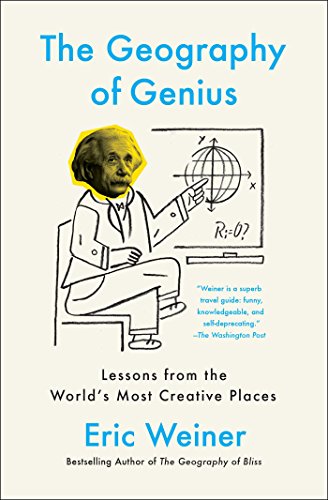
The Geography of Genius - by Eric Weiner


Nine years ago I embarked on a project of reading "Year Of" books. One of the books I read, together with my geographer husband, was Eric Weiner's Geography of Bliss in which the author sought out the world's happiest places. When we discovered that Weiner had written another geography book we downloaded it and listened to it together during our regular drives between Bridgewater and Fairhaven. In The Geography of Genius Weiner visits places that were once hotbeds of creativity, or in the case of Silicon Valley, still are.

Of course libraries are essential elements when discussing genius and Weiner mentions them no fewer than twenty times.

Twice he used the library as a metaphor:

  • In Athens, Greece he decides to take a walk, as was the wont of many of the great thinkers who hailed from that city. His host, Tony, "approves of walking". However, it appears to Weiner that "this approval does not extend beyond the realm of the theoretical as Tony's expanding belly "says more about the divide between ancient and modern Athens than a library's worth of books".
  • It seems that the stereotype of the shushing librarian will be around for quite some time. Weiner uses the image to explain that working in a quiet space may in fact not be conducive to creative thinking. And that it is in fact the moderate noise levels found in coffee houses that make them ideal places to incubate ideas.

Importantly, Weiner also points out that libraries are not just places for books, but for programs and as gathering centers as well when he sees people queuing for a lecture at the National Library in Edinburgh, Scotland.

Libraries weren't always a public resource. Early libraries were by membership or subscription only. Today public libraries are recognized as the People's University. Block printing during the Song Dynasty (969 to 1276 AD) in Hangzhou China brought information to the masses. "Soon, thousands of titles, on all sorts of topics, were published each year. One library alone, at the Imperial Palace, housed some eighty thousand scrolls."

In Calcutta he discusses colonization with this description of Job Charnock - a seventeenth-century English sea captain, who married an Indian woman.
He wore loose, baggy Kurtas, smoked a hookah...and drank the local libation, a potent moonshine called arrack. Job Charnock, founder of Calcutta, son a English aristocrats, proud servant of the queen, went native.
That might come as a surprise given our image of the British and their attempts to rule India without interacting with India.
Charnock was the exception to those who agreed with Lord Macaulay "a senior official in the Raj, who infamously said that a single shelf of a good European library was worth the whole native literature of India and Arabia."

The same type of European-superiority thinking is evident in Joshua Hammer's work The Bad-Ass Librarians of Timbuktu as well.

Throughout his travels the author sings the praises of several librarians who helped him along the way:
  • In Hangzhou, China a librarian named Norman delivers a difficult-to-find copy of the English translation of Brush Talks from Dream Brook by eleventh-century genius Shen Kuo to Weiner's hotel "with all the furtive intrigue of a drug deal or CIA drop".
  • During a visit to the archives Laurentian Library in Florence (designed by Michelangelo) he speaks with Dr. Shelia Baker who is excited about a recent discovery of a letter written by Galileo to a friend. She also explains that to those who lived in the 15th century a book cost as much in relative terms as a car does today. Books were status symbols. Scholars were people who owned many books (even if they never read them).
  • In the Silicon Valley Archives where he walks "into a majestic room, brimming with wooden cabinets and history" a librarian hands him a cardboard box filled with correspondence from Fred Terman's days at the Harvard Radio Research Laboratory during World War II.
  • And, finally, in the acknowledgements Weiner thanks Kathleen McNamara director of Georgetown University's Mortara Center for providing "that most valuable of gifts: a library card."
Smart people use libraries.

Thursday, February 12, 2015

Secret Daughter - Shilpi Somaya Gowda


My sister gave me this novel when I asked her for something I could read on the plane ride home from my recent visit with her. It is the story of three women: Asha, a young woman who was adopted from India and brought to the United States as a baby; Somer, Asha's adoptive mother; and Kavita, Asha's birth mother. The three stories are woven together as Asha goes on a voyage of self-discovery. Ultimately there is resolution and redemption for all.

The Lane Library at Stanford University's School of Medicine is important to Somer as the place where she met her future husband. Serious students, they both spent more time there than their fellow medical school students
It was almost a decade ago, under the dull yellow lights of Lane Library at Stanford's School of Medicine, that they first noticed each other. They were there night after night, and not just on the weeknights when the rest of the class studied, but on Friday nights, instead of going out to dinner, and on weekends, when the others went hiking. There were only a dozen of them, the Lane regulars: the most studious ones, the hardest workers.  
There is no doubt in this librarian's mind that Somer's heavy use of the library was a direct result of the fact that her mother worked in a library, although Somer "has never understood how her mother stay[ed] interested in such a mundane job." This after learning that her mother has just rearranged the reference section to make way for some furniture and was working on organizing a series of workshops on biographies of famous women. Really, how could anyone call that mundane?