Showing posts with label graphic novel. Show all posts

Friday, February 27, 2026

Wake Now in the Fire - by Jarrett Dapier & AJ Dungo

This very recently published graphic novel is a fictionalized account of real events. In 2013 Chicago Public School (CPS) removed all copies of Marjane Satrapi's Persepolis from classrooms. Once administrators determined that they didn't want the book to be used as part of the curriculum it was removed from classrooms, even as classes were being conducted. (A very similar situation occurred in the Tucson Unified School District (TUSD) around the same time.) The predictable refrain of "we're not banning books" from CPS Administration was evident. The CEO (yes CEO!) of the Chicago Public Schools at the time Barbara Byrd-Bennett claimed to know nothing about the removal of the books, and insisted that CPS is "not in the business of censorship". Turns out she was lying on both counts. Moreover, in 2015 Byrd-Bennett was convicted on bribery charges and spent time in federal prison.

Teachers, librarians, and students worked together to ensure that the book remained in the library, even as it was removed from classrooms. However, CPS was also working at the time to shut down most of the school libraries in the district.

The book doesn't shy away from an explanation that book banners come in both the red and blue variety. A student asks how such a thing can happen in bright blue Chicago. His teacher responds

Censorship is, unfortunately, something humans do. Humans in communist dictatorships, humans in right-wing theocracies, humans in red towns, blue towns...It's an instinct we seem to have for different reasons. 

A graphic novel about the banning of a graphic novel. I do like things that are meta. 

And I don't expect we will have to wait long before the book banners start challenging this one, too.

Wednesday, March 13, 2024

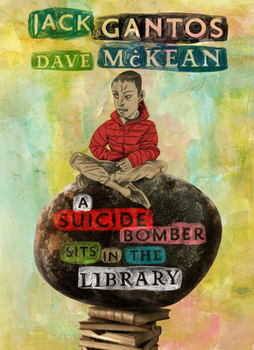
A Suicide Bomber Sits in the Library - by Jack Gantos


I first learned of this "unpublished" work when I read the Booklash Report from PEN America which describes several cases of pre-emptive censorship (in which authors either change, or pull, their works before publication in response to public accusations of harm. 

When criticism of a book veers into accusations of harm, authors may feel compelled to respond to their audiences in real time—typically through social media. In some cases, this means fact-checking details that have been lost or misrepresented in the social media uproar. In 2018, for example, Dave McKean, the illustrator of the controversial children’s graphic novel A Suicide Bomber Sits in a Librarytweeted to clarify that the book’s Muslim protagonist was not in fact illiterate—a sticking point in a since-deleted, viral tweet posted by comics publisher Zainab Akhtar.

It turns out that the book never got published anyway, over charges that it was "Islamophobic". But then, I discovered that the "unpublished" work had actually been published as part of an anthology (Here I Stand edited by Amnesty International) in 2016. An interlibrary loan request brought this work to me so I could read the story for myself. 

The short story does not include McKean's illustrations (which would have appeared in the graphic novel). I think it is clear, however that the protagonist is illiterate. We see this in the very first paragraph. 

He has been told to fear nothing and that he will be perfectly safe in the library. Not even the secret police will think to look for him there, since he cannot read.

There is no indication in the rest of the story that the boy knew how to read.  

While sitting in the library the boy watches as others select and enjoy books, and begins to wonder what he is missing.

The suicide bomber...wants to ask what happens next in the story but he has been instructed to remain silent because books will master him just as they have mastered his enemies. He has been taught that books create a false life in a godless world that should not exist. Books cannot be trusted when only God has the key to paradise.

Well, this certainly reminds me of current events - censoring a book about censorship. 

Those on the left who would censor books do not like to be compared to those on the right who do the same. It is difficult to see oneself reflected in an unflattering light. For another example of left censorship see this article from The New York Times.

I end my post with this quote from the book.

He walks away thinking of the faces of the readers in the library. They were not ruined. They were happy. They were safe. Whatever power lived within those books did not hurt them (emphasis mine)

More information about the controversy can be found in this article from the Guardian. 

Friday, July 7, 2023

Gender Queer: A Memoir - by Maia Kobabe


Note: The author of this work uses gender neutral Spivak Pronouns.

Topping the list of banned and challenged books for 2022 Kobabe's graphic memoir explores how e discovered eir identity as a nonbinary person starting as a toddler.

Although a late bloomer as a reader, as a teenager Kobabe discovered queer books at the library and began to read voraciously. E describes a feeling "as if lightning was coming from the pages...Electricity flowing directly into my palms" when reading gay sex scenes in the Fake Series of books by Sanami Matoh; and the Last Herald Mage Trilogy by Mercedes Lackey.

Like Alison Bechdel (who also wrote a queer graphic memor - Fun Home) Kobabe worked in eir college library, where e came out as bi-sexual for the first time. The college library is also a space where e tries sexting for the first time. Libraries are safe spaces to try new things.

As a cartoonist Kobabe taught one-day comics workshops to junior high students at local public libraries. Keenly aware of the current political climate, e ultimately decides not to share eir pronouns, nor share that e is nonbinary with the students. E questions this decision and wonders if e is doing a disservice to them, especially as e recognizes how much it would have meant to em if e had had a nonbinary or trans teacher in junior high. The importance of representation is a crucial theme of this work, and is one of the reasons censors want to keep others from reading it.

By far my favorite part of the book is a scene in which Kobabe meets eir cousin's new baby for the first time. Cousin Josh, and his wife, Faith ask what the baby should call his grown nonbinary relative. Kobabe responds "I don't know a good gender-neutral term for 'aunt'...Can I be his librarian? Or cartoonist?"

Find out more about this book at its author from the New York Times.


Wednesday, July 5, 2023

Class Act - by Jerry Craft

Jerry Craft's sequel to New Kid continues the story of friends Jordan and Drew at the prestigious Riverdale Academy Day School in the Bronx. Jordan and Drew have a hard time fitting in to the mostly white school. 

The Riverdale School's Morgan Library is "state of the art" at least that's what Principal Mr. Roche tells some potential students from the underserved Cardi De Academy. The students from Cardi De respond that their library "is six boxes of old books...five of them...on Martin Luther King". 

Jordan and Drew are asked by Librarian Miss Brickner to "help pick out diverse books for the library", they are initially eager to help but when they suggest that graphic novels be included she retorts that "graphic novels aren't real books". I always like to see a bit of metafiction in a book.

Both New Kid and Class Act have been challenged in a number of school districts across the country, most notably in Katy, Texas where an event with Craft was cancelled in 2021 after a parent complained that the books advocated Critical Race Theory (something that the author had never even heard of before).

 I picked this book up from a Little Free Library  with this cool sticker on it.


Wednesday, March 15, 2023

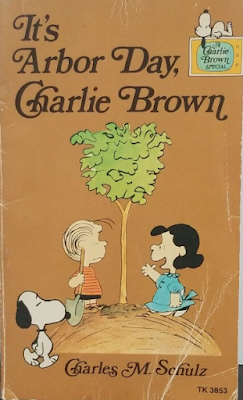
It's Arbor Day Charlie Brown - by Charles M. Schulz


My husband (James) was recently named to our town's Tree Committee (yes, that's a thing). Our adult child told him that there was a Peanuts television special about Arbor Day that he would probably be interested in. He found a copy for purchase on DVD and we await its arrival. Meanwhile he also found a used copy of the book version for purchase and had it sent to our house. (I also discovered that our local public library has a copy on DVD; I always check the library before buying.)

This full-color comic features Sally being humiliated when asked in class to tell what Arbor Day is and responds that it's the "day that all the ships come sailing into the arbor". Assigned to write a report about Arbor Day she seeks Linus' help who suggests a trip to the library where he's sure there are "some books about Arbor Day". What follows are several pages of images of Sally and Linus doing research at the library, as well as some shots of Snoopy and Woodstock laughing at a book on dog obedience training, and playing with the photocopier, which gets them kicked out.

I look forward to celebrating Arbor Day  is year on April 28. I guess that's what my elementary school was celebrating in the 70s when they used to give us saplings to take home and plant. Otherwise, I don't recall ever recognizing it.

Tuesday, April 7, 2020

The Influencing Machine - by Brooke Gladstone, illustrated by Josh Neufeld


Fans of National Public Radio know Brooke Gladstone from the program On the Media. I noticed this graphic non-fiction on a display created by one of my co-workers. Although it is almost 10 years old the messages about how the media influence public opinion are still quite relevant. This book covers history, politics, censorship, bias, echo chambers, misinformation, and the changing nature of the news cycle with good humor in an easy-to-digest format.

Ultimately, what this book is about is information literacy - tracking down sources, verifying sources, and rejecting bad sources. Gladstone explains how bad information can become part of the collective consciousness simply by being repeated by people who don't know anything about it. Furthermore she demonstrates and that it is not always good journalism to provide both sides of an issue if one side is misinformed. She also explains that too much information (information overload) can be harmful. This is not a new concern, and she points to a story in Plato's "Phaedrus" in which "Socrates derides the invention of writing with a story of the Egyptian god who invented the alphabet brags to a king" who reponds that "this discovery...will create forgetfulness in the learners' souls-they will trust to the external written characters and not remember of themselves".  Likewise Gutenberg's printing press had bibliogrpaher Conrad Gesner complaining of the "confusing and harmful abundance of books". Gesner in compiling the Universal Library decided only to include books written in Greek, Latin, and Hebrew.

This of course is where librarians come in. As "media theorist Clay Shirky says many people confuse information overload with filter failure". Catalogers, librarians, news aggregators, and other databases services already have those filters in place. Librarians can help people to navigate to the right resources for their information needs.

Monday, February 10, 2020

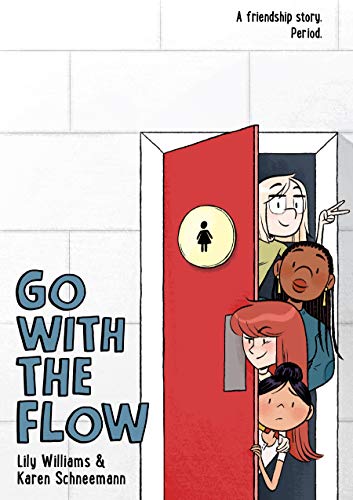
Go With the Flow - Lily Williams & Karen Schneemann


Three best friends Christine, Brit, and Abby befriend new girl Sasha when she gets her first ever period during the first week of classes at her new school. The three girls sashay Sasha into the bathroom when they notice blood on the back of her pants. Like so very many people before them they discover the vending machine for tampons and pads is "always empty" and they rightly point out that even if they are stocked, a person might not have the right change to purchase the needed item. Artist Abby uses the incident, and the injustices it highlights, to create a piece for the library art exhibit on "feminist voices and activism" she also starts a blog about menstrual equality. The school has plenty of money for new football equipment and uniforms, but won't provide basic essential hygiene products for those who menstruate. Abby just keeps getting madder and madder at the thought of it all and decides that the library exhibit just wasn't big enough to make a statement. Her "go big or go home" exploit involves graffiti and property destruction, and causes major embarrassment to Sasha who is still trying to live down her "Bloody Mary" nickname.

I have to say that as fed up as I am with the fact that the tampon vending machines at Bridgewater State University were all removed from the restrooms, it is more honest than having machines that are always empty. I do still wonder though how it is that the University can afford branded soap dispensers, but cries poor when I suggest that free menstrual hygiene products be made available.
Where the tampon vending machine used to be. Also visible is the basket I placed in the restroom two years ago where I put free tampons and pads I buy with my own money. Many anonymous others have also contributed products to this endeavor.


Branding is apparently very important for contributing to our Bears' sense of pride!


Monday, December 23, 2019

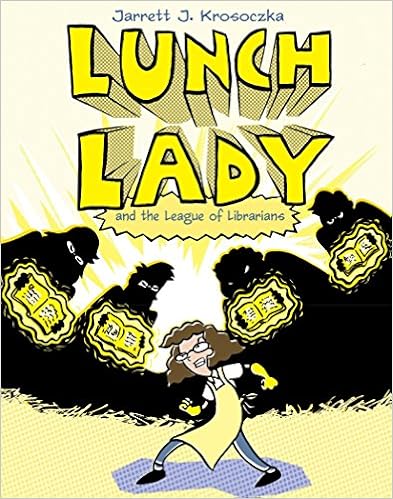
Lunch Lady and the League of Librarians - by Jarrett J. Krosoczka


One in a series of "Lunch Lady" books, this graphic novel demonstrates the power of books and reading, but at the expense of librarians (Rhonda Page, Edna Bibliosa, Vivian Bookwormer, and Jane Shelver). The librarians are out to destroy the new shipment of the X-Station 5000 videogame system and steal money from the cheerleaders, the Book Fair, and the public fund so they can buy weapons in order to carry out their dastardly plan. An epic magic battle the Lunch Lady (using her aresenal of food ammunition) and the Librarians using characters from well known books (e.g. The Lion, the Witch, and the Wardrobe; The Three Little Pigs; Alice in Wonderland) ends with the librarians' arrest. Didn't like this one much. The librarians were evil.

Thursday, October 11, 2018

The Essential Dykes to Watch Out For - by Alison Bechdel


Baltimore County Public Library's #BWellRead challenge for September 2018 was to "read a book you've always meant to read". I wasn't sure how to interpret "always" but I looked back on the list I've been keeping since about the start of this century and decided that a book that's been waiting ten years to be read qualified.

I made several attempts to purchase this at an independent bookstore, which it turns out would have been appropriate since much of the action takes place in such a store. Ultimately, however, I caved and ended up getting this from Amazon. I do offer myself some absolution though as I bought something at each of the independent shops I visited.

Although this reads as a graphic novel it is, in fact, a collection of the Dykes to Watch Out For comic strips. The book includes strips originally published between 1987-2008. While each panel features an independent episode, it reads as a soap opera with characters falling in and out of love, changing careers, becoming parents, and negotiating the evolving political landscape. I had not thought about some of the old political issues that come up in this work for a long time, and likewise was reminded how long some of the stalwarts in Washington have been around making trouble. It was sort of like visiting an old "frenemy".

Despite the fact that the characters in this work are quite well read, it was not until about the midway point of this 390-page book that I found any mention of libraries at all, and it was in a fantasy sequence. Each of three roommates (Ginger, Lois, and Sparrow) imagines what it would be like to live without the other two. Ginger's daydream involves a well organized bookshelf  "in Library of Congress order". I then had to read another 80-ish  pages before a library comes into play again, this time for real. Mo and her paramour Sydney do it "by the book" (so to speak) right there in the HQ 70s in the University Library (the range that includes books on lesbianism). It is no doubt the excitement of this tryst that prompts Mo to apply to library school, something we discover on the very next page! It is at this point that the libraries just keep coming as we follow Mo through her acceptance, taking classes, graduation, and getting her first job - in a post PATRIOT act world.

I am posting this one in honor of National Coming Out Day.

Thursday, March 1, 2018

The Night Bookmobile - by Audrey Niffnegger


The unnamed narrator in this surreal tale discovers a special mobile library that contains everything she has ever read - not just the books but also "periodicals and ephemera-cereal boxes and such". "It's a very complete collection" the enigmatic librarian, Mr. Openshaw, tells her. She spends a few hours with her books, but as the sun rises Mr. Openshaw shoos her out of the shabby Winnebago that serves as her literary memory explaining that the library's hours are "dusk to dawn". The narrator's obsession with finding the bookmobile again leads to several major life changes for her - including becoming a librarian herself.

A story about the love of books, and reading, and how books hold and become our memories.

Sunday, January 22, 2017

March (Books 1,2, &3) - by Lewis, Aydin, and Powell


Representative John Lewis won the National Book Award for Book Three in this series. I recommend reading all of them. This graphic novel series follows Lewis through his childhood on an Alabama farm and his struggle to become educated (even by defying his own family) to his civil rights work during the 1950s & 60s with the Student Nonviolent Coordinating Committee (SNCC) to the historic march with Martin Luther King, Jr., and hundreds of other protesters, from Montgomery, Alabama to Selma, Alabama in March of 1965. Later that year President Johnson would sign the Voting Rights Act ensuring access to the vote for African Americans from whom it had been denied.

Books 1 & 3 of the series make specific mention of libraries. Book One gives us the story of Lewis' childhood. He tells how he "loved going the library. It was the first time I ever saw Black magazines like Jet, Ebony, The Baltimore Afro-American, or the Chicago Defender". He gives shout out to librarian Careen Harvey who told her young charges "My Dear Children, Read. Read Everything."

Book 3 tells us that when the Civil Rights Act of 1964 was signed that, among other things, "it ended segregation in public schools, libraries, and parks".

The poignancy of these two points in the story is magnified when one listens to Lewis' acceptance of the National Book Award.


Saturday, September 27, 2014

Fun Home - by Alison Bechdel


I first read about Bechdel's book earlier this year when I learned that the South Carolina State legislature was planning to cut $52,000 from the budget of the College of Charleston for using this work in its freshmen "College Reads" Program due to the homosexual themes of the work. Eventually a compromise was reached which allowed the College to keep its budget, but in a truly Orwellian move, the legislature required that the $52,000 be spent on materials that taught about the Constitution. More about the controversy and other attempts to ban this graphic novel can be found here.

Bechdel's graphic memoir tells of her childhood growing up in a funeral home in Pennsylvania with a closeted gay father. It also tells of her own awakening as a lesbian in college. Libraries played an important role for her. Bechdel tells both of working in her college library (putting bar codes on books) and of finding solace in the public library. She compares the lure of the books in the library to Odysseus' siren song. And learns that in the public library she can get the information she seeks without judgement. This may also be the first book I read that contains a poem about a library.

I decided to read this book for Banned Books Week since the focus this year is on graphic novels. When I searched for it on the iBooks store I discovered that it was only available in electronic format in Spanish. I was just about ready to look for a hard copy instead, and then I remembered that I speak Spanish! Some of the vocabulary presented a challenge for me, but I wasn't sorry to learn some interesting new words!

Monday, September 22, 2014

The Adventures of Captain Underpants: An Epic Novel - by Dav Pilkey

It's Banned Books Week!

I will be blogging all week about banned and challenged books. This year's focus is on graphic novels. I begin with The Adventures of Captain Underpants. 

Clearly written for nine-year-old boys, this novel reads as if it were written by one. I don't necessarily fault it for that. I see the appeal for the target demographic and I chose to read it after all, which is what Banned Books Week is all about - choosing for ourselves what we want to read. There are other books in this series, and I have chosen NOT to read those.

Pilkey's novel topped the list of most frequently challenged books of 2013 for "offensive language" (I guess that would be words like "toilet" and "wedgie" and "doo-doo") and for being "unsuited for age group" - huh? this book is perfectly suited for the age group. I can't imagine for whom else it would be suited!

There are no libraries in this book, but the two main characters, George and Harold, do like to write their own comic books (about Superhero Captain Underpants). They charge 50 cents each for them though, so there is no free sharing of information either.

See what Dav Pilkey has to say about all this:

Wednesday, August 6, 2014

Sex Criminals (Volume 1) One Weird Thing - by Matt Fraction and Chip Zdarsky


I appreciate a book that recognizes that librarians are sexual beings. I also appreciate a book that recognizes the superhero status of librarians. In Sex Criminals authors Fraction and Zdarsky have created a librarian character (Suzie) whose superpowers are activated when she reaches orgasm. Suzie can make time stop whenever she comes. She meets her match in Jon, who has the same gift she does. The two decide to use their power to become modern day Robin Hoods - robbing from the rich (the evil banks) and giving to the poor (the about-to-be foreclosed library).

The authors clearly appreciate a good library (and a good librarian). And they make a bit of a dig at the woeful status of sex information a young person might discover at school. Remembering her quest for information when she discovers her special secret Suzie asks
Ever try to utilize the resources of the public school system to learn about sex? No wonder so many dumb kids get knocked up. Nobody knows anything and if they do, they're legally bound from telling you.
However, she "falls in love with libraries" when she gets the assistance she needs from a non-judgmental and super helpful public librarian. (This is clearly what inspired her to become a librarian herself).

There are five books in this series. Although I found this fun, I don't plan on reading the rest. I get the gist.

Thursday, September 26, 2013

Banned Books Week: The Complete Persepolis - by Marjane Satrapi


This graphic memoir that tells the author's story of growing up during Iran's Islamic Revolution got a lot of coverage in March and April of this year when it was banned in the Chicago Public Schools (CPS) for its graphic images of torture. While denying it banned the books CPS did say it ordered the book removed from seventh grade curriculum and classrooms. Hmmm...let's take a look at the American Library Association definition of  banning
A challenge is an attempt to remove or restrict materials, based upon the objections of a person or group.  A banning is the removal of those materials.  Challenges do not simply involve a person expressing a point of view; rather, they are an attempt to remove material from the curriculum (emphasis mine) or library, thereby restricting the access of others.  Due to the commitment of librarians, teachers, parents, students and other concerned citizens, most challenges are unsuccessful and most materials are retained in the school curriculum or library collection.
Like Bradbury's Fahrenheit 451 there is true irony in the challenge of this work in that part of it treats the issues of loss of information as well as the censorship of ideas. As a young schoolgirl Marjane is confused when she is told to tear all the pictures of the Shah from her schoolbooks; and finds her dreams of visiting the United States and going to University dashed when the US Embassy is occupied and hostages are taken. All the Universities were closed for two years while books at "all levels" were revised so as not to lead young people "astray from the true path of Islam".

The book also specifically tells of Marjane getting information from a library on at least two occasions. In one her father goes to the library and brings back three books that she reads in a matter of ten days: The Secrets of the CIA; Freemasonry in Iran; and The Memoirs of Mossagegh. In the other, she and her husband spend the summer in museums and libraries researching mythological heroes in order to design a theme park in Tehran, a plan which never is implemented.

Find out more about this controversy

Chicago Public Schools denies it banned the book "Persepolis"