Showing posts with label maryland. Show all posts

Wednesday, August 12, 2026

The Adjunct - by Maria Adelmann

This dark satire about the Academy's gig economy tells the story of Samantha, a PhD living in Baltimore, Maryland (my home town) trying to teach enough classes at two different colleges to keep the wolves at bay. Sam's plight, and that of her fellow adjuncts, is becoming more common as colleges and universities eschew hiring tenure track faculty and rely more on part-time contract faculty. As my husband (James) and I listened to the audiobook we reflected on our own times working as adjunct faculty. While we would never suggest that we were paid well for the work, for us it was never about survival. My contract teaching work was done at a time when a part-time job was exactly what I needed while I was the primary caregiver for our young child. James' part-time teaching was done while he was finishing his PhD and he had a full-time job in IT. He took evening teaching jobs so as to have recent teaching experience when he started looking for a tenure track job. We were lucky. Many of our colleagues had no health insurance, no spouse's salary to fall back on, and no guarantee that they would even have jobs at the end of any given semester.

As a "campus novel" libraries are sprinkled throughout the work providing insight into their myriad uses, including as a student job, a meeting place, and a space for study. Sam also borrows a Chromebook from the Baltimore Public Library because although her department expects her to have one, they do not provide her with one. 

There is a lot of "meta" in this work, including a meta librarian. Sam is an aspiring writer and describes a romance she wrote in which a librarian (who doesn't like romance novels) befriends her stalker, unaware that he is stalking her. Once they develop a relationship he loses interest, and she begins to take an interest in romances.

Of course I always like reading about a library in any book, but it is especially fun when one I've actually been to is mentioned. In this book the Enoch Pratt Free Library was given a shout out.

Saturday, August 26, 2023

Adnan's Story - by Rabia Chaudry


I was vaguely aware of the Serial podcast when it first aired in 2014 but I didn't listen to it until about a year later after an old friend told me that the story was about people who had attended the same high school (Woodlawn High in Baltimore County) that we had. Although the events described in the first season of Serial took place many years after we graduated it still made listening to the podcast especially riveting for me. 

Woodlawn High has always had a tough reputation among the Baltimore County high schools. One of my most vivid memories is of walking into the girl's restroom in the immediate aftermath of a botched self-abortion. During my time there in the late 70s and early 80s, collectively we experienced a cross burning on campus, and the (off-campus) shooting death of a fellow student by another student. Unlike the students who attended Woodlawn in 1999, there were no counselors brought in to help us process either of these events. We were simply told not to discuss them (especially not with the press, who was all over). I saw the murdered boy's girlfriend in school the next day. It didn't even surprise me. My parents would have also told me to get my butt to school if my boyfriend had been killed.

Rabia Chaudry is a friend of Adnan Syed's family and in this book provides more information about Syed's trial for the murder of his ex-girlfriend Hae Min Li. Although convicted, Syed has always maintained his innocence and last year was released after over 20 years in prison when additional evidence of his innocence was provided.

The Woodlawn branch of the Baltimore County Public Library was featured in the first episode of the podcast. Located adjacent to the campus of the high school it is an easy place to get to after school. Li's murder took place on the afternoon of January 13. Syed could not remember exactly where he was that day, but a fellow student (Asia McClain) remembered seeing him at the public library after school which would have provided the alibi that Syed needed. Unfortunately his lawyer never followed up on this information. Chaudry (herself a lawyer) explains more about how this crucial evidence was ignored, and tells of her own conversations with McClain.

Adnan's Story mentions the prison library in two different contexts: for legal research and also as a workplace.
Once, while he was assisting the prison librarian, she asked him to go drop off some books in her car. She handed him her keys and he walked out to the lot where the car stood. He was outside the prison, free and clear, in the employee parking lot. If he had wanted, he could have gotten in her car and driven away.
I selected this book as part of the University of Maryland Baltimore County's  (UMBC) Retriever's Read Bingo which includes a space to read a book by a UMBC author. While Syed and I are both Woodlawn High Alums; Chaudry and I are both UMBC alums.

Rabia Chaudry is co-host of the Undisclosed podcast.

Monday, May 22, 2023

Our Missing Hearts - by Celeste Ng

This dystopian novel, reminiscent of The Handmaid's Tale, gives us a glimpse of what happens when prejudices go unchecked. As we watch the far right cycle through villanzing every marginalized group, (landing most recently on the LGBTQ+ community) this work is prescient in more ways than one.

In Our Missing Hearts Anti-Asian sentiment is sanctioned by the government through PACT (the Preserving American Cultures and Traditions Act). PACT also encourages citizens to report their neighbors for un-American activities (broadly defined) and allows great leeway in banning books. Children are removed from their homes and permanently re-placed if their parents are deemed to be un-American. Current news from Florida and Texas regarding trans children echoes this story line. Ng's book centers on a mixed race family: Asian-American mother Margaret; Caucasian father (Ethan); and their son Bird (aka Noah).

When Margaret's little-known (and apolitical) book of poetry unwittingly becomes a symbol of a protest movement Margaret goes on the lam leaving Bird and Ethan behind in hopes of keeping father and son together even as she cannot be with them. When asked about Margaret's whereabouts Bird and Ethan always answer that they do not know, and that she is no longer a part of the family.

There is much in this book about libraries and censorship. Although libraries exist they are largely empty (of people and books). Described as a "ghost town" the public library is still a sanctuary for Bird (and his friend Sadie). The librarian helps Bird to find a book based on only a vague description. They use an old card catalog to find it but the book has been removed from the library. As was his mother’s poetry book - Our Missing Hearts. The librarian tells him “We don’t burn books here this is America…we pulp them. She says his mother’s book was probably turned into toilet paper and wiped someone’s butt a long time ago. Although they do not traffic much in books, the librarians are still connecting people and information. "The brain of a librarian is a capacious place." 

The public librarians are part of a subversive group that provides information to parents whose children have been “re-placed” - surreptitiously passing notes between the pages of interlibrary loan books. The librarians also hide Sadie away from her foster family as she tries to reunite with her parents. Train and bus schedule information is provided to Bird at the library. The librarian tells him that she is only letting him know how to find the information: what he does with it is his business. 

Likewise classrooms are described with empty bookshelves because “books are outdated the minute they're published”. However, students are informed by their teachers that books haven’t been banned, obviously, because that would contradict the first amendment. Rather, the books have been removed so as not to expose students to harmful ideas. This is eerily reminiscent of a viral video that recently made the rounds online of an empty school library in Florida.


Ethan shelves books in a Harvard University library. A PhD, he used to teach linguistics there, but lost the job over Margaret's "politics".  As a linguist, Ethan is especially interested in word derivations. He enjoys explaining where words come from (in multiple languages) to his son. The book included an explanation about the derivation of the word library coming from the word for tree bark, something I had never known before.


Thursday, February 16, 2023

Bay Country: Reflections on the Chesapeake - by Tom Horton


The New York Times pull quote on the cover of this work states that "Fans of Aldo Leopold, John McPhee, and Sigur Olson won't be disappointed...Mr. Horton displays a stunning command of the language." I will admit to not having ever heard of Sigurd Olson; however, I have read two of McPhee's books (one for my Celebrating the States project some years ago), and more I recently blogged about Leopold's Sand County Almanac . I agree that like McPhee and Leopold, Horton has a "stunning command of the language". Furthermore, as in Leopold's work, libraries in Horton's book are used metaphorically, as a way to understand (read) nature. 

The roots of corn we seldom notice, but ought to heed; for they speak as eloquently as the golden ears and luxuriant foliage topside, but a different message indeed. Pull up a stalk sometime and the first thing that will strike you is how easy it was to do, and how scanty are the underpinnings of so statuesque a plant. Pushing up its glossy green regimens across a thousand square miles of Maryland, this giant, wild grass, bred into the aristocrat of cultivated cereals, epitomizes the pride and problems of our agriculture - and of more than agriculture - I venture there is more profound social commentary in a cornfield than in some libraries, if one is willing to dig for it.

With a coring device [scientists] extract gray-brown cylinders from the bay's bottom, a distance down through the muck of several feet, but a journey back through time of a thousand years. Grain by grain, layer by layer, a few micrometers a year, the sediments washing off the 64,000-square-mile watershed that extends from New York to West Virginia have compiled a rich natural historical library, awaiting only a generations of readers skilled enough to translate it.

...public commitment to restoring the bay is running at an all-time high. Throughout the watershed, people and their elected leaders are gabbling excitedly about the prospects, as a flock of geese gets raucous just before lifting off for new feeding grounds. The challenge is infectious, the script outline looks promising; but just as yet the library at the bottom of the bay reads caution. 

Horton's soothing prose made this love letter to the Chesapeake Bay (and all of Maryland) a perfect read aloud for this Marylander and her husband. The book was originally published in 1987, the year we were married - in Maryland!

Saturday, August 28, 2021

A Ride to Remember: A Civil Rights Story - by Sharon Langley and Amy Nathan


When I was very young my family and I enjoyed visits to Gwynn Oak Amusement Park in Baltimore, Maryland. Hurricane Agnes destroyed the park in 1972 and it was not rebuilt. Rather than an amusement park, it now is a park of the type one might go for a picnic, or to fly a kite. 

Gwynn Oak Park opened in 1893 and like many amusement parks at the time it was segregated.I was unaware that the park had not been desegregated until 1963 when I heard about this book and attended a webinar about it last year. You can watch the webinar here.

My parents moved to Baltimore from the midwest in January of 1962 and started their family. My older sister was born in late September of the same year which made this story, about a girl who was 11 months old on August 28, 1963, especially relevant for me. Sharon Langley was the first African American to ride the Carousel at Gwynn Oak Park on the day it was desegregated. 

Langley explains segregation in this work via a conversation between herself and her parents about her family's role in desegregation.
For a long time, black and white kids couldn't do many things together. They couldn't go to the same schools or to the same restaurants and libraries or even sit together at the movies. It was the law.
    "Why didn't somebody do something about those kinds of laws?" I asked.
    "They did," said Mama.
    "We did," said Daddy.
    Many people - both blacks and whites - knew that segregation was unfair and just plain wrong.
    Some people said, Just wait. Times will change.
    But others said, Why wait? What's wrong with now? They held protests at restaurants, stores, and movie theaters. They tried to get officials and courts to make new laws to create a better city - a place that would welcome and include all people.
    By the time I was born, some unfair laws had changed in Baltimore. Kids could go to the same schools and libraries, restaurants, and some movie theaters, too - no matter the color of their skin. "But the amusement park just wouldn't budge," said Daddy. 

Beautifully illustrated by Coretta Scott King Award winner Floyd Cooper this book tells a story of segregation and desegregation appropriate for young readers.

Thursday, November 21, 2019

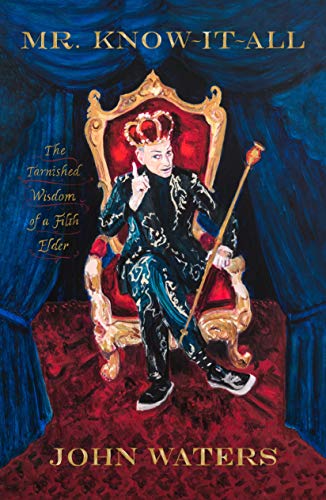
Mr. Know-It-All: The Tarnished Wisdom of a Filth Elder - by John Waters


John Waters was the keynote speaker at the Association of College and Research Libraries Conference at the Baltimore Convention Center in 2007. And I was there. As a dyed-in-the-wool Baltimoreon I was happy to visit my hometown and hear this native son giving us exceptional advice  on how to get more people to visit the library ("be nude").

In this collection of essays he reflects on his work over the last 50 years, and looks at his life today. I was glad to find five places where libraries were mentioned, although all were a bit unusual.

In "Bye, Bye Underground" in which he describes his "odorama" gimmick in the film Polyester using scratch and sniff cards he tells of 3M's inspriational "library of smells".

He recounts many of the strange things people have asked him to autograph, including a freshly used tampon, in "Overexposed". It is of course not unusual to ask an author to sign a book and he relates the story of a girl he scolded for "bending the paperback cover back far enough to break the spine when she asked for autograph on the title page". The fan snapped back at him "I bought the book, so I can do anything I want with it." Waters accepts this and paraphrases the young woman: "In other words, take your library-science bullshit and shove it, Mr. Know-It-All."

Few people would suggest that their ideal home would be in the Brutalist architecture style, but Waters' describes a house of horrors to rival the Addams Family's in "My Brutalist Dream House". The house does have a library, though which one would be able to enter a panic room
by pulling a faux spine of a book you grab like a handle and the whole shelf spins around. Once you saw the horrifying selection of fascist books displayed here in my satellite reading room, you'd feel anything but safe. Hitler at Home, Dead Funny: Humor in Hitler's Germany, Magda Goebbles: First Lady of the Third Reich, and Born Guilty: Children of Nazi Families. We've got all the other monsters, too: Idi Amin, Pol Pot, Ronald Reagan, even On Democracy by Saddam Hussein.  
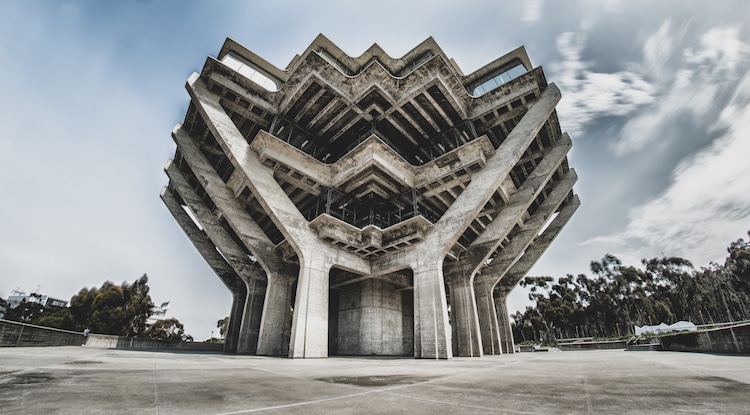
As this essay wraps up Waters fetishizes Brutalism as he fantasizes about his favorite coffee-table book This Brutal World by Peter Chadwick. "Damn" he says "that giant concrete mushroom sprouting rigidly from the top of the Geisel Library in San Diego (architect: William Pereira) is hot!"


I'd never heard about Betsy the finger-painting chimpanzee before reading "Betsy". This monkey artist, like Waters and me, hailed from Baltimore. Betsy had some fame in the 1950s, but it was short-lived. Likewise her boyfriend Dr. Thom (a relationship created by her managers) was unable to find success playing piano.
Dr. Watson tried to make him a star in his own right, buying him a piano and hoping to donate some of the recordings of his banging on the keys to the public library to be cataloged and placed alongside the the composers Beethoven, Bartók, and Brahms. The library politely declined. 
I do wonder which library was contacted. Enoch Pratt? Baltimore County Public?

Fans of Waters won't be surprised by his raunchy brand of humor. Those who don't like him, still won't like him, and those who don't know him will likely find out more than they bargained for.

Tuesday, July 16, 2019

The Hired Girl - by Laura Amy Schlitz


I'm not sure how I found out about this historical novel, but I expect I must have read a review that indicated that it was a Baltimore (aka my hometown) story.

Schlitz tells the tale of  Joan Skraggs (alias Janet Lovelace) a young girl who runs away from her abusive father (who burned her books!) and ends up working for the Rosenbach family in Baltimore. She tells her employers that she is eighteen, although her actual age is much younger. Janet loves to read and is thrilled when she is invited to use the Rosenbach's private library. Still she dreams of one day visiting the Enoch Pratt Free Library, and getting a proper education. Since she only has Sunday mornings and Tuesday afternoons off during which she either attends Mass, or receives religious instruction it seems as if she will never have time to explore the libraries, art galleries, or any of the other myriad benefits the city has to offer.

Wednesday, February 20, 2019

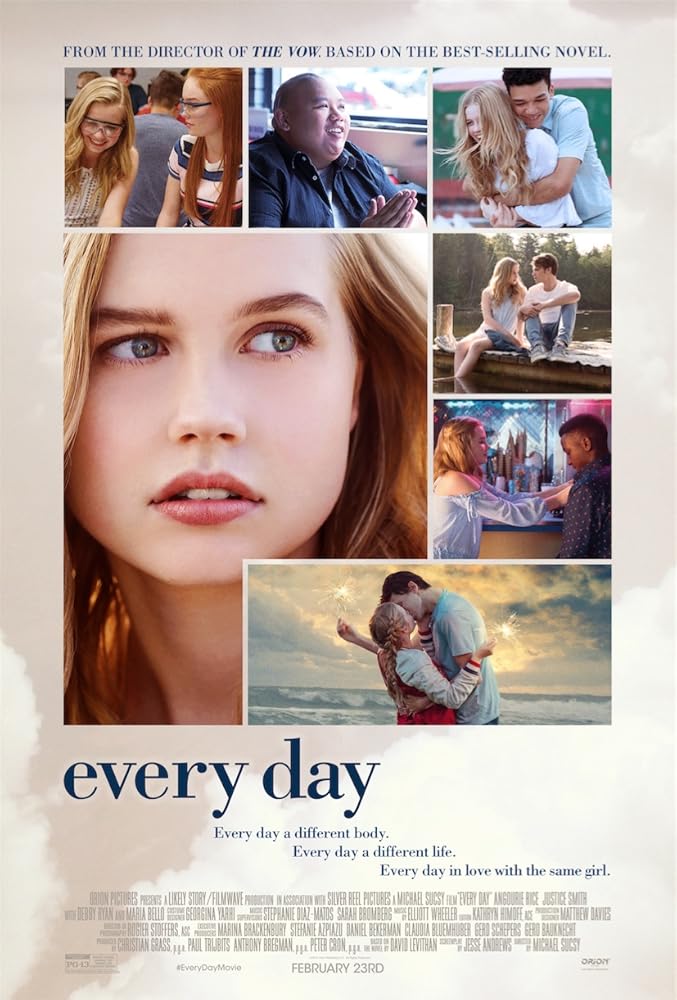
Every Day (the movie)


This is a love story between Rhiannon, a teenage girl, and A, a soul who wakes up in a new body every day. A never knows what gender, race, ethnicity, or abilities they will have from one day to the next. Neither does A have any control over whose body they will inhabit on any particular day. They only know it will not be the same one as the day before, and that it will be someone about the same age as they were the day before. 

On the day that A wakes up in the body of George they find themselves in an "old school situation". George's mother picks out his clothes, and only agrees to let him out of the house to go to the library to study. A contacts Rhiannon and tells her that they have about an hour to meet before George's mother picks him up. Rhiannon and A get "shushed" at least three times before Mom arrives and goes ballistic when she finds Rhiannon kissing her son between the stacks and chases her out of the building.

This very non-binary tale, based on the book by David Levithan, is thought provoking well executed.

Wednesday, August 1, 2018

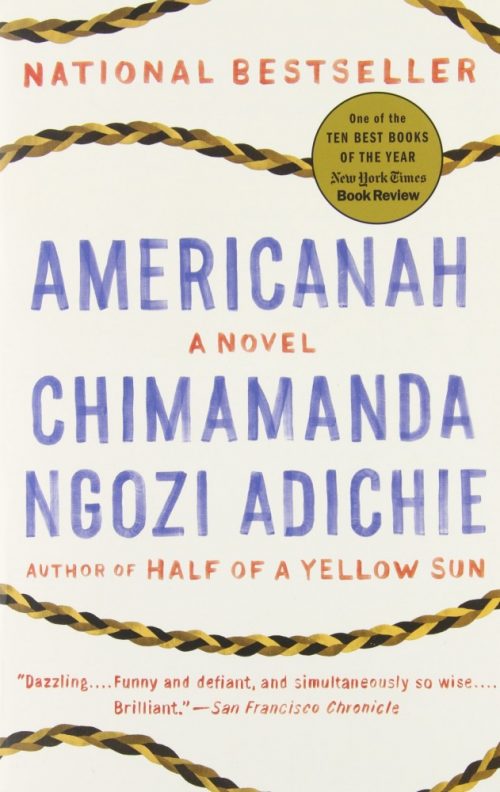
Americanah - by Chimamanda Ngozi Adichie


Adichie's book tells the story of Ifemelu, a Nigerian woman who immigrates to the United States, and then, after becoming a U.S. citizen, returns to Nigeria. As a smart, savvy young woman it should go without saying that Ifemelu is also a library user.

Ifemelu and her boyfriend Obinze first use the library only as a place to meet, but she becomes a more active user after she moves to the United States for college. Obinze (an "Americophile") sends her a reading list of American writers he believes she should read. After already having found The Adventures of Huckleberry Finn "unreadable nonsense" she wasn't expecting to find an author she liked, but
She hungered to understand everything about America...Obinze suggested...American books, novels and histories and biographies. In his first e-mail to her...he gave her a list of books. The Fire Next Time was the first. She stood by the library shelf and skimmed the opening chapter, braced for boredom, but slowly she moved to a couch and sat down and kept reading until three-quarters of the book was gone, then she stopped and took down every James Baldwin title on the shelf. She spent her free hours in the library, so wondrously well lit; the sweep of computers, the large clean, airy reading spaces, the welcoming brightness of it all, seemed like a sinful decadence...in those weeks...she discovered the rows and rows of books with their leathery smell and their promise of pleasures unknown...
Well, who needs a man?

Ifemelu is not the only one in this story who uses the library. There are at at least three other characters who are clearly patrons. One of these is Blaine, a boyfriend in her adult years, who not only uses the library, but also defends a library employee at Yale, where Blaine is a professor of Political Science. Blaine is a friend of Mr. White, a "rheumy-eyed" security guard "with skin so dark it had an undertone of blueberries". When a white employee mistakenly suspects that Mr. White is involved in a drug deal and calls the police Blaine organizes a protest after the university responds to the incident with a statement that it was "a simple mistake that wasn't racial at all".

An especially curious passage to read in the summer of "Permit Patty", "Bar-B-Q Becky" and "Coupon Carl".

I think that perhaps Adichie's last mention of the library in this work is my favorite of all time. Ifemelu applies for a research fellowship at Princeton University. When she reads her acceptance, hands shaking, she discovers that "the pay is good, the requirements easy: she was expected to live in Princeton and use the library and give a public talk at the end of the year." All I could think was that the only thing I could think of that would be even better than having a job as a librarian, would be to to be paid just to use the library.

Friday, April 13, 2018

Library on Wheels - by Sharlee Glenn


This week (April 8-14) is National Library Week. Wednesday (April 11) was National Bookmobile Day. It was also the day that Glenn's book about the very first Bookmobile was published. I had pre-ordered it from Amazon, and it was shipped on Wednesday, arrived to Thursday, and read (by me) on Friday. Well researched and illustrated with historic photographs, letters, and other period artifacts, this book tells the story of Mary Lemist Titcomb, chief librarian of the Washington County (Maryland) Free Library from 1901-1931. Titcomb established several innovative library programs in the early 19th century, including instituting one of the first children's rooms, and delivering books and other library materials to schools. Not content with simply serving those who were able to come to the public library in Hagerstown (the county seat) Titcomb launched a story hour program for rural children, and set up book depositories in smaller towns, to ensure that access to books and reading was widespread. Realizing she was still not serving all residents, she commissioned the first bookmobile in the United States - a horse drawn wagon whose route included family farms and other isolated areas. The wagon was driven by the library's janitor, Joshua Thomas, who proclaimed himself to be a "Book Missionary" on the 1910 U.S. census.

My favorite part of this book has to be this bit from a newspaper article written about Ms. Titcomb for The (Hagerstown) Builder 
The hostess was most gracious, most charming. She wore a soft gray silk and a dainty slipper was visible. The hostile one saw it, saw too-could she believe it?-the feminine frivolity, a jeweled buckle. She heard too, the little woman discussing "Spring Fashions" vivaciously, knowingly, for Miss Titcomb is no mean authority on style and her dress, like her work, is always up-to-date.
It seems you can be fashionable while wearing sensible shoes.

For more books that feature bookmobiles (including another one about the very first bookmobile) you can see my previous posts here.

Thursday, March 17, 2016

Carsick - by John Waters


Baltimore, Maryland holds a special place in my heart. It is not only the land of my birth, it is also where I met, fell in love with, and married my husband. If all this weren't enough to make me feel good about the place it also is the home of movie director John Waters. My husband James and I are long-time fans of Waters and enjoyed reading his book about hitchhiking from his home in Baltimore to his home in San Francisco together. The book is divided into three sections. The first is a fantasy  trip called "The Best that Could Happen"; the second a fantasy trip entitled "The Worst the Could Happen"; and the third called "The Real Thing". Fantasy chapters included rides with celebrities, alien abductions, magic farts, and some rather poopy pants. None of this will surprise those who are familiar with Waters' work. The third section was actually the most surprising. It is where Waters cynicism is least evident. He was genuinely grateful for all who picked him up, even if only going a few blocks. He was also touched by the number of straight men he met who spoke lovingly, and affectionately of their wives, and enjoyed the company of all who rode with him.

Of course as much as I enjoy any book, it does not find a place on this blog without at least touching on some aspect of libraries. Waters' book makes the cut for his fantasy chapter "Bernice" in which a renegade librarian who runs her own bookmobile-type service delivers paperback porn (without cover art) to niche collectors. They visit one of her clients, Cash, who lives in a house made entirely out of cover-less paperback smut. (I don't know if such a house actually exists anywhere, but I do know there is a house in Rockport, Massachusetts made entirely out of newspapers).

What I especially liked about this chapter was that Waters says he knows "how wild librarians can be" having been a keynote speaker at "several of their conferences." Since I was a librarian at a conference in which Waters was the keynote speaker (the Association of College and Research Libraries 2007 conference in Baltimore) it was almost like reading about myself - wild librarian that I am.

I marked one other passage in this book for blogging, even though it had nothing to do with libraries. It did, however, have to do with Baltimore nostalgia. Those who have seen John Waters know about his iconic mustache. During his "real" trip, he frets that it is starting to get a little bushy, and compares himself to "Baltimore's longest-running TV weatherman", Bob Turk. It is not just that I remember Bob Turk, in 1975 an eleven-year old me was invited to read a story on-the-air that I wrote for his local Christmas special program. It is one of my best childhood memories.

Bob Turk
John Waters

This was a fun and quick read. Fans of John Waters will not be disappointed.

Thursday, December 3, 2015

Books: A Memoir - by Larry McMurtry


I think this may be the first McMurtry book I've read, although I know I've seen movies based on some of his books (e.g. The Last Picture Show; Terms of Endearment; Lonesome Dove). I doubt this book will be made into a movie though. It really is simply a recollection of his days as a book buyer and seller. Most of the libraries he mentions are personal libraries, although public, school and university libraries, as well as the Library of Congress come into play also.

The beginning of the book was the most interesting part to me, in which McMurtry describes the bookless house of his childhood. He knew how to read at a young age, but cannot understand how he learned. He also describes the life-changing gift of 19 books he received from a cousin who was going off to war.  The author relates that while he was growing up there was no public library in his town (Archer City, Texas) and that he helped to start one decades later. He also stole books from his high school library. Everyone knew it, and the books were eventually "stolen" back from him.

McMurtry describes specialized collections, and eccentric collectors and why they liked what they liked, and tells of a book dealer in Baltimore [my hometown] "who believed in making all book repairs with duct tape." Of Baltimore he also has this to say "if pickings were slim, we could always console ourselves with a few first-rate crab cakes from one or another of the area's many restaurants." If my readers gain nothing else from reading this blog please know this: you have not had a crab cake unless you have eaten one in Maryland. Once you have a real lump-meat crab cake you will never go back to the crumb-and-cracker-filled soggy messes that pass as crab cakes elsewhere.

When I wrote my post about Erica Jong's Fear of Flying I explained the near-miss of thinking I was going to blog about my first "library dream", but alas I discovered that the Low Library was no longer functioning as a library. McMurtry came through in his memoir to provide this "first" instead. He describes his recurring "book dreams" sometimes as in a bookshop, or
alone in a large library...The books...are quite vivid...very much like books...in auction catalogs...that are very much like other books...but never an exact match. 
McMurtry laments changes he sees in public libraries with books being pushed out to make way for more computers. He says
in many cases not even the librarians want books to be there. What consumers want now is information, and information increasingly comes from computers...But they don't really do what books do, and why should they usurp the chief function of a public library, which is to provide readers's access to books? Books can accommodate the proximity of computers but it doesn't seem to work the other way around. Computers now literally drive out books from the place that should, by definition, be books' own home: the library.
I understand his grief, but I also understand that libraries, like all things, must evolve or go extinct.

If I were to write a book memoir I would start with the book The Happy Egg by Ruth Krauss a book I ordered from the Scholastic books order form when I was four or five years old. I did not know how to read, but I loved being read to, and I asked my parents to read this book to me so often that I memorized it. I remember then, proudly "reading" it aloud to my father. I also remember in second grade ordering a book about dinosaurs from the Scholastic books order form. When the books arrived in my classroom we were called up one at a time to claim our order. A boy in my class had also ordered the same dinosaur book and when the teacher called his name and gave him the book she remarked that it was a "good book for a boy". Everyone then laughed when I went to retrieve my book. I wish I could just chalk this anecdote up to "stupid things people did in the '70s", but frankly I think the gender-ing of toys and books has only gotten worse.

Perhaps I will write a book memoir. It seems like a good project for 2016.

Wednesday, April 15, 2015

Clara and the Bookwagon - by Nancy Smiler Levinson (In honor of National Bookmobile Day)


This easy-to-read book for children is based on the story of the first bookmobile, a horse-drawn wagon that served rural Maryland (my home state) at the turn of the 20th century.

Young Clara very much wants to learn to read, but her parents tell her they have no money for books, and are too busy running the farm to read in any case. When the bookwagon comes to her farm she and the librarian convince her parents that learning to read with the books she can borrow free of charge, will not only add to the quality of her life, but may also help her learn new things that will benefit the farm.

Tuesday, August 20, 2013

The Immortal Life of Henrietta Lacks - by Rebecca Skloot


I've been intrigued by this title for several years. So, recently when two different friends of mine suggested that it be would be a good choice for Bridgewater's One Book One Community (OBOC) reading program several of us on the OBOC steering committee decided to read it. It does look like an excellent choice for a community-wide read with a lot of issues for discussion including race, class, medical ethics, legal ethics, and science vs. religion.

Author Rebecca Skloot, sets out to find out about the real person behind the HeLa cell line. In 1951 cancer cells were taken from Henrietta Lacks who was being treated at the Johns Hopkins Hospital in Baltimore, Maryland (one of the few places that offered treatment to African American patients at the time). Lacks' cells turned out to have an incredible rate of reproduction and were the first cells that were able to be kept alive in a culture. Still reproducing today they have been used in countless medical, and other scientific experiments. Lacks' family did not find out about the cells until 25 years later. And virtually none of the people doing research with Lacks' cells knew anything about the woman they came from (most thought her name was Helen Lane). In Skloot's quest to find out about the mother of five who died of cervical cancer at age 31 she consulted doctors and researchers; traveled to Lacks' family home in Clover, Virginia; and interviewed family members, much of the time accompanied Lacks' daughter Deborah, who knew almost as little about her mother as Skloot did.

Henrietta Lacks moved from her hometown of Clover to Turner Station, a suburb of Baltimore, Maryland for her husband to take a job at Bethlehem Steel. So, it is at the Turner Station Branch of the Baltimore County Public Library that Skloot meets the librarian who shows her a VHS tape of the BBC program The Way of All Flesh.

At the time of Lacks' death there were no laws or ethical codes that required doctors to ask permission from patients to take living tissue. There were laws requiring permission of the family before removal of tissue from dead bodies. Controversy remains as to when the cells were removed, and whether consent was granted.

This work is completely readable and accessible, even for those of us who have not had a science class since tenth grade biology.

More information
http://rebeccaskloot.com/
http://henriettalacksfoundation.org/
Recent article from the New York Times tells of the Lacks family finally being given a place at the table.
Remembering Henrietta Lacks
The Supreme Court ruled in June that naturally occurring genes could not be patented, although synthetic ones can be.

Monday, October 1, 2012

Banned Books Week - Top Ten Banned Books

I had grand plans to read each of the "top ten" banned books for 2011 in preparation for Banned Books Week, but as it turns out I only read one: Alice in Rapture, Sort of from the Alice series by Phyllis Reynolds Naylor. The series comes in at number 6 on the list. I had, however, previously read some of the other books on the list: ttfn by Lauren Myracle; The Hunger Games trilogy by Suzanne Collins; and To Kill a Mockingbird by Harper Lee. For a complete list see below.
  1. ttyl; ttfn; l8r, g8r (series), by Lauren Myracle
    Reasons: offensive language; religious viewpoint; sexually explicit; unsuited to age group
  2. The Color of Earth (series), by Kim Dong Hwa
    Reasons: nudity; sex education; sexually explicit; unsuited to age group
  3. The Hunger Games trilogy, by Suzanne Collins
    Reasons: anti-ethnic; anti-family; insensitivity; offensive language; occult/satanic; violence
  4. My Mom's Having A Baby! A Kid's Month-by-Month Guide to Pregnancy, by Dori Hillestad Butler
    Reasons: nudity; sex education; sexually explicit; unsuited to age group
  5. The Absolutely True Diary of a Part-Time Indian, by Sherman Alexie
    Reasons: offensive language; racism; religious viewpoint; sexually explicit; unsuited to age group
  6. Alice (series), by Phyllis Reynolds Naylor
    Reasons: nudity; offensive language; religious viewpoint
  7. Brave New World, by Aldous Huxley
    Reasons: insensitivity; nudity; racism; religious viewpoint; sexually explicit
  8. What My Mother Doesn't Know, by Sonya Sones
    Reasons: nudity; offensive language; sexually explicit
  9. Gossip Girl (series), by Cecily Von Ziegesar
    Reasons: drugs; offensive language; sexually explicit
  10. To Kill a Mockingbird, by Harper Lee
    Reasons: offensive language; racism 

Alice in Rapture, Sort of
There are over 20 books in the Alice series, and I only read one of them. I think the challenges must come from some of the later books in the series, as Alice gets older in each one. Rapture takes place during the summer between sixth and seventh grades (a.k.a. "the summer of the first boyfriend") - some french kissing going on, but not much else, at least for Alice and her friends. Her brother, Lester, does have to answer to their father for "entertaining" a young woman in his (the father's) bedroom. As for "nudity" there was one scene in which a bathing suit top came off; no language that I can imagine anyone calling offensive (unless you count "heck") and some talk about "big boobs". I am not sure what the "religious viewpoint" is. One of Alice's friends, Elizabeth, is Catholic and there is some questioning about what is considered a sin and what is not.


Libraries don't play much of a role, although they are mentioned on two consecutive pages, in unrelated passages. Alice's father suggests she go to the library to learn about child care when she is hired for her first babysitting job, and Alice recalls the multitude of rules she had in elementary school including
what entrance you used in the morning, what door you used going home, when you could talk in the library, how many paper towels you could use in the rest room, and how many drinks of water you could get during recess.
This book was especially fun for me to read because it takes place in Maryland (my home state). References to the Baltimore Orioles, High's Dairy stores, and Ocean City invoked some strong nostalgia in this accidental Bay Stater.

For more information about Alice see Phyllis Naylor's blog:

More Information about Frequently challenged books see the American Library Association's page


Monday, April 16, 2012

The Beginner's Goodbye - by Anne Tyler

I discovered Anne Tyler's newest book while browsing Maxwell Library' small leisure reading collection. I haven't read all of her books, but since she writes about my hometown (Baltimore, Maryland) I pick up her books when I notice them. This is the story of Aaron, who is left a (relatively young) widower when a tree falls on his home and kills his wife, Dorothy. As he reflects on his life, and marriage, Dorothy starts to visit him, at first in fleeting glimpses, and eventually having conversations with him.

Since the book is about Baltimore, it was no surprise to me that the one library mentioned by name was the (Enoch) Pratt Library. In one of  Dorothy's memories, she recalls the first meal she cooked for Aaron, and realized that she had no idea how to prepare steak, so she "called the Pratt Library's reference section to see how to cook a steak. They suggested grilling or broiling, but [she] didn't own a grill and ...wasn't all that clear about broiling, so they said okay, fry it in a pan...."

Do people still call the reference desk to ask these kinds of questions? I remember answering all kinds of questions about cooking, and recipes, and ingredients when I worked at the McAllen Memorial Library reference desk in Texas, but I imagine people now just Google that sort of information.

Since I lived in Baltimore County, rather than in the City, I didn't go to the Pratt library often. I do remember going to story hour there once or twice when I was very young, and going there to do some research with some old women's magazines when I took my first Women's Studies course at the University of Maryland Baltimore County. It is a great library. I remember a true feeling of reverence using those old bound periodicals.