Showing posts with label Oklahoma. Show all posts

Wednesday, February 14, 2024

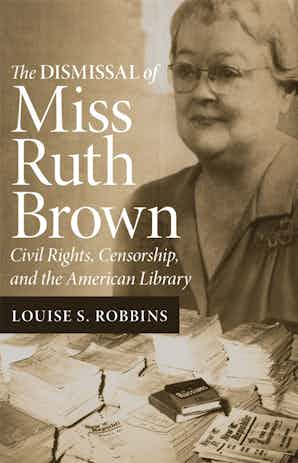
The Dismissal of Miss Ruth Brown - by Louise S. Robbins


Eight years ago I wrote about the film Storm Center. I recently learned that this film, produced at the height of McCarthyism, was loosely based on the case of Ruth Brown, who was fired from her job as librarian at the Bartlesville (Oklahoma) Public Library in 1950. Robbins' book even contains a rather thorough summary of the movie. Bette Davis (who played ousted librarian Alicia Hull) was questioned about taking the role by at least one parent, Anne Smart. 

Smart sent Davis a "report of the book controversy" she was causing in Marin County [California]...Her report depicted in "vivid detail...the type of material being given to our children in some schools. [The report]...made its way around the country for for several years [and contained] the names of authors "all extremely well listed as to their communist and/or communist front affiliations by various government investigating committees."

The more things change... 

Brown was an outspoken civil rights activist in her town. Her racial justice work during the height of McCarthyism made her an easy target. Charges that she was circulating "subversive" materials was a façade for the real reason of her dismissal.

The back cover blurb of this work (published in 2000) reads 

The fundamental issues of the Brown case make it especially pertinent today when differences - in race, gender, class, and national origin - are again feared and as challenges to materials in library collections again escalate. Ruth Brown's story helps us understand the matrix of personal, community, state, and national forces that can lead to censorship, intolerance, and the suppression of individual rights

This description is even more eerily prescient today. As are discussions in the book of neutrality, academic freedom, freedom of acquisition, freedom of access (especially to controversial materials) and the blatant sexism. 

Ruth Brown was one of the women, mostly white and middle-class, who made up 88.8 percent of the allied profession of librarianship in 1950. For a salary less than a man would receive, she organized and maintained a comfortable homelike space where people, especially young people, went for wholesome enlightenment (emphasis mine). The professional role of the librarian gave communities low-cost female employees (emphasis mine) to provide healthy recreational and informational reading while it extended the margins of the domestic sphere without exploding them. The librarian's role did not transgress boundaries as long as the homelike space and the materials and activities organized in it remained safe, comforting, and submissive to the prevailing ideology...

The more things change... 

The Library Bill of Rights was originally adopted by the American Library Association (ALA) in 1939 to ensure access to information (even what some might consider harmful or dangerous) to all. "The ALA articulated the importance of allowing citizens to decide for themselves what they should read, an idea Brown expressed in her interview with the city commission". This is a stark contrast to the description of the "stereotypical" librarian 

in Alice I. Byran's 1952 research report, The Public Librarian...[who] was "rather submissive in social situations" and lacked self confidence. "Indiscreet" was not part of the lexicon by which librarians, especially female librarians, were described. In fact female librarians have been characterized as discreet to a fault in book selection practices, "ruthless in their own censorship." Marjorie Fiske's 1959 classic , Book Selection and Censorship, depicted its mostly female subjects as anxious and fearful, avoiding challenges to library materials through self-censorship.

The more things change... 

 And on a final note, we see the same ideological concerns in libraries today as libraries in Montana and Georgia cut ties with the ALA over president Emily Drabinski's identity as a Marxist lesbian.

The more things change...

Wednesday, December 6, 2017

George & Lizzie - by Nancy Pearl


Even if there had been no libraries in this book, it would still get a post here for being written by the librarian's librarian Nancy Pearl. However, there are, unsurprisingly, dozens of times libraries are mentioned in this work.

James and I took the train into Boston in September to hear Pearl read from her new novel at the Boston Public Library, and bought a signed copy. She was happy to pose with me for this un-selfie (James took it) and specifically inquired "Are you a librarian?" (with a smile) when I asked her if she minded taking her picture with me. 

Blogger with author Nancy Pearl

George & Lizzie is not your typical love story. While tales of opposites attracting (in this case an optimist and a pessimist - George and Lizzie respectively) are not unusual, George and Lizzie have a lot more going on. Lizzie has two big secrets that she's keeping from George, as well as a host of other issues that stem from her unusual childhood - having been raised by her aloof Behavioral Psychologist parents Lydia and Mendel. Lizzie is bemused by George's desire to help her see the world through a lens of hope, but pushes back at every turn.

George's optimism ultimately makes him famous on the public-speaking circuit. 
in George's world there were no tragedies; rained-out picnics, famine in China, lost library books, monsoons in Bali, divorce, children drinking at ten, mainlining heroin at twelve, and dead at fifteen...In his world there were no irretrievable bad choices or wrong turns. Each one was, instead, an Opportunity for Growth...
The next time I hear a student complain about having to pay I fine I will remind them that it is simply an opportunity for growth...

Lizzie is a library user from a young age. She liked the little library at her kindergarten where "Lizzie's whole class went for an hour two mornings every week". Lizzie's parents insisted that Shelia, her babysitter, take her on outings to "ballets, museums, libraries, operas, theaters, and planetariums" rather than places like the Bowlarama. I would suggest that there should be room in a child's life for the Bowlarama and its ilk along with the the more culturally entertaining places. Libraries, of course, are fun, and Shelia helped make them so by checking out books "that she loved when she was Lizzie's age". Shelia also took Lizzie on four-leaf clover hunts. "Lizzie never met anyone who could find four-leaf clovers like Shelia could". This is probably only because she has never met me! My prowess for finding the rare vegetation has led me to deem myself "The World's Greatest Four-Leaf Clover Finder".

Something Lizzie and I have in common is that we were both born on a Wednesday. Lizzie found the poem "Monday's child" in a library book and after reading it understood was why she was "full of woe". I remember reading that poem for the first time, and my father showing my brother, sister and I how to use the perpetual calendar in the phone book to find out what day of the week we were born on. Like Lizzie I was rather displeased with my lot. As Lizzie realizes it would have been better to have been born on a Tuesday or Friday. 

One of Lizzie's favorite library books was Bonny's Boy about a cocker spaniel and "after searching for years, she finally found herself a copy at a book sale run by the Ann Arbor Public Library".

As a high schooler she goes to the library to read up on football in preparation for something she refers to as "The Great Game" - a game which ultimately becomes one of her big secrets. She also read a lot of teen romance novels from the library where she learned about dating, but was also left with a lot of questions about sex.

In college Lizzie uses the UGLI (Undergraduate Library at the University of Michigan Ann Arbor) to study with her boyfriend Jack (who becomes her other secret) and then takes a job there there "shelving books, all of which looked frightfully uninteresting" in an attempt to take her mind off the fact that Jack left for the summer and seemed to have forgotten about her. In fact, he never returns to school. Jack's "ghosting" of Lizzie is what makes her use of the library as an adult so pathetically sad. Although Lizzie tells George she does "nothing much" with her days, the truth is she spends them at the library "trying to find Jack using the public library's collection of telephone books". Traveling with George provides her with opportunities to visit other libraries and look at their phone book collections as well. Of course today Lizzie could probably reconnect with her old flame within seconds by searching for him on Facebook, or Googling him, but George and Lizzie's story takes place in a magical time called the nineties, a time when a public library's phone book collection was well used. I know because I worked in a public library in the 1990s. We would field calls from people all over the country asking if we had a phone book for a certain city, and if so they'd ask us to look up a phone number for them.

James and I read this out loud together. It was a good read aloud for us as we reminisced about the nineties, and laughed out loud. It also had regular breaking points so we were always able to find a stopping point.

A must-read for all librarians. 

Tuesday, October 18, 2016

Where the Heart Is - by Billie Letts


This is the third Billie Letts book I've blogged about here. Each one was found by serendipity - the first (Made in the U.S.A.) while browsing the leisure reading shelf of the library where I work, and the other (Shoot the Moon) at Somethin's Brewing Book Cafe. This one I found at The Little Free Library which recently appeared on Washington St. in Fairhaven, Massachusetts, near where my beach house is located. I was thrilled to be able to ride my bike there and pick out a book.

Of the three Letts' books this one is the most library-centric, and includes at least three different kinds of libraries (public, academic, and prison). The libraries tend to be positive forces for the characters in the books; the librarians, however leave a bit to be desired.

When seven-months-pregnant Novalee Nation is abandoned by her boyfriend at the Wal-Mart in Sequoya, Oklahoma she meets an eclectic group of people who help her out in some unexpected ways. She camps out at the store each night, and hides from the employees as they open it each morning. During the day she explores Sequoya and finds the public library "a two-story brick building with a black wrought-iron fence, the lawn planted with joseph's coat, calendula and foxglove." The first library Novalee had ever been in that "didn't have wheels under it". Inside she discovered
a room with dark wood carved into intricate designs, tall windows of thick, frosted glass and red velvet drapes held back with silver cord, chandeliers whose crystal drops caught fragments  of light transfused into rich blues and deep greens, paintings in gold frames of nude women with heavy bellies and thick thighs. And books. Racks of books, stacks of books, walls of books.
The librarian, however, was absent, as she was informed by the only other person in the building. Forney Hull turned out to be the alcoholic librarian's brother who took care of both his sister and her patrons. Forney and his sister live in the library, which before becoming the library was their childhood home. Novalee is enchanted with the idea of  being able to live at the library "to have all those books to read..." She also gets to celebrate her birthday at the library. This is the first library birthday celebration I have come across, and I had actually been wondering if I would ever find one!

Meanwhile, Novalee's good-for-nothing ex, Willy Jack (a.k.a. Billy Shadow), winds up in prison for theft. There he meets Claire Hudson, prison librarian:
She was a big woman who had to shop for queen tall pantyhose and size eleven shoes, double E. She wore dark clothes - stiff gray gabardines, navy twills and black serges...boxy suits with high necks, long sleeves and tight collars. Claire avoided garments with lace, bows and fancy buttons and she owned no jewelry, not even a watch. She held strong disdain for anything showy, allowing herself only one extravagance: Band-Aids....She wore them constantly and in abundance...She covered her warts, moles and ingrown hairs...pimples, cuts and fever blisters...burns, abrasions, hangnails and bites...eczema, psoriasis, scratches and rashes. 
Clair Hudson changes Willy Jack's life when she helps him to get a guitar to keep in his cell and he writes a song. Ultimately, though, she betrays him. It is unclear whether it is out of simple meanness, or perhaps because of some mental illness.

One other library gets a shout out - the one at Bowdoin College in Maine. No other information about the library is provided except that is is "great".

This book had a lot of surprises, and ultimately a happy ending, without being too sappy. Libraries play an important role as places of turning points for the characters.

Thursday, October 27, 2011

Shoot the Moon - by Billie Letts

Shoot the Moon by Billie LettsThe very first book I reviewed on this blog was Letts' Made in the U.S.A. I had never heard of Billie Letts before I read it; I simply picked the book up off the "leisure reading" shelf at the library where I work. I enjoyed the novel, so when I happened upon another of her books at Somethin's Brewing Book Cafe I picked it up and paid the $2 cost. As a bonus I was told that it was 2- for-1 day, so I also grabbed a copy of Blackbird by Jennifer Lauck (which I have not yet read).

Shoot the Moon is the story of Mark Albright, a Beverly Hills veterinarian, who learns after the death of his parents that he was adopted, and that his birth mother, Gaylene Harjo, is from DeClare, Oklahoma. He travels to DeClare in search of Gaylene only to discover that she was murdered shortly before he was put up for adoption, and that her baby, Nicky Jack, had also been presumed dead, at least, up until Mark showed up.

Libraries were not as important in this work as they were in Made in the U.S.A. There were a few passing mentions, Mark vomits on the lawn of the public library after reading about Gaylene's gruesome ending at the archives of the local newspaper. He also discovers a few library books, 30-years overdue, in the home of his birth grandmother, who has kept her daughter's room exactly as Gaylene left it. He also learns from his aunt that when his teenage mother learned she was pregnant she gave up her dreams of college and "checked out a bunch of books from the library on child care."

This was a good story, with a lot of places to speculate about who done it. The murder mystery is ultimately resolved, but in a way I found anti-climactic, although surprising.

By the way, I highly recommend a visit to Somethin's Brewing for anyone visiting the south shore of Massachusetts. This comfortable cafe features fair trade coffee, used books, and is housed in one of the original Carnegie libraries. In 2005, Lakeville opened a new, modern library across the street from the original.