Showing posts with label librarian's library. Show all posts

Thursday, October 3, 2024

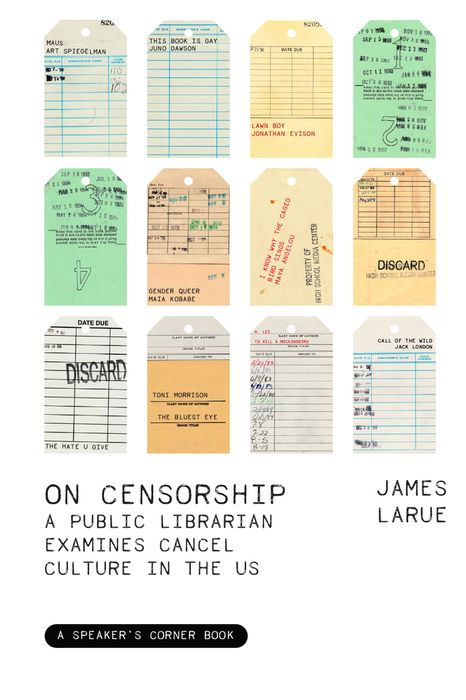
On Censorship: A Public Librarian Examines Cancel Culture - by James LaRue


I've been invited several times as a guest speaker on "The Dissidents" podcast. During the month of September, as a lead up to Banned Books Week (September 22-28) one of the hosts (Elizabeth) and I read LaRue's book and recorded four half-hour(ish) conversations about it. Last night, as a finale, we invited the author to speak with us about his work on a livecast. It was a fun (and hopeful) conversation.

Listen to all of our conversations:

Episode 1

Episode 2

Episode 3

Episode 4

Episode 5

Thursday, January 13, 2022

Feminists Among Us: Resistance and Advocacy in Library Leadership - edited by Shirley Lew and Baharak Yousefi

I spotted this collection of essays on the New Books shelf at the library as I was looking for something to read over the holidays. While this wasn't really light reading, it was the only book I finished of the three I checked out. The other two were novels that just didn't keep my interest.

The essays in this book explore leadership, feminism, racism, sexism, diversity, and intersectionality (among other things) within the library profession. It is most definitely an academic book, written primarily for other academic librarians

Of course it is no surprise to those of us in librarianship that "white heterosexual men in feminized professions...benefit from 'the assumption that they are better suited than women for leadership positions'". However, as Maura Smale quotes Chris Bourg out in the first essay "Always a Novice" 

If all of you who don't want to play politics, who don't want power & influence to change your values, and who want to have a healthy work life balance shy away from leadership positions; it might mean that you are leaving the leadership of our profession in the hands of those who aren't concerned about those things.

It is a truth that men tend to get the leadership positions in libraries. My own library just hired a white male as our new Dean. In collective memory of the university "white male" describes every library leader we have ever had. 

 "Isn't feminist leadership just about being a decent human being" is the question explored in the final essay "Feminist Praxis in Library Leadership". While the question may seem simplistic it spiraled into quite a lengthy essay. Through targeted interviews with eleven library leaders the authors asked six open-ended questions

  • What is feminism?
  • What is leadership?
  • What are some examples of your feminist leadership actions?
  • How are you addressing issues of diversity and inclusion?
  • What do you read that informs your feminism and/or your leadership?
  • What other related topics would you like to tell us about?

From there three more questions emerged

  • What does being a feminist mean to you?
  • What makes leadership feminist?
  • What tips or advice do you have for others looking to activate their feminism at work?
Readers are provided with some perceptive answers to these questions.

A timely work.

Friday, December 17, 2021

Melvil Dewey - by Fremont Rider

December 10 was Dewey Decimal System Day  The date was chosen to coincide with the birthday of the system's namesake Melvil Dewey. In honor of this day I checked out a biography of Dewey from the library where I work (which does not use the Dewey Decimal System). I noticed that his birthday is mentioned several times throughout the work, starting with the first page, and including the fact that he was appointed to the New York Board of Regents on December 10, 1889 (this was included without highlighting the fact that it was also his birthday). 

The book, simply titled Melvil Dewey, was published in 1944, and mostly has praise for the man we now recognize as sexist, racist, and anti-Semitic. Although there is some mention in the work of these latter two identities they are downplayed. His clear bias toward Christianity can be found in the Dewey Decimal Classification system itself. The 200 range of the system is where books on Religion are found. Christianity is covered in the range of 220-280, and "other religions" are relegated to only the 290s.  

His sexism is disguised in the book with passages such as this one: 

All through his life, women were more congenial intimates with him than men; he was more at ease with them; he worked more to more purpose with them; he played with them with greater zest. 

While he did admit women to the Columbia University, essentially forcing the University into co-education, when he started the Library School, we now know that his reasons were less than altruistic. While he believed that well-educated women would make jim-dandy librarians he also left a legacy of low pay as women "were also more likely to get sick or leave the profession to pursue 'home life'". Furthermore, male librarians deserved more pay than women because they "could also lift a heavy case, or climb a ladder....There are many used for which a stout corduroy is really worth more than the finest silk." (See the link at the end of the post for more information on this.)

About 20 years ago the then-president (a man) of my university actually told the librarians (all of whom at the time were women) at a meeting to discuss salaries that we knew when we went into a female-dominated profession that we would make less money - that it was "societal". And that, after all, he couldn't be expected to solve this "societal problem". Why he couldn't try to solve it on our campus is another question. That president's sexist legacy lives on here as well. Librarians continue to work a twelve-month contact for less money than our faculty colleagues who work a ten-month contract. 

Melvil Dewey was also obsessed with simplifying things, especially spelling. He learned and taught shorthand, and changed the spelling of his first name from Melville to Melvil. As well, he attempted to shorten his last name to "Dui". 

An example of his writing included in the work reads

In skool in Adams Center I rebeld agenst compound numbers. I told the teacher that jeometri taut us a strait lyn was the shortest distance between 2 points & that it was absurd to hav long mezur, surveyor's mezur & cloth mesur; also absurd to hav quarts & bushels of difernt syzes & to hav avoirdupois, troy & apothecari weits, with a pound of feathers hevier than a pound of gold. I spred out on my attik room table sheets of foolscap & desyded that the world needed just 1 mezur for length, 1 for capasiti & 1 for weit, & that they should all be in simpl decimals lyk our muni.

He very much liked the metric system and advocated for the United States to adopt it. I remember when I was in Junior High in the mid 70s that we had to learn the metric system in math class because it was coming to the United States, and soon! President Gerald Ford and after him President Jimmy Carter were going to make it happen. Then Ronald Reagan was elected and just like that people stopped talking about the metric system and we are left only in the company of Liberia and Myanmar as the only countries not to have adopted the metric system as the standard system of measure.

While we cannot deny the legacy Dewey has left on the library profession, we are also experiencing a reckoning of the damage his legacy has left. Two years ago the American Library Association changed the name of the Melvil Dewey Medal to the ALA Medal of Excellence. More about Dewey's sexism and racism can be found in this article from Slate.com. 

Monday, August 16, 2021

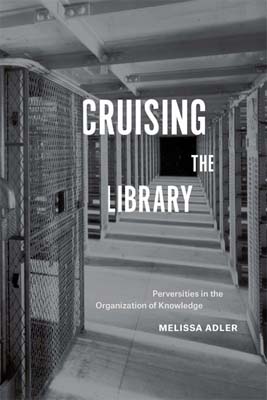
Cruising the Library - by Melissa Adler

I noticed the title of this book while I was looking for something else in our library catalog. (I don't remember what I was originally searching.) The author begins with a discussion of the Library of Congress catalog subject term "Paraphilias" - a word I had never heard of before reading this book, which is exactly her point. Very few people know this word, and even if they could guess its meaning, they probably wouldn't think to search for it in the library catalog even if they had heard of it. Using the word as a subject heading effectively hides the work even as it is available on the open shelves of the library.

(At the time of this posting my own library had six titles listed under the subject heading Paraphilias.)

Through the exploration of this term Adler demonstrates that how we classify books has more to do with librarians determining what is "normal" (rather than simply reflecting it) especially when it comes to sex. Furthermore, the Library of Congress 

disciplines sex and sexuality by privileging scientific domains and text, granting such disciplines authority while obfuscating the humanities, popular literature, and emerging interdisciplinary and local knowledges.

She also demonstrates how whiteness and heterosexuality are presumed "normal" by searching the catalog for specific terms.

Much of this book is an exploration of the now defunct Delta collection of the Library of Congress - a little known collection of erotica, works deemed obscene, or those containing information about "perverse" or "aberrant" sexual practices. The Delta collection was restricted - those wishing to use it had to ask. By putting certain works in the Delta collection librarians had power in determining what was considered obscene or "aberrant". Now long gone, Adler discovered that even finding information about the existence of the Delta collection was hard to come by. An excerpt from her book about the collection was published on Literary Hub (which you can read here).

Those of us who work in libraries are no strangers to the use of the library as sexual space. Many a library worker can tell you a story of coitus interruptus or of finding post-coital evidence while straightening books the stacks. Adler also sees the library itself as a sensual and seductive place

The library is an erotically charged space. Some might even regard the pleasurable experience of browsing and losing and finding oneself in the stacks as an exercise in sadomasochism. The classificatory apparatuses in the library, with their disciplinary divisions and regularizing and shaming techniques, often bar opportunities for cross-disciplinary play, prohibit the intermingling of bodies, and cut the perverse from the normal (as if such an act was actually possible). In the library space, submission to and enactment of technologies of control facilitate and inhibit promiscuousness in browsing, perverse reading, and bodily pleasures.

I am always interested in what people have to say about book banning. Adler quotes President Dwight D. Eisenhower who had this to say about it in 1953

Don't join the book burners. Don't think you are going to conceal faults by concealing evidence that they never existed. Don't be afraid to go into your library and read every book. 

Be like Ike.

Monday, June 14, 2021

The Future of Academic Freedom - by Henry Reichman

I found out about this book when I signed up for a Zoom event with the author (Henry Reichman) through the American Library Association's Intellectual Freedom Round Table

In the book’s foreword Joan Wallach Scott says Reichman "embraces the idea that education exists to advance the common good, measured not in economic terms but as an enhancement of the human spirit; and he is adamant about the importance of protecting the political rights of students and faculty alike to protest inequality and injustice on campus and in the larger society." 

Protests are of course an expression of free speech, as are counter protests. Likewise questioning authority, confronting invited speakers, and challenging those with opposing viewpoints are all legitimate forms of free speech. Exercising one's first amendment right does not prevent others from doing the same.

We are indeed living in interesting times. As librarians are debating the removal of Dr. Seuss books from the shelves, we hear terms like “cancel culture” as well as questions about whether people are even allowed to protest anything anymore. Trigger warnings are expected on syllabi and in presentations. 

Do all University students have the right to feel comfortable at all times? Has social media and political correctness taken away our ability to speak freely in academic settings? Do faculty even have academic freedom anymore? 

What exactly is academic freedom? 

The American Association of University Professors' 1915 Declaration of Principles on Academic Freedom and Academic Tenure included three basic elements: freedom in the classroom; freedom in research; and freedom in extramural utterance. Reichman discussed all three elements in the book and in his Zoom talk.

The focus in any discussion of academic freedom ultimately seems to be on students. As Reichman points out:
Colleges and universities have traditionally been places designed...to make people uncomfortable. Education can and should be joyful, but it should also be challenging, difficult, and sometimes unsettling. Yet increasingly we hear that the faculty's right to academic freedom must be limited by the "right" of students not to be "offended" or unduly disturbed by material or ideas they encounter in and out of class.
The Association of University Professionals’ (AAUP) statement On Trigger Warnings rejects the idea that people have the right to not be offended. "The presumption that students need to be protected rather than challenged in a classroom is at once infantilizing and anti-intellectual.” 

I would also argue that Administration often acts in a way to infantilize faculty and other university employees as well. Reichman quotes Greg Lukianoff to drive the point home.
Campus administrators have been successful in convincing students that the primary goal of the university is to make students feel comfortable. Unfortunately, comfortable minds are often not thinking ones.
Furthermore, ensuring that all students are “comfortable” is an impossible standard. White Supremacists and Black Lives Matter activists cannot both expect that they can speak about their views “comfortably” in the same space. In fact, no one participating either actively or passively in such a space can expect to feel comfortable. That is no reason not to have the discussion.

It is worthwhile to note that students don’t necessarily want a sheltered learning environment either. A Gallup poll on free speech in 2016 found that 78 percent of students favored an "open learning environment" as opposed to a "positive learning environment" that "opposed free speech". 

Free Speech

I liked the idea set forth by Historian L.D. Burnett, who considers her classroom a "rehearsal space" where students can "work through ideas" without worrying that they will "unwillingly be part of someone's snarky narrative". Students and faculty should be able to explore difficult topics in class, and expect to feel uncomfortable doing so, without worrying that they will become the next victims of targeted online harassment campaigns which may threaten their jobs, families, and lives”. 

I find it ironic that social media, which gives us all a platform to express our views, is simultaneously making it more difficult to speak freely. Any mistake, misstep, misinterpretation, or misunderstanding in the classroom (or in research) can be recorded and posted online and literally create life-threating situations for those involved. However, it is equally important to note that the offended students do have the right to express their grievances. "Toleration does not imply acceptance or agreement. The freedom to speak does not give one the right not to be condemned and despised for one's speech." 

Students also have the right to protest speakers they don't like, so long as they don't interfere with the ability of those who do wish to hear them and are free to invite speakers whom they would prefer to hear to campus. They are also free to enter into discourse with any speaker with whom they disagree. It is important to note, however, that there is no requirement that each speaker be "balanced" with one of the opposing viewpoint. 

Should free speech ever be curtailed on campus? 

Reichman discusses the right of faculty to speak freely about political and social issues outside the classroom.
Faculty members who speak as citizens often speak about topics far from their academic specialty. Physicists or engineers, for example, may express controversial views on political or social issues that have no bearing at all on their fitness to teach or conduct research in physics or engineering. 
He gives the example of two engineering professors (one at Northwestern University and the other at California State University, Long Beach) who "publicly advocated Holocaust denial but retained their positions without challenge so long as they did not inject those views into the classroom". 

If however, they had been history professors and expressed those views in class there is an argument to be made for dismissal. In Reichman's presentation he made the ironic statement that "the less you know about a subject the freer you are to talk about it". 

The Problem with Administration 

It is not uncommon in the ivory tower to hear arguments that a university ‘needs to be run like a business’. This is hogwash. I agree with Reichman who sees University Administration and the “students as customers” model as the biggest threat to academic freedom. 

Administration is more concerned with "institutional image" than with truth seeking, even as Administration has the right to express disapproval of faculty speech. 

Moreover, Administration should not "be trusted with the truth-seeking institutions with which they've been entrusted. They are to promote the college as a place of teaching. But they are not teachers." 

This point is illustrated in the book that treats the topic of adjunct (contingent) faculty who do not have the protection of tenure, and who often are left to "cobble together the semblance of a career from a series of part-time jobs". Relying on these workers is a threat to academic freedom, and paradoxically, "adversely affects graduation rates 'with the largest impact being felt at the public master's level institutions'.
Administration at my own University may wish to take heed. 
Academic capitalism's stress on measuring, assessment, and quantification has yielded what David Graeber colorfully calls 'the bullshitization of academic life: that is, the degree to which those involved in teaching and academic management spend more of their time involved in tasks which they secretly - or not so secretly - believe to be entirely pointless. 
So, what are universities for, anyway? 

Well, it’s not “work force” preparation, but lately that has been hard to deny. 

Reichman points out that "most Americans...recognize that colleges and universities play many roles beyond helping graduates obtain a good job". Furthermore, college graduates are likely to change careers several times during their lives, making preparation for specific, narrowly defined jobs a bad administrative decision. 

University of Wisconsin Milwaukee professor Christine Evans explains the importance of a liberal arts education:
The humanities train critical thinkers and citizens. That may be inconvenient for politicians who see their constituents as merely 'work force' but it is definitely good for our democracy, as well as our economy.
Reichman continues with the University of Wisconsin system as a case study. “The University of Wisconsin - Superior suspended nine majors, fifteen minors, and one graduate program in 2017. Affected programs included theatre, sociology, journalism, and political science. Other programs were placed "on warning" and told to make curricular changes to "meet regional needs" and be more "attractive for students". Students protested with sit-ins and gathered over 5,000 petition signatures to overturn the suspensions”. 

Meanwhile, Administration at the University of Wisconsin-Stevens Point threatened thirteen majors including several in the humanities. At the same time they proposed sixteen new programs "with high- demand career paths". These included marketing, management, graphic design, fire science and computer science. In response the campus Save Our Majors coalition organized the campus' biggest protest since the Vietnam War.

To counter the point, my own alma mater, the University of Maryland Baltimore County (UMBC), recently published this story in which the student profiled (computer science major Jordon Troutman) specifically expresses the importance of the humanities on his studies.
His computer science and math courses have prepared him for the work; so have courses in the liberal arts and his experiences with campus engagement. 
Elective courses in philosophy “helped me understand broadly how to articulate these non-quantitative concepts,” such as fairness, Troutman says. A particular Honors College course about how the media uses faces and how we internalize what the faces represent stuck with him. 
 Reichman quotes Stefan Collini in his work What are Universities for? in explaining that universities are a public good and that knowledge is worth pursuing for its own sake.
A society does not educate the next generation in order for them to contribute to the economy. It educates them in order that they should extend and deepen their understanding of themselves and the world acquiring...kinds of knowledge and skill which will be useful in their eventual employment, but which will no more be the sum of their education than that employment will be the sum of their lives.
Also important to note is that public colleges and universities get only a small percentage of their budget from the state governments, even as the state legislatures attempt to exert ever more control over teaching, learning, and research. 

Reichman memorializes the book to Free Speech Movement activist Reginald Zelnik as well as to Judith Krug - founding director of the American Library Association's Office for Intellectual Freedom. 

I leave my post with this thought (paraphrased from Louis Brandeis): 

More information is better than less information. More speech is better than less speech.
Wednesday, May 19, 2021

The Writer's Library: The Authors You Love on the Books that Changed their Lives - by Nancy Pearl and Jeff Schwager

My husband and I listened to the audio version of this work, which features interviews of writers about books, reading, and writing. I had never heard of many of the interviewees, and my book and author ignorance was magnified when they began discussing other books and authors I'd never heard of. Which is not to say it wasn't a good listen. It was a bit stilted though since Pearl and Schwager were simply reading questions that had already been asked and answered in real conversations with the authors, and the responses were read by people who were not necessarily the original responders. Nevertheless, we enjoyed listening to enthusiastic discussion about books and reading, and the many responses that indicated a love for libraries and librarians. After each conversation Pearl and Schwager would read a list of some of the books and authors in each interviewee's library. I was struck by how many included Richard Adams' Watership Down - a book I have never read, but at least I've heard of it.

From the amazon.com website

The authors interviewed in this work are: Russell Banks, TC Boyle, Michael Chabon, Susan Choi, Jennifer Egan, Dave Eggers, Louise Erdrich, Richard Ford, Laurie Frankel, Andrew Sean Greer, Jane Hirshfield, Siri Hustvedt, Charles Johnson, Laila Lalami, Jonathan Lethem, Donna Tartt, Madeline Miller, Viet Thanh Nguyen, Luis Alberto Urrea, Vendela Vida, Ayelet Waldman, Maaza Mengiste, and Amor Towles.

Thursday, November 19, 2020

Calling Bullshit - by Carl T. Bergstrom and Jevin D. West


At a recent meeting on information literacy on our campus a colleague from the Biology department called my attention to this work, which is based on a course the authors teach at the University of Washington. More than just how to spot fake news, the authors remind us that bullshit is everywhere. It is in local and national news, in our social media feeds, and yes, even in PR from University Administration. 

We cannot blame the messenger for any of this. Early in the work the authors describe the lament of fifteenth century priest and scribe Filippo de Strata who "railed against the damage wrought by the invention of the printing press". He worried that the low cost of printing materials would place written materials in the hands of the masses thereby lowering their value and authority. 

Five hundred years later in 1969 sociologist Neil Postman's comments on the pablum of mass media expresses concern that "infotainment" will distract the masses from real issues. Neither de Strata nor Postman could have imagined the level of bullshit brought on by the internet.
Publicly, Filippo de Strata fretted that the 'brothel of the printing press' would lead readers to cheap salacious entertainment...Privately, he may have been more concerned about his own job security.
I sometimes wonder about scholars, and some librarians who wish to guard certain information (under the guise of academic freedom). Is it the scholarship they are really attracted to, or simply the idea that they want others to believe that they are the ultimate authority?

A few years ago I read this article that discussed the issue of "abstract spin", the idea that authors of academic papers made their abstracts (sometimes the only part of a paper another person reads) focus on the juicy parts of the study. In this way they are more likely to get press coverage. Of course no one reporting on the story actually read the article, and may not have even read the abstract directly for that matter. The authors of Calling Bullshit likewise discussed the question of what gets covered in the popular press and what doesn't. Most notably that "negative results simply aren't exciting". Furthermore
The research studies that are reported in the popular press are not a random sample of those conducted or even of those published. The most surprising studies are the ones that mate the most exciting articles... When science writers cast scientific studies in popular language, they sometimes omit important caveats, offer stronger advice than is justified, present correlations as causal relationships, or extrapolate from findings in lab animals to suggest immediate application in humans
I attend a fair number of presentations on fake news and misinformation, and have occasionally given them myself. One thing that can be counted on at any of these kinds of workshops is a question about how to convince someone that they are spreading false information. I don't really have a good answer for them, and typically I've noticed other presenters don't either. Bergstrom and West provide some good advice including understanding that a person's identity may be tied to their world view so "decoupling" issues of identity from the story you want to debunk is important. To wit:

Keep it simple - "falsehoods can be crafted to be simple" (consider how often we see meme's reduced to two pictures demonstrating someone  - or something - as bad and the other as good). When offering a counterargument keep you story simple as well.

Take it offline - don't publicly humiliate another person - you will not convince them and you will surely piss them off.

Find common ground - recognize that the other person has concerns (just as you do).

Do not repeat the myth before debunking, this increases the likelihood that the myth will be perpetuated. A good piece of advice I got regarding debunking things on social media is not to simply put a comment with a link to the source. For one thing most people won't see it, and for another it is a bit embarrassing for the original poster who may have shared in good faith. I also learned not to share the post with my own commentary as that will likely perpetuate the myth as well. Instead I download the post, change it and repost so that is is clear that I am breaking the chain of sharing. Here is an example


And finally the authors provide these tips for detecting bullshit:

1. Questioning the Source of the Information
  • Who is telling me this?
  • How [do they] know it?
  • What is this person trying to sell me? - Hint they are always trying to sell you something - you may not necessarily have to part with your money in order to "buy it"

2. Beware of Unfair Comparisons
Find out how comparisons are being made between x and y. Comparisons may be between two different kinds of things (apples to oranges)  or there may be some arbitrary condition thrown in that skew the results

3.  If it's too good to be true - it is.
Statistics have been cherry picked so that readers will generalize, or an incomplete picture is drawn with only partial data reported. Go to the original source to get the real story. I actually practiced what I preached here with the story about abstract spin (above). Once I read the article in the in Inside Higer Ed I found the original study and read it, too. 


And remember "When you are using social media, remember the mantra 'think more, share less'".

Tuesday, January 14, 2020

Masked by Trust: Bias in Library Discovery - by Matthew Reidsma


In the spirit of Algorithms of Oppression this book provides insight into how search engine results are generated. Going beyond Google, which may "customize" results for individual users, Reidsma also explains how library databases aren't necessarily without prejudice either, even though all users will see the same results if they enter the exact same search. Auto-suggestions can likewise shape our thinking in ways we may not have anticipated. All search engines are working on algorithms that were created by people (mostly young, white men). Their own biases will necessarily become part of the algorithm, even if they do not intend it.

Reidsma cites Bonnie Nardi and Vicki O'Day's work to suggest that we rethink the metaphor of library tools to a "library ecology".
The thing about the ecology metaphor is that it highlights the interconnectedness of all these different things coming together in one place. It emphasizes the co-evolution of technology and people. Its [sic] about people and tools together.
Perhaps the most  useful reason for dropping the tool metaphor is that tools require convergent thinking. You cannot create a tool with divergent thinking, where many possibilities exist...
...by switching our focus to seeing our technological systems as ecologies, and thus using divergent thinking to address the design and engineering of these systems, we can move beyond the limitations of tool-based thinking and design systems that are made to be used by diverse people.
This gave me a bit to ponder, and will change the way I teach people to think about and use our databases.

Friday, June 14, 2019

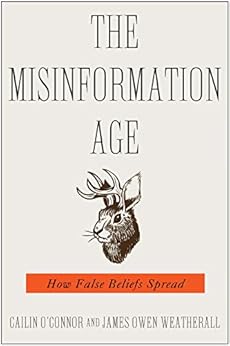
The Misinformation Age: How False Beliefs Spread - by Cailin O'Connor and James Owen Weatherall


While libraries are never specifically mentioned in this work, it's place on this blog is secured due to the information literacy theme. This work not only tells how false beliefs are spread (twitter isn't the only way) but also how some might be slowed down or stopped. This also explains how truth is malleable, and how even scientists and other experts can be mislead. No one is immune from false beliefs (not even librarians).

I was most interested in the conclusions because the authors make the same point I did when I presented on fake news at a conference two years ago. We cannot expect social media platforms, news aggregators, or algorithms to do this work for us.
...we need to recognize that fake news stories - and propaganda more generally - are not fixed targets. These problems cannot be solved once and for all. Economist Charles Goodhart is know for "Goodhart's law"..."When measure becomes a target, it ceases to be a good measure." In other words, whenever there are interests that would like to game an instrument of measurement, they will surely figure to how to do it - and once they do, the measurement is useless...As soon as we develop algorithms that block fake news sites, the creators of these sites will have tremendous incentive to find creative ways to outwit the detectors. 
The more we, as individuals, know the better we each can become at identifying fake news, fake research, and propaganda. My advice is to read as much as you can.


Monday, November 14, 2016

A Field Guide to Lies: Critical Thinking in the Information Age - by Daniel J. Levitin


I downloaded this e-book after watching this short interview with the author. Levitan has a lot to say about information literacy and includes chapters on understanding numbers, graphs, and statistics (and how all can be used to deceive); and how to think critically and logically so as to avoid being duped. Crucially, he discusses the importance of doing our own research in order to verify claims we've heard
Time spent evaluating claims is not just time well spent, it should be considered part of an implicit bargain we've all made. Information gathering and research that used to take anywhere from hours to weeks now takes just seconds. We've saved incalculable numbers of hours of trips to libraries and far-flung archives, or hunting through thick books for the one passage that will answer our questions. The implicit bargain that we all need to make explicit is that we will use just some [emphasis in original] of that time we saved in information acquisition to perform proper information verification.
Levitan also makes clear the importance of librarians in the information age. He specifically mentions asking a librarian for assistance in finding the origin of a quote often misattributed to Mark Twain ("It ain't what you don't know that gets you into trouble. It's what you know for sure that just ain't so."). He tells of consulting expert research librarian Gretchen Lieb at Vassar who explained the difficulty in tracking it down explaining that "Quotations are tricky things. They're the literary equivalent of statistics, really, in terms of lies, damn lies, etc." The quote in question most likely originated with humorist Josh Billings.

Levitan also explains about the scientific process, and what peer-review entails. Further he explains that it is becoming more difficult to tell which journals are reputable with the "proliferation of open-access journals that will print anything for a fee, in a parallel world of pseudo-academia". He goes on to say that "Reference librarians can help you distinguish the two" and specifically gives a shout out to Jeffrey Beall, a research librarian at the University of Colorado, Denver who has created a "blacklist" of disreputable journals.

This book was especially useful for me as I am currently researching how to teach students how best to evaluate websites and other open-access sources. In fact, I would recommend this book to all budding researchers (and I know a few experienced ones who might benefit from it as well). It is written clearly with just enough illustrations and was well worth the time I spent reading it.

Tuesday, March 22, 2016

This Book is Overdue! How Librarians and Cybrarians Can Save us All- by Marilyn Johnson


Johnson is not a librarian, but according to her jacket-cover biography she "owns multiple library cards and uses them often." She certainly does a wonderful job of singing the praises of librarians as she travels to where the librarians are to find out what they do and what makes them tick. The copyright on this work is 2010, which doesn't seem that long ago, but reading this made me realize how fast things are changing. Johnson has an entire chapter on Second Life which was all the rage not so long ago, but now has only about a million users. She also has a chapter on librarian bloggers, (which I feel a bit meta blogging about) even as I also realize that blogs aren't exactly cutting edge any more either. But while our heads spin about the speed at which information moves and technology changes, the book also illustrates some things that never change. Johnson asks us to consider this
Did you ever? I mean, did you ever think that being a librarian meant dealing with poop? Talking about it finding little piles of it in the stacks, writing about it on the Web. I certainly never thought that I would have to write about it. In fact, one of the things that appealed to me about this book was the intellectual, cerebral, almost disembodied nature of the subject of librarians in the digital age...I imagined the wired world of information and literature, full of brilliant, helpful, visionary librarians...I didn't want to be sitting in a sticky chair thinking about poop.
I don't think poop was one of the topics we discussed in any of my classes in library school, but I certainly had to deal with it as a librarian at a public library. How someone could mistake the elevator for a restroom I'm not sure, but there you have it.

I am always interested when I find a connection between books. In the case of This Book is Overdue! the connection is with The Library Book. In her chapter entitled "Gotham City" Johnson provides a bit of the history of the planning and construction of the New York Public Library, referring to several of the people mentioned in Fiske's book.

It was lovely to read such a librarian-positive book by someone who is a not a librarian herself.

Friday, January 8, 2016

The Meaning of the Library: A Cultural History - edited by Alice Crawford


The Millicent Library (the public library in Fairhaven, Massachusetts) looks like a castle (as do the Town Hall, High School, and Unitarian Church). I made my first visit to the beautiful Millicent Library about a month ago, although I have been spending weekends in Fairhaven regularly since August of this year. I spotted Crawford's book immediately as I walked in the building, and remembered that I had recently read a review of it. It became the first thing I checked out of the Millicent Library. Divided into three parts: The Library Through Time; The Library in Imagination; and The Library Now and in the Future each of the 12 chapters was written by a different person on a different theme. I was most interested in the second part as it included chapters on "The Library in Fiction" and "The Library in Film" (a.k.a. on this blog as "'Library' Books" and "Librarians on film", respectively) so I was surprised that it was the chapter on "The Library in Poetry" that I enjoyed the most. I generally don't read a lot of poetry, and I don't think I've seen much library poetry, but I will now most certainly be looking forward to reading Jorge Luis Borges "El guardian de los libros" (The Guardian of the Books) - in the original Spanish, of course; as well as Emily Dickinson's "In a Library".

The final chapter "The Modern Library and Global Democracy" was written by recently retired Librarian of Congress James H. Billington. He introduces the chapter by stating that 
  1. librarians are becoming more (emphasis in original) rather than less important in this new age of instant electronic communication; and
  2. libraries as places have a key role to play in building and sustaining participatory and accountable democratic societies-the kind that have historically not fought one another.
He points out that even during the Soviet era libraries in Russia "provided refuges for scholars unwilling to become propagandists...preserv[ing] and provid[ing] access both to the memory of Russia's pre-Communist past and to the experience of the post-World War II West." Further he tells of learning from a Native American chief that "long before European settlers brought books to North America, the elder of a tribe would preserve the knowledge of his people in his head the way librarians would later do in their collections. 'But we didn't call him a gatekeeper' [the word Billington used]...we called him the dream keeper". Billington uses this metaphor of "dream keeper" to round out the chapter
Wonder and silence are better for dream keepers than for image makers. Reading can balance our noisy, hurry-up, present-minded world with what Keats called "silence and slow time". Whatever else you do in life do not fail to experience the simple pleasure of being alone with a good book on a rainy day.  


Tuesday, June 2, 2015

BiblioTech : Why Libraries Matter More than Ever in the Age of Google - by John Palfrey


Last week I attended the Rhode Island Library Association (RILA) Conference in Newport. I was fortunate to be able to hear Scott Bonner (the funny and humble director of the Ferguson, Missouri Public Library) talk about how he was able to continue to serve his community during last August's crisis in the wake of the shooting death of Michael Brown by a police officer. More recently, a similar situation in my hometown of Baltimore, Maryland (where Freddy Gray died while in police custody) lead librarian Melanie Townsend Diggs to the decision to keep the Enoch Pratt Free library open even while violence erupted nearby. These examples of library as a safe community space (read more about them in American Libraries magazine) are only part of the reason that libraries still matter.

Providing computers and wifi to those who do not have home access, or are away from home is certainly another important reason why libraries still matter, but it is not just the digital access that is necessary, it is also the access to librarians who can help people navigate the internet or assist a student with completing her assignment. Alison Head and Michael Eisenberg's reasearch for Project Information Literacy demonstrates that students who consult with librarians when conducting school research are more likely to use research databases than Google for future research needs. A finding that has been confirmed by my own research. Palfrey also points out that while many coffee shops and restaurants may also offer free wifi, there are no librarians around to help patrons with their research. Furthermore, it is "simply not true that you can find everything you need through a Google search."

The idea of public libraries belonging to the people, rather than corporations, is another essential aspect. Author Dennis Gaffney is quoted in Palfrey's book
I love libraries because their names have not yet been appropriated like those of sports arenas by the the likes of Pepsi, Fleet Bank, or National Car Rental. The notion that anyone would name a community library the Tropicana Branch sounds absurd, and it should, because we own our libraries.
Palfrey goes on to explain that this means that "we are free to pursue our own interests and ideas, without fear of reprisal or economic consequence."

New information is exploding at a rate that could not have been imagined even 25 years ago. "Each day we produce 2.5 quintillion bytes of data. As a result, 90 percent of the data in the world were created in that last two years." Enter libraries and librarians who are helping to organize and manage the information, and helping people to locate what they need among the plethora of digital and print sources. Digital Public Library of America is one starting place where digital collections are being created and curated. Record preservation and record sharing is still within the purview of libraries, museums, and archivists, all of which employ people specifically trained to do so.

In his chapter on school libraries "the most common type of library in the United States" Palfrey points out that they
support all children as they learn to make sense of today's new information landscape, not just those who can afford to download any book they like onlo their Amazon Kindle. Digital savvy should not be limited to those who can pay for it, and school libraries play an essential equalizing role in this respect. 
This is true even as we continue to see stories about school libraries, and librarians being among the first to go when budgets need to be cut.

Issues of privacy are treated in the chapter "Law: Why Copyright and Privacy Matter so Much". Librarians have questioned and fought the Patriot Act, ever since it first went  into effect within weeks of the 9/11 attacks.
Librarians worry, with some reason, about what protections readers will have when the police come calling for information about books they have checked out. Librarians have long fought encroachments on civil liberties of this sort. The debate over the USA Patriot Act was a major cause célèbre for librarians, for instance. The notion that a reader's interest in a book about Islam might tip an investigation toward a particular suspect sent chills down the collective spines of librarians.
Interestingly, at the aforementioned RILA conference I attended a program on patron privacy with respect to third party vendors, and discovered that while librarians may respect patron record privacy our vendors do not necessarily share our views.

As one might imagine I marked a lot of passages in this work while I was reading it. I did not blog about everything that interested me here. Some of what interested me, but which is not included here, can be found in this video of the author speaking at the Kansas City Public Library.


Libraries do still matter - both in digital and physical space. They should remain free of charge, as well they should remain spaces for free expression.

Tuesday, November 4, 2014

Bulllspotting: Finding Facts in the Age of Misinformation - by Loren Collins


Heuristics are mental shortcuts that allow people to solve problems and make judgments quickly and efficiently... and allow people to function without constantly stopping to think about their next course of action. While heuristics are helpful in many situations, they can also lead to biases (from about education)

I've been working with one of the Psychology professors at my University for the last few years researching how students use heuristics in making choices about what to "click" when confronted with thousands of choices in a "Google" result list. Collins explains how we evolved to use heuristics and how the scientific method developed over a long period of time.

As a librarian who teaches Information Literacy (IL) this book wasn't so much "eye opening" for me as it was validation and clarification. Collins explores why people believe pseudo-science, rather than examining things via the scientific method (hint: it's easier and faster) and also how we can be more effective in our critical thinking in an age where false information can be sent around the world in a less than a day.

The author also looks at pseudo-history, and pseudo-law, explaining why "the crank in his basement...with a high school diploma [insists] that he understands American jurisprudence better than the Supreme Court."

I was reminded while reading the chapter on pseudo-law that the O.J. Simpson trial was taking place in 1995 while I was working in a public library. About once a week during the nine-month trial someone would call and ask how they could get in touch with Marcia Clark, the prosecutor in the case, always telling me they had some key information they needed to share with her.

There were a few specific mentions of libraries, but the interest in this one for librarians is less on where and how Collins refers to them, as it is on how librarians can better understand why and how our users are looking for information.

Tuesday, December 4, 2012

Librarian's Book of Quotes - edited by Tatyana Ekstrand

I recently became the owner of an iPad, and found this book while browsing my library's e-book collection in the hopes to teaching myself how to download them. I failed at the download, but was able to read this online. It was a quick read, but apparently I read it too fast because I was prompted twice to enter one of those codes to prove I was not a robot. My reading was interrupted by a message that the way I was reading was inconsistent with a human reader. What? Turning the pages one by one? I find it especially annoying, ironic, and rather post-modern, that I to had to prove to a machine that I was not a robot. Anyway, I finished the book despite this inconvenience. The book is not much more that what the title says it is. It is just over 100 pages of library-positive quotes from well-known celebrities, authors, United States presidents and first ladies, and some folks who are not so well known, or perhaps only well-known in library circles (e.g. Nancy Pearl "the librarian's librarian"; and Herbert S. White, Professor Emeritus of Library Science).

There were a lot of great quotes here. I added one to my Banned Books Week Guide. I've commented on some of my other favorites below.
--------------------------------------------------------------------------------------
News flash! When your teachers told you there was no such thing as a stupid question, they were lying. Garrison Keillor knows this, and recognizes librarians for putting up with it. He says:

Librarians . . . possess a vast store of politeness. These are
people who get asked regularly the dumbest questions
on God’s green earth. These people tolerate every kind of
crank and eccentric and mouth-breather there is.
--Garrison Keillor, A Prairie Home Companion,
13 December 1997
--------------------------------------------------------------------------------------
GraceAnne DeCandido expresses something that I find especially exhilarating about my job. A lot of our work is serendipity; we just never know when something we've learned will be useful to someone else.

One of the great joys of being a librarian is that it is the last
refuge of the renaissance person—everything you have ever
read or learned or picked up is likely to come in handy.
--GraceAnne A. DeCandido,
“Ten Graces For New Librarians”
--------------------------------------------------------------------------------------
Isn't seeing our name in print what we all hope for?

I always tell people that I became a writer not
because I went to school but because my mother took
me to the library. I wanted to become a writer so I
could see my name in the card catalog.
--Sandra Cisneros
----------------------------------------------------------------------------------
There were quotes from four different presidents, but I thought this one from First Lady Lady Bird Johnson, outshone all of those.

Perhaps no place in any community is so totally
democratic as the town library. The only entrance
requirement is interest.
--Lady Bird Johnson
--------------------------------------------------------------------------------------
Melvil Dewey did more than invent a decimal system for classifying books; he was also founder of the first Library School in the United States. His quote, which exalts women, belies that fact he wanted to populate his school with them because he knew they wouldn't be paid much. His legacy lives on today.

To my thinking, a great librarian
must have a clear head, a strong
hand, and above all, a great heart
. . . and i am inclined to think that
most of the men who achieve this
greatness will be women.
--Melvil Dewey, Library Journal, January 1899
------------------------------------------------------------------------------------
This was the only quote from an athlete I recognized.

I’m not comfortable being preachy, but more people need
to start spending as much time in the library as they do on
the basketball court.
--Kareem Abdul-Jabbar
-----------------------------------------------------------------------------------
This one, from a person I have not heard of, was the most thought-provoking

I have never met a public librarian who approved of
censorship or one who failed to practice it in some
measure.
--Leon Carnovsky, Library Quarterly 20 (1950)
-----------------------------------------------------------------------------------
For those who cannot afford to travel, the library card is more important than the passport.

The three most important documents a free society gives
are a birth certificate, a passport, and a library card.
--E. L. Doctorow, New York Times, 27 March 1994
---------------------------------------------------------------------------------
The book's editor ended with a few of her own quotes, this one made me smile.

Catalogers are some of the few
professionals who take pride in being anal.
--Tatyana Eckstrand
--------------------------------------------------------------------------------
One observation I made reading this was that however much librarianship is a female-dominated profession  (over 80% of librarians are women), the quotes in this work were, by and large, from men. At first I thought is was my imagination, but all sources were listed at the end of the book, so I counted them up. This was a count simply based on first names, so although it might not be completely accurate, even taking into account some guessing errors, the proportion of men to women represented is over three to one. I am not sure what to make of this. Do men really say more pithy things than women? Or, is it simply that, as a society, we still pay more attention to them. I remember doing some research in my own library school days, and reading about a librarian from the early 20th-century who pointed out that in her day, if they wanted to see anything accomplished, women just had to let men take the credit for everything. I frankly don't think we've come very far in the last 100 years.