Showing posts with label short stories. Show all posts

Wednesday, June 12, 2024

My Librarian is a Beautiful Lesbian Ice Cream Cone and She Tastes Amazing - by Chuck Tingle


My sister sent me an Amazon link to this super-short story. I really had no choice but to purchase the ebook and download it to my Kindle app. In a world where sentient ice cream cones are a thing that don't give anyone pause, we can also easily accept the wonderful metafiction that allows us to believe that the ice cream librarian is reading a book about herself as it is being written.

Certainly not a book for everyone's taste, but definitely a fun read. It also came with a bonus story "Nice Guy Dinosaur Doesn't Pound Me in the Butt Because I'm not Interested and He's Not Actually Nice He's Just Annoying and Creepy and Doesn't Respect My Boundaries When I Tell Him We're Not on a Date".

I have no additional comments about the bonus story. The title pretty much tells all, plus which there are no librarians.

Wednesday, March 13, 2024

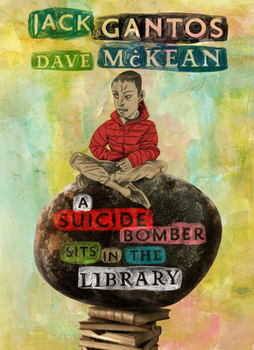
A Suicide Bomber Sits in the Library - by Jack Gantos


I first learned of this "unpublished" work when I read the Booklash Report from PEN America which describes several cases of pre-emptive censorship (in which authors either change, or pull, their works before publication in response to public accusations of harm. 

When criticism of a book veers into accusations of harm, authors may feel compelled to respond to their audiences in real time—typically through social media. In some cases, this means fact-checking details that have been lost or misrepresented in the social media uproar. In 2018, for example, Dave McKean, the illustrator of the controversial children’s graphic novel A Suicide Bomber Sits in a Librarytweeted to clarify that the book’s Muslim protagonist was not in fact illiterate—a sticking point in a since-deleted, viral tweet posted by comics publisher Zainab Akhtar.

It turns out that the book never got published anyway, over charges that it was "Islamophobic". But then, I discovered that the "unpublished" work had actually been published as part of an anthology (Here I Stand edited by Amnesty International) in 2016. An interlibrary loan request brought this work to me so I could read the story for myself. 

The short story does not include McKean's illustrations (which would have appeared in the graphic novel). I think it is clear, however that the protagonist is illiterate. We see this in the very first paragraph. 

He has been told to fear nothing and that he will be perfectly safe in the library. Not even the secret police will think to look for him there, since he cannot read.

There is no indication in the rest of the story that the boy knew how to read.  

While sitting in the library the boy watches as others select and enjoy books, and begins to wonder what he is missing.

The suicide bomber...wants to ask what happens next in the story but he has been instructed to remain silent because books will master him just as they have mastered his enemies. He has been taught that books create a false life in a godless world that should not exist. Books cannot be trusted when only God has the key to paradise.

Well, this certainly reminds me of current events - censoring a book about censorship. 

Those on the left who would censor books do not like to be compared to those on the right who do the same. It is difficult to see oneself reflected in an unflattering light. For another example of left censorship see this article from The New York Times.

I end my post with this quote from the book.

He walks away thinking of the faces of the readers in the library. They were not ruined. They were happy. They were safe. Whatever power lived within those books did not hurt them (emphasis mine)

More information about the controversy can be found in this article from the Guardian. 

Thursday, September 12, 2019

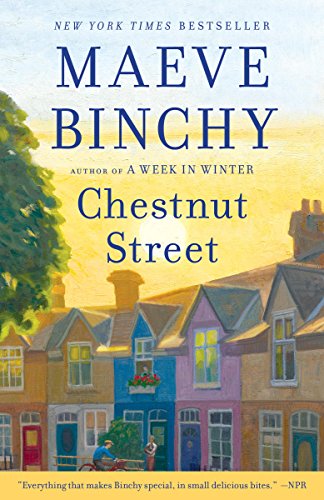
Chestnut Street - by Maeve Binchy


I picked this book from a free book exchange shelf. I was drawn to the title as Chestnut Street is also the name of the street where my beach house is located. Binchy's Chestnut, however, is in Dublin, Ireland rather than on the south coast of Massachusetts.

Like the similarly titled The House on Mango Street by Sandra Cisneros Binchy's book is a series of vignettes. Some of the characters and events overlap, but each chapter can stand on its own. The stories represent different periods of time from the 1950s to the 2000s. 

Several of the stories involve library users or library workers. 

First up is young Nessa (aka Vanessa) who was told by her sophisticated Aunt Elizabeth that "All that matters is seeing places of elegance, places with high standards". Such places include the Chester Beatty Library. Her aunt also explains that there is no reason for her (Vanessa) to take piano lessons as she can learn to appreciate music by borrowing music CDs from the library.

Additionally we meet:

  • Libby who found solace in volunteering in bookshops and libraries when her marriage fell apart
  • Molly who discovered that going to the library and reading all the books she "meant to read" was part of a miracle cure for insomnia
  • Brian "Bucket" Maguire who sought assistance from "Miss Mack in the library - before she went blind - for suitable books and games he could share with [his son] Eddie on his visits" 
  • And Gwendoline who wondered why her new neighbor Carla owned so many paperbacks "instead of borrowing them from the library, where they were free"
Usually when I take a book from a free book exchange, I send it back out into the universe of book readers by placing it on another free shelf, or in a Little Free Library. This one, though, I will put in a place of honor on the shelf in my own house on Chestnut Street.


Friday, May 18, 2018

You Think It, I'll Say It stories - by Curtis Sittenfeld


One thing I've learned about listening to audio books is that if I expect that I might want to blog about the book I should download the Kindle version, if available, in addition to the Audible edition. This provides me with (searchable) text version in which I can go back and find references to libraries after I'm done listening.

Sittenfeld's stories create a witty yet biting look at suburbia - each with its own surprises. The author shows us that beyond the superficial existences we observe, multi-faceted individuals live. Characters who are portrayed as one-dimensional are given depth once we see them from other angles. And some even use the library.

In "Vox Clamantis in Deserto" the undergraduate narrator at Dartmouth College's is a user of the Baker-Berry Library

Kirsten, a former close acquaintance of Lucy Headrick (a.k.a. "The Prairie Wife") is anxious to read Headrick's new memoir. She decides it is worth buying when she discovers that there are over 300 people ahead of her on her local library's waiting list also desperate to read what the "lifestyle" guru, with over 3.1 million Twitter followers, has to say.

Good stories of imperfect, flawed individuals. This was fun listening.

Monday, December 11, 2017

Uncommon Type: Some Stories - by Tom Hanks


Tom Hanks' collection of short stories contains seventeen tales, each featuring a typewriter, but only one ("Who's Who") that features a library. 

In the fall of 1978 Sue Gliebe shows up at the New York apartment of an acquaintance (Rebecca) from the Arizona Civic Light Opera (ACLO) looking for a place to stay as she (Sue) makes her way to the Great White Way. Seven weeks later Sue is wearing her welcome thin, which Rebecca's roommate Shelly has made abundantly clear. Sue knows she needs to update her resume but does not have a typewriter. When she asks Shelly about borrowing one Shelly informs her that "they rent them at the library". A rainy trek to the New York Public Library ("the famous building at Forty-Second and Fifth, the landmark building with the stone lions in front") with a busted umbrella ends with the sad discovery that the Main Library was closed on Mondays. 
Just as a roll of thunder outblared the honking horns of traffic, she lost the battle against tears, the collective disappointments simply too much: New York City roommates were not friendly soul sisters; Central Park was a place of naked trees, unusable benches, and spent rubbers; windows had security gates that locked rapists out and victims in; no cute sailors were waiting to meet a girl and get a kiss...and the Public Library was closed on Mondays 
Sue's sobbing is interrupted by the voice of Bob Roy, the gay general business manager of the ACLO who just happens to live in New York City. Just as if in a fairy tale Bob Roy takes her back to his cozy apartment, feeds her, and fixes up her resume himself. The rest, as they say, is history. 

Which just goes to show you that libraries really do change lives, even when they're closed. 

Lagniappe

While "Who's Who" is the only story with a library I would be remiss if I failed to give an honorable mention to the story "Welcome to Mars" in which a young surfer, Kirk, remembers his school librarian Mrs. Takimashi (along with some English teachers, and his first crush) as someone who had recognized that he was special. 

My husband and I listened to the audio version of this work, which is read by Hanks. The last story ("Stay With Us"), however, was performed as a radio play along with actors Peter Gerety, Peter Scolari, Cecily Stong, Holland Taylor, and Wilmer Valderrama.

Thursday, March 16, 2017

Public Library and Other Stories - by Ali Smith


I brought this book with me to jury duty on Monday. I arrived about 20 minutes early, went through security, and was directed to wait on a bench. I sat down, opened the book for the first time, and by the time I was called in had read the first story. The rest of the small jury pool and I were led to another room to await further instructions. I was interested to see that most of my companions that morning had also brought something (mostly books) to read. The rest of the morning passed rather uneventfully. We watched a short orientation video, and occasionally a court officer would let us know what was happening with the day's docket, but mostly we were left to read in the blissful library-like quiet of the jury room. Eventually, at 11:00, we were informed that no juries would be needed that day and we could all go home. At that point I had read almost half the book. The next day snow storm Stella closed the University where I work and so I had a day to catch up with my blogging and reading. I finished Smith's book and started another.

The funny thing about this collection is that there is no one story in it actually called "Public Library". However, The stories alternate with pieces of memories, reminiscences, and histories of libraries elicited by the author from acquaintances and strangers alike.  The stories themselves rarely mention libraries. Word play, books as touchstone, and literary allusion are all, however, what make up the mood of this work. Reading this while sitting in silence with my discerning fellow jurors left me with a feeling of connection along with a sense of the energy we still get from books and reading, and knowing that libraries still matter.


Friday, September 30, 2016

The Sexy Librarian's Big Book of Erotica - edited by Rose Caraway


I didn't originally intend to make this post one for Banned Books Week, but in re-reading Bix Warden's foreword I noted his quote from Jo Goodwin "a truly great library contains something to offend everyone" and I was reminded that Banned Books Week is about celebrating the freedom to read. So although I did not find any specific information indicating that this book was banned anywhere it seems especially appropriate for blogging during Banned Books Week. It is a celebration of our right to read what we like.

Bix also notes that "librarians...are often smart and sexy; they read wildly and across many genres, from horror to science fiction to literary fiction and nonfiction. If it's well written and thoughtful, a librarian is likely to enjoy it." As a librarian I appreciate this description. Smart and sexy is appropriate because it is sexy to be smart. I also do enjoy a variety of genres. On this blog readers will find fiction and non-fiction, romances, thrillers, funny books, serious reads, children's books, young adult books, and stories from all over the world.

Although librarians are often the stuff of fantasies only one of the twenty-two stories ("Notes on a Scandal", by Melly Maher) actually featured a librarian (well actually a librarian in training). Lauren's librarian-training program appears to include lessons an sporting an appropriate "librarian look" with "her dark-blonde hair...twisted up behind her head with what looked like chopsticks anchoring it. The dark-brown plastic rims of her glasses...[emphasizing] the chocolate brown of her eyes." As her favorite patron, Brandon, discovers she is also quite a good writer.

While not including a librarian, the first story of the anthology,  "Book Swap" by Rachel Kramer Bussel, does explore a love of reading and sharing books.

I recommend sharing this book with someone you love.

Wednesday, December 16, 2015

The Library Window - by Margaret Oliphant


Reading is cyclical. I had barely just started reading The Meaning of the Library: A Cultural History, edited by Alice Crawford, when I found out about this story (mentioned on pg. xv of the Introduction) written in 1896. A library ghost story, this is a metaphor for all the mysteries in libraries, those solved as well as those yet to be discovered. Is there a false window in the Library, or is it a view into another world? The entire story is embedded below. A synopsis can be found here. 


Monday, January 12, 2015

Land of Love and Drowning - by Tiphanie Yanique


I had the pleasure of hearing Ms. Yanique give a reading and Q&A last November when she visited Bridgewater State University. She read from Land of Love and Drowning which I then attempted to check out of the library where I work (which was only there because I ordered it knowing the author would be coming to campus) but someone had beaten me to it. I was finally able to check it out over the winter break. This is a wonderful tale about three generations of Bradshaws during the early and mid-twentieth century. This novel tells some of the history of the Virgin Islands while taking the reader on a journey of magic realism. The narration in the story alternates between sisters Annette and Eeona, and an omniscient narrator giving several perspectives on the family.

The Bradshaw sisters each takes advantage of the library in her own way. Older sister Eeona, living alone, uses the library in the traditional manner - finding books to read "Thrice in one week she went to the library and picked up a novel. She plowed through the books until the gas in the lamp burnt down." Annette makes use of the library's typewriter rental service to write her husband a letter requesting a divorce, she also researches baby names for her second daughter there, and decides on Eve Youme.

I remembered during the reading that the author said something about naming being the first sorcery a parent performs on a child. While I hadn't thought about it in exactly those terms I realized that she was absolutely right. When parents name their baby a certain destiny is created for the new human, and while parents may have their own ideas about meanings and monikers, it is also true that the parents' spells can come undone
...naming is a voodoo all parents do. Annette listed the child's second name as Youme. She'd spent hours in the island's library looking up baby names instead of studying for the teaching certificate. The name didn't mean "ours" as she'd first hoped. It meant "dream." But that also made sense and perhaps what was ours was all a dream anyway. Something to keep striving for or something all in our mind-depending. And as these things go on island, the child was never called Eve. She was called Youme early on, but in the islands' history she will simply be called Me. History could do that, change a person's name. History was something so simple and insistent that none of us has escaped it. 
I enjoyed the imagery, the story, the characters, and learning a bit about the Virgin Islands.

Lagniappe:
I also read Yanique's collection of short stories How to Escape from a Leper Colony. The final story in the work "Kill the Rabbits" includes one description of a prison library:
When I'm not staring out at the sea I lime in the library. I prefer the salt air to the library's a.c. but sometimes I like the quiet. I like the hard wooden chairs with firm backs. It's a small quiet place, like a vault with precious gold bullion. A vault inside the jail. The tile on the floor is scrubbed shiny and clean and my shoes squeak when I walk. They only let three of us in at a time. And we have to sit at different tables. There are only three long tables in the library. There's a computer in the corner that connects to the Internet.
There is also one librarian metaphor as Herman describes seeing his girlfriend Xica for the first time
She was in a yellow dress that was shiny and out of date-out of place in a tapas bar....She sat at the edge of a bar stool, her back so straight that she reminded me of a librarian.

Friday, December 12, 2014

A Fantastic Holiday Season: The Gift of Stories - edited by Kevin J. Anderson and Keith Olexa


This collection of sci-fi short stories all have a holiday theme, and all wrap up with an appropriately upbeat ending, although some of them take a rather harrowing journey to get there. None of them have any action actually taking place in a library, although three of them did mention the use of a library. In Brad Torgersen's "Astronaut Nick" young Jimmy learns from his school library that the filth inside of a chimney was "equivalent to a spaceship exhaust". Leo, in Nina Kiriki Hoffman's "Close Knit", spends some time in the library reading magazines, and looking at apartment ads, to avoid "the return to his parent's house as long as possible". And at a Hogwart's-like boarding school created by Mercedes Lackey in "The Longest Night" student Vickie Nagy, while sad to not be with her parents over the Christmas break, realizes it won't be so bad as she will "have full access to the school library and other magical amenities" while enjoying the "really posh Guest Quarters".

My favorite story was the last one - "Unappreciated Gifts" by Patricia Biggs, about a heterosexual werewolf set up on a blind date with a gay "fake" vampire. Alas, no libraries though.

Monday, May 20, 2013

Herotica 3 - edited by Susie Bright


Back in the 1990s, when I was working at a Public Library in Texas, we received a donation of books for the children's collection that claimed to be appropriate for K-12 readers. I don't remember where the donation came from, but I do remember that we were puzzled by their designation as children's books. Some seemed to be appropriate for a variety of ages, but others were clearly adult-themed literature. Susie Bright's collection of short stories, Herotica 3, challenged even my own liberal beliefs about age appropriateness. While I don't deny that the work might be appropriate for a public library, it seemed a bit of a stretch to include this one in the children's, or even young adult, collection. Since the copy we received was also damaged, it didn't end up in the collection at all, and it found its way into my own personal library. I read it at the time, and have not revisited it again, but I recall that my favorite story involved a three-way with a librarian, so I recently re-read that story, strictly for the sake of blog completeness, of course.

In Susan St. Aubin's "Hope" we find a wonderfully different definition of the sexy librarian, rather than a young woman who only needs to remove her big glasses and let her hair down, in Hope we discover a confident 50-ish woman "with shoulder length white hair curled under in a way the seems natural. She's not short or tall, not fat or thin, but has the kind of build [the narrator's] father used to call healthy. Her face in tanned and her long gold earring have some kind of purple stone inlay that glints through her hair. Her skirt is purple too, and her lavender sweater scoops low enough  to reveal the tanned skin of her full breasts...she doesn't wear underpants."

I was especially drawn to this character when I read that she'd "been all over Mexico, and plans a long trip to Peru next year...talking of boats and flights and donkey guides to Machu Picchu". Hmmm must be something about librarians.

A wonderful bedtime story. Read  it with someone you love.


Tuesday, January 22, 2013

Bad Haircut: Stories from the Seventies - by Tom Perrotta


In his introduction, Perrotta says this collection of short stories about growing up in the '70s  is "about everything the Wonder Years leaves out". He is referring to drugs, sex, homophobia, racism, bullying, and questioning of authority. The ten stories that comprise the work follow one character called "Buddy" from childhood through early college. Buddy, who instigates some of the cruelty we see in the book, is not necessarily a sympathetic character, but we are only seeing glimpses of his life. One thing I do like about Buddy is that he is a library user. Although use of the library is only mentioned in two stories: "The Wiener Man"; and "The Jane Pasco Fan Club" I will optimistically believe that Buddy used the library a lot since there is a nine-year time span between these two stories. In "The Wiener Man" eight-year old Buddy specifically says he checked a book out. In "The Jane Pasco Fan Club" Buddy and the lovely Jane go to the library to debate "the virtues of telling a story through the eyes of a minor character". And it is here that we see romance bloom between the teenagers - so much fun we can have at the library.

Thursday, December 20, 2012

This Is How You Lose Her - by Junot Diaz

I had high hopes for this collection of short stories, by one of my favorite authors, when I found a reference to going on a date in the library on the second page of the very first first story, and then read about "the nerd every librarian in town knows" only two pages later. I expected then, that the book will be chock-a-block full of libraries and librarians. Alas, it was not to be: these two library references were the only ones.

That is not to say that I did not thoroughly enjoy this work. The stories are original, and the writing is colorful. Those who read Diaz's previous collection of short stories, Drown, will remember the character Yunior, who is the protagonist in almost all of  these stories, except "Otravida,Otravez", the only story told from a woman's point of view. All, however, involve some pendejo (usually Yunior) treating some woman (or women) like crap. The last story, called "The Cheater's Guide to Love", where we learn that Yunior, even as a well-educated, grown man, never changes his ways brings it all together. Those looking for a story of redemption will not find it in this work.

This was the first book I bought through the iBooks store to read on my new iPad. I must say I liked it. It was cool the way I could use the virtual bookmarks, and virtual yellow sticky notes to remind myself what I wanted to write about. And I liked that I could read a popular new book without paying top dollar, or waiting a really long time on the library waiting list. The downside is that it is much more difficult to share this way.