Showing posts sorted by date for query bryson. Sort by relevance Show all posts

Monday, August 8, 2022

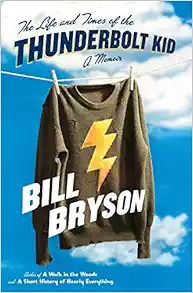
The Life and Times of the Thunderbolt Kid - by Bill Bryson


While on a short vacation in Niantic, Connecticut friends introduced us to The Book Barn  - a delightful (and huge) used bookstore with books for every interest. I walked out with six books, and my husband left with five, all for about $50!

Bryson's memoir about growing up in the 1950s was the perfect beach vacation read. Light and funny it also mentions libraries about half a dozen times. 

When he failed to produce a signed permission slip in order to go on a school field trip he spent the day in the the school library which he 

actually didn't mind at all. It's not as if I were missing a trip to the Grand Canyon or Cape Canaveral. This was Des Moines. There were only two places schools went on trips in Des Moines-to the Wonder Bread Factory...and the museum of the Iowa State Historical Society, the world's quietest and and most uneventful building...

We can deduce from this that the library was not a quiet and uneventful place. Apparently young Bill Bryson understood that the library was full of adventure! 

His parents, who were "affectionate...in a slightly vague and distracted way" sometimes went to the movies together, or to the library. I have always held that libraries are good places for dates. There are often programs, lectures, or book discussions to attend together. Or a couple could simply go and pick out a book to read together.

Bryson spent much of his childhood obsessing on how and where he could see naked women. One place was his

father's small private library of girlie magazines in a secret place known only to him, me, and 111 of my closest friends.
However, for a real live experience he set his sights on the strippers' tent at the Iowa State Fair where the twelve year old was denied entry because one needed to be thirteen to enter. So the following year he
assembled every piece of ID I could find-school reports, birth certificate, library card, faded membership card from the Sky King Fan club...

only to be thwarted once again when the minimum age for entry was changed to fourteen.

He laments that his old elementary school "lost its wonderful gym and auditorium...to make way for a library and art room...". Myself, I'd much rather be in a library (or an art room for that matter) than a gym. 

On the very next page of the book he laments the loss of the "enormous photo library" housed at the Des Moines Register and Tribune newspapers. He is (rightly) surprised and disappointed to discover that they were all destroyed and "recycled for the silver in the paper".

Bryson writes of one bit of urban lore that he, like most people, have no reason not to believe, although it is utterly false. As an information literacy specialist I feel I must set the record straight on the subliminal advertising study in Ft. Lee, New Jersey in which

patrons were shown a film in which two clipped phrases -"Drink Coca-Cola" and "Hungry? Eat Popcorn" - were flashed on the screen for 1/3000 of a second every five seconds, much too fast to be consciously noted, buy subsconsciously influential, or so it seemed, for sales of Coke went up 57.7 percent and popcorn by nearly 20 percent during the period.

Life magazine is cited as the source of this information (although a full citation with volume, issue, date, etc. is not provided). In fact, it turns out the data from the experiment was never able to be repeated, and some question whether the experiment even ever took place at all. Nevertheless the legend will not die. More information about the Subliminal Advertising study can be found on Snopes.com.

I did find the rather elusive Life magazine article. Those who want to look it up will find it in the March 31, 1958 issue (v. 44 no. 13) pp. 102-114. It's called "'Hidden Sell' Technique is almost Here".

Tuesday, May 2, 2017

The Road to Little Dribbling - by Bill Bryson


My husband and I couldn't resist picking up Bill Bryson's latest work after so very much enjoying Notes from a Big Country and A Walk in the Woods. We weren't disappointed as we once again enjoyed some laugh-out-loud reading time together.

Following what he designates as "the Bryson Line" the author transected the United Kingdom from Bognor Regis to Cape Wrath, stopping at a variety of bergs in between, visiting tourist traps, and little known spots alike, he makes keen observations on the people and places along the way.
The Bryson Line

It is unclear whether or not he visited any libraries on this particular journey, however, he did write about things he had learned in libraries
  • Such as the fact that Dwight D. Eisenhower had a home called Telegraph Cottage on the edge of Wimbledon Common during World War II and
  • How the system of road numbering works in Britain in fact he was "surprised to learn that there is a system to British road numbering...it is not like systems elsewhere."
He also discussed libraries as part of an important part of a community
  • Even if the community never existed. Motopia "was a proposed model community based on the uniquely unexpected idea of banishing cars." Motopia, however, was to include "housing, shopping, offices, libraries, schools, and recreational space" with its inhabitants "getting from place to place on moving sidewalks or in taxi boats along lakes and a small network of canals".
  • He also points out that even when Britain was referred to "the Sick Man of Europe...there were flowerbeds in roundabouts, libraries, and post offices in every village, cottage hospitals in abundance, council housing for all who needed it" and wonders why "the richer Britain gets, the poorer it thinks itself"  
  • He notes that Canford Cliffs, while lacking many of the shops he remembered from his previous visit thirty years prior, still maintained "a lovely little library and a proper village center."
  • In a completely deserved dissing of Birmingham, which had announced "massive spending cuts" that would make two-thirds of city employees "redundant" Bryson points out that this move included halving the staffing levels at the new £189 million central library, as well as cutting its hours by 46%, among so many other things. Bryson' sarcasm about all of this is right on target
All of this is being done to save £338 million over four years. That sounds like an enormous sum, but in fact it is a saving of about £1.40 per week per citizen. I wonder what all those lucky people of Birmingham will do with that extra £1.40 flowing into their pockets every week.
American citizens would do well to pay attention. Tax cuts rarely mean that middle and working class people will benefit.

Bryson also uses libraries as metaphors, or simply uses them to make a point
  • He doesn't like it, for instance, "when a hotel puts some books in a bar and calls it The Library."
  • He remembered "the Natural History Museum as being almost empty of other visitors and very quiet, like a library" although, that aspect had changed for his recent visit. He does point out, however, that the whole country of England is quiet in comparison to the United States "like a big library".
  • He suggests that one way to "receive formal adulation" in the United States is by "paying for a hospital wing or a university library or something along those lines." The other way is to "single-handedly take out a German machine-gun nest while carrying a wounded buddy on your back at a place called Porkchop Hill or Cemetery Ridge..."  
This is an entertaining book, and would be a good choice for a vacation read.

Thursday, April 23, 2015

Notes From a Big Country - by Bill Bryson


This collection of essays was originally published as a series of columns about the United States for the U.K. publication the Mail on Sunday's Night and Day magazine in the late 1990s. Although some references are a bit dated now (e.g. floppy disks, woes of land-line telephones) the anecdotes were still laugh-out-loud funny. My husband and I read these together over the course of the long winter. The right-on-target observations about life in the USA in Bryson's inimitable style were the perfect antidote to the winter doldrums we experienced in New England this year. As a bonus, Bryson mentioned libraries in six of his essays

In "Well, Doctor, I was Just Trying to Lie Down" Bryson begins with some information from one of my all-time favorite reference books The Statistical Abstract of the United States. His discussion of the number of people injured (400,000) by beds, mattresses, and pillows segues into what he learned from the Abstract 's"Table No. 206: Injuries Associated with Consumer Products" which he specifically says he found in his local library while "looking up something else altogether". This is what is so great about the print version of the Abstract. It is an absolutely fabulous browsing book. Before there was FaceBook to waste time on, there was the Statistical Abstract.

Explaining American's penchant for rules in "Rule Number 1: Follow All Rules" he describes his frustration in the constant changing of rules without warning. The first time he found out about airline rules regarding showing a picture ID before boarding (and this was pre 9/11) he was at an airport checking in for a flight. He discovers that he has "all kinds of identification - a library card, credit card, Social Security card [remember when we used to carry those around with us?], health insurance card, airline ticket" all had his name, but none had his picture. He illustrates his priorities so well - here - 120 miles away from home, he did not bring a driver's license, but he did carry his library card.

American's love affair with cars is treated in "Why No One Walks". Like me, Bryson chose to live in a place "within walking distance of shops." He describes Hanover, New Hampshire as a "typical New England college town, pleasant, sedate, and compact. It has a broad green, an old-fashioned Main Street, nice college buildings with big lawns, and leafy residential streets. It is, in short, an agreeable place to stroll. Nearly everyone in town is within a level five-minute walk of the shops" yet, he explains, no one walks, except him. He walks "nearly every day...to the post office or the library or the local bookshop". Bryson and I are rare breeds here in the United States. Driving is something I know how to do, but will avoid whenever possible.

On informality in America (in "Help for the Nondesignated Individual") Bryson extols the wonders of living near the campus of Dartmouth College
one of the Ivy League colleges, like Harvard and Yale - but you would never guess it.
None of its grounds are off limits...Indeed much of it is open to the community. We can use the library attend its concerts, go to its commencement exercises if we want.
This, of course is how it should be. Living and working in a college town myself I know how contentious town/gown relations can be. Opening events, and the library, up to the local community is not only a good PR move, it is the right thing to do. One of the first papers I wrote in library school was on community use of academic libraries. I think any college or university, public or private, has an obligation to allow at least some use of its library facilities to the local community.  I am glad to say that the university library in which I work allows free borrowing privileges to anyone who lives in town.

There is little that gets my geographer husband and I more excited than reading something that entwines his passion for places and mine for books and libraries together. So you can only imagine the magical evening we had after reading "Where Scotland is and other Useful Tips" in which Bryson tells of going to the library in order to "look at the travel section." There he found "four books exclusively on Britain, plus another eight or so on Europe generally, with chapters on Britain". Ultimately he discovers that "what Americans know about Britain is pretty much nearly nothing..."

And, finally, in "The Fat of the Land" Bryson describes his misadventures in dieting and a trip to the library to find a book with a better diet than the bran and water diet one his wife invented for him. He settles on a work titled Don't Diet which he reads in "that reading area that libraries set aside for people who are strange and have nowhere else to go in the afternoons but none the less are not quite ready to be institutionalized..."

While there are no other libraries to write about, my reference librarian self would be remiss if I did not correct the mistake Bryson makes in his essay about our shared favorite holiday - Thanksgiving - in "The Best American Holiday." He provides some history of the pilgrims, and when President Lincoln declared it a national holiday in 1863 to be celebrated on the last Thursday of November, however; Bryson then goes on to say that "there it has stayed ever since." This is not quite true, in 1939 President Roosevelt moved it to the fourth Thursday of the month. While the fourth Thursday is often the last one, in years in which there are five Thursdays in the month Thanksgiving remains on the fourth. This ensures that there are always at least four full (shopping) weekends before Christmas.

While probably not what most would suggest for date night, I highly recommend reading this with a romantic partner. Laughing together is a wonderful aphrodisiac. My husband was happy to see that I found another of Bryson's books (A Short History of Nearly Everything) for us to read together. If there are any libraries in that one you will no doubt find out about it here. For more Bryson fun, I also recommend A Walk in the Woods. 

Wednesday, December 18, 2013

The Things You Find on the Appalachian Trail: A Memoir of Discovery, Endurance and a Lazy Dog - by Kevin Runolfson


Bridgewater, Massachusetts' One Book One Community selection for spring 2014 is Bill Bryson's memoir of an ill-fated attempt to hike the entire Appalachian Trial.  A Walk in the Woods is a book which I found hysterically funny. There was some discussion on the One Book Steering Committee, though, about whether some might not enjoy Bryson's particular brand of humor the way that I do, and that perhaps we should suggest some alternative selections. Runolfson's book looks like it is clearly in the running. I think it will have wide appeal with a variety of populations, especially since the author's faithful dog, Rufus plays such an endearing role in the work.

Hiking the entire trail from Georgia to Maine between March and October 2001 in an effort to recover from a bad divorce Runolfson learns much about himself, and the kindness of strangers, as he also finds love on the trail.

Of course, I was thrilled to read that he stopped at several libraries during his six-month quest. He specifically mentions this for the first time as he walks through the Virginia portion of the trail. He first mentions one small library in Glasgow, which I am not sure he actually stopped in, but he is clearly happy to find a "huge library two blocks from the campsite" in Waynesboro where he can access e-mail. He also uses the public library near the end of the New York portion of the trail to use a pay phone (I wonder if those are still functional along the AT?) and to "waste the rest of the day reading". Although normally I would take issue with the using the verb "waste" in conjunction with reading and spending time in a library, I'm going to let this one slide, he did after all, have a long journey with a bit of a deadline. He also mentions visiting the library in Rutland, Vermont.

Public libraries are important institutions that serve many constituencies. It is good to know that a visitor to a town can use the public library to read, check e-mail, use the rest room, refill their water bottle, use a pay phone, or simply take a break. Supporting the library in your own town is the ultimate act of kindness to strangers. When you use the library in another town you are the beneficiary of the kindness of others. This is how a civil society functions.

Wednesday, February 20, 2013

A Walk in the Woods - by Bill Bryson


After selecting a string of rather didactic books (interesting though some of them were) our town's One Book One Community Committee decided to look for something fun for next year's read. To that end, we (the Committee) are considering Bryson's work about hiking the Appalachian Trail. I checked it out from the very library where I work, and took it home over the President's day weekend. I finished reading it in two days, and laughed out loud on so many occasions I lost count. Bryson and his friend Katz both out of shape, decide to hike the Appalachian Trail. Everything about his trip is funny, from going to the camping store to get outfitted for the trip, to finding his traveling companion, and the descriptions of other hikers, and helpers, he meets along the way. The book also has great geology, geography, and history lessons (but without being too didactic of course). And, to put icing on the cake, Bryson sings the praises of Laurie Potteiger an "Information Specialist...a mine of information" who works at the Appalachian Trail Conference headquarters in Harper's Ferry, West Virginia. Plus, he mentions libraries two times! In one case he explains that the walk to the public library in his own town of Hanover, New Hampshire is part of why it is a nearly perfect little town. In the other, he describes going to the Mt. Carmel, Pennsylvania Library and asking about the nearby town of Centralia, a town that was almost completely swallowed by an underground coal fire (a fire which apparently still burns today). At the Mt. Carmel Library he is provided with "three fat files bulging with newspaper and magazine clippings". Ahh, the good old days of vertical files. Do any libraries still maintain these?

It is very likely that the entire town of Bridgewater will be enjoying this book next spring.