Thursday, January 5, 2023

Mr. Harrigan's Phone - the movie

Our lives are made up of a series of "befores" and "afters". 

Mr. Harrigan's Phone takes place in the years immediately after 9/11, but before the 2016 election. This placement in time is important for the context of the story. The internet was nascent, and the first generation of iPhones were just coming out, and it was fair to be concerned about how we might be monitored electronically. 

Based on the short story by Stephen King this film tells the story of a friendship between an elderly billionaire, Mr. Harrigan (Donald Sutherland) and Craig (Jaeden Martell) a teenager Harrigan employs to read to him. When Craig decides to gift Mr. Harrigan a new iPhone Harrigan is reluctant to accept it for a variety of reasons. However, Craig convinces him that the real-time information he can get on the stock market makes the phone a gold mine. Mr. Harrigan is immediately impressed with the internet, and subsequently predicts a variety of misuses and misunderstandings of it, all of which, eventually, came to pass.

In addition to the Harrigan's lesson on information literacy there are two scenes inside a library. One early scene demonstrates how essential libraries are to accessing information for those who may not have technology available to them otherwise.


Wednesday, January 4, 2023

Only Murders in the Building - Season 2 episode 8 "Hello Darkness"

 I watched season 2 of this Hulu series back in the summer when it first aired and I've been meaning to write about it ever since. Now that I am on sabbatical I had time to re-watch it and make my post.

For the uninitiated Only Murders in the Building is a comedy series starring Steve Martin, Martin Short, and Selena Gomez. The three play neighbors in a posh apartment building in Manhattan who solve crimes  (only murders in the building) together while producing a podcast.

Season 2, episode 8 takes place during a blackout. Two of the other tenants Lester (Michael Cyril Creighton) and Jonathan (Jason Veasey) begin to flirt by asking each other for batteries for their flashlights. Lester invites Jonathan into his apartment where the two begin to get to know each other by candlelight.

Lester is the Assistant Director of Collection Development at the Central Manhattan Public Library.  Jonathan plays a hyena in the Broadway production of The Lion King but yearns for something more. "What could a Broadway star want to be instead?" asks Lester. "Don't laugh" comes the reply. "I've always wanted to be a children's librarian". Incredulous Lester responds "I'm a librarian". "Shut up!" says Jonathan. Lester then demonstrates his wit with the retort "That's our slogan!" 

Their poignant duet of "The Sound of Silence" not only brings these two together, but the entire building as well.


Friday, December 9, 2022

I Kissed Shara Wheeler - by Casey McQuiston


Being out and queer at Willowgrove Christian Academy is hard enough for Chloe Green without also having Shara Wheeler, the Principal's "perfect" daughter as her rival for class valedictorian. To complicate matters further, Shara disappears after she steals a kiss from Chole. That Shara had previously been presumed to be straight (the girlfriend of a star football player, no less) confounds everyone. Chole, Smith (Shara's boyfriend), and their friend Rory begin a search for Shara based on some rather complicated clues. 

No YA novel would be complete without some action taking place in the school library. Rory and Chloe sneak into the Principal's office after hours via the library air duct. They are able to get a key to the library from Chloe's friend Georgia who works as a library aide, although Georgia is unaware of what they were planning. While the ruse of traveling through air ducts is comically common in fiction, I don't know anyone IRL who has ever done it, although apparently it has been used with some success. Read about one case here.

Chloe and Shara have a unique library connection but only Chloe knows about it until close to the end of the book. Chloe witnesses Shara throwing away her bejeweled cross necklace in the library trashcan, which Chloe retrieves and then keeps. There are other mentions of studying and meeting in the library sprinkled throughout, but my favorite use of the library was this metaphor, written by Chloe's friend Georgia for a creative writing assignment
There's a girl with brown eyes who reminds me of the first book I ever loved. When I look at her, I feel like there might be another universe in her. I imagine her on a shelf too high for me to reach, or peeking out of someone else's backpack, or at the end of a long wait at the library. I know there are other books that are easier to get my hands on, but none are half as good as her. Every part of her seems to have a purpose, a specific meaning, an exact reason for being...

Another fun romp from the author of Red, White, and Royal Blue.


Thursday, December 8, 2022

Cape Cod - by Henry David Thoreau

Thoreau spent a year on Walden Pond; however, he spent only a week visiting Cape Cod in October 1849 before writing this book (although he does mention three visits in total). He traveled from shoulder to fist, back before there was a canal that cut the town of Onset off from the rest of the Cape and before the Cape was such the destination that it is today. He talks to many locals during his travels.

In Pond Village he talks to some blackfish fishermen.  

the Social Whale, Globicephalus Melas of De Kay; called also Black Whale-fish, Howling Whale, Bottlehead, etc.

he learns that these whales are valuable for their oil and that whole schools of them have been caught and then sold for thousands of dollars.

In the Naturalists' Library, it is said that, in the winter of 1809-10, one thousand one hundred and ten "approached the shore of Hralfiord, Iceland, and were captured". 

When Thoreau got to Provincetown he took a"little steamer" back to Boston and describes the scene at the wharf

I see a great many barrels and fig-drums, - piles of wood for unbrella-sticks, - blocks of granite and ice, - great heaps of goods, and the means of packing and conveying them, - much wrapping-paper and twine, - many crakes and hogsheads and truck, - and that is Boston. The more barrels, the more Boston. The museums and scientific societies and libraries are accidental.  
I found this book on one of the many bookshelves in my house, although I believe my husband had read it before, it was previously unread by me. It is available for free through Project Gutenberg.

Wednesday, November 30, 2022

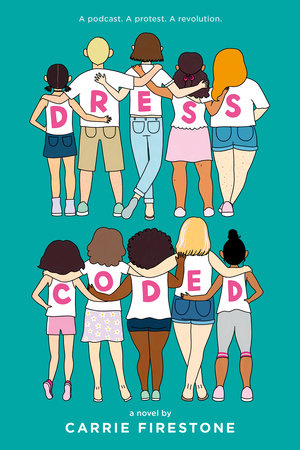
Dress Coded - by Carrie Firestone


I do love Little Free Libraries, of which there are about half a dozen near our weekend home in Fairhaven, Massachusetts. I found this book in the LFL located closest to our house. This novel tells of Molly Frost and her comrades at Fisher Middle School who are sick of having their clothing monitored. Shorts and skirts that aren't longer than the end of one's fingertips, bare shoulders, and other "distracting" attire is cause for being "coded". When Molly's friend Olivia is humiliated by the principal for exposing her shoulders because she removed her sweatshirt to tie around her waist to hide the period blood on her white pants Molly starts a podcast to protest. The protest gains serious momentum which ends with an Occupation in the schoolyard.

The school library, the public library, and a "fantasy library" where Molly imagines a decent older brother who protects her from the bullies who pelt her with ice balls are all part of this story.

Molly's mother attends a lecture at the local public library on "how guinea fowl and possums are better than chemicals for managing ticks."

The school library is a place where parents meet to discuss an upcoming end-of-year trip; where (girl) students are sent to have their clothing scrutinized; and where Molly and her friend Navya meet to write their speech for the School Board meeting. While writing their notes they find an ally in Mr. Beam, the school librarian, who "drops a blue folder on the table, winks, adjusts his tie, and walks away...It's stacked with articles about dress code protests and how, by law, student dress codes cannot be evenly enforced". You can always count on a librarian for assistance with subversive activity.


Monday, October 24, 2022

Gentrifier: A Memoir - by Anne Elizabeth Moore


Over the summer I made my first visit to Detroit. My husband (James) has been teaching a one-credit course about it for several years, but neither of us had ever been there. He recommended this book to me after he read it. A story told in vignettes from a writer who is given a house in Detroit by an unnamed organization. The intention was that Moore would have "a room of one's own" in which to concentrate on her writing without the distractions of rent. Things did not work out exactly as intended. A myriad of problems beset the author as a result of the gift of the house.

James recommended the book to me when he read the first snippet about a library

A woman emails me because she hears I have been asking about local literacy programs. In her email she writes that she presumes I own many books. She would like some, she says. She is taking up donations because her child's school library does not have any books. She says this casually, as if books were an option that this library simply chose not to offer. Later I discover it is common in Detroit schools to not have books. I give her every title I can spare.

This depressing view of libraries in Detroit continues throughout:

The downtown public library is grand and stately...Inside are frescoes, rotting, ornate decorations marred by water stains or holes, and a display of all the former branches of the Detroit Public Library system, their years of and reasons for closure or, in a few cases, their current hours...For three years, the branch near my house is not open when I stop by. I go to the main branch instead to request information on the history of my neighborhood, but the librarian looks annoyed when I ask for assistance. He tells me there are no books for me. So I leave.

Easily the most gutting architectural experience of my life is stumbling across the charred crumbling beams of a house on the northwest side...The roof is gone, only a few corners of the building still standing, and full daylight shines on a space intended to remain interior...The contents of the burned half structure have been picked through, with only functionless children's toys...sacrified to the land. Undisturbed is a whole children's library, remarkably undamaged, that no one thinks to plunder. 

In unpacking her personal library Moore's initial excitement of turning the second bedroom in her house into a library is quickly thwarted when she discovers that there are not furniture stores that carry book shelves, nor that any local furniture makers have any interest in building any.

Eventually, she determines that the headache that came with the free house isn't worth it.

After teaching for two years in Detroit, a former student, no longer in any of my classes, tells me she checked out my book from interlibrary loan. She expresses dismay that the school I teach at does not carry my books, although they are used as texts in schools elsewhere. "It was really good!" she says, eyes wide. "I can't believe you teach here!"
By this time I have already submitted my notice.

A bittersweet moment comes when a young neighbor, against her parents wishes, comes to Moore's house to and asks her to help create her own zine. Which she does and "It is amazing". This is only after Moore

put every imaginable effort into convincing the young women of Detroit, in this neighborhood and elsewhere, not only to love and value literature but to wield it as a tool

However, Moore has given up at this point and has packed up her belongings to move to a new city and a different job. 

convinced that the disregard for literacy in the schools and bookshelves in the furniture stores and books in the libraries all point to a basic truth about the way writing is valued here. It is not.

As she reflects on her time in Detroit she has this to say about her neighbors

If I were to craft a composite portrait of Detroiters I have come to know, I would sketch out a strong, steady woman of color who conserves her energy to ensure she retains enough to get through the day, focused always on the survival of her children. She would be kept with some regularity from opportunity by municipal failure or malfeasance, making instead do with what is on hand, parceling it to loved ones carefully, often well aware of the lead poisoning, the crumbling public school, the absence of books from library shelves, the water shutoff, the foreclosure. The women I meet in Detroit maintain an entire city on the strength of love and perseverance... 

It should not have to be so. 

The Book of Form and Emptiness - by Ruth Ozeki

Please note: Because I listened to this book, there may be misspellings in character names, and quotes may not be exactly as written in the print version.

There are too many levels of meta in this one for me to follow them all. The book, in addition to narrating the lives of the characters, is also narrating itself.  

A host of rich characters populates this book: these include Corey, a children's librarian; Annabelle, a would-be librarian who had to leave library school when she became pregnant; Benny, Annabelle's son - a truant who hears voices and uses the local public library to hide out; Aikon a decluttering guru and bestselling author; and a band of colorful library patrons. 

After Annabelle's husband, Kenji, dies in a freak accident she has a hard time coping with raising her son, doing her job clipping news stories for clients, and running her home. As she begins to hoard, Benny struggles with his own mental illness and he begins to have auditory hallucinations. He and his mother share a love for libraries and both find refuge in their local public library. 

I listened to this book on audio, and there was so much in it, I will limit myself here to commenting only on the notes I made while listening.

I start with my favorite quote from the book. Librarian Corey shows up to help Annabelle clear out her house wearing a shirt that reads: "Librarian - because bad-ass motherfucker isn't an official job title".

As she attempts to console Annabelle, who is feeling completely overwhelmed and begins to sob, Corey "shushes" her. As a librarian she, of course, knows from shushing.

The books in the library calmed the voices in Benny's head. Books are described as sacred, and the libraries as temples. Stopping at the library on the way back from a psychiatrist appointment was a treat.

In an attempt to "liberate" the voices from his body, Benny injures himself with a thumbtack. Thumbtacks are described as dangerous, but not as dangerous as books. This was especially striking to me as I consider the new age of book banning that we are currently experiencing. Although I cannot recall the exact context of this description of dangerous books in Ozeki's work, it is appropriate to say that some believe that the ideas found in books are more dangerous than any of the myriad real life-threatening dangers we face daily.

Although Annabelle didn't finish library school, she clearly has a librarian's keen sense for finding elusive information. When Benny disappears she is aware that he may be with his friend who calls herself The Aleph. Searching Aleph alone wasn't enough to find her. Annabelle knew to search for "The Aleph". 

The Aleph is an artist who specializes in snow globes. The best one she makes is one for Benny that features a library scene with books and letters floating in the water.

The question "What is real?" is at the center of this work. It is a question Benny explores at the behest of The B-Man one of the eccentric patrons of the public library. It is what makes this work so meta. Is the book narrating itself, or is it Benny's head?