Showing posts with label Idaho. Show all posts

Friday, October 9, 2026

The Banned Books Club - by Brenda Novak

When Gia Rossi returns to her hometown to help her dying mother she expected to have to confront the hostile neighbors who think she ruined the life of Mr. Hart, the teacher who molested her seventeen years prior. She did not expect her sister to disappear with Gia's two young nephews and to navigate her brother-in-law's hostility.

Of course I could hardly resist reading this one for Banned Books Week, although it wasn’t really what I expected.

There was in fact only a little of the story that involved book banning. While some action takes place around a reunion of a high school banned books club (a club that was started as a rebellion against the PTA who insisted on removing The Catcher in the Rye, The Outsiders, and The Handmaid's Tale from Honors English) with a bit of editing the same story could have been written about an ecology club, a drama troupe, the Gay Straight Alliance, the Student Government Organization, or any other high school group. Likewise, there aren't any heroes who vanquished book banning villains.

The Banned Books Club is still meeting after seventeen years and are reading Stephen King's Cujo. One member suggests that she understands why some people would want to ban it, as it was "upsetting" and furthermore had no "message". Gia points out that horror novels are simply meant to entertain, and don't necessarily need a message. This might have been my favorite line in the book. I think that too often book publishers, especially for children's and Young Adult books, seem bent on everything having a moral. We also need silly stories that simply entertain, and make reading fun. Reading fun books is how people learn to love reading.

I ordered a signed copy of this book from the author’s website. It came with a little puzzle in a test-tube shaped container 

.


Friday, November 17, 2023

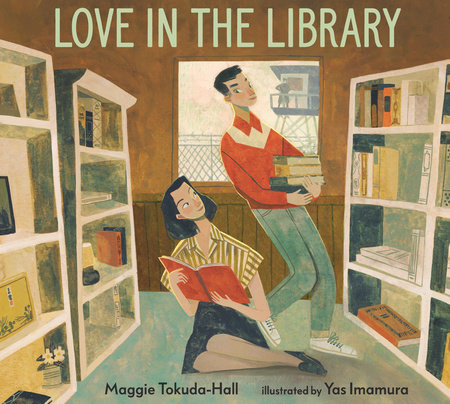
Love in the Library - by Maggie Tokuda-Hall


In her Author's Note Tokuda-Hall tells the readers that this is the story of her maternal grandparents who met in Minidoka, a Japanese incarceration camp in Idaho. Tama (her grandmother) was the camp librarian, although "she didn't know how to be a librarian...In the camps people did the jobs that needed doing." Her grandmother had taken the job because "she liked books". George (Tokuda-Hall's grandfather) came every day to check out books. Tama questioned whether he could actually be reading all the long books he checked out. No, he wasn't reading them all. He was "only human". And the realization that she was the real reason he came every day dawned on her. Their love grew amidst their  whispers. 

George's "voice was so big it barely fit in the library..." Tama "held up her finger to remind him of the rules. They were in a library, after all."  

The Author's note also connects the story of Minidoka to current events. 

As much as I would hope this would be a story of a distant past, it is not. It's very much the story of America here and now. The racism the put my grandparents into Minidoka is the same hate that keeps children in cages on our border. It's the myth of white supremacy that brought slavery to our past and allows the police to murder Black people in our present. It's the same fear that brings Muslim bans. It's the same contempt that creates voter suppression, medical apartheid, and food deserts. The same cruelty that carved reservations out of stolen, sovereign land, that paved the Trail of Tears. Hate is not a virus; it is an American tradition.

Tokuda-Hall's author's note sparked controversy when Scholastic asked her to edit it in order to include the work in Scholastic's diversity-focused Rising Voices collection earlier this year. Tokuda-Hall refused and Scholastic ultimately issued an apology. More information about the request, Tokuda-Hall's response, and a link to the apology can be found in this article from Publisher's Weekly  

Thursday, April 12, 2018

Educated - by Tara Westover


Raised and home-schooled by survivalist parents in the Idaho mountains Tara Westover rejected her family's admonishments not to go to college and enrolled in Brigham Young University (BYU) before she turned 18. Ultimately she becomes a Cambridge-educated PhD, but not without painfully examining her role in the family. Her father's conspiracy theories about universities and the Illuminati were made known to her long before she thought about going to college herself. Her mother had taken charge of her children's homeschooling, which mostly consisted of letting them learn what they wanted when they wanted, and included occasional trips to "the Carnegie library in the center of town".

Westover recognized that she was one of the least disciplined of her siblings when it came to "doing school" which gave her a lot of reason to doubt her abilities when she arrived at BYU. Her misgivings were magnified when she discovered that her classmates had an understanding of US culture and history that she did not share. Her realization that everyone else knew what the Holocaust was, for instance, caused her not only embarrassment, but also opened her eyes to the fact that her peers shared a collective knowledge that she was missing. She did not even know what she did not know.

If Westover had anxieties about her place at BYU they were only compounded when she arrived at Cambridge. Upon her arrival on campus she and her denizens were invited to take a tour of the chapel, including the roof. She describes the experience of watching her classmates, and her professor fight the wind on top of the building as they cling to the wall while she climbs higher. Finally explaining to her professor that "she'd roofed [her] share of hay sheds" and that
The wind is just wind. You could withstand these gusts on the ground, so you can withstand them in the air. There is no difference. Except the difference you make in your head...I'm just standing...You are all trying to compensate...You've made yourselves vulnerable. If you could just control your panic, this wind would be nothing.
Even this insight though, was accompanied by apprehension
I wanted the mind of a scholar, but it seemed that Dr. Kerry saw in me the mind of a roofer. The other students belonged in a library; I belonged on a crane.
Her ultimate success in earning her PhD demonstrates that she certainly did belong in a library, and the final third of the book (from the time she lands in Cambridge for the first time) is scattered with references to using it. This stands in stark contrast to the first 200 (plus) pages, where there is only one.