Showing posts with label Japan. Show all posts

Friday, June 21, 2024

What You Are Looking For is in the Library - by Michiko Aoyama


Five people, each at a crossroads in life, find their way to the Community Library, a place none of them had given much thought to before. Tomoka, Ryo, Natsumi, Hiroya, and Masao discover that reference librarian Sayuri Komachi will not only find the books that will answer your question, she also finds books to answer the question you didn't know you had. The mysterious librarian also gives a bonus gift in the form of a felted trinket to each of the seekers. The description of Ms. Komachi provides an interesting take on the old librarian stereotype, and one that demonstrates a larger than life perspective

The librarian is huge...I mean, like, really huge. But huge as in big, not fat...she is wearing a beige apron over an off-white, loose-knit cardigan...Her hair is twisted into a small tight bun right on top of her head, and she has a cool kanzashi hairpin spiked through her bun with three white flower tassels hanging from it.

Natsumi is a parent to a young child (Futaba). She works at a publishing house and before her daughter was born she was an editor for a magazine called Mila. However, when she returned to work following a short maternity leave she was placed in the information resources department where her job was 

to retrieve data for employees upon request, and seek various permissions when required...also [writing] company profiles for the website and other PR material for external use

While she does not identify herself as a librarian, those of us who do the work know what she is. 

I was particularly intrigued by this passage regarding Natsumi's work

In my Mila days, I used to have no reservations about reading at my desk, since anything could be a potential source of ideas. But in Information Resources I hesitated to do any general reading. Just in case my colleagues might think I was slacking off.

It is not unusual for people to make comments about how great a librarian's job must be with "nothing to do all day but read". You can be sure this comment will raise some serious ire, followed by an explanation about how librarians have ABSOLUTELY NO TIME TO READ as we are much too busy answering reference questions, ordering books, unjamming printers, supervising clerks, resolving database and computer problems, and a myriad of other things. Here is my truth: sometimes I was busy, and sometimes I wasn't. As a public services academic librarian I was usually pretty busy teaching classes, and helping people with research during about eight months of the year. During the summer months though I read - a lot! Much of what I was reading was professional literature, or things relevant to my research interests, but sometimes I was just reading for fun. There seems to be way too much concern that a person might have "down time" at work. In library work, no matter what your role, I would argue that reading is the best use of such time because as Natsumi says "anything could be a potential source of ideas." Generally being a well-read person helped me to answer more than a few reference questions. 

Ms. Komachi is often found busy working on her felting. When Masao finds her doing this he "sense[s] anger in her expression and she seems unapproachable." Masao had misread the expression. In fact Ms. Komachi was quite ready to help. The question of approachability has come up a lot during my tenure in public service. As I said, down time is not unusual and it is unreasonable to think that we would sit doing nothing. I was often doing research when I wasn't directly teaching, or helping someone, but that didn't mean I wasn't available. 

Hiroya is a young man who is not sure where he fits in. He is described as a NEET (not in employment, education, or training). He enjoys manga and hopes to be an artist. Ms. Komachi mentions that he seems to know a lot about manga. He responds that his uncle used to own a manga café "a coffee shop with heaps of manga...They don't have private rooms, just tables where you can sit and order a drink, then read from the manga library in the shop."

Ms. Komachi is not the only library employee of course. All the characters also get help from Nozomi, a library assistant who aspires to be a librarian. She explains to Hiroya that "if you take a  library assistant training course...then work for three years, you can qualify for the librarian training course...you can also go to university to study". Hiroya is impressed that "becoming a librarian is harder than [he] thought." This is another thing that is not well understood among the general population. In fact most people who work in libraries are not librarians. Those who are at the desk checking out books, or who reshelve returned books, or process them to be made available, or work to keep the library clean, or run the in-house coffee shops, are not librarians. In most cases, in order to get work as a "librarian" one needs to have completed a Master's degree in Information and Library Science (MILS). Although sometimes those without the degree have the title, the MLIS is the usual and accepted credential needed for professional librarian work.

Ultimately Ms. Komachi is a binding force between the characters, each other, and their community.

A story about making meaning and finding your place. I read this one aloud to my husband. We both enjoyed it. 


Thursday, March 21, 2024

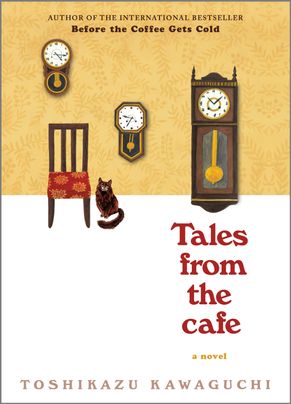
Tales from the Cafe - by Toshikazu Kawaguchi


During the early days of the pandemic James and I read Kawaguchi's book Before the Coffee Gets Cold which told of a coffee shop (Funiculi Funicula) that allowed customers to time travel, as long as they returned to the present "before the coffee gets cold". There were other quirky rules to follow as well, including where a would-be time traveler could sit - only in a seat otherwise occupied by a ghost. The ghost (aka the woman in the white dress) sits all day and reads, except for one daily trip to the toilet (why a ghost needs to use the bathroom is a question asked, but not answered). It is during this brief window each day that someone else might get a chance to time travel. I did not blog about this thoroughly enjoyable book when we read it because, alas, it had no libraries.

Tales from the Cafe has more stories from café Funiculi Funicula with this important change to the set up 

Until a couple of years ago, the woman in the dress read a novel entitled Lovers over and over again. One day, Miki remarked, "Doesn't she get bored reading the same novel?" and presented her own picture book to the woman in the dress.

This led coffee shop employee Kazu to the idea that she could provide new reading material to the woman in the dress with regular visits to the library. The woman in the dress accepted the fresh books, but without ever any acknowledgement of gratitude. Nevertheless Kazu continues to go the library once a week.

Both this book and Before the Coffee Gets Cold are episodic, with a unifying storyline.

A book about finding happiness. 

Thursday, November 13, 2014

My Year of Meats - by Ruth Ozeki


Jane is a documentary filmmaker who lives in New York City. Akiko is a housewife in Tokyo. Both are being abused by the same man: Joichi "John" Ueno who is Akiko's husband and Jane's boss. Jane is working with John on a television program for the Japanese market called My American Wife! which features a different wife preparing a different meat-based recipe each week. John insists that Jane only scout out "wholesome" white families, and insists that Akiko make each "recipe of the week". As Jane learns more about the beef industry (the sponsor of the show) she begins to subvert the message. The diverse families she showcases also provide Akiko with some new ideas for changing her own life.

The story takes place in 1991, a time before the internet, or e-mail. Communication was done by telephone or fax, and research was done at the library. Jane speaks of going to her hometown public library as a child to research her perfect mate. As the daughter of a Japanese mother and a white father she wanted to produce an offspring who "embodied the United Nations"
In my early teens when Polly and the the other girls were assembling ideal boyfriends from the body parts of teen movie idols and lead guitarists, I was conjuring a mate along very different lines. The way I figured it, I had the chance to make a baby who could one day be King of the World...I went to the Quam (Minnesota) Public Library and looked up "The Races of Men" in an old Frye's geography book
The passages she goes on to describe, written in 1902, are certainly racist by today's standards, which is one reason she feels justified in removing Frye's book from the same library when she returns as an adult.
Call it censorship, but on that trip home to visit Ma after the Bukowsky show, I stole Frye's Grammar School Geography from the public library. It was the least I could do for the children of Quam.
Ah, the rallying cry of the censor! 'I must protect others from this book from which I, myself, do not need protection. I have the knowledge and the critical thinking abilities to handle this work, but alas others do not.'

She continues with her other reason for taking the book
But to be perfectly honest, I wanted the book, and it's not the kind of thing you can easily pick up at a Barnes & Nobel superstore. It felt like antique pornography to me, with its musty old text, quaint etchings, and poisonous thoughts. From time to time I still pore over its stained chamois-soft pages, satisfying my documentarian's prurient interest in the primary sources of the past.
She has no concern for other researchers who might also want the book for the same reasons she does. My advice to those who question what a particular book is doing in a library is to ask a librarian about it.  It might be that the the horribly understaffed library has not been able to take on a "weeding" project to remove outdated materials, or that books are still available as primary sources for researchers. Perhaps a case could be made that Frye's work no longer belonged in the children's department, but that does not necessarily mean that it should be removed from the library entirely, perhaps it should simply be moved to the archives.

Grammar School Geography by Alexis Everett Frye is a real book. You can read the whole thing here.

This was a good read, with a lot of disturbing information about the beef industry, feedlots, and hormones. Ozeki skillfully weaves many different themes together, as well as several story lines.

Tuesday, February 25, 2014

Dear Miss Breed - by Joanne Oppenheim


The internment of Japanese-American citizens during World War II is a chapter of United States history that some would prefer to pretend never happened. I remember finding out about this injustice as an adult, and wondering why it wasn't taught in any of my American History classes in school, or my class on Constitution, Citizenship and Public Issues (CCPI) - a required course for all High School Seniors in Maryland during the 1980s. It is especially baffling to me because while I was taking CCPI there were actually Congressional Hearings about the internment going on at the time. How could it not have been worthy of a class discussion?

In 1942, after the Japanese invasion of Peal Harbor San Diego Public Children's Librarian Clara Breed discovered that many of her most enthusiastic patrons, American children of Japanese descent, were going to be sent to "relocation centers" with their families. She asked them to write to her, providing them with penny postcardsasking that they let her know where they were and how they were doing. From this she began a correspondence with many of the children. She also provided them with books, toys, supplies, and material for making clothes.

Clara Breed saved the letters that the children sent her. In 1993 they were donated to the Japanese American National Museum (you can read some of the letters here), and they are the basis of this book.

The children tell stories of the substandard conditions to which they were subjected (for some their first stop after being evacuated from their comfortable middle class homes was a refurbished horse stable - still smelling of urine). Surrounded by barbed wires and armed guards the camps were poorly heated, and poorly equipped, making for an especially difficult adjustment. Even so, the children's letters are hopeful, and demonstrate strong spirits.

Also included in this work are excerpts from opinion pieces from newspapers at the time. The bigotry is clear. It is also true that some things don't change, although today we are more likely to read such comments as anonymous posts and "tweets".

This work is evidence of librarians' long-time commitment to social justice. One former correspondent explained when he was interviewed for the book that as a "neglected child" Miss Breed introduced him "to the magical world of books". Clara Breed championed the rights of an especially vulnerable population at a time when it was especially un-popular to do so. In an article written for the Horn Book magazine in 1943, Breed tells the story of her young friends. It is interesting to note the stereotypes, albeit positive ones, evident in her article, as well as the language that many will find rather politically incorrect for the 21st century.

I was especially interested to see one of the children wrote to Miss Breed about how much she enjoyed "playing library" and discovering that another one grew up to work in a library.

Interestingly, as I was finishing this book I found out about Allegiance a new musical currently being produced in New York that tells the story of the Japanese-American internment camps.


Tuesday, August 16, 2011

How to Be an American Housewife - by Margaret Dilloway

This novel tells the story of mother and daughter - Shoko and Sue. Shoko survived the bombing of Nagasaki as a child, and eventually emigrates to the United States with her American-Sailor husband, Charlie. Sue is born and raised in the United States. In addition to negotiating the generation gap that all parents and children must, they have to figure out a way to bridge a culture gap as well. Shoko has the additional challenge of learning American customs, while she learns to love her new husband.

Libraries were featured a few times in this book. Most notably Shoko tells how she dreamed of becoming a diplomat and  "loved reading about different cultures". She found books at the library about "France, England, and Germany...[and] wanted to learn their languages."

Sue mentions her local public library as a feature in her neighborhood that is a "good place to raise a child". Indeed.

These are juxaposed with Shoko's wishing she had a book while waiting for some lab results: "Charlie and I weren't big readers. Books were too expensive and library books were full of germs from all the people who had checked them out." I was left to wonder what happened to the curious young woman with diplomatic aspirations who read all she could.