Showing posts with label dewey. Show all posts

Monday, May 5, 2025

Free for All: The Public Library (PBS: Independent Lens)

Featuring viewpoints from PEN America, The American Library Association, librarians, and library users this documentary film provides an historical perspective of libraries from Benjamin Franklin, Melville Dewey, and Andrew Carnegie to the present day culture wars that involve drag queens and a book banning crisis. In addition to many little known librarians throughout history the film gives insight into Arturo Shomburg who built a black history collection during the Harlem renaissance and to Ruth Brown who was fired during the McCarthy era for "harboring" subversive materials. Throughout, the film demonstrates the importance of libraries in all parts of the country (urban, rural, and suburban) as well as the tenacity of librarians in the face of tax cuts and calls to shut down libraries completely.

The documentary Free for All: The Public Library is available for free for all at pbs.org

Friday, December 17, 2021

Melvil Dewey - by Fremont Rider

December 10 was Dewey Decimal System Day  The date was chosen to coincide with the birthday of the system's namesake Melvil Dewey. In honor of this day I checked out a biography of Dewey from the library where I work (which does not use the Dewey Decimal System). I noticed that his birthday is mentioned several times throughout the work, starting with the first page, and including the fact that he was appointed to the New York Board of Regents on December 10, 1889 (this was included without highlighting the fact that it was also his birthday). 

The book, simply titled Melvil Dewey, was published in 1944, and mostly has praise for the man we now recognize as sexist, racist, and anti-Semitic. Although there is some mention in the work of these latter two identities they are downplayed. His clear bias toward Christianity can be found in the Dewey Decimal Classification system itself. The 200 range of the system is where books on Religion are found. Christianity is covered in the range of 220-280, and "other religions" are relegated to only the 290s.  

His sexism is disguised in the book with passages such as this one: 

All through his life, women were more congenial intimates with him than men; he was more at ease with them; he worked more to more purpose with them; he played with them with greater zest. 

While he did admit women to the Columbia University, essentially forcing the University into co-education, when he started the Library School, we now know that his reasons were less than altruistic. While he believed that well-educated women would make jim-dandy librarians he also left a legacy of low pay as women "were also more likely to get sick or leave the profession to pursue 'home life'". Furthermore, male librarians deserved more pay than women because they "could also lift a heavy case, or climb a ladder....There are many used for which a stout corduroy is really worth more than the finest silk." (See the link at the end of the post for more information on this.)

About 20 years ago the then-president (a man) of my university actually told the librarians (all of whom at the time were women) at a meeting to discuss salaries that we knew when we went into a female-dominated profession that we would make less money - that it was "societal". And that, after all, he couldn't be expected to solve this "societal problem". Why he couldn't try to solve it on our campus is another question. That president's sexist legacy lives on here as well. Librarians continue to work a twelve-month contact for less money than our faculty colleagues who work a ten-month contract. 

Melvil Dewey was also obsessed with simplifying things, especially spelling. He learned and taught shorthand, and changed the spelling of his first name from Melville to Melvil. As well, he attempted to shorten his last name to "Dui". 

An example of his writing included in the work reads

In skool in Adams Center I rebeld agenst compound numbers. I told the teacher that jeometri taut us a strait lyn was the shortest distance between 2 points & that it was absurd to hav long mezur, surveyor's mezur & cloth mesur; also absurd to hav quarts & bushels of difernt syzes & to hav avoirdupois, troy & apothecari weits, with a pound of feathers hevier than a pound of gold. I spred out on my attik room table sheets of foolscap & desyded that the world needed just 1 mezur for length, 1 for capasiti & 1 for weit, & that they should all be in simpl decimals lyk our muni.

He very much liked the metric system and advocated for the United States to adopt it. I remember when I was in Junior High in the mid 70s that we had to learn the metric system in math class because it was coming to the United States, and soon! President Gerald Ford and after him President Jimmy Carter were going to make it happen. Then Ronald Reagan was elected and just like that people stopped talking about the metric system and we are left only in the company of Liberia and Myanmar as the only countries not to have adopted the metric system as the standard system of measure.

While we cannot deny the legacy Dewey has left on the library profession, we are also experiencing a reckoning of the damage his legacy has left. Two years ago the American Library Association changed the name of the Melvil Dewey Medal to the ALA Medal of Excellence. More about Dewey's sexism and racism can be found in this article from Slate.com. 

Monday, December 17, 2018

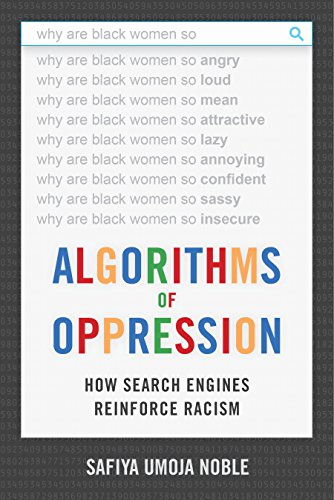
Algorithms of Oppression - by Safiya Umoja Noble


In the aftermath of Hurricane Katrina (one of the most devastating natural disasters of the 21st century) my husband learned an important lesson about doing Google image searches in front of a class. Typing in "Katrina" into the search box he (and the class) were bombarded with pictures of buxom women. This was literally just days after the hurricane struck and news of horrific flooding and drownings were still the top news stories of the day. Noble explains that similar results are returned when one types in the words "black girls".

However much we might want to believe that machines will provide neutral results, the fact remains that algorithms are written by people (mostly young, white men) who wittingly or not, program in their own biases.

My own research on Google and heuristics demonstrates exactly what conventional wisdom tells us: that people are more likely to click on links that appear at the top of a search result list. If people don't see what they want they assume it isn't there. It is very unlikely that someone will look beyond the first screen of results.

This is not only a problem in Google, but in library databases as well. Providing the example of searching the term "black history" in the ARTstor database the author shows a result page full of European and White American artists.

There was a lot to say about libraries and librarians in this work. In some places there is praise for our work, and recognition of our value. In others the author offers fair criticism and suggestions about where we can do some reflection and reparation where outdated language and systems are used.

A few years ago, I gave a presentation in which I compared librarians to colonizers. By creating an ambiguous and arbitrary system of organization and classification, and putting ourselves in charge of it, and, furthermore placing those on the margins in a position that requires them to come to us for assistance we are regulating knowledge, and determining who gets a piece of it. Noble goes even further explaining how the Dewey Decimal System itself, along with the standardized subject headings, were created so as to oppress. Citing the work of Hope A. Olsen from the the School of Information Studies at the University or Wisconsin, Milwaukee Noble explains that

Those who have the power to design systems - classification or technical - hold the ability to prioritize hierarchical schemes that privilege certain types of information over others. 

As recently as 2016 the term "Illegal Alien" was being used as a Library of Congress Subject Heading (LCSH). Students at the Dartmouth College were successful in their bid to have the term removed. The headings "Noncitizen" and "Unauthorized Immigration" are now used. The move was not without controversy and included a threat to the funding of the Library of Congress in the form of  HR 4926 "Stopping Partisan Policy at the Library of Congress Act". Librarians have recognized our own use of outdated and offensive language before, replacing the heading "Jewish question" with "Jews" and "Yellow Peril" with "Asian Americans".

Privilege and bias are also evident in the Dewey Decimal Classification system. For instance over 80% of the 200 range  numbers is used for Christian religions although only about a third of people worldwide identify as Christians.

Librarians, however, also can be credited for discovering and resolving some of these problems. I was reminded of this article, recently shared with me: Remembering the Howard University Librarian who Decolonized the Way Books were Catalogued".  It is important to note that the librarian was a woman of color, highlighting the necessity of a diverse population when designing and creating systems.

In her conclusion Noble envisions a new type of search engine, one in which
...all of our results were delivered in  a visual rainbow of color that symbolized a controlled set of categories such that everything on the screen that was red was pornographic, everything that was green was business or commerce related, everything in orange was entertainment, and so forth. In this kind of scenario, we could see the entire indexable web and click on the colors we are interested in and go deeply into the shades we want to see...In my own imagination and in a project I am attempting to build, access to information on the web could be designed akin to the color-picker tool or some other highly transparent interface, so that users could find nuanced shades of information and easily identify borderlands between news and entertainment, or entertainment and pornography, or journalism and academic scholarship.
This is indeed an ambitious project, and I would add that all caveats for design would apply. Such an undertaking would need a large, diverse group of people to categorize. As well I would be cautious about cutting into the autonomy of the users. What is pornography to some is art to others. Letting an algorithm decide what is scholarship and what is journalism can also be problematic. Some scholarship isn't really scholarship, and some journalism isn't really journalism. No matter what search engine is used everyone should use deliberation and do their due diligence in making selections about sources.

On the final page Noble reminds us that
Now more than ever we need libraries, universities, schools, and information resources that will help bolster and further expand democracy for all, rather than shrink the landscape of participation along racial, religious, and gendered lines.

Monday, December 16, 2013

Dewey's Christmas at the Library - by Vicki Myron and Bret Witter


I first blogged about Dewey the Library Cat three years ago during my year of "Celebrating the States" during which I celebrated the anniversary of each state with a movie, a book, and an appropriate food item. For my Iowa book I read Vicki Myron's Dewey: The Library Cat, a book for middle-grade readers about a real cat who was left in a book drop at the public library in Spencer, Iowa. Dewey Readmore Books was subsequently adopted by the whole town. This book was based on the orginal "Dewey" book: Dewey: The Small Town Library Cat who Touched the World. There are several children's picture books about the Library Cat, including Dewey's Christmas in the Library, which I was able to download on my iPad for a mere $2.99. I am a sucker for Christmas stories, and this one was extra special to me, being about a library after all. This story tells about Dewey's first Christmas and how he helped to decorate the library's award-winning Christmas tree. A sweet story based on Dewey's real life adventures.


Friday, January 4, 2013

Quiet, Please: Dispatches from a Public Librarian - by Scott Douglas


Like Anne Miketa'a Library Diaries, Douglas' book is a series of essays about his work, co-workers, and the patrons at the public library where he is employed. Unlike Miketa's book, this one is funny and well-written. Rather than simply making fun of people and insulting them, Douglas reflects on what he learns from them, and how they help him grow, both professionally, and personally.

I probably could comment on something he says on just about every page, but in the interest of not making this the longest blog post ever, I make particular note of my favorite library topics:

On stereotypes
The Librarians who interviewed him for his first professional job "were distinctively librarian - large framed glasses, granny hairdos, and uptight frowns". This sentence refers the reader to one of Douglas's many footnotes which reads "the stereotypes about librarians are largely true." Sadly, I must concur. He goes on with these descriptions:

And,
"You say library (emphasis in original) and there's this iconoclastic image of an old-lady librarian telling people to be quiet and not to run." To be fair here, Douglas goes on to say how important "that iconoclastic lady" is to the library.

And,
'The librarian was the typical stereotypical librarian-ugly clunky glasses, hair in a tight bun, and clothing that could just as easily have been put on a man. She looked irritated when I asked her where I could plug in my laptop..."

He doesn't, however, cast any aspersions about himself being hip, even as a non-stereotypical young, straight, male librarian:
"I wasn't cool. I was a librarian, and not being cool was as cool as I'd ever get."

On critical thinking
As a university librarian I am often frustrated by the fact that we are supposed to teach students to be critical thinkers, but it seems we are not supposed to do it (think critically) ourselves. Administrators seem to just want us to do what we are told. Douglas makes a similar point when discussing his frustration with his courses in library school
I didn't think the school needed to get political and have faculty implement viewpoints, but I thought it was important to study the way media, both online and on TV, had radically changed the way people sought information. How can librarians teach others to think critically and objectively when they themselves are not doing it?
On censorship
The library banned MySpace.com when it became a nuisance.
It didn't take long for things to get out of hand....Teens started stealing library cards so they could get extra time [on the computer]; adults would constantly argue about why they deserved more hours; and even little fourth graders were asking older kids for advice on how to 'pimp out' their MySpace page....Ultimately, MySpace was blocked because it was slowing down the network. This wasn't the real reason. The real reason was because it was making all the librarians mad. Actually, the straw that broke the camel's back was when a manager saw a teen posting a photo of girl's nipple piercing [sic] to his page.
Popular online role playing games would meet a similar fate. When a "middle-aged mother of three kids" started spending all her time in the library playing a video game Douglas was told to
Find out what this game is and make...a list of why we should ban it. I want to get rid of that lady. If all she is doing is playing a video game then she doesn't need to be in the library
Once the website was blocked the woman stopped coming to the library, so did her children, who often came to the library to read books.

When Douglas got fed up with teens acting up in the library while he was "in charge" he banned them from using the internet unless they were doing homework. When a page points out to him that that's censorship, Douglas replies "there's a big difference between censorship and punishment". I often say that when someone says what they are doing is not censorship, you can be sure that it's censorship. I have to say that the burnt-out page saved the day on this one. He texted the library manager, who was on vacation, and tattled on Douglas, who was admonished by his manager to let the teens back on to the computers.

Last month when I blogged about The Librarian's Book of Quotes I noted the commentary I found most "thought provoking"

I have never met a public librarian who approved of
censorship or one who failed to practice it in some
measure.
--Leon Carnovsky, Library Quarterly 20 (1950)

Here, we see this in action.

On gender
When I was in library school, one of my assignments was to write about five famous librarians throughout history. I was very frustrated with the assignment, as I was determined to write only about women in this female-dominated profession, and as I was studying the early days of librarianship, I had to dig pretty deep to find someone who was not a man to write about. (Ultimately, I did succeed in my quest). Famous librarians that Douglas mentions about are:
Melvil Dewey (whom he does recognize as a "hater of women" as well as an "elitist racist dick")
John Cotton Dana
John J. Beckley
Charles Ammi Cutter

Famous women librarians are remarkably hard to find. Consider, for instance, the first hit I got when I "googled" "famous librarians". On this list of Top Twenty Five Most Famous Librarians in History, only seven are women.

I was particularly intrigued by this commentary about women in library history:
"One thing male librarians rejoiced at was the fact that they could save money by hiring women; at the time, [when children were finally allowed into libraries] women who did the same job as men at the library earned less."

"At the time"?! Give me a break! This is still true today. See the Library Journal Salary Survey.

And an interesting thing I learned from Douglas is that John Newberry's (for whom the Newberry Award is named) A Little Pretty Pocket Book is credited as being the first book in the genre of children's literature. I was surprised to learn that the book was actually marketed "with a ball for boys or a pincushion for girls". I recently read this article which looks at the gendering of toys in the 20th century. It seems we have come full circle.

And finally:
I added An Extremely Goofy Movie to my list of must-watch library movies based on Douglas's recommendation.

More on Scott Douglas at http://www.scottdouglas.org/index.htm


Tuesday, December 4, 2012

Librarian's Book of Quotes - edited by Tatyana Ekstrand

I recently became the owner of an iPad, and found this book while browsing my library's e-book collection in the hopes to teaching myself how to download them. I failed at the download, but was able to read this online. It was a quick read, but apparently I read it too fast because I was prompted twice to enter one of those codes to prove I was not a robot. My reading was interrupted by a message that the way I was reading was inconsistent with a human reader. What? Turning the pages one by one? I find it especially annoying, ironic, and rather post-modern, that I to had to prove to a machine that I was not a robot. Anyway, I finished the book despite this inconvenience. The book is not much more that what the title says it is. It is just over 100 pages of library-positive quotes from well-known celebrities, authors, United States presidents and first ladies, and some folks who are not so well known, or perhaps only well-known in library circles (e.g. Nancy Pearl "the librarian's librarian"; and Herbert S. White, Professor Emeritus of Library Science).

There were a lot of great quotes here. I added one to my Banned Books Week Guide. I've commented on some of my other favorites below.
--------------------------------------------------------------------------------------
News flash! When your teachers told you there was no such thing as a stupid question, they were lying. Garrison Keillor knows this, and recognizes librarians for putting up with it. He says:

Librarians . . . possess a vast store of politeness. These are
people who get asked regularly the dumbest questions
on God’s green earth. These people tolerate every kind of
crank and eccentric and mouth-breather there is.
--Garrison Keillor, A Prairie Home Companion,
13 December 1997
--------------------------------------------------------------------------------------
GraceAnne DeCandido expresses something that I find especially exhilarating about my job. A lot of our work is serendipity; we just never know when something we've learned will be useful to someone else.

One of the great joys of being a librarian is that it is the last
refuge of the renaissance person—everything you have ever
read or learned or picked up is likely to come in handy.
--GraceAnne A. DeCandido,
“Ten Graces For New Librarians”
--------------------------------------------------------------------------------------
Isn't seeing our name in print what we all hope for?

I always tell people that I became a writer not
because I went to school but because my mother took
me to the library. I wanted to become a writer so I
could see my name in the card catalog.
--Sandra Cisneros
----------------------------------------------------------------------------------
There were quotes from four different presidents, but I thought this one from First Lady Lady Bird Johnson, outshone all of those.

Perhaps no place in any community is so totally
democratic as the town library. The only entrance
requirement is interest.
--Lady Bird Johnson
--------------------------------------------------------------------------------------
Melvil Dewey did more than invent a decimal system for classifying books; he was also founder of the first Library School in the United States. His quote, which exalts women, belies that fact he wanted to populate his school with them because he knew they wouldn't be paid much. His legacy lives on today.

To my thinking, a great librarian
must have a clear head, a strong
hand, and above all, a great heart
. . . and i am inclined to think that
most of the men who achieve this
greatness will be women.
--Melvil Dewey, Library Journal, January 1899
------------------------------------------------------------------------------------
This was the only quote from an athlete I recognized.

I’m not comfortable being preachy, but more people need
to start spending as much time in the library as they do on
the basketball court.
--Kareem Abdul-Jabbar
-----------------------------------------------------------------------------------
This one, from a person I have not heard of, was the most thought-provoking

I have never met a public librarian who approved of
censorship or one who failed to practice it in some
measure.
--Leon Carnovsky, Library Quarterly 20 (1950)
-----------------------------------------------------------------------------------
For those who cannot afford to travel, the library card is more important than the passport.

The three most important documents a free society gives
are a birth certificate, a passport, and a library card.
--E. L. Doctorow, New York Times, 27 March 1994
---------------------------------------------------------------------------------
The book's editor ended with a few of her own quotes, this one made me smile.

Catalogers are some of the few
professionals who take pride in being anal.
--Tatyana Eckstrand
--------------------------------------------------------------------------------
One observation I made reading this was that however much librarianship is a female-dominated profession  (over 80% of librarians are women), the quotes in this work were, by and large, from men. At first I thought is was my imagination, but all sources were listed at the end of the book, so I counted them up. This was a count simply based on first names, so although it might not be completely accurate, even taking into account some guessing errors, the proportion of men to women represented is over three to one. I am not sure what to make of this. Do men really say more pithy things than women? Or, is it simply that, as a society, we still pay more attention to them. I remember doing some research in my own library school days, and reading about a librarian from the early 20th-century who pointed out that in her day, if they wanted to see anything accomplished, women just had to let men take the credit for everything. I frankly don't think we've come very far in the last 100 years.

Sunday, May 8, 2011

On this Day in Library History

Dewey Proposes Library Classification System

Click the picture for the full story. I did notice that the short article downplays Dewey's sexism - simply saying  [h]e founded the first "School of Library Economy" at Columbia University and helped ensure the "feminization" of the new profession by admitting women to its first class." Really he admitted women so that he could create a workforce of educated people whom he did not believe would need to be paid much. Unfortunately his legacy continues.