Showing posts with label Nazis. Show all posts

Friday, February 3, 2023

The Librarian of Auschwitz - by Antonio Iturbe

People like to share memes with me about book collecting and book hoarding. These are meant to be humorous, but I generally don't find them especially funny. I do have quite a few books in my house, but I do not let them take over. I often read books from the library and then return them, or when I buy them I have a "one in, one out" policy. Purged books go to free book shelves, or are donated to libraries. They are shared. Books are meant to be read and shared, not simply put on display. I thought a lot about all of this as I read The Librarian of Auschwitz. This novel is based on the real story of Dita Kraus who, along with her family was sent to the family camp at Auschwitz-Birknenau during the Holocaust. Although she was only 14 years old Dita was asked to be the clandestine librarian at the clandestine school run by fellow prisoner Fredy Hirsch. She took on the task although the punishment for keeping the books would surely have been death had she been discovered. The eight tattered books entrusted to Dita's care were shared among the classes at the school, and otherwise hidden beneath a floor board. All the books had value, even the Russian grammar book, written in Cyrillic which no one in the camp read.

Early in the book the forbidden works are described as dangerous although they do not have "a sharp point, a blade or heavy end". 

Throughout history all dictators, tyrants, and oppressors, whatever their ideology - whether Aryan, black, oriental, Arab, Slav or any other racial background; whether defenders of popular revolutions, or the privileges of upper classes, or God's mandate, or martial law - have had one thing in common: the vicious persecution of books. Books are extremely dangerous; they make people think.

Even among the prisoners there was concern about what was to be found in some of the books. Fredy Hirsch tried to warn Dita off reading The Good Soldier Svejk, telling her that it was "not appropriate for children, especially girls". To which our heroine responds "Do you honestly believe that after observing on a daily basis the dozens of people entering the gas chambers...[that] what I read in a novel might shock me?". The same book is demonized by some other prisoners, and again Dita puts them in their place.

Reading this in light of the unprecedented book-banning that we are seeing in the United States today makes it especially chilling. Concerns about what someone might find in a book seem rather ridiculous in a country where children are gunned down in their classrooms and by police. 

In addition to the eight books, the school also runs a "library on legs". Similar to the human books in Ray Bradbury's Fahrenheit 451, people who have memorized stories share them verbally.

Before being sent to the Auschwitz Dita and her family were first sent to the ghetto in Terezín, a place with a library-on-wheels, a trolley pushed through the streets which was generally "warmly welcomed" although the "books were often stolen, and not always so they could be read. They were also used as toilet paper or as fuel for the stoves".

One of the books entrusted to Dita is H.G. Wells The Time Machine. Dita determines that Wells was right, time machines do exist, in the form of books. Furthermore, she realizes that books can take us "much farther than any pair of shoes".

Wednesday, September 15, 2021

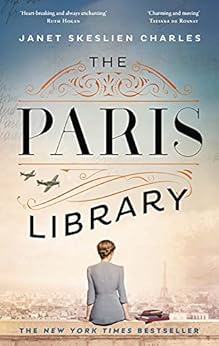
The Paris Library - by Janet Skeslien Charles


Numbers floated round my head like stars. 823. The numbers were the key to new life. 822. Constellations of hope. 841. In my bedroom late at night, in the morning on the way to get croissants, series after series - 810,840,890-formed in front of my eyes. They represented freedom, the future.
So begins the story of Odile Souchet who thinks in Dewey Decimal numbers. She is thrilled to get a job at the American Library in Paris in 1939 where she can put both her library degree and her ability to speak English to good use. She has always loved books and the library, a place she frequented with her aunt as a child.  

Her job becomes a lot more challenging when Nazi's occupy her beloved "city of readers". The subversive librarians (including the aptly named Miss Reeder) find ways to continue to provide books and services to their Jewish patrons, even after the library is closed to them. Nazi's also looted libraries as well as the private collection of "prominent Jewish families" Additionally, censors regularly blacked out news from the daily papers making the sharing of knowledge that much more difficult. "Fake news" in the form of rumors also shakes up the library as a "sanctuary of facts" as patrons share misinformation with each other. 

Shushing is of course a time-honored tradition in libraries (at least as far as popular culture is concerned). While I will admit to having shushed a few exceptionally loud library users (usually university administrators) I have also, ironically, been shushed myself by people trying to study in the library, just as librarian Odile was shushed when she "screamed with joy" after returning to the library after 10 days of being away and seeing her brother's girlfriend Bitsi (who was also the children's librarian). In one passage Bitsi is described as "holding an open book over her head, like it's a roof" as if she is telling "the children that books are a sanctuary".

The story oscillates between Paris during World War II and Froid, Montana in the 1980s. Virtually all of the passages I marked while reading this are in the sections that take place in France. The only exception comes very late in the book. Lily, Odile's young neighbor storms "Dad's wife took away Forever!...She said Judy Blume writes 'smut'.' Censorship is wrong!" To which Odile responds "So is throwing a fit instead of sitting down to have a conversation...You should ask Ellie what she fears." She goes on to explain that "Ellie's scared the book will put ideas in your head, scared you'll want to experiment with sex." Lily retorts "I read Out of Africa and disn't establish a coffee plantation in Kenya!" I of course agree that censorship is wrong. I also agree that having a conversation is better than throwing a fit.

Tuesday, January 5, 2016

All the Light We Cannot See- by Anthony Doerr


In the summer of 1984 I spent a month studying Spanish in Salamanca, Spain. My cousin Lori came at the end of the month to travel with me for a few weeks. She suggested that we take the train to Saint-Malo, France and spend some time on the beach. I was enchanted with the old buildings, and the extreme tides which could strand a person in one of the old ruins for an entire day if you weren't paying attention. I don't think I learned anything of the history of the place at the time though. Reading Doerr's book I felt like I was walking through a dreamscape-something familiar but that didn't seem quite right. It was strange trying to justify my fun vacation 32 years ago with learning about the Nazi occupation. I dreamt about Saint-Malo twice while I was reading this book. I don't remember ever having dreamt about it before.

The story is of Marie-Laure, a blind French girl who loves mollusks; and Werner, an orphaned German boy who is a whiz at learning how things work. Werner is curious and clever to the point that the Nazis recognize his abilities in technology. He is recruited for training with the regime - his supremely Aryan looks an additional asset. Marie-Laure is likewise clever and her father does not allow her to let her blindness handicap her. He insists that she learn to read Braille, teaches her how to solve puzzles and builds scale models of their neighborhood in Paris, and another one when they flee to Saint-Malo (to live with Marie-Laure's great uncle) so that she will be able to navigate the streets on her own. The chapters alternate between Werner's and Marie-Laure's two stories until near the end when Werner and his crew arrive in Saint Malo looking for illegal radio transmitters and the two lives converge.

This book was recommended by a friend, not because it was an especially library-centric book, but rather because it is just such a good book. However, it wouldn't be included here if it didn't have at least some library references. There were, in fact, about a dozen or so.

Marie-Laure's father works at the Museum of Natural History in Paris where he distributes keys to other employees "zookeepers...office staff...technicians and librarians and scientific assistants..."

Of course, the library is included in the scale model of Saint-Malo he builds as well. The library in Saint-Malo is a place where Marie-Laure also has a few meetings with others. And ultimately, we learn of the the burning of Saint-Malo (and its library) on August 8, 1944
Flames scamper up walls. Parked automobiles catch fire, as do curtains and lampshades and sofas and mattresses and most of the twenty thousand volumes in the public library. The fires pool and strut; they flow up the sides of the ramparts likes tides; the splash into alleys, over rooftops, through a carpark. Smoke chases dusk; ash chases smoke. A newsstand floats, burning.
One Nazi uses the geological library in Vienna to do some research on precious stones. He is assisted by a "mousy librarian" and "an underweight secretary wearing brown shoes, brown stockings, a brown skirt, and a brown blouse." The Nazi soldier is researching precious objects for the "führer" who, rumor has it, "intends to remake the Austrian town of Linz into an empyrean city, the cultural capital of the world. A vast promenade, mausoleum, acropolis, planetarium, library, opera house..."

The library as metaphor is used twice in this work. As the city of Saint-Malo empties of its inhabitants it is described, rather desolately, as a "library of books in an unknown language, the houses great shelves of illegible volumes, the lamps all extinguished."

And finally Marie-Laure, many years later, images that the air itself is a library, not only with "images of electromagnetic waves...torrents  of text conversations, tides of cell conversations, of television programs, of e-mail...commercials for Carrefour and Evian prebaked toaster pastries..." but also "that souls might also travel those paths...might harry the sky in flocks, like egrets, like terns, like starlings...a record of every life lived, every sentence spoken, every word transmitted still reverberating within it."


One final note:
This story reminded me of listening to Michel Chikwanine. His story of being a child soldier in the Democratic Republic of Congo was tragically reminiscent of Werner's story. Child soldiers are still being recruited today. Human Rights Watch has more information.


Monday, April 7, 2014

The Book Thief - by Markus Zusak


There is some irony in the fact that my library's copy of The Book Thief has been overdue since December. I strongly suspect it is not coming back - at least not any time soon. I had put myself on the waiting list for the book before Christmas, but after the book failed to be returned in any kind of a timely fashion, I got a message that my "hold" request had expired. I ended up buying a copy for my iPad, which turned out to be pretty cheap. I think it was under $5.

It is, of course, right and good to read a book before you see the movie upon which it is based. The Book Thief movie came out in theaters in November, but I did not see it, having not yet read the novel. The movie will be released on Netflix tomorrow, which I do look forward to seeing, now that I have done my due diligence.

This is the story of a girl named Liesel. Liesel lives in Germany, under the Nazi regime, with her foster parents and a Jew (Max) who lives under the basement staircase. Liesel is the eponymous "book thief". Her first theft being almost an accident, the rest were rather deliberate. Her second theft came during one of the Nazi book burnings
The Germans loved to burn things. Shops, synagogues, Reichstags, houses, personal items, slain people, and of course books. They enjoyed a good book burning, all right - which gave people who were partial to books the opportunity to get their hands on certain publications that they otherwise wouldn't have. 
Most of the rest of the thefts are from the personal library of the mayor's wife, Ilsa Hermann. But once the Frau Hermann figured out what was happening, she played along by leaving books out, and making it easy for Liesel to enter her home to browse the shelves.

The importance of books to Liesel is evident to all. Her foster father, "Papa", teaches her to read and write and then, knowing how much the printed word means to his young charge threatens to burn all her books if she tells the family secret - the one literally hidden away in the basement. Max knows how much the books means to her when he writes a book for her using pages from Mein Kampf that he paints over to make fresh writing surfaces.

The books Liesel steals become not only her salvation, but the salvation of others as well. When those in her neighborhood were sent to bomb shelters with only their most important possessions in tow, Liesel took a book, and read to everyone.
For at least twenty minutes, she handed out the story. The youngest kids were soothed by her voice, and everyone else saw visions of the whistler running from the crime scene. Liesel did not. The book thief saw only the mechanics of the words - their bodies stranded on the paper, beaten down for her to walk on. Somewhere, too, in the gaps between a period and the next capital letter, there was also Max. She remembered reading to him when he was sick. Is he in the basement? she wondered. Or is he stealing a glimpse of the sky again.
SPOILER ALERT

Ultimately, it is a book that literally saves Liesel's life. Hidden in the basement, where Max once stayed, she is reading the book he left for her when her town is leveled.

Only one person survived.
She survived because she was sitting in a basement reading through the story of her own life, checking for mistakes...The shells of wreckage cantered down, and hours later, when the strange, unkempt silence settled itself on Molching, the local LSE  could hear something. An echo. Down there, somewhere, a girl was hammering a paint can with a pencil...
She was still clutching the book.
She was holding desperately on to the words who had saved her life.
I notice upon a second reading of this passage that the author chose the word "who" rather than "which" in this last sentence, giving an anthropomorphic quality to the book. It was the book "who" saved her, as much as the soldiers who removed the rock to release her.


Wednesday, November 6, 2013

The Reader - the movie


An enigmatic woman, Hanna Smitz (played by Kate Winslet) helps a teenage boy, Michael Berg (David Kross) return to his home after he falls ill and the two begin an affair. Set in 1950s Germany the Hanna insists that  Michael read to her each time they meet, before they make love. Eventually she disappears from his life and the next time Michael sees Hanna she is a defendant at a Nazi war crimes trial. Hanna is sentenced and adult Michael (played by Ralph Fiennes) continues to read to her by way of recorded cassette tapes sent to her in prison.

There is one scene in the prison library in which Hanna asks for one of the books she has been listening to.

Tuesday, July 31, 2012

Fear of Flying - by Erica Jong


Because reading 50 Shades of Grey just seemed too trite, I decided to read Jong's classic piece of erotic fiction instead. This is the story of Isadora, torn between her husband Bennett, and her lover Adrian she reflects on her life, loves, and lusts. As a writer Isadora does quite a bit of research and tells of researching the history of the Third Reich at the USIS (United States Information Service Libraries) while her husband was stationed in Germany. After getting a job writing a column for a newsletter Isadora begins doing some research about a Nazi amphitheater she discovers in Heidelberg. In Heidelberg's main public library she finds a guidebook dated 1937 in "English and German on facing pages, with cheap, yellowing paper, black and white photographs and old Gothic type." Most intriguing about this work was that "every ten pages or so a paragraph or photo or a small block of type was covered over with a square of oak-tag. Like any good researcher worth her salt Isadora is determined to find out what is under those tags. "I checked out the book (along with four others so the librarian wouldn't be suspicious) and raced home where I carefully steamed the offending pages over a tea-kettle spout." (Normally, I would be bound by librarian ethics to point out that this would likely cause damage to a book, but censoring is way worse than making the pages a bit wavy, so in this case the ends justify the means).Once Isadora removes the offending tags she finds photographs with swastika flags, and of Nazi salutes and passages that give evidence of the German exceptional-ism of the time. In discussing the censorship with a former Nazi, Isadora begins to question her own honesty in writing, and realizes that she is self censoring her own true feelings.
I refused to let myself write about what really moved me: my violent feelings about Germany, the unhappiness in my marriage, my sexual fantasies, my childhood, by [sic] negative feelings about my parents...I had pasted square oak-tag patches over certain areas of my life and steadfastly refused to look at them.  
The book is the metaphorical removal of Isadora's oak tags as she explores all of the things she describes in the passage above. It is an intellectual exploration as well as a sexual one - and she does explore sex in the library. Isadora tells of flirtations in the Butler Library at Columbia University, as well as describing how she "studied together" (the quotes were in the original) with the man who became her first husband in the Butler Library "where [she] was later shocked to hear that some sacrilegious students actually screwed."

The Butler library was ultimately where Isadora went to escape her first marriage as she "sweated in the stacks...writing a ridiculous thesis on dirty words in English poetry."

And I thought I was going to have a "first" for this blog - a library dream. In the penultimate chapter of the book Isdoara describes a dream in which she is graduating from college. She walks up a flight of stairs "which looked more like a Mexican temple than the steps of Low Library."  But in doing a bit of research, I discovered that the Low Library at Columbia is no longer a library (and was not at the time the book was written). It is now the administration building.

As is true with much erotic literature (most recently with 50 Shades) Fear of Flying has been banned, and censored. See this entry from "The Field Guide to Forbidden Books" blog for more details.