Showing posts with label education. Show all posts

Monday, October 5, 2026

On Book Banning - by Ira Wells

Whenever I talk about book banning I make clear that the current crisis is driven by the religious right who are requesting the removal of thousands of books from schools and libraries (and have lately taken to targeting booksellers as well). I also make clear that they are not the only ones who are looking to censor what we can read. Book challenges come from both the left and the right, feminists and misogynists, people of a variety of religious backgrounds, politicians, and even from librarians. Ira Wells recognizes this and does not shy away from discussing this full range of restrictions and its consequences.

Wells begins by describing a "library audit" conducted at his children's (Ontario, Canada) elementary school. 

...the principal...told a group of parents...that she wished she could get rid of "all the old books". The bulk of the library's holdings were, from her perspective, to Eurocentric, too male, too heteronormative.

By "old books" the principal meant any book over 15 years old, regardless of its other qualities. This would necessarily include a lot of children's classic works, as well as plenty of works by LGBTQ authors and BIPOC authors.

He makes fair comparison between the Mom's for Liberty crowd in Florida and the Ontario progressives each with their own agenda for "child safety". Each group has identified categories of books that they believe should go. While the religious right wants all books with LGBTQ themes removed, the Canadian progressives would like to see books that are not "woke" enough removed.

Greater sensitivity to racially charged language and imagery has resulted in school library challenges to The Adventures of Huckleberry Finn, Of Mice and Men, and several titles by Dr. Seuss. After some school districts banned from classrooms all books by non-Black authors that contain the N-word, novels like Lord of the Flies and To Kill a Mockingbird went from being mandatory to unteachable.

Predictably both groups of would be banners identify the works they'd like removed as "potential sources of student 'harm'". 

Also, predictably, the principal of Wells' children's school insisted that she was not banning any books, but rather simply "weeding" the collection.

...but this is a misrepresentation of library protocol: As the American Library Association states, "While weeding is essential to the collection development process, it should not be used as a deselection tool for controversial materials."  

Wells work also explores the history of book banning through a lens of religion as well as the history of libraries and the freedom of speech, current trends in monitoring speech including "soft censorship" which happens when titles are excluded from publication or purchase in order to avoid challenges. 

Monday, September 23, 2024

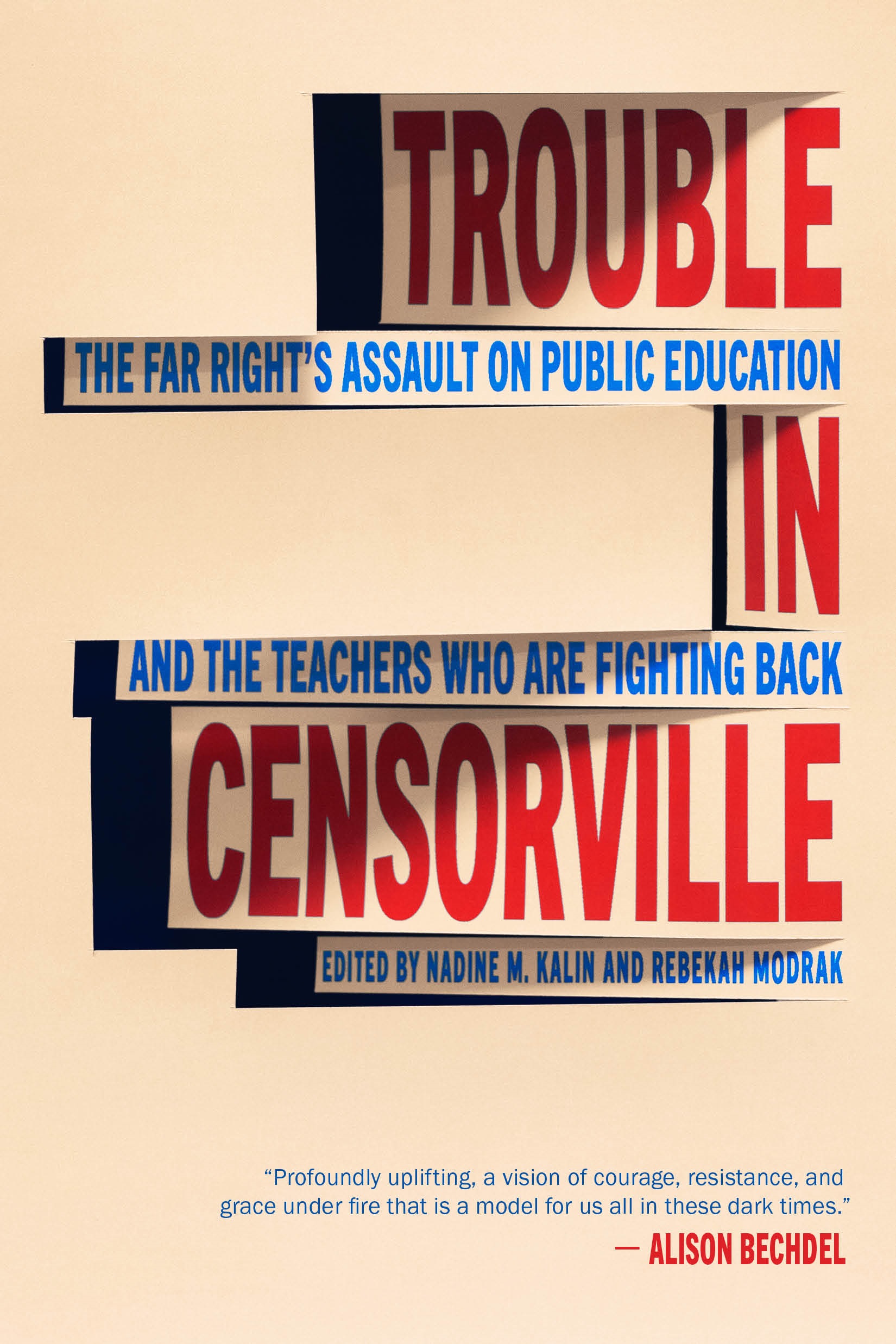
Trouble in Censorville: The Far-Right's Assault on Public Education and the Teachers who are Fighting Back - edited by Nadine M. Kalin and Rebekah Modrak


It should come as no surprise to anyone following the news, be it local or national, that book challenges are on the rise. According to PEN America there have been over 10,000 book bans in public schools in the last year.  

This book is a collection of essays by teachers and librarians across the country who have been targeted and harassed for having a diverse collection of books in their classrooms and libraries. 

I would recommend to those who are interested in this topic not to read the book in its entirety, cover to cover, over a short period of time, as I did. The tone weighed on me, even though I knew what to expect.

There is also a certain same-ness to these stories (even as each is unique), which again may weigh on the reader. It is important to note, however, that the same-ness is due to the fact that those who are attacking the educators are all using the same playbook, and attacking the same books. Allegations of pornography in the children's section and grooming young children are de riguer from those who purport to protect children.

At least two of the essays in this work were written by the same librarians I read about in The Secret Lives of Booksellers and Librarians. Notably included in both are Martha Hickson (school librarian in New Jersey) and Carolyn Foote (retired school librarian in Austin, Texas). The tone of the two works couldn't be more different, however. Overall, Secret Lives is light, whereas this one is heavy. Secret Lives is a celebration of books and reading. Censorville is a call to arms and indeed includes a list of things we can do to "resist attacks on public education". 

More information about this work, the educators who are profiled, and and additional links to more resources can be found at Censorville.com.

EveryLibrary sponsored a panel discussion with Kalin and Modrak along with some of the authors from this work which can be found online here.

Banned Books Week 2024 runs from September 22-September 28. 

Tuesday, April 27, 2021

If I Understood You, Would I Have This Look on my Face? - by Alan Alda

The subtitle of Alda's book is "My Adventures in the Art and Science of Relating and Communicating". He begins his book by telling a story about some miscommunication between himself and his dentist which resulted in Alda not being able to do his job as an actor effectively. The dentist was unclear when telling Alda about the procedure and Alda was too intimidated to ask for clarification. Alda wraps up with the book by explaining the importance of storytelling. Stories make information sharing more relatable, and are more interesting than lectures. In between he tells a lot of stories to illustrate his points and to engage the reader as he explains how people can better understand each other.

While Alda does mention looking up some information in the Stony Brook online library, this brief library reference isn't what prompted me to write a post about the book on the "Library Books" blog. It was instead, what Alda discusses near the end of the work in the chapter called "Jargon and the Curse of Knowledge". Here he explains not only that we shouldn't use professional jargon when speaking to lay people (meaning anyone outside of our own profession - whatever it may be) but also why that can be hard to do. "Once we know something it is hard to unknow it, to remember what it's like to be a beginner. It keeps us from considering the listener". 

I thought a lot about what Alda said in this chapter in light of how my job as a reference librarian has changed in the last year since I do most of my work remotely. Virtually all reference questions are now asked and answered "virtually" via live chat text messages. When someone chimes in with a question I often feel as if I am coming into the middle of a conversation. It is not uncommon for a a question to start with something like 'I can't find any information on my topic'. Here I am at so many disadvantages. I don't know the person's topic; I don't know what kind of information they need; I don't know where they have already looked; I don't have nuances to help me such as body language or voice tone. Most importantly I don't know if they've ever even used the library search engines before. I have to keep this in mind when I start asking questions myself (e.g. "What is your topic?"; "Do you know how to get to (X) database?"; "Do you know what a database is?"). I have to do all this knowing that the person asking the question doesn't have benefit of reading my body language or voice tone, either.

As a university librarian I have noticed miscommunication on many levels. Professors miscommunicate between themselves because they use jargon from their own field without thinking that the words or phrases they're using may have different meanings in other fields (or to laypeople). I often help bewildered students who need assistance finding "peer-reviewed" articles. Their professor has told them they need to use them, without explaining what that means. The student often assumes that I don't understand it either. Since they'd never heard of it, why would they think I had. The professors have forgotten that once upon a time they didn't know what a peer-reviewed article was either. They had to learn it, but it is now so ingrained as part of their work that they don't remember what is was like to not know.

I recommend this book for everyone. It is easy to read, jargon free, and based on scientific evidence.

Tuesday, May 7, 2019

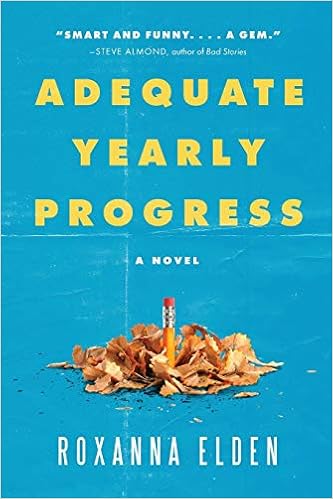
Adequate Yearly Progress-by Roxanna Elden


This satire about the fictitious Brae Hill Valley High School in Texas provides readers with a view of teachers' lives, both inside and outside the classroom. There are a lot of acronyms and, as one might expect from the title, there is much here about assessment, binders full of data, and standardized tests. It is somewhat prescient that this story about Texas' STARR assessment tests, and the real poet who couldn't answer the questions about her own poem has been making the rounds recently.

Brae Hill Valley has a media center "formerly known as the library". Its only use in this work is for a meeting of the Pre-Holiday Cross-Departmental Midyear-Assessment Data Chat ("PHCDMAC for short"). The only mention of the media specialist's (aka librarian's) work involves cutting out a laminated sign warning students to keep their distance from the creepy mechanical Santa Claus that was making its annual appearance from the school's supply room. Ah, well, at least BHVHS has a librarian. Many school districts find librarians to be easy targets when budgets are cut. This story from the Spokane (Washington) Spokesman-Review makes clear how little attention is actually paid to all the assessment data that educators are required to collect. Although there is a strong positive correlation between having school libraries with professional librarians and better student achievement librarian positions continue to be eliminated across the country.

Thursday, April 12, 2018

Educated - by Tara Westover


Raised and home-schooled by survivalist parents in the Idaho mountains Tara Westover rejected her family's admonishments not to go to college and enrolled in Brigham Young University (BYU) before she turned 18. Ultimately she becomes a Cambridge-educated PhD, but not without painfully examining her role in the family. Her father's conspiracy theories about universities and the Illuminati were made known to her long before she thought about going to college herself. Her mother had taken charge of her children's homeschooling, which mostly consisted of letting them learn what they wanted when they wanted, and included occasional trips to "the Carnegie library in the center of town".

Westover recognized that she was one of the least disciplined of her siblings when it came to "doing school" which gave her a lot of reason to doubt her abilities when she arrived at BYU. Her misgivings were magnified when she discovered that her classmates had an understanding of US culture and history that she did not share. Her realization that everyone else knew what the Holocaust was, for instance, caused her not only embarrassment, but also opened her eyes to the fact that her peers shared a collective knowledge that she was missing. She did not even know what she did not know.

If Westover had anxieties about her place at BYU they were only compounded when she arrived at Cambridge. Upon her arrival on campus she and her denizens were invited to take a tour of the chapel, including the roof. She describes the experience of watching her classmates, and her professor fight the wind on top of the building as they cling to the wall while she climbs higher. Finally explaining to her professor that "she'd roofed [her] share of hay sheds" and that
The wind is just wind. You could withstand these gusts on the ground, so you can withstand them in the air. There is no difference. Except the difference you make in your head...I'm just standing...You are all trying to compensate...You've made yourselves vulnerable. If you could just control your panic, this wind would be nothing.
Even this insight though, was accompanied by apprehension
I wanted the mind of a scholar, but it seemed that Dr. Kerry saw in me the mind of a roofer. The other students belonged in a library; I belonged on a crane.
Her ultimate success in earning her PhD demonstrates that she certainly did belong in a library, and the final third of the book (from the time she lands in Cambridge for the first time) is scattered with references to using it. This stands in stark contrast to the first 200 (plus) pages, where there is only one.

Wednesday, September 2, 2015

The Nature of College - by James J. Farrell

Just in time for Back to School! I read this book in preparation for the fall semester during which I will be teaching a course called Sustainability 101. Students in the class will be assigned this book along with Colin Beavan's No Impact Man (which it pains me to say doesn't mention libraries at all).

Anyway, I digress. I read this in preparation for teaching the class, but it was especially thought-provoking for me to read as I sent my own daughter off to college for the first time. Farrell's book looks at the many resources a college student uses in given day. My daughter's college helpfully provided us a list of things she would need for her dorm, and in case they forgot to include anything Target had a special section of the store labeled dorm "essentials" - things such as string lights and welcome mats. I must admit that I found it easier just to load up the cart than to critique the list (or argue with my daughter). I think I ultimately talked her out of one thing. And so before she even got to college we had amassed a bounty of  "things" for her to take with her. I have honestly decided just to bury my own head in the sand rather than calculating the environmental cost of it all.

Farrell's book mentions libraries a few times, generally as part of a list of places a student might go. They are not specifically analyzed in terms of what resources they use, or help conserve, however.

Wednesday, October 30, 2013

Biblioburro: A True Story from Colombia - by Jeanette Winter


From author Jeanette Winter, who brought us The Librarian of Basra,is another true story of a librarian who goes beyond the unexpected.

I've blogged about the Biblioburro before (here and here). I did not realize that there was a book about the Biblioburro though (although, really, I should have!). This book relates the story of Luis Soriano; his wife, Diana; and his two trusty burros Alpha, and Beto. Luis' own love of reading and his work as a teacher prompted him to share books with people in remote parts of Colombia, many of whom had no books of their own. This is a wonderful story that demonstrates how librarians are called to their work through a passion not only for books, but for sharing information.

This book's brightly-colored illustrations also give it an authentic Latin flair.


Tuesday, June 4, 2013

What Teachers Make - by Taylor Mali


Last month I posted Taylor Mali's video "I'll Fight You for the Library". My husband ordered Mali's book of essays after watching his video "What Teachers Make" - a poem that has made him famous as an advocate for educators. The book includes the "I'll Fight You" poem, as well as mentioning libraries, and librarians in a few other places. I think though, that the essay called "My Best Day as a Teacher" which does not mention libraries, per se, may be the one that best exemplifies information literacy, my own area of expertise. In it Mali describes an incident with a student who said she wanted "to write a persuasive essay that argued in favor of making it illegal for gays to adopt children." Mali "said nothing" except to "remind her of requirements for the paper, the number of different sources" and more importantly, in my opinion "the questions to ask of those sources to make sure they were reliable." He goes on to tell that the student came back to him a few days later to ask if she could "switch sides" because she did not find evidence to support her initial position. Of course there were sources that supported the student's initial position, but once she asked the questions to determine their reliability those sources would have been deemed invalid.

Too often I am asked by students to help them find information that is either non-existent, or unreliable. They have already written their papers, and come to the library only after they are ready to "quote load" it. They then become frustrated with me because there is no scholarly source to support their position. This is a problem on several levels. One is that the student leaves the library with the perception that the librarian  was of no help which means that we are unlikely to see that student again. Another is that students may find they are incapable of changing their minds in the face of new evidence. A problem we see played out everyday on the news. It doesn't matter what scientific evidence we have, climate change deniers will continue to dig in their heels. They will always be able to find some information somewhere that supports their view. I am reminded of a quote I heard at a conference last week: "We live in an age of information, not of knowledge." Information is easy to find. Finding good information takes time, and a not just a bit of critical thinking. It seems it is time to reassess the value of "instant" information, and of an educational system that has made standardized testing its goal.