Showing posts with label Connecticut. Show all posts

Monday, May 22, 2023

Our Missing Hearts - by Celeste Ng

This dystopian novel, reminiscent of The Handmaid's Tale, gives us a glimpse of what happens when prejudices go unchecked. As we watch the far right cycle through villanzing every marginalized group, (landing most recently on the LGBTQ+ community) this work is prescient in more ways than one.

In Our Missing Hearts Anti-Asian sentiment is sanctioned by the government through PACT (the Preserving American Cultures and Traditions Act). PACT also encourages citizens to report their neighbors for un-American activities (broadly defined) and allows great leeway in banning books. Children are removed from their homes and permanently re-placed if their parents are deemed to be un-American. Current news from Florida and Texas regarding trans children echoes this story line. Ng's book centers on a mixed race family: Asian-American mother Margaret; Caucasian father (Ethan); and their son Bird (aka Noah).

When Margaret's little-known (and apolitical) book of poetry unwittingly becomes a symbol of a protest movement Margaret goes on the lam leaving Bird and Ethan behind in hopes of keeping father and son together even as she cannot be with them. When asked about Margaret's whereabouts Bird and Ethan always answer that they do not know, and that she is no longer a part of the family.

There is much in this book about libraries and censorship. Although libraries exist they are largely empty (of people and books). Described as a "ghost town" the public library is still a sanctuary for Bird (and his friend Sadie). The librarian helps Bird to find a book based on only a vague description. They use an old card catalog to find it but the book has been removed from the library. As was his mother’s poetry book - Our Missing Hearts. The librarian tells him “We don’t burn books here this is America…we pulp them. She says his mother’s book was probably turned into toilet paper and wiped someone’s butt a long time ago. Although they do not traffic much in books, the librarians are still connecting people and information. "The brain of a librarian is a capacious place." 

The public librarians are part of a subversive group that provides information to parents whose children have been “re-placed” - surreptitiously passing notes between the pages of interlibrary loan books. The librarians also hide Sadie away from her foster family as she tries to reunite with her parents. Train and bus schedule information is provided to Bird at the library. The librarian tells him that she is only letting him know how to find the information: what he does with it is his business. 

Likewise classrooms are described with empty bookshelves because “books are outdated the minute they're published”. However, students are informed by their teachers that books haven’t been banned, obviously, because that would contradict the first amendment. Rather, the books have been removed so as not to expose students to harmful ideas. This is eerily reminiscent of a viral video that recently made the rounds online of an empty school library in Florida.


Ethan shelves books in a Harvard University library. A PhD, he used to teach linguistics there, but lost the job over Margaret's "politics".  As a linguist, Ethan is especially interested in word derivations. He enjoys explaining where words come from (in multiple languages) to his son. The book included an explanation about the derivation of the word library coming from the word for tree bark, something I had never known before.


Wednesday, November 30, 2022

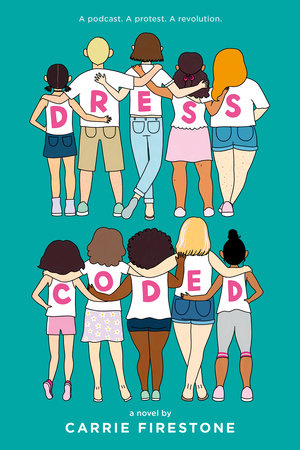
Dress Coded - by Carrie Firestone


I do love Little Free Libraries, of which there are about half a dozen near our weekend home in Fairhaven, Massachusetts. I found this book in the LFL located closest to our house. This novel tells of Molly Frost and her comrades at Fisher Middle School who are sick of having their clothing monitored. Shorts and skirts that aren't longer than the end of one's fingertips, bare shoulders, and other "distracting" attire is cause for being "coded". When Molly's friend Olivia is humiliated by the principal for exposing her shoulders because she removed her sweatshirt to tie around her waist to hide the period blood on her white pants Molly starts a podcast to protest. The protest gains serious momentum which ends with an Occupation in the schoolyard.

The school library, the public library, and a "fantasy library" where Molly imagines a decent older brother who protects her from the bullies who pelt her with ice balls are all part of this story.

Molly's mother attends a lecture at the local public library on "how guinea fowl and possums are better than chemicals for managing ticks."

The school library is a place where parents meet to discuss an upcoming end-of-year trip; where (girl) students are sent to have their clothing scrutinized; and where Molly and her friend Navya meet to write their speech for the School Board meeting. While writing their notes they find an ally in Mr. Beam, the school librarian, who "drops a blue folder on the table, winks, adjusts his tie, and walks away...It's stacked with articles about dress code protests and how, by law, student dress codes cannot be evenly enforced". You can always count on a librarian for assistance with subversive activity.


Wednesday, May 19, 2021

This Much I Know is True - the television series

In a spectacular execution of every librarian's nightmare Thomas Birdsey (Mark Ruffalo) has a psychotic break in the Three Rivers Public Library as he wields a carving knife and then cuts off his own hand. The aftermath leaves his twin brother Dominick (also played by Ruffalo) to navigate the mental health care system, social workers, doctors, and family, as well as the break down of his own personal life. 

The six-part mini series tells the story of the two brothers and the abuse they suffered, their regrets, and their troubled relationship with each through a series of flashbacks narrated by Dominick.

This series was based on the book by the same name by Wally Lamb. Although I had not read this work, I have read several of his other novels: She's Come Undone; I'll Take You There; and We are Water (which also takes place in the fictitious Three Rivers, Connecticut).

Thursday, January 21, 2021

Rufus M - by Eleanor Estes

Back in September I attended a webinar with the librarian's librarian Nancy Pearl. She was doing a virtual book tour for her most recent work The Writer's Library (which I have not yet read). She said something that I wish more people would take to heart: "Any book your haven't read is a new book". I have never understood the obsession some people have with buying some hot new book, as if there aren't literally millions of other things they could be reading while they wait for their turn on the waiting list at the library, or until the book is available in paperback. During the Q&A someone asked about library-centric books and it was here that I learned about Rufus M

Pearl specifically said that the first chapter was especially worthwhile for demonstrating the magic of getting a library card. Although the book was published in 1943 this was indeed a "new book" to me. And I imagine even almost 80 years after its first publication that the first chapter will still resonate with anyone who has earned the privilege of getting their first library card. I wonder how many people remember that moment? 

Rufus is tasked with making sure his hands are clean, and learning to write his name before he can get his own card and check out a book. The librarian makes clear both that she wants Rufus to have a card, and that having one is a serious responsibility. She is kind yet firm in her insistence that Rufus learn to sign his own name in order for him to get his own card. 

There is a bit of "shushing" action in this chapter as well. 

There are a dozen other episodic chapters in this work, the library is mentioned again in a few of them. This work will likely appeal to those who enjoy Beverly Cleary's works.


Nancy Pearl discusses her book The Writer's Library


Monday, January 11, 2021

Everything All at Once - by Katrina Leno

About to graduate from high school Lottie is mourning the death of her favorite aunt (Helen) a famous children's book author. Aunt Helen's books are about a pair of immortal siblings (Alvin and Margo Hatter) and are wildly popular among people of all ages. There are of course those who do not like her books "the Anti-Hatters [who] burn the books on YouTube...They say the idea of immortality is a sin against God".

Aunt Helen donated half of her estate to "various charities and libraries of her choosing". She clearly understands the importance of libraries to authors. Some authors seem to think that libraries are somehow stealing royalites from them.

Aunt Helen also had owned the "most expansive private library" of anyone Lottie knew. Helen was even "featured on the front page of Libraries International twelve separate times". Lottie is emphatic in her instance that "Libraries International was an actual magazine". I, however, could find no evidence that such a magazine exists.

We don't actually see much of Lottie using the library although she does meet her friend Sam at one. Sam travels a lot and tells her that he gets a library card wherever he goes "that's important" he tells her.


Monday, May 20, 2019

Death Overdue-by Allison Brook


It's Mystery Month May and so, although I don't really like mystery novels, I read one. Of course I picked one about a librarian.

This is a rather light mystery about a young librarian, Carrie, who with the help of a friendly ghost, Evelyn Havens (former library employee, and aunt to Carrie's nemisis "prune-faced" Dorothy), solves the 15-year old murder of Laura (another library employee) in the fictional town of Clover Ridge, Connecticut.

Some interesting tidbits worthy of comment here (besides the fact that Evelyn "shushes" Carrie when she first meets her).

Dorothy is quite an unpleasant sort and furthermore had been envious of Laura back in the day "because all the patrons liked her and wanted her to help them". Evelyn had tried to explain to Dorothy that she should smile more and speak in a "pleasant manner" so that patrons would like her too. Dorothy's response had been that
her job was to answer questions and look up information. She wasn't paid to be an entertainer as well 
And here I must give some acknowledgement to Dorothy's point of view. The expectation that we smile, and that part of our work must involve getting people to like us is a burden demanded heavily upon women. Somehow I doubt that if Dorothy had been a man anyone would have made the same suggestion. In fact, I expect that the opposite would have been true. Her serious manner would have instead have been seen as a sign that she knew what she was talking about.

Meanwhile, Carrie endures a bit of "mansplaining" from police Lieutenant Mathers who suggests that she can find out more about Laura's murder from the newspaper articles online, which she can read at the library.

I think the best line though (and what obviously makes this fiction is) when Carrie is offered the job of head of programs and events and is informed that while the work is demanding "the salary's quite good" LOL.

Friday, February 15, 2019

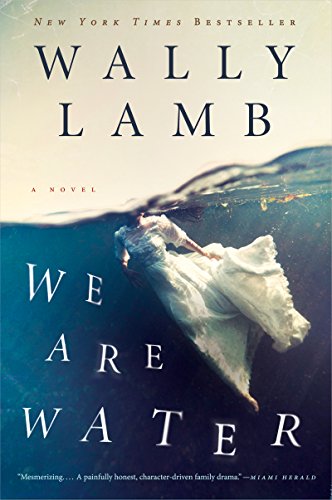
We Are Water - by Wally Lamb


In this work Lamb re-imagines the town of Norfolk, Connecticut and artist Ellis Ruley as the fictitious Three Rivers, Connecticut and Josephus Jones respectively. It tells the story of the Oh family: Annie, an artist who is about to marry her same-sex partner; Orion, her psychologist ex-husband; and her children Ariane, Andrew, and Marissa. Each chapter focuses on a different character.

Annie's early life is shaped by a flood that killed her mother and baby sister. The disaster is something she rarely discusses, so her children must research it at the public library, reading the old newspaper accounts on microfiche. 

Annie is also the subject of an internet search on a public library computer, many years later. A search performed by someone who, as a condition of his parole, was to stay off the internet. Nevertheless, the parolee (Annie's long lost cousin Kent) "walked from the halfway house to the library downtown [and found] an open computer station, far enough from the front desk for anyone to see..."

As a young woman Annie searched for a job using the Want Ads found in the local paper at the public library. She had been primed from a young age to use the library, as her mother had taken her to story hour as a child. Belinda, whose father was buried the same day as Annie's mother and sister, remembered Annie from her days working at the library. Belinda once even used her job there as a cover to her parents when she goes to meet a boy at the movie theater - telling them she was called in to work to fill in for someone who was sick. 

Although not an especially library-centric book, this one does demonstrate a myriad of different ways that libraries are used. 

Monday, May 14, 2018

How to Be a Muslim: An American Story - by Haroon Moghul


Baltimore County Public Library's April 2018 #BWellRead Challenge category was to "a memoir/biography about a person who doesn't look like you". Of course, as my husband pointed out, this could mean anyone who is not my sister, but I took it in the spirit of the challenge and selected Moghul's story. A Pakistani Muslim who grew up in New England, Moghul was born with a myriad of health problems, which relegated him to being one of the "geeky" kids growing up. And where there are geeks there are libraries.

Early in the work Moghul describes the very well-educated family into which he was born - one that
appreciated, encouraged, and rewarded bookishness - which made life easier, since [he] was the kid who made a beeline for the library when the last bell rang.
It is a good thing he was so comfortable in the library as it is a place with which he would became quite familiar. As the only kid whose parents wouldn't sign his permission slip to take sex ed the  "doofy twelve-year-old" was dispatched to the school library while the rest of the kids in his class received their illicit lessons. He became so well-known in his library he described it as a place where "everyone fist-bumped him". As an adult he also made good use of a "well funded public library systen" while waiting for his bookish mother to give lessons on Islam to "housewives".

As an about-to-graduate student of New York University (shortly post 9/11) Moghul proposes that the University hire a Muslim chaplin (himself) to "a senior university official, a woman whose stunning workspace occupied the rarefied top floor of NYU's library". It is here that he learns that "there were levels of power and influence that [he] hadn't the slightest idea of." It has always seemed more than a bit ironic to me that University officials are so quick to recognize the value of library space only when they want to claim it for other-than-library needs.

I learned quite a bit about Islam from this work. I have enjoyed reading several religious memoirs of late. You can see my other posts here, here, here, and here.

Thursday, January 18, 2018

This Child of Faith - by Sophronia Scott & Tain Gregory


I took on BookRiot's Read-Harder Challenge for 2017. Finding a "book in which a character of color goes on a spiritual journey" did turn out to be a challenge for me, and so Scott & Gregory's book was the last one I read to complete the list. The book was released on December 14, the fifth anniversary of the mass shooting at Sandy Hook elementary school. Gregory was a third grader at Sandy Hook on the day of the shooting and one of his best friends (Ben) was murdered that day. He and his mother (Scott) co-wrote this book about their faith and how it sustained them through the tragedy.

Most of the narrative in this memoir takes place prior to the shooting. It tells how the family sought out a church, found one that fit, and began to get involved in church life. Their faith was firmly held prior to the tragedy.

While libraries don't play a huge role in the story, it is distinctive in that all four types of libraries: academic, school, public, and special (in this case a church library) are mentioned and used by the authors:

  • Scott tells how her Sunday morning job at Harvard's Cabot Science Library kept her from going to church while she was in college
  • She tells about the "beautiful library" at the private school her son attended prior to transferring to Sandy Hook elementary
  • And of checking out "Veggie Tales" music CDs from the public library for her young son to enjoy
  • The church library is not just a place she goes to check out books, but is also used as a comfortable place to wait while her son is in choir practice

There is also this passage which describes reading about libraries, and presents them a safe places
When I was a girl I read the book Escape from Witch Mountain in which a girl named Tia could open any locked door simply by turning the handle. It only worked if it was okay for her to be in there, a right place to be, such as library or church...I was enchanted by the prospect of having such a magical power. But even more so I felt comforted by the idea that safe places would always be open and available.
It would be wonderful if anytime a person needed to be in a library they could find one open and welcoming. We do our best with budget and personnel constraints.

Wednesday, August 2, 2017

Orange is the New Black - by Piper Kerman


I've been intending to read Kerman's memoir ever since the debut of the Netflix series of the same name in premiered in 2013. After recently watching the fifth season, I finally got over to my public library and checked the book out. Much less edgy than the television show, Kerman's book is, nevertheless, a quick and fascinating read.

While the television show's characters Poussey (Samira Wiley) and Taystee (Danielle Brooks) might have one believe that the prison library is a hub of activity, it was in fact barely mentioned in the book. Most of Kerman's reading materials were sent to her by friends and family, so much so that she ended up with her own personal library, which she was glad to share with others. When she left the federal penitentiary in Danbury, Connecticut she donated all of her books to the prison library. She knows her books are being used when a year after her release she receives a letter from Danbury
Formal and stilted, it was from Rosemarie, and folded into it were two photographs of my grandmother. My cousin had sent them to me in prison...Rosemarie wrote that she hoped I was doing well on the outs, and that she had found these photos in a book in the library and recognized who it was. 
Photographs are among the more innocuous things found in returned library books. For some real tales from the stacks see this post from BookRiot, and this one from BuzzFeed.

Another fellow inmate, Levy, upon being released was interviewed by the Hartford Courant newspaper and described her six-month sentence as a "holiday" with a "wide range of classes" as well as "two libraries with a wide array of books and magazines, including Town and Country and People". All of this, of course was a surprise to her fellow inmates who listened to her complain and cry every day of her incarceration.

In the book's Afterword Kerman (now serving on the board of the Women's Prison Association) points out that the United States has the world's biggest prison population with 25% of the wold's prisoners, but only 5% of the world's population. Low level offenders make up a huge proportion of these inmates. She further explains
Most of the women I know from prison have lived lives that were missing opportunities many of us take for granted. It sometimes seems that we have built revolving doors between our poorest communities and correctional facilities, and created perverse financial incentives to keep those prisons full, at taxpayers' expense. America has invested heavily in prison, while the public institutions that actually prevent crime and strengthen communities - schools, hospitals, libraries, museums, community centers - go without.
Sing it, Sister!

Tuesday, January 17, 2017

I'll Take You There - by Wally Lamb


Film professor Felix runs a club that screens classic movies in an old vaudeville theater. It is there that he meets the ghost of movie director Lois Weber. Weber informs Felix that he is being given a special opportunity to watch movies featuring his younger self, and that he would also be able to enter and be part of the films. Episodes focus on the summer before he (Felix) begins first grade when he and his older sisters are excited about helping their former babysitter win the Miss Rheingold title; and the year his twelve-year old self watched as his sister Frances (aka Fran) developed anorexia and a family secret was revealed.

There wasn't much about libraries in this one, but it doesn't take much to make the cut on my blog. I was optimistic at first that there would be some good library stuff when I read that Felix's daughter's boyfriend, Jason, was a New York University Special Collections librarian, but he barely makes any appearance in the work beyond the first mention early in the story. The Miss Rheingold contest is brought up in several contexts in the book, and one is that of a lonely newlywed bride,Verna, ripping an entry form from a magazine she reads at the New London public library (she "looked over at the desk to make sure the librarian was busy" first).Verna also found solace at the library during her long solitary days as the wife of a Merchant Marine. And on a final note about libraries, Felix's daughter, Aliza, writes an open blog post to her mother, Kat, and in something I will dub Gen Y-splaining, reminds her mother that young women in the 1950s had few career options. These included "mother, teacher, nurse, secretary, librarian, fashion model". Furthermore she says Aunt Fran (who eventually became a denist) didn't want to be any of those things. She probably just didn't realize how fun being a librarian could be. I imagine she saw the job as just stamping out books.

Monday, January 25, 2016

The Map Thief - by Michael Blanding


My husband, James and I read this book aloud together. It was recommended by a friend as it brings together James' passion of geography and mine of books and libraries. We finished this a few weeks ago, but I held off blogging about it because I found out that we would have the opportunity to hear the author speak at the Massachusetts State Library in Boston shortly after we finished it. It was not our first visit to the State House - James goes there about once a year with his EarthView globe-, but it was the first time visiting the State Library. Blanding was witty and seemed to thoroughly enjoy speaking in the stately room. He smiled the entire time as he showed slides with maps and photographs and discussed how he did the research for his book. The Map Thief  is the true story of E. Smiley Forbes III who stole maps from the Boston Public Library, the New York Public Library, the Beinecke  and Sterling Libraries at Yale, Harvard Library, as well as the British Library. In order to pay the phenomenal debts he racked up for his home on Martha's Vineyard, as well as for his planned community Sebec, Maine, Forbes, a well-respected map dealer, began stealing rare maps in order to sell them to collectors. It was a Yale librarian, Margit Kaye, who first suspected Smiley, when she noticed a smudge mark on a map that Smiley had posted on his website - a smudge she was sure she had made! However, when she brought her suspicions to the attention of her supervisor his response was a dismissive "what do you want me to do...arrest the guy?" Ultimately it was another Yale librarian, Naomi Saito, who set in motion the events that lead to Smiley's arrest in 2005.

Blanding talked to a number of librarians and map dealers in the course of researching this book. He also explores the history of maps and mapmaking, and discusses my favorite Librarian/Geographer, Eratosthenes, head librarian of the famous Library of Alexandria in Egypt in 240 B.C.

Blanding's book also tells of how maps were recovered and then how forensics were used to determine which maps belonged to which library. I was especially interested in the clever librarians who used wormholes to identify their map of Gerard de Jode's Speculum Orbis Terrarum
For centuries libraries had been plagued with wood-boring insects that laid their eggs in the stacks. When the larvae hatched, they used the digestive enzymes in their alimentary canals the chew through wood and paper, leaving behind a tiny trail. Somewhere in its 427-year history, the Beineke's copy of the Speculum had contracted its own case of pests. In the front of the book, a dozen pages sported a small constellation of three pin-sized holes near the bottom and another hole three inches up. Now, as the librarians laid the map carefully back into the volume, those holes matched identical holes in the edge of the map where it had been held in place.
Well researched, well written, and full of real-life clever librarians, this is a title truly worthy of its place on this blog.

A post script: While the book is finished, the story is not. As recently as November of last year  the Boston Public Library  recovered a stolen map thanks to an "eagle-eyed" librarian who identified a the map based on flaws in the document.

My favorite quote from the day: "It was a battle, but it was a quiet battle because they were librarians."

Author Michael Blanding signs copies of his book, surrounded by maps, at the State Library.

Tuesday, May 20, 2014

The Adults - by Alison Espach


This satire follows the story of  Emily, who within the course of a year watches a neighbor commit suicide; experiences the divorce of her parents; becomes a sister to her father's love child; and embarks on an affair with one of her high school teachers. The on-again-off-again relationship with "Mr. Basketball" (a.k.a. Johannes, Jonathan, and Jack) continues over about a dozen years.

Emily's only two mentions of libraries are in stark contrast to each other. The first time demonstrates a certain naivety; the second shows an especially daring sexual side. In describing her grandmother's death, when Emily was 10, she (Emily) recounts her mother suggesting that the family get out of the hospital room for a little while to get some coffee. Emily reminds her mother
I am only ten, my legs are barely covered in peach fuzz, I just found out there are two r's in "library," this whole time it had never been "ly-bary" and how embarrassing, I'm so so embarrassed, Mom, can I have a ginger ale instead?
Much later in the book Emily, while having sex in a public restroom during one of her reunions with Jonathan thinks about going "somewhere else"
off to the basement stacks of the public library, where sex was a dark art and we were just students. Where I had to keep on my wool dress for decorum's sake and he just unzipped his pleated khaki's and out he tumbled like a waterfall.
This is a good summer read - pure escape.

Friday, March 21, 2014

Becoming Odyssa - by Jennifer Pharr Davis


After graduating from college Jennifer Pharr Davis sets out to hike the Appalachian Trail from Georgia to Maine. Her Odyssey prompts her to take the trail name "Odyessa" as she sets out on a journey of self discovery. Davis' writing is honest and funny and demonstrates a true love affair with the trail. Like the other books I've read about the "AT" (A Walk in the Woods; The Things you Find on the Appalachian Trail) I read this as part of my town's One Book One Community program. And while all of these books were enjoyable, and inspiring each in its own way, none have prompted me to want to dust off my old backpack and set out on the hike myself.

The bar for inclusion on this blog is simply that a library be mentioned, and Davis almost didn't make the cut. However, in a break from the trail to visit with family in Connecticut she visits the Yale University library and tells the tale of seeing "two volumes of the Gutenberg Bible at the Beinecke Rare Collections Library.

I look forward to hearing Ms. Davis speak about her experiences when she visits Bridgewater in May.

The author's middle name serves as her aptronynm as the distance as the Appalachian Trail is over 2100 miles long. It is also the name of a town I once lived in.