This short novel explores the universal expectation that women sidestep their own desires in favor of men's wishes. Girls may be denied educational opportunities in favor of their brothers getting better opportunities. Men are praised for the work women do (both at home and in the office). Women are expected to do errands at their workplace that men are not asked to do. Husbands continue with careers while wives quit or go to part-time work when children arrive. Sexual harassment is also a theme of this work.
Libraries get two nods in this book. Jiyoung studies with her boyfriend at the university library, and at a client dinner for Jiyoung's division (where she was plied with beer) her division head, after drunkenly making inappropriate comments to her
hired himself a chauffer over the phone..."My daughter attends university right here. She was studying late at the library and wants me to come pick her up because she's scared to go home by herself".
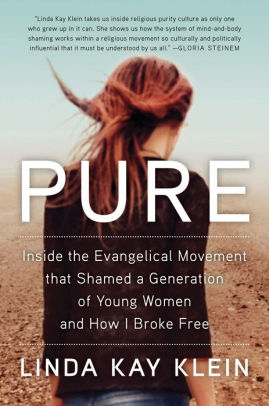
Based on her own experiences, and interviews with dozens of women, Klein's scholarly memoir describes how the purity movement (or what Jessica Valenti calls "the cult of virginity") perpetuates rape culture and creates a climate of humiliation for women. Far from being healthy, many of those who grew up with abstinence-only messages not only found themselves unable to have a healthy sexual relationship, their mental and physical health often suffered as well.
Libraries are mentioned in only three places in this work, but of course that is three times as many as are needed to secure a spot on my blog. They all came near the end. One involved a young evangelical man concerned about his obsession with women's bodies. He would walk "around campus, the library, the supermarket, perpetually hoping to see another accidental glimpse of ...something [cleavage, leg, skin]". He was, laughably, advised by his pastor to attend a Sex Addicts Anonymous meeting, where, not surprisingly, he was met with "an awkward silence" after sharing his story.
Another passage recounted a gay lawyer's research in Washington, DC's theological libraries "where he continued to wrestle with the rift between theology he loved and the lived experience he couldn't refute."
The most interesting, however, was this passage of a young woman who told her story of contemplating suicide
Rosemary prepared for a trip to Europe, where she would spend her sophomore year of college. By the time she was packing her bags...she was so depressed that she was seriously planning her suicide. She would kill herself in a European library, she told herself. She had always loved books so much.
Ultimately, the trip had a healing effect when Rosemary found a brand of Christianity in Europe that focused on fellowship rather than shaming.
Back in June I blogged about Betty Friedan's classic feminist work The Feminine Mystique. I mentioned then that I had just started to read Sheryl Sandberg's Lean In commenting that if there were any libraries in the book you would find out here. So here I make good on my promise. There is one. Sandberg tells of the first job she took out of college "at the World Bank as research assistant to Larry Summers...[She] spent the first nine months in the stacks of the Bank library...looking up facts and figures for Larry's papers and speeches." We can safely assume that she was not Summers' assistant, though, when he made his now infamous remarks at Harvard in 2005 about women's (lack of) aptitude in the sciences. I actually found it rather ironic how much she praised Summers in this book. A quick look at the index indicated that he actually gets twelve times as much print space as libraries do!
When this work first came out earlier this year it got a lot of press. There was some controversy of course, what with a woman suggesting that other women can be leaders and all. I read this slowly (two chapters a month) as part of a discussion group on our campus. We met monthly to discuss what we read, and to reflect on how the book might relate to us. There were several dozen women who were part of this group, which included not only librarians, but administrators, clerical workers, maintenance workers, and faculty members. I think it is fair to say that Sandberg's book reflects her own socioeconomic, heteronormative status, but that is not to say that her words are not relevant to those who do not share those statuses. In our discussions we were all able to see how we could lead from where we were, and to suggest ways to make things better for ourselves, and others. There were places though where we recognized that Sandberg's privilege plays a big role in what she is able to accomplish. We also agreed that while we can make some changes for ourselves, there is much that needs to be recognized by society at large. Sandberg, for example suggests to "make your partner a partner". For those of us who have partners this is fine advice as far as it goes, but even for those of us whose husband's drive the carpool, and share other household responsibilities we still have to contend with things like schools only ever calling the mother to pick up a sick child (even when the father's name and number are listed first). I also find that while I generally enjoy working in the same organization as my husband, one major drawback is that some people seem to think of me as his messenger. If he isn't in his office when they happen to stop by, or he is slow to respond to e-mail they have no compunction of contacting me and asking me to "let him know that...", or even ask me to deliver something to him. He virtually never gets messages for me unless they are of the 'remember me to your wife' variety.
Sandberg's message that women should decide what is important to
them and ask for it is another place where her socioeconomic status seems to
make her unaware of how much of the world functions. I can hardly imagine a
woman working two minimum wage jobs having the privilege of telling her boss
that she'd like to be home for dinner with her children most days of the week.
While she may be just as likely to want such a simple thing, she is not likely
to have much flexibility in her scheduled hours, and may be too busy getting
from one job to the other to even consider making that dream come true.
Despite its problems, ultimately I give this book a thumbs up. I
do believe Sandberg has the best interests of everyone (men, women, and
children) at the heart of this work, and everyone can find something from which
to benefit in it.
During World War II millions of American women went to work in factories at jobs left by men who were fighting overseas. Spurred on by a government campaign that includedRosie the Riveter, these women also became de facto heads of household and were responsible for running the household finances. When the war ended women were not only forced out of these jobs (again, by government campaign) so that men could have them, they were also discouraged from completing their educations, so that they could instead marry young and become "housewives". Aided and abetted by women's magazines, and even the curriculum in women's colleges, the myth of the "feminine mystique" gave the post-war generation of women the message that they could best find fulfillment as wives, mothers, and housekeepers. The messages and images from the 1950s put men in the role of protectors and breadwinners, while women were told they didn't need an education, career, or even a job (Rosie the Riveter not withstanding). Having these things would not only prevent them from fully developing as women, it would also undermine their husbands' roles. In reality, of course, the women's development was stunted, and they were left to wonder what was missing from their lives.
Earlier this year the publishing and library magazines that routinely come across my desk featured articles that reflected on the 50 years since the publishing of Friedan's feminist manifesto. (A 50th- anniversary edition has been published, but I read a 10th-anniversary edition). I had heard about this classic work, and remember selling copies of it back in my college days working in a bookstore, but I had never read it. It seemed the time was right. I could not have imagined how right it was. I started writing this post even before I finished the first chapter. By the time I got to the third chapter my head was spinning. There is just so much to say about this book. As the writer of this New York Times article states some of the attitudes reflected in the work "remain unchanged". Here I point to several recent news stories:
Facebook recently lit up with protests when Swiffer co-opted the famous World War II "Rosie the Riveter" icon to sell a cleaning product.
A recentreport from the University of Chicagorevealed that in 40% of households women are the primary breadwinners. In many cases this is because there is no man present, nevertheless, four commentators from FoxNews have a meltdown over this news.' It is against nature'. 'It will destroy the American family'. The fear that the men's role as protector will be undermined is too evident. This shows little change from Friedan's statement 50 years before that "[a]t every step of the way feminists had to fight the conception that they were violating the God-given nature of women". Friedan also quotes from the book Modern Woman: The Lost Sex which claimed that "careers and higher education were leading to the 'masculization of women with enormously dangerous consequences to the home...'"
Short stories in women's magazines the 1950s & 1960s contained messages that women should be wondering why straying husbands were looking elsewhere. What could a woman do that might bring her husband back? Change her hair color? Lose some weight? Keep the house cleaner? It is her job to figure out why he is cheating, and make the necessary changes to herself! so that he'll come back. And so also says Pat Robertson, 2013.
Articles in women's magazines then (as now) featured actress not in their roles as successful career women, but as wives and mothers.(And, by the way, can we please stop using the term "baby bump"? And what's with the arrow always pointing to a celebrity's stomach, as if we wouldn't know which part of a woman's body to look at for evidence that she's pregnant!?)
Janet Maslin, the author of the aforementioned NYT article closes by saying "I have a photograph of myself with Betty Friedan. We were together on a radio show. I was there because I was a critic for The Times and I arrived at The Times because of opportunities her book created. I wish I had known how much I owed her." This statement I contrast to conservative political commentator Monica Crowley's remarks in the fabulous PBS series "Makers". Twice in her short segment Crowley refers to feminists as "so called" feminists, as if that is not what they really were (or that perhaps we no longer exist), and clearly has no recognition that she would be never have gotten where she is without benefiting from their struggle. I highly recommend watching the Makers series, BTW. All three episodes can be viewed by clicking on the link above. But what does Friedan say about libraries? Yes, Betty Friedan did write about libraries in this work. She begins with acknowledging the "Frederick Lewis Allen Room of the New York Public Library and its provision to a writer of quiet work space and continuous access to research sources" without which "this particular mother of three might never have started a book, much less finished it". She also describes sitting "for many days in the New York Public Library, going through bound volumes of American women's magazines for last twenty years." This image resonated with me because it reminded me of doing the same sort of project myself in the 1980s when I took my first Women's Studies class. I was assigned to look at women's magazines from the 1940s and remember sitting with the big bound volumes at the Enoch Pratt Free Library in Baltimore. Other students in my class were assigned to look at other decades. I remember our professor telling us that we shouldn't expect see much change in the messages over the 50-year time period we were studying, even though the images may have evolved. I was particularly interested in the fact that Friedan discovered that the magazines from the 1930s and 1940s did carry more articles about "the world outside the home" than those of the 1950s and 1960s. I was saddened to see this message about librarians in a passage in which Friedan describes the types of career-woman role models she had growing up
The only other kind of women I knew [besides housewives]...were the old-maid high-school teachers; the librarian; the one woman doctor in our town, who cut her hair like a man; and a few of my college professors. None of these women lived in the warm center of life as I had known it at home. Many had not married or had children. I dreaded being like them, even the ones who truly taught me to respect my own mind and use it, to feel that I had a part in the world. I never knew a woman, when I was growing up, who used her mind, played her own part in the world, and also had children.
I have thought about this passage a lot. It reminded me of learning about Sor Juana Ines, the Spanish mystic nun and author who lived during the 17th century. She, like her brethren, knew that the way for a woman to become educated in their day was to become a nun, which did necessarily giving up marriage and children. It is too bad that Friedan seemed to see these teacher and librarian career women as simply "old-maids", rather than as women who made a choice to become educated and have a career - a choice that allowed the women activists who came after them to build upon their work and knowledge, so that others might have a few more choices themselves. Again, it is important to acknowledge those who came before us.
In interviewing young college women in 1959 Friedan spoke to one senior who lamented not using the library more. She had taken to "wandering around the stacks" to find books that interested her. She wished, in fact that she had developed more interests. She had learned her freshman year to "turn up [her] nose at the library". But as a graduating senior she wished she had taken harder courses and read more. "But" she adds, "I guess those things don't matter when you're married." Another young woman, who admitted to being excited by books, and would sometimes spend all day (8 a.m. to 10 p.m.) in her college library dropped out of the honors program and stopped reading quite so much, for fear of not being able to lead a rich life which she said included marriage, children and "a nice house".
Other places libraries are mentioned were as places for women to volunteer. Remarkably, she also notes that the more interesting volunteer jobs-
the leadership of the cooperative nurseries, the free libraries, the school board posts, even the PTA presidencies - are filled by men. The housewife who doesn't "have time" to take serious responsibility in the community, like the woman who doesn't "have time" to pursue a professional career, evades a serious commitment through which she might finally realize herself; she evades it by stepping up her domestic routine until she is fully trapped.
Furthermore she notes that women who did step into these more challenging roles found a greater sense of fulfillment.
This book is a must read. Its message is clearly just as relevant today as it was 50 years ago.
In a truly paradigm-shifting work, Fine revists the nature vs. nurture debate regarding sex roles. Questioning conventional wisdom, as well as current scholarship, she delves into how society creates and reinforces gender stereotypes. Even those of us who believe we were raising our children in gender-neutral settings are easily lead into this trap. Explaining how even many feminists, like myself, simply threw up our hands in surrender when our young daughters showed serious preferences for princesses and pink, despite our best efforts to dress them in gender neutral onesies and provide them with sports equipment, Fine provides evidence to show that perhaps we weren't as neutral as we believed. Furthermore, our children are influenced by so many other outside forces we are at a loss to control them all.
In her chapter entitled "The Glass Workplace" Fine explores the question of why men are drawn to some jobs while women are drawn to other (most notably the "helping") professions, and what happens when those of one gender try to cross-over to a profession of another. It is here that I found the only mention of librarians.
...often, when men choose to enter less-prestigious female professions they quickly find rolled out for them a red carpet leading to a better-paying position within the field...sociologist Christine Williams coined the term "glass escalator" to encapsulate her discovery that men in (what are currently) traditionally female occupations like nursing, librarianship (emphasis mine), and teaching "face invisible pressures to move up their professions. As if on a moving escalator, they must work to stay in place."...Perceived as, in a sense, too competent for feminine occupations, they were tracked into more supposedly legitimate, prestigious ones.
This will come as no surprise to those of us in these professions. In my 20 plus years as a librarian, I have almost always had a male boss. On those occasions when I've worked for a woman director, she was placed in the position only in an "acting" capacity, until a permanent (male) could be found. To be fair, I have worked as a department head, and had men working as my subordinates, but the head honcho has almost always been a man.
One glaring omission from this work was a discussion of transgender children. Transgendered individuals are given minimal mention in "The Glass Workplace", but that is the only place that explores this topic.
A thought-provoking work. I am looking forward to discussing it with my colleagues in the Women's and Gender Studies Program in the fall.