Algorithms are created by humans. Humans are flawed and have biases, these flaws and biases are programmed into algorithms, perhaps not explicitly, but with consequences nonetheless.
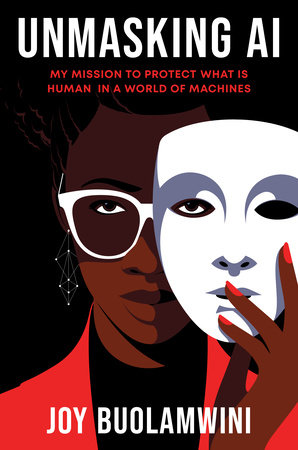
As a graduate student at the Massachusetts Institute of Technology (MIT) Buolamwini, using an open-source face tracking library to work on a project, discovers that facial recognition programs are especially bad at recognizing black and brown faces. Her research eventually brought her to The White House, to testify before Congress, to National Television, and Netflix. And ultimately to become founder of the Algorithmic Justice League. She mentions the use of code libraries on several occasions.
She describes volunteering as an undergraduate at the Carter Center on a project to eradicate tropical diseases. Visiting the Jimmy Carter Presidential Library in Athens, Georgia she
walked through the gardens near...the library [and] saw a piece of art that offered hope - a bronze statue of a child leading a blind elder using a stick they both held. Sightless Among Miracles had been donated to the center to underscore the effort to support the global control of onchocerciasis (river blindness).
Perhaps the most disheartening (for me) passage was this
After two years on the MIT campus I was finally making my way to the Hayden Library. With online access to almost all the resources I needed, I had yet to step foot into a campus library. After printing out results on archival paper that felt soft yet sturdy to the touch and hunting down last-minute typos, I felt ready to submit my master's thesis.
While I recognize that online resources have allowed us to put libraries into users' pockets, which is decidedly more convenient for all, it doesn't mean the physical library isn't important as a place. And since I'm required to be in my office most of the time, even though almost everyone is using the library remotely, I do wish more people would take advantage of the space.
Our lives are made up of a series of "befores" and "afters".
Mr. Harrigan's Phone takes place in the years immediately after 9/11, but before the 2016 election. This placement in time is important for the context of the story. The internet was nascent, and the first generation of iPhones were just coming out, and it was fair to be concerned about how we might be monitored electronically.
Based on the short story by Stephen King this film tells the story of a friendship between an elderly billionaire, Mr. Harrigan (Donald Sutherland) and Craig (Jaeden Martell) a teenager Harrigan employs to read to him. When Craig decides to gift Mr. Harrigan a new iPhone Harrigan is reluctant to accept it for a variety of reasons. However, Craig convinces him that the real-time information he can get on the stock market makes the phone a gold mine. Mr. Harrigan is immediately impressed with the internet, and subsequently predicts a variety of misuses and misunderstandings of it, all of which, eventually, came to pass.
In addition to the Harrigan's lesson on information literacy there are two scenes inside a library. One early scene demonstrates how essential libraries are to accessing information for those who may not have technology available to them otherwise.
In the spirit of Algorithms of Oppressionthis book provides insight into how search engine results are generated. Going beyond Google, which may "customize" results for individual users, Reidsma also explains how library databases aren't necessarily without prejudice either, even though all users will see the same results if they enter the exact same search. Auto-suggestions can likewise shape our thinking in ways we may not have anticipated. All search engines are working on algorithms that were created by people (mostly young, white men). Their own biases will necessarily become part of the algorithm, even if they do not intend it.
Reidsma cites Bonnie Nardi and Vicki O'Day's work to suggest that we rethink the metaphor of library tools to a "library ecology".
The thing about the ecology metaphor is that it highlights the interconnectedness of all these different things coming together in one place. It emphasizes the co-evolution of technology and people. Its [sic] about people and tools together.
Perhaps the most useful reason for dropping the tool metaphor is that tools require convergent thinking. You cannot create a tool with divergent thinking, where many possibilities exist...
...by switching our focus to seeing our technological systems as ecologies, and thus using divergent thinking to address the design and engineering of these systems, we can move beyond the limitations of tool-based thinking and design systems that are made to be used by diverse people.
This gave me a bit to ponder, and will change the way I teach people to think about and use our databases.
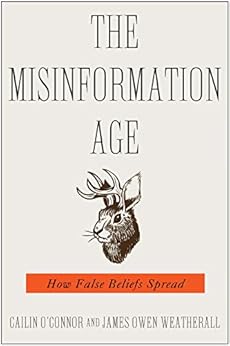
While libraries are never specifically mentioned in this work, it's place on this blog is secured due to the information literacy theme. This work not only tells how false beliefs are spread (twitter isn't the only way) but also how some might be slowed down or stopped. This also explains how truth is malleable, and how even scientists and other experts can be mislead. No one is immune from false beliefs (not even librarians).
I was most interested in the conclusions because the authors make the same point I did when I presented on fake news at a conference two years ago. We cannot expect social media platforms, news aggregators, or algorithms to do this work for us.
...we need to recognize that fake news stories - and propaganda more generally - are not fixed targets. These problems cannot be solved once and for all. Economist Charles Goodhart is know for "Goodhart's law"..."When measure becomes a target, it ceases to be a good measure." In other words, whenever there are interests that would like to game an instrument of measurement, they will surely figure to how to do it - and once they do, the measurement is useless...As soon as we develop algorithms that block fake news sites, the creators of these sites will have tremendous incentive to find creative ways to outwit the detectors.
The more we, as individuals, know the better we each can become at identifying fake news, fake research, and propaganda. My advice is to read as much as you can.
I downloaded this e-book after watching this short interview with the author. Levitan has a lot to say about information literacy and includes chapters on understanding numbers, graphs, and statistics (and how all can be used to deceive); and how to think critically and logically so as to avoid being duped. Crucially, he discusses the importance of doing our own research in order to verify claims we've heard
Time spent evaluating claims is not just time well spent, it should be considered part of an implicit bargain we've all made. Information gathering and research that used to take anywhere from hours to weeks now takes just seconds. We've saved incalculable numbers of hours of trips to libraries and far-flung archives, or hunting through thick books for the one passage that will answer our questions. The implicit bargain that we all need to make explicit is that we will use just some [emphasis in original] of that time we saved in information acquisition to perform proper information verification.
Levitan also makes clear the importance of librarians in the information age. He specifically mentions asking a librarian for assistance in finding the origin of a quote often misattributed to Mark Twain ("It ain't what you don't know that gets you into trouble. It's what you know for sure that just ain't so."). He tells of consulting expert research librarian Gretchen Lieb at Vassar who explained the difficulty in tracking it down explaining that "Quotations are tricky things. They're the literary equivalent of statistics, really, in terms of lies, damn lies, etc." The quote in question most likely originated with humorist Josh Billings.
Levitan also explains about the scientific process, and what peer-review entails. Further he explains that it is becoming more difficult to tell which journals are reputable with the "proliferation of open-access journals that will print anything for a fee, in a parallel world of pseudo-academia". He goes on to say that "Reference librarians can help you distinguish the two" and specifically gives a shout out to Jeffrey Beall, a research librarian at the University of Colorado, Denver who has created a "blacklist" of disreputable journals.
This book was especially useful for me as I am currently researching how to teach students how best to evaluate websites and other open-access sources. In fact, I would recommend this book to all budding researchers (and I know a few experienced ones who might benefit from it as well). It is written clearly with just enough illustrations and was well worth the time I spent reading it.
Johnson is not a librarian, but according to her jacket-cover biography she "owns multiple library cards and uses them often." She certainly does a wonderful job of singing the praises of librarians as she travels to where the librarians are to find out what they do and what makes them tick. The copyright on this work is 2010, which doesn't seem that long ago, but reading this made me realize how fast things are changing. Johnson has an entire chapter on Second Lifewhich was all the rage not so long ago, but now has only about a million users. She also has a chapter on librarian bloggers, (which I feel a bit meta blogging about) even as I also realize that blogs aren't exactly cutting edge any more either. But while our heads spin about the speed at which information moves and technology changes, the book also illustrates some things that never change. Johnson asks us to consider this
Did you ever? I mean, did you ever think that being a librarian meant dealing with poop? Talking about it finding little piles of it in the stacks, writing about it on the Web. I certainly never thought that I would have to write about it. In fact, one of the things that appealed to me about this book was the intellectual, cerebral, almost disembodied nature of the subject of librarians in the digital age...I imagined the wired world of information and literature, full of brilliant, helpful, visionary librarians...I didn't want to be sitting in a sticky chair thinking about poop.
I don't think poop was one of the topics we discussed in any of my classes in library school, but I certainly had to deal with it as a librarian at a public library. How someone could mistake the elevator for a restroom I'm not sure, but there you have it.
I am always interested when I find a connection between books. In the case of This Book is Overdue! the connection is with The Library Book. In her chapter entitled "Gotham City" Johnson provides a bit of the history of the planning and construction of the New York Public Library, referring to several of the people mentioned in Fiske's book.
It was lovely to read such a librarian-positive book by someone who is a not a librarian herself.
Last week I attended the Rhode Island Library Association (RILA) Conference in Newport. I was fortunate to be able to hear Scott Bonner (the funny and humble director of the Ferguson, Missouri Public Library) talk about how he was able to continue to serve his community during last August's crisis in the wake of the shooting death of Michael Brown by a police officer. More recently, a similar situation in my hometown of Baltimore, Maryland (where Freddy Gray died while in police custody) lead librarian Melanie Townsend Diggs to the decision to keep the Enoch Pratt Free library open even while violence erupted nearby. These examples of library as a safe community space (read more about them in American Libraries magazine) are only part of the reason that libraries still matter.
Providing computers and wifi to those who do not have home access, or are away from home is certainly another important reason why libraries still matter, but it is not just the digital access that is necessary, it is also the access to librarians who can help people navigate the internet or assist a student with completing her assignment. Alison Head and Michael Eisenberg's reasearch for Project Information Literacy demonstrates that students who consult with librarians when conducting school research are more likely to use research databases than Google for future research needs. A finding that has been confirmed by my own research. Palfrey also points out that while many coffee shops and restaurants may also offer free wifi, there are no librarians around to help patrons with their research. Furthermore, it is "simply not true that you can find everything you need through a Google search."
The idea of public libraries belonging to the people, rather than corporations, is another essential aspect. Author Dennis Gaffney is quoted in Palfrey's book
I love libraries because their names have not yet been appropriated like those of sports arenas by the the likes of Pepsi, Fleet Bank, or National Car Rental. The notion that anyone would name a community library the Tropicana Branch sounds absurd, and it should, because we own our libraries.
Palfrey goes on to explain that this means that "we are free to pursue our own interests and ideas, without fear of reprisal or economic consequence."
New information is exploding at a rate that could not have been imagined even 25 years ago. "Each day we produce 2.5 quintillion bytes of data. As a result, 90 percent of the data in the world were created in that last two years." Enter libraries and librarians who are helping to organize and manage the information, and helping people to locate what they need among the plethora of digital and print sources. Digital Public Library of Americais one starting place where digital collections are being created and curated. Record preservation and record sharing is still within the purview of libraries, museums, and archivists, all of which employ people specifically trained to do so.
In his chapter on school libraries "the most common type of library in the United States" Palfrey points out that they
support all children as they learn to make sense of today's new information landscape, not just those who can afford to download any book they like onlo their Amazon Kindle. Digital savvy should not be limited to those who can pay for it, and school libraries play an essential equalizing role in this respect.
This is true even as we continue to see stories about school libraries, and librarians being among the first to go when budgets need to be cut.
Issues of privacy are treated in the chapter "Law: Why Copyright and Privacy Matter so Much". Librarians have questioned and fought the Patriot Act, ever since it first went into effect within weeks of the 9/11 attacks.
Librarians worry, with some reason, about what protections readers will have when the police come calling for information about books they have checked out. Librarians have long fought encroachments on civil liberties of this sort. The debate over the USA Patriot Act was a major cause célèbre for librarians, for instance. The notion that a reader's interest in a book about Islam might tip an investigation toward a particular suspect sent chills down the collective spines of librarians.
Interestingly, at the aforementioned RILA conference I attended a program on patron privacy with respect to third party vendors, and discovered that while librarians may respect patron record privacy our vendors do not necessarily share our views.
As one might imagine I marked a lot of passages in this work while I was reading it. I did not blog about everything that interested me here. Some of what interested me, but which is not included here, can be found in this video of the author speaking at the Kansas City Public Library.
Libraries do still matter - both in digital and physical space. They should remain free of charge, as well they should remain spaces for free expression.
Heuristics are mental shortcuts that allow people to solve problems and make judgments quickly and efficiently... and allow people to function without constantly stopping to think about their next course of action. While heuristics are helpful in many situations, they can also lead to biases (from about education)
I've been working with one of the Psychology professors at my University for the last few years researching how students use heuristics in making choices about what to "click" when confronted with thousands of choices in a "Google" result list. Collins explains how we evolved to use heuristics and how the scientific method developed over a long period of time.
As a librarian who teaches Information Literacy (IL) this book wasn't so much "eye opening" for me as it was validation and clarification. Collins explores why people believe pseudo-science, rather than examining things via the scientific method (hint: it's easier and faster) and also how we can be more effective in our critical thinking in an age where false information can be sent around the world in a less than a day.
The author also looks at pseudo-history, and pseudo-law, explaining why "the crank in his basement...with a high school diploma [insists] that he understands American jurisprudence better than the Supreme Court."
I was reminded while reading the chapter on pseudo-law that theO.J. Simpson trialwas taking place in 1995 while I was working in a public library. About once a week during the nine-month trial someone would call and ask how they could get in touch with Marcia Clark, the prosecutor in the case, always telling me they had some key information they needed to share with her.
There were a few specific mentions of libraries, but the interest in this one for librarians is less on where and how Collins refers to them, as it is on how librarians can better understand why and how our users are looking for information.