Showing posts with label health. Show all posts

Tuesday, December 10, 2024

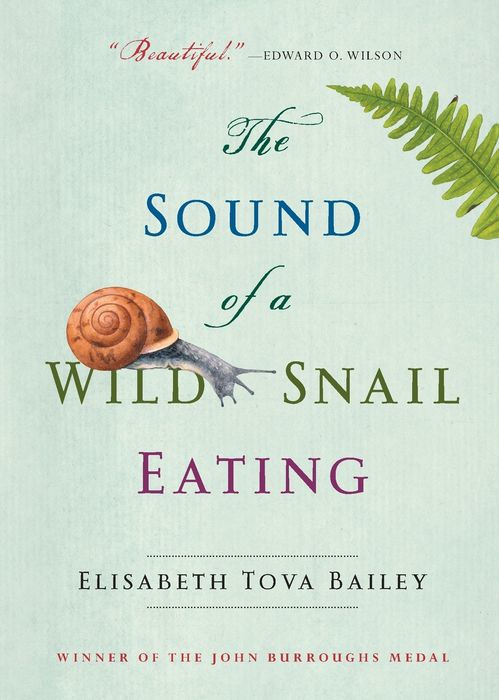
The Sound of a Wild Snail Eating - by Elisabeth Tova Bailey


This book was recommended to me by my son as I was recovering from a recent illness. The author recounts one-year of a decades long illness in which she was unable to even sit up on her own. She finds solace with a snail who lives in a terrarium next to her bed. 

She specifically states that at the worst of her illness she was not able to even read to herself, and that the library was a place (among others) that she could not go. As she recovers a bit she can sit up enough to read again and requests "through interlibrary loan the twelve-volume compendium The Mollusca which covers the entire phylum of mollusks".

A quick, yet meditative read.

Thursday, November 13, 2014

My Year of Meats - by Ruth Ozeki


Jane is a documentary filmmaker who lives in New York City. Akiko is a housewife in Tokyo. Both are being abused by the same man: Joichi "John" Ueno who is Akiko's husband and Jane's boss. Jane is working with John on a television program for the Japanese market called My American Wife! which features a different wife preparing a different meat-based recipe each week. John insists that Jane only scout out "wholesome" white families, and insists that Akiko make each "recipe of the week". As Jane learns more about the beef industry (the sponsor of the show) she begins to subvert the message. The diverse families she showcases also provide Akiko with some new ideas for changing her own life.

The story takes place in 1991, a time before the internet, or e-mail. Communication was done by telephone or fax, and research was done at the library. Jane speaks of going to her hometown public library as a child to research her perfect mate. As the daughter of a Japanese mother and a white father she wanted to produce an offspring who "embodied the United Nations"
In my early teens when Polly and the the other girls were assembling ideal boyfriends from the body parts of teen movie idols and lead guitarists, I was conjuring a mate along very different lines. The way I figured it, I had the chance to make a baby who could one day be King of the World...I went to the Quam (Minnesota) Public Library and looked up "The Races of Men" in an old Frye's geography book
The passages she goes on to describe, written in 1902, are certainly racist by today's standards, which is one reason she feels justified in removing Frye's book from the same library when she returns as an adult.
Call it censorship, but on that trip home to visit Ma after the Bukowsky show, I stole Frye's Grammar School Geography from the public library. It was the least I could do for the children of Quam.
Ah, the rallying cry of the censor! 'I must protect others from this book from which I, myself, do not need protection. I have the knowledge and the critical thinking abilities to handle this work, but alas others do not.'

She continues with her other reason for taking the book
But to be perfectly honest, I wanted the book, and it's not the kind of thing you can easily pick up at a Barnes & Nobel superstore. It felt like antique pornography to me, with its musty old text, quaint etchings, and poisonous thoughts. From time to time I still pore over its stained chamois-soft pages, satisfying my documentarian's prurient interest in the primary sources of the past.
She has no concern for other researchers who might also want the book for the same reasons she does. My advice to those who question what a particular book is doing in a library is to ask a librarian about it.  It might be that the the horribly understaffed library has not been able to take on a "weeding" project to remove outdated materials, or that books are still available as primary sources for researchers. Perhaps a case could be made that Frye's work no longer belonged in the children's department, but that does not necessarily mean that it should be removed from the library entirely, perhaps it should simply be moved to the archives.

Grammar School Geography by Alexis Everett Frye is a real book. You can read the whole thing here.

This was a good read, with a lot of disturbing information about the beef industry, feedlots, and hormones. Ozeki skillfully weaves many different themes together, as well as several story lines.

Monday, January 27, 2014

Like a Virgin - by Aarathi Prasad


I had a bit of trouble concentrating while I was reading this one, not because of the sexual subject matter, but rather because it gave me an earworm. Much as I like Madonna, hearing the refrain of one song over and over in my head was pretty distracting.

This was a fascinating book though, explaining how different organisms reproduce, including those who do so asexually. Discussions of cloning mammals, and advances in fertility treatments demonstrate that a human virgin birth is probably not far outside the realm of possibility, perhaps in the very near future.

There were also two noteworthy things for the "Library Books" blog. One mention that the sequencing of human DNA "has provided a library of essential biological information". If there had been nothing else in this book to blog about here, it might not have even gotten an entry, but in addition to libraries in books, any time I find information about banned books I have to comment. Book banning is a time-honored tradition, which appears to go back as long as there have been books. I can even imagine Neanderthals chipping away someone else's cave drawings in order to put up a "more accurate" or even "less offensive" version of events. The banned book in question here is Aristotle's Masterpiece, or, The Works of Aristotle. This book was, in fact, not written by Aristotle, but includes some of his ideas, as well as others', and was banned in the UK from the 18th through the mid 20th century, when it became available in 1960.

The book includes descriptions of midwifery, female reproductive organs, and all things related to sex and embryos...In the United States...[it] was much more accepted. Until the middle of the nineteenth century, it was the most commonly read medical text-despite the arrival of new microscopes, dissection tables, and complex experimentation, which completely contradicted the book's depictions of the workings of reproduction.
Never let science get in the way of education. Such things are still taking place today as creationists make their religious viewpoints the focal points of science classes, even in public schools.

Tuesday, September 17, 2013

The World's Strongest Librarian - by Josh Hanagarne


Well, I couldn't resist this one! Librarian Hanagarne begins each chapter of his life story with an anecdote about his work in the Salt Lake City Public Library, but most of what this book is really about is found in the subtitle: "A Memoir of Tourette's, Faith, Strength, and the Power of Family". As he tries to find the best way to live with Tourette Syndrome, he is also on a journey of strength training, parenting, and religious questioning.

Hanagarne writes about visiting the library as a baby and how he developed a true love for books and reading from a very early age, and all the librarians knew him by name. I was reminded about taking my own daughter to "book babies" story time at my own public library so that by the time she could walk the librarian remarked that she "strutted around like she owned the place". Now at age 16 she still loves the library, and in fact has a job at her high school library.

I loved reading that as a child Harnagarne's mother let him pick out whatever he wanted from the library. "He can read what he wants" she tells his father who worries that his son will "drive his teachers crazy" when he starts school. His mother's proclamation only goes so far though. She is unhappy about her fifth grader's choice of Stephen King's Misery and puts her foot down, telling him the book is not appropriate for him. Hanagarne, however, finds ways around his mother's prohibition. (See the Wikipedia entry on The Streisand Effect for more information about how forbidding something will only make it more desirable.) I also loved that as a fifth-grader Hanagarne read Are You There God, It's Me, Margaret . While reading Judy Blume's classic work was de riguer for all the girls in my fifth grade class, if any of the boys in my class ever read it, they certainly didn't do it in public.

Throughout the work we see Hanagarne's love affair with books demonstrated over and over again.  As a fifth-grader at a newly built elementary school he marvels at the all the brand new books in the library "a virgin landscape of pages and paragraphs and dust jackets...". He packs eight boxes of books to take with him to college; and knows he has found the woman of his dreams when she shows him the accessories she made for her Strawberry Shortcake dolls as a girl which included  homemade backbacks, each carrying tiny hand-sewn books. "That Jeanette had spent her childhood sewing books so that her dolls could be literate was too perfect." Of course he instills a love of libraries and reading in his own young son, and puts no restrictions on what he can read (at least he doesn't admit to any). Stay tuned next week for my Banned Books Week essay about why I let my daughter read whatever she wants.

I was especially intrigued by his description of a patron in his library who traveled from Nicaragua. The visitor was awed by the huge library, where information was free. A "miracle" he called it, so different than anything he was used to. The following pictures may give readers an idea as to what he meant.

Here is your blogger is at the National Museum in Managua in 2006. Notice not only the use of the card catalog, but that several of the drawers are missing.

Here I am six years later, in front of a library that is closed during the coffee-picking season.

After 10 years of picking away at his undergraduate degree, Hanagarne manages to get his Masters degree in Library Science in just one year. The author sums up his library school experience thusly: "Library school was uninspiring." I often wonder about those librarians I speak with who did find their studies inspiring. Did they take better classes? Go to a better school? or do they just think that much differently than the rest of us? Uninspiring indeed.

The descriptions of body building were the least interesting aspect of the book to me, though I was bemused by the reactions of those who found out what the super-tall, muscular man did for a living. People really seemed to have a hard time reconciling these two facets of his life. "You're a strong guy" one observer says. "Do you work in construction or something?" "I'm a librarian" responds Hanagarne. "Oh. Wait, what - like in a library". Yeah.

I checked  this book out from the library where I work. Our standard location for a barcode is on the top of inside back flap of the book jacket, where one likely finds a short "about the author" biography. And so it is for this book. I got a kick out of the fact that the photo of Hanagarne, holding a boulder over his head, has been altered by the barcode placement, so that he looks like he is holding up the barcode over his head. Seems appropriate somehow for the world's strongest librarian.


Read Josh Hanagarne's blog at http://worldsstrongestlibrarian.com/
Tuesday, June 19, 2012

Drop Dead Healthy - by A.J. Jacobs


During My Year of Reading "Year of" Books I read two of Jacob's "stunt lit" memoirs: The Year of Living Biblically and The Know-It-All in which he attempts to live by all of the Bible's 700 + rules; and reads the entire Encyclopedia Britannica A-Z, respectively. In reviewing my blog posts on these two books, I notice that I never wrote anything about Jacobs having used a library. Perhaps he did, and I didn't blog about it, but I really made a point that year of including such things. It appears we are now one for three. In this work Jacobs spends two years trying out a variety of diets, and exercise regimes in his "humble quest for bodily perfection." Each chapter focuses on one body part. Each month Jacobs researches what he can about the body part, and why it is important for it to be healthy, and how to make it so. One chapter is about the brain, but he never mentions going to the library during that month. The only chapter that suggests he did any research in a library is "The Bladder" (in which he goes on a 3-day juice fast). He tells of returning home after having "spen[t] the day at the library, reading...health books" to find his wife irritable after having spent the day with the kids, and consuming nothing but juice all day. She gave up her fast at that point.

Like his other books, this one is self-deprecating, funny, and left this reader with some food for thought, without having to go to all the trouble of taking on the crazy project herself.