Showing posts with label sexism. Show all posts

Monday, May 5, 2025

Free for All: The Public Library (PBS: Independent Lens)

Featuring viewpoints from PEN America, The American Library Association, librarians, and library users this documentary film provides an historical perspective of libraries from Benjamin Franklin, Melville Dewey, and Andrew Carnegie to the present day culture wars that involve drag queens and a book banning crisis. In addition to many little known librarians throughout history the film gives insight into Arturo Shomburg who built a black history collection during the Harlem renaissance and to Ruth Brown who was fired during the McCarthy era for "harboring" subversive materials. Throughout, the film demonstrates the importance of libraries in all parts of the country (urban, rural, and suburban) as well as the tenacity of librarians in the face of tax cuts and calls to shut down libraries completely.

The documentary Free for All: The Public Library is available for free for all at pbs.org

Wednesday, February 14, 2024

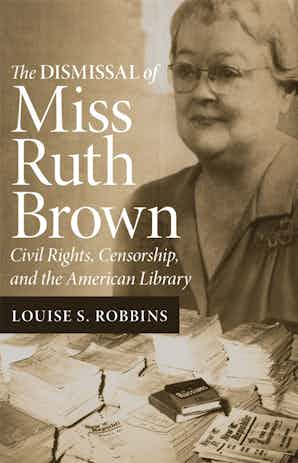
The Dismissal of Miss Ruth Brown - by Louise S. Robbins


Eight years ago I wrote about the film Storm Center. I recently learned that this film, produced at the height of McCarthyism, was loosely based on the case of Ruth Brown, who was fired from her job as librarian at the Bartlesville (Oklahoma) Public Library in 1950. Robbins' book even contains a rather thorough summary of the movie. Bette Davis (who played ousted librarian Alicia Hull) was questioned about taking the role by at least one parent, Anne Smart. 

Smart sent Davis a "report of the book controversy" she was causing in Marin County [California]...Her report depicted in "vivid detail...the type of material being given to our children in some schools. [The report]...made its way around the country for for several years [and contained] the names of authors "all extremely well listed as to their communist and/or communist front affiliations by various government investigating committees."

The more things change... 

Brown was an outspoken civil rights activist in her town. Her racial justice work during the height of McCarthyism made her an easy target. Charges that she was circulating "subversive" materials was a façade for the real reason of her dismissal.

The back cover blurb of this work (published in 2000) reads 

The fundamental issues of the Brown case make it especially pertinent today when differences - in race, gender, class, and national origin - are again feared and as challenges to materials in library collections again escalate. Ruth Brown's story helps us understand the matrix of personal, community, state, and national forces that can lead to censorship, intolerance, and the suppression of individual rights

This description is even more eerily prescient today. As are discussions in the book of neutrality, academic freedom, freedom of acquisition, freedom of access (especially to controversial materials) and the blatant sexism. 

Ruth Brown was one of the women, mostly white and middle-class, who made up 88.8 percent of the allied profession of librarianship in 1950. For a salary less than a man would receive, she organized and maintained a comfortable homelike space where people, especially young people, went for wholesome enlightenment (emphasis mine). The professional role of the librarian gave communities low-cost female employees (emphasis mine) to provide healthy recreational and informational reading while it extended the margins of the domestic sphere without exploding them. The librarian's role did not transgress boundaries as long as the homelike space and the materials and activities organized in it remained safe, comforting, and submissive to the prevailing ideology...

The more things change... 

The Library Bill of Rights was originally adopted by the American Library Association (ALA) in 1939 to ensure access to information (even what some might consider harmful or dangerous) to all. "The ALA articulated the importance of allowing citizens to decide for themselves what they should read, an idea Brown expressed in her interview with the city commission". This is a stark contrast to the description of the "stereotypical" librarian 

in Alice I. Byran's 1952 research report, The Public Librarian...[who] was "rather submissive in social situations" and lacked self confidence. "Indiscreet" was not part of the lexicon by which librarians, especially female librarians, were described. In fact female librarians have been characterized as discreet to a fault in book selection practices, "ruthless in their own censorship." Marjorie Fiske's 1959 classic , Book Selection and Censorship, depicted its mostly female subjects as anxious and fearful, avoiding challenges to library materials through self-censorship.

The more things change... 

 And on a final note, we see the same ideological concerns in libraries today as libraries in Montana and Georgia cut ties with the ALA over president Emily Drabinski's identity as a Marxist lesbian.

The more things change...

Wednesday, February 7, 2024

The Music Man (the movie)


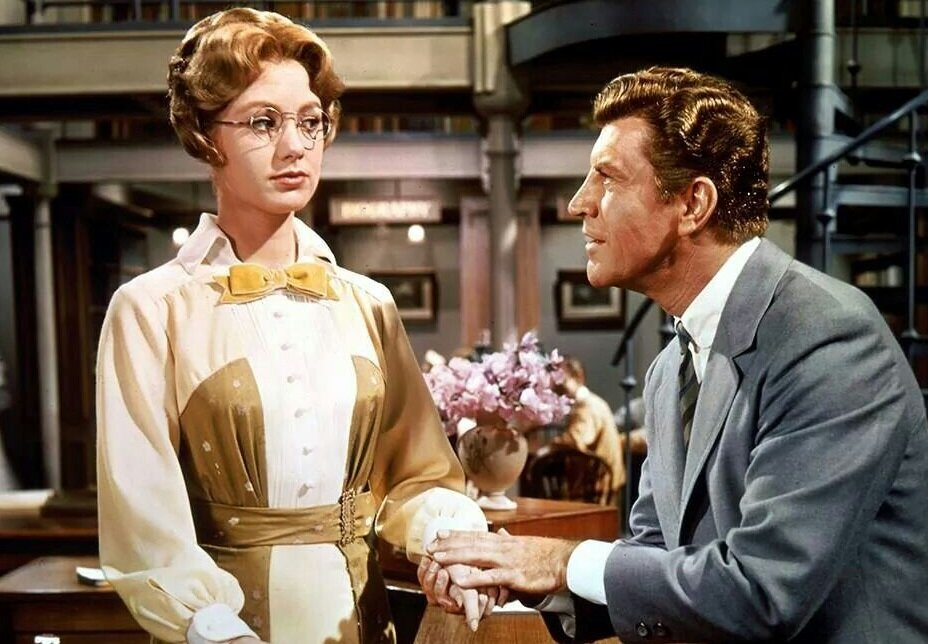
Prof. Harold Hill sexually harasses Librarian Marian Paroo in The Music Man 

I was the guest speaker in my husband's class earlier this week. The lesson for the day was how to find information to do research on Coffee. The day before the class he said he liked to start his classes with some music and asked me to suggest something. "How about Marian Librarian" said I. 


We used a video we found on YouTube. I realized while we were showing it to the class that it had been a long while since I'd seen it (certainly not since before the Me Too movement) and so I felt compelled, after watching it with the class, to mention that this display of sexual harassment was completely inappropriate.

Nevertheless James and I decided to watch the entire two-and-a-half-hour movie together that evening (it actually took two nights because the movie is so very long). I can't deny that it is a fun movie with some catchy tunes, even though the cringe-worthy sexual harassment is all too familiar to those of us who work in public services.

There is almost too much to say about this, so I will stick with the highlights.

First of all Shirley Jones as Marian is, without a doubt, the most iconic of all fictional librarians - a "sadder but wiser"... "stuck up"..."maiden lady librarian who gives piano". Lucky for swindler "Professor" Harold Hill (Robert Preston) that type of woman is exactly his "speciality".

What I remembered about Marian was that she curated a fine collection of materials for use by the citizens of River City, Iowa and was a defender against the would-be censors. Important to note, however, is that Eulalie Shinn, the Mayor's wife (Hermione Gingold), complained about what her daughter was reading, but was unconcerned that others might read the same book. Parents always have the right to dictate what their own children can read. Something Mrs. Shinn understood. 

What I didn't remember was Marian's own heinous crime of ripping a page out of one of the library's books! This is simply not acceptable - even if the librarian does believe that she is going to save the City from itself by doing so. 

There were some interesting things to note about the library hours. For instance, when Marian returns from work in the evening her mother asks "Library open later than usual?" "It always is" is Marian's un-ironic reply. The library was also open on the Fourth of July.

There is some serious "shush-ing" going on at the River City Public Library. Even Marian herself gets shushed by some of her patrons.

And Professor Harold Hill? As my late Grandmother used to say about my Uncle Dave "he can fall in a pile of shit and come out smelling like a rose"

Thursday, January 18, 2024

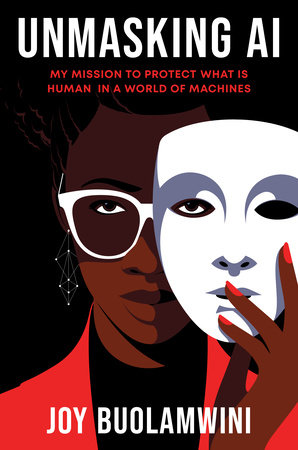
Unmasking AI - by Joy Buolamwini


Algorithms are created by humans. Humans are flawed and have biases, these flaws and biases are programmed into algorithms, perhaps not explicitly, but with consequences nonetheless.

As a graduate student at the Massachusetts Institute of Technology (MIT) Buolamwini, using an open-source face tracking library to work on a project, discovers that facial recognition programs are especially bad at recognizing black and brown faces. Her research eventually brought her to The White House, to testify before Congress, to National Television, and Netflix. And ultimately to become founder of the Algorithmic Justice League. She mentions the use of code libraries on several occasions.

She describes volunteering as an undergraduate at the Carter Center on a project to eradicate tropical diseases. Visiting the Jimmy Carter Presidential Library in Athens, Georgia she 

walked through the gardens near...the library [and] saw a piece of art that offered hope - a bronze statue of a child leading a blind elder using a stick they both held. Sightless Among Miracles had been donated to the center to underscore the effort to support the global control of onchocerciasis (river blindness).

Perhaps the most disheartening (for me) passage was this

After two years on the MIT campus I was finally making my way to the Hayden Library. With online access to almost all the resources I needed, I had yet to step foot into a campus library. After printing out results on archival paper that felt soft yet sturdy to the touch and hunting down last-minute typos, I felt ready to submit my master's thesis.

While I recognize that online resources have allowed us to put libraries into users' pockets, which is decidedly more convenient for all, it doesn't mean the physical library isn't important as a place. And since I'm required to be in my office most of the time, even though almost everyone is using the library remotely, I do wish more people would take advantage of the space.  

Monday, August 1, 2022

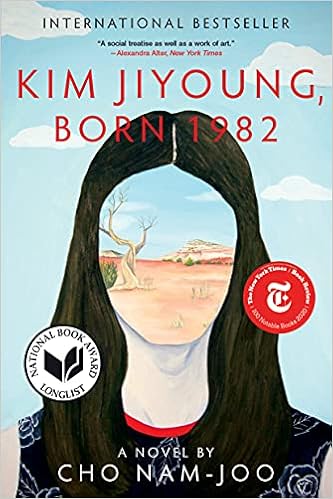
Kim Jiyoung: Born 1982 - by Cho Nam-Joo


This short novel explores the universal expectation that women sidestep their own desires in favor of men's wishes. Girls may be denied educational opportunities in favor of their brothers getting better opportunities. Men are praised for the work women do (both at home and in the office). Women are expected to do errands at their workplace that men are not asked to do.  Husbands continue with careers while wives quit or go to part-time work when children arrive. Sexual harassment is also a theme of this work.

Libraries get two nods in this book. Jiyoung studies with her boyfriend at the university library, and at a client dinner for Jiyoung's division (where she was plied with beer) her division head, after drunkenly making inappropriate comments to her 
hired himself a chauffer over the phone..."My daughter attends university right here. She was studying late at the library and wants me to come pick her up because she's scared to go home by herself".
A worthwhile read for Women in Translation Month, or any month.

Friday, December 17, 2021

Melvil Dewey - by Fremont Rider

December 10 was Dewey Decimal System Day  The date was chosen to coincide with the birthday of the system's namesake Melvil Dewey. In honor of this day I checked out a biography of Dewey from the library where I work (which does not use the Dewey Decimal System). I noticed that his birthday is mentioned several times throughout the work, starting with the first page, and including the fact that he was appointed to the New York Board of Regents on December 10, 1889 (this was included without highlighting the fact that it was also his birthday). 

The book, simply titled Melvil Dewey, was published in 1944, and mostly has praise for the man we now recognize as sexist, racist, and anti-Semitic. Although there is some mention in the work of these latter two identities they are downplayed. His clear bias toward Christianity can be found in the Dewey Decimal Classification system itself. The 200 range of the system is where books on Religion are found. Christianity is covered in the range of 220-280, and "other religions" are relegated to only the 290s.  

His sexism is disguised in the book with passages such as this one: 

All through his life, women were more congenial intimates with him than men; he was more at ease with them; he worked more to more purpose with them; he played with them with greater zest. 

While he did admit women to the Columbia University, essentially forcing the University into co-education, when he started the Library School, we now know that his reasons were less than altruistic. While he believed that well-educated women would make jim-dandy librarians he also left a legacy of low pay as women "were also more likely to get sick or leave the profession to pursue 'home life'". Furthermore, male librarians deserved more pay than women because they "could also lift a heavy case, or climb a ladder....There are many used for which a stout corduroy is really worth more than the finest silk." (See the link at the end of the post for more information on this.)

About 20 years ago the then-president (a man) of my university actually told the librarians (all of whom at the time were women) at a meeting to discuss salaries that we knew when we went into a female-dominated profession that we would make less money - that it was "societal". And that, after all, he couldn't be expected to solve this "societal problem". Why he couldn't try to solve it on our campus is another question. That president's sexist legacy lives on here as well. Librarians continue to work a twelve-month contact for less money than our faculty colleagues who work a ten-month contract. 

Melvil Dewey was also obsessed with simplifying things, especially spelling. He learned and taught shorthand, and changed the spelling of his first name from Melville to Melvil. As well, he attempted to shorten his last name to "Dui". 

An example of his writing included in the work reads

In skool in Adams Center I rebeld agenst compound numbers. I told the teacher that jeometri taut us a strait lyn was the shortest distance between 2 points & that it was absurd to hav long mezur, surveyor's mezur & cloth mesur; also absurd to hav quarts & bushels of difernt syzes & to hav avoirdupois, troy & apothecari weits, with a pound of feathers hevier than a pound of gold. I spred out on my attik room table sheets of foolscap & desyded that the world needed just 1 mezur for length, 1 for capasiti & 1 for weit, & that they should all be in simpl decimals lyk our muni.

He very much liked the metric system and advocated for the United States to adopt it. I remember when I was in Junior High in the mid 70s that we had to learn the metric system in math class because it was coming to the United States, and soon! President Gerald Ford and after him President Jimmy Carter were going to make it happen. Then Ronald Reagan was elected and just like that people stopped talking about the metric system and we are left only in the company of Liberia and Myanmar as the only countries not to have adopted the metric system as the standard system of measure.

While we cannot deny the legacy Dewey has left on the library profession, we are also experiencing a reckoning of the damage his legacy has left. Two years ago the American Library Association changed the name of the Melvil Dewey Medal to the ALA Medal of Excellence. More about Dewey's sexism and racism can be found in this article from Slate.com. 

Wednesday, January 29, 2020

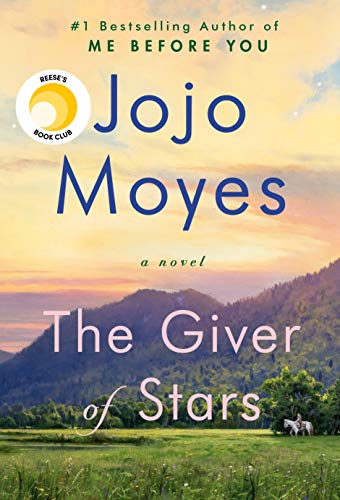
The Giver of Stars - by Jojo Moyes


People often share with me articles such as this one about the Kentucky Packhorse librarians, one of President Roosevelt's Works Progress Administration (WPA) projects. During the Great Depression these bad-ass librarians rode through rough mountain terrain in all weather in order to deliver books to rural Kentuckians. Moyes' novel tells the story of Margery O'Hare, Alice Van Cleve, Sophia Kenworth, Beth Pinker, Kathleen Bligh, and Isabelle (Izzy) Brady who took on the challenge of ensuring all in the mining town Baileyville could access reading materials.

Not everyone in town was happy about the set up. There were those who were not happy that Sophia a "colored" woman was working in the library. And some residents preferred that the librarians not bring any reading materials to their families (except perhaps the Bible), lest they "spread all kinds of crazy notions". Nevertheless even amid reports of 
wives no longer keeping house because they're too busy reading fancy magazines and cheap romances...[and] children picking up disruptive ideas from comic books 
the librarians took their charge seriously, and delivered materials to homes and schools across the mountainside. 

Newlywed Alice volunteered for the duty despite the vigorous objections of her husband and father-in-law who felt that as a proper woman she should stay home. The Van Cleve men, along with Pastor McIntosh and his sister Pamela also insisted that the horse riding was interfering with Alice's ability to have children. "It's like if you shake a jar of milk up too much, it turns sour. Curdles, if you like". Explains the clueless elder Mr. Van Cleve. Pastor McIntosh adds that he'd in fact read an article indicating as much. Although Alice is a bit naive about certain sexual matters, she is well aware of the real reason she hadn't conceived, and it had nothing to do with horseback riding. Rather than pointing out her husband's disinterest in sex she instead launches into an explanation of the importance of information literacy.
Knowledge is so important, don't you think? We all say at the library, without facts we really do have nothing. If I'm putting my health at risk by riding a horse, then I think it would only be responsible for me to read the article you're talking about. Perhaps you could bring it next Sunday, Pastor?
Alice further points out that
in England [whence she hails] nearly all well-brought up ladies ride. They go out hunting, jumping ditches, fences, all sorts. It's almost compulsory. And yet they pop out babies with extraordinary efficiency. Even the Royal Family. Pop, pop, pop!  
One of the more popular books in the library was a discretely requested manual called Married Love by one  Dr. Marie Stopes. The women who ventured to read the work found that their husbands spent less time at the honky tonks and more time at home "shorn of their usual short tempers".

It even worked for those women who preferred not to be married. Margery O'Hare read it twice and she and her beau Sven Gustavssen and made good use of the advice therein. Curious? You can read the whole thing here.

This book has something for everyone - murder, romance, intrigue, censorship, and more. My husband and I listened to the audio version. An excellent tale it is.

See also my post for That Book Woman for a children's picture book about the Packhorse librarians.


Tuesday, January 14, 2020

Masked by Trust: Bias in Library Discovery - by Matthew Reidsma


In the spirit of Algorithms of Oppression this book provides insight into how search engine results are generated. Going beyond Google, which may "customize" results for individual users, Reidsma also explains how library databases aren't necessarily without prejudice either, even though all users will see the same results if they enter the exact same search. Auto-suggestions can likewise shape our thinking in ways we may not have anticipated. All search engines are working on algorithms that were created by people (mostly young, white men). Their own biases will necessarily become part of the algorithm, even if they do not intend it.

Reidsma cites Bonnie Nardi and Vicki O'Day's work to suggest that we rethink the metaphor of library tools to a "library ecology".
The thing about the ecology metaphor is that it highlights the interconnectedness of all these different things coming together in one place. It emphasizes the co-evolution of technology and people. Its [sic] about people and tools together.
Perhaps the most  useful reason for dropping the tool metaphor is that tools require convergent thinking. You cannot create a tool with divergent thinking, where many possibilities exist...
...by switching our focus to seeing our technological systems as ecologies, and thus using divergent thinking to address the design and engineering of these systems, we can move beyond the limitations of tool-based thinking and design systems that are made to be used by diverse people.
This gave me a bit to ponder, and will change the way I teach people to think about and use our databases.

Tuesday, July 30, 2019

Finding Dorothy - by Elizabeth Letts


When I was very young everyone I knew enthusiastically anticipated the annual airing of The Wizard of Oz on network television. When our family finally got a color television set in the mid '70s I was stunned to discover that the Wizard  was filmed in black and white. My mother assured me that the color scenes were coming. It seems that the tradition of the yearly national viewing ended in 1980, around the time that the VHS tape became popular. Once anyone could record or purchase the movie to watch whenever they wanted the ritual viewing was relegated to nostalgia. As for me, I purchased the 50th anniversary edition of the tape in 1989, after I'd seen the movie perhaps 20 times. It came with some extra footage including deleted scenes, and a Wizard-themed commercial for Downy fabric softener. It also had a little booklet with trivia and other information about the filming of the movie. I still own this tape and a videocassette player on which to view it.

The movie is based on L. Frank Baum's book of the same title, the first of many books in the "Oz" series. Elizabeth Letts' book is a fictionalized account of the life of Maud Baum, widow of the author. The story alternates between 1939 and Maud's involvement in the filming of the movie and her relationship with Judy Garland, and her life in the late 1800s - growing up, meeting and marrying Frank, and raising a family with him. A dreamer with a vivid imagination L. Frank Baum wasn't exactly the person suffragist Matilda Gage had in mind to marry her daughter. Maud was one of the early co-eds accepted to Cornell University and Matilda had great plans for her. But the elder Gage also knew she had raised a daughter who would make up her own mind, and that she wasn't going to be browbeat by her mother into a decision not her own. The Baums moved a number of times as Frank chased jobs and financial opportunities. Maud always made the best of whatever life had in store for them. They never could have imagined the success they found when Frank's first "Oz" book was published.

There are several passages describing Maud's time at Cornell, including some in which she utilized the Sage library, a place she knew she could find quiet and solitude.

I was especially intrigued by the two passages regarding censorship of feminist materials. Matilda Gage was a force to be reckoned with and not one to let censorship prevent her from sharing knowledge and information. On the eve of Maud's marriage she lets her daughter in on the secret to limiting family size - information found in a booklet entitled A Woman's Companion - a book "outlawed" by Anthony Comstock "the United States postal director and...vehement anti-suffragist". The booklet advised soaking a sponge in carbolic acid and "push[ing] it all the way to the mouth of the womb" in order to prevent pregnancy. More about Anthony Comstock and his war on contraception can be found here.

As Matilda Gage nears her death she tells her daughter how she'd like her fortune distributed, a fortune that is not as big as she'd hoped. As her own book Woman, Church and State had been "banned from libraries" she did not "earn as much as [she] should have." I expect she would be happy to know that her book is now freely available online for anyone who wishes to read it.

As is often the case with historical fiction the reader wonders which parts are true and what is imagined. Letts helps with this in the Afterword, explaining how she did her research, and where she took artistic licence. One thing we learn is that women in Hollywood (and elsewhere) have been enduring sexual harassment since long before "me too" was a hashtag.


Tuesday, January 29, 2019

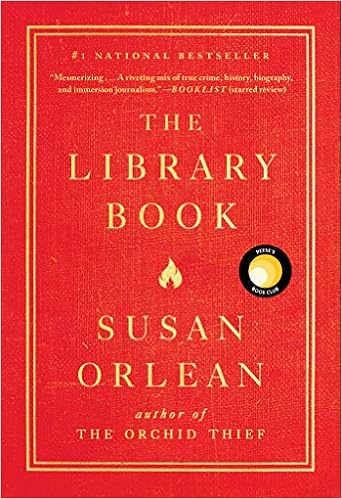
The Library Book - Susan Orlean


This book started showing up all over my Facebook feed late last year. Excerpts, interviews, and recommendations came from friends, family, and organizations. Everything I saw gave me reason to believe that I would love this book. And I did.

Of course it would have been right and good (and indeed, most meta) for me to have gotten a copy of this from a library, but I knew that there would be a long waiting list, and I really couldn't wait, so I purchased and downloaded an e-version onto my iPad. I read it out loud with my husband. We both thoroughly enjoyed it.

Normally when I read a book I mark any passage I find about libraries, so that I can easily find them when I am done reading it in order to write my blog post. It is not so simple when I read a book entirely about libraries. If I were to mark every relevant page I would essentially have to re-read the entire book, and I'd still be hard pressed to figure out what to write about here. So I was forced to make some hard decisions. As it is, I marked over sixty pages, so not even everything I found especially noteworthy made the final cut.

In this ode to libraries Orlean weaves together her own relationship with public libraries with the story of the Los Angeles Public Library (LAPL) and the fire that destroyed the Central Branch in 1986. The tale includes the history of the LAPL begining in the 19th century. Replete with quirky characters including early library director Henry Lummis, and Harry Peak, the man who was arrested for, but never convicted of, starting the fire.

Library Love

Orlean's own love affair with libraries began when she was a child when she went to her local public library regularly with her mother, and they would discuss what books they checked out on the way home. She explains that her family owned very few books because her parents knew that they could get what they wanted for free at the library. In college she eschewed the library and began buying books, to the point that she only had wistful memories of the library. A school project for her first grade son brought her again to the public library
As my son and I drove to meet the librarian I was flooded by a sense of absolute familiarity, a gut-level recollection of this journey, of parent and child on their way to the library. I had taken this trip so many times before, but now it was turned on its head, and I was the parent bringing my child on that special trip...when we stepped in, the thunderbolt of recognition struck me so hard that it made me gasp.
From there Orlean rediscovers her love of libraries, and discovers some things that aren't quite so lovable about them as well. For instance, we see that sexism in libraries has a long history with the tale of Mary Jones who lost her job as director just because they wanted to hire someone else (a man)

Mary Jones' story begins with Mary Foy who was hired in 1880 when
the library was still an organization run by, and catering to, men. Women were not yet allowed to have their own library cards and were permitted only in the Ladies' Room. No library in the country had a female head librarian, and only a quarter of all American library employees were women. The feminization of librarianship was still a decade away.  
Foy served as library director until 1884 when she was removed to make room for Jessie Gavitt, daughter of a "popular rancher". It was further determined that "Foy's father was doing well enough financially that he could now afford to take care of her". A succession of women ran the library until 1905 when Mary Jones, then director, was asked to resign by the library board who believed that "it would be in everyone's best interest to have a man run the library." The man they had in mind was an unconventional fellow named Charles Fletcher Lummis. He was offered the job of director at twice the pay of Jones.

Lummis had been in Los Angeles since 1885, when he walked there from his home in Ohio to take a job as a journalist.  He dressed in a "manner that was not typical for a Caucasian male of the 1880s. His favorite outfit was a three-button suit coat and trousers made of bright green wide-wale corduroy, which he wore with a red-and-black patterned cummerbund."

A philanderer, he was "the focus of endless gossip...reckless, dramatic, quixotic, romantic, and perhaps a bit of a tall-tale teller".

Eventually, Lummis' offensive ways became too much, and in 1910 he was asked to leave.

Fire

The story of the fire is interwoven with the story of the enigmatic Harry Peak who some believed started the fire. Ultimately, it was never determined who set the fire, or for that matter if it was arson at all. Harry Peak, however, always remained a person of interest. He was questioned several times, and even arrested and ultimately had over a dozen stories regarding his whereabouts on the day in question. Sometimes he produced an alibi, other times he put himself near the library (but not in it) and at other times he confessed to the crime.

In describing the fire the author made excellent use of allusion, letting her readers know that "The temperature reached 451 degrees and the books began smoldering".

Censorship, book burning, and information loss is the topic of chapter 9 in this book. From Egypt's Great Library of Alexandria, to the Spanish Inquisition, to the colonizers in the Americas destroying Aztec codices, to what George Orwell called that "most characteristic of [Nazi] activit[ies]" - the burning of books. The Feuersprüche (Fire Incantations)
was a pet project of Joseph Goebbels, the Nazi Party's propaganda chief, who understood how fundamental books were to Jewish culture, theology, and identity. Burning Jewish books, in his opinion was an ideal form of bloodless torture, demonstration the limitlessness of German control...The irony of the Feuersprüche was that they [the Nazi's] treated books as seriously as Jews did. To feel the need to destroy them acknowledged the potency and value of books, and recognized the steadfast Jewish attachment to them.
In describing the LAPL fire and its aftermath the author demonstrates how the burning of books, information loss, and the investigation effected those who worked in the library.
Twenty-four of Central's 250 librarians...asked for transfers to other branches. A survey of the remaining staff asked what the most stressful aspect of the fire was. The answers were dire. They included: "Feeling of powerlessness, helplessness brought about by confusion...feeling of isolation of having to work in an almost empty shell of a building that was once a vital place"; Being afraid that, even though nobody was killed in the fire, somebody is going to be killed or badly hurt..."; and "Feeling like a refugee. Holes ripped in an organic entity."...
Furthermore the "librarians complained of eye infections, breathing difficulties, skin irritation, and post-traumatic stress disorder."

Random Musings

Rather than giving each chapter a title, the author started each chapter with a bibliography of books (along with their Dewey Decimal Call numbers) that were related to the upcoming pages. When I noticed inclusion of a book I'd read (or better yet blogged about - such as chapter thirty's Bibliotech) I was sure to mark it. Chapter fourteen's list caught my attention with the inclusion of Map Librarianship: An introduction by Mary Lynette Larsgaard. The  very book that served as my textbook in 1991 when I took a course on Map Librarianship at the University of Arizona Graduate Library School. A few years ago I found the text in packed away in  box at home and used it to make a book-themed Christmas decoration.


Last Christmas when I put this on display at the library I overheard one student say to another "Look at that, they ruined a perfectly good book to make a decoration". While I agree on principle that we shouldn't destroy books, I also think that making art from out-of-date textbooks is a wonderful use of these works (and frankly, this would otherwise have simply be sent to the recycling bin).

The rumors of the demise of libraries are long standing, as evidenced by LAPL's Senior Librarian Glen Creason's reporting that when he entered library school in 1979 (on a whim, hoping to meet women) that the head of the RAND Corporation announced that libraries would soon be obsolete. 

Perhaps one of my favorite anecdotes in the book is the story about a CBS radio program called Americans at Work that aired during the Great Depression and featured plays about different professions. One of the plays was about a young woman (Helen) wanting to become a librarian. Her mother insists that it is a job for "older ladies who need to help out a bit". Then Helen's uncle comes to the rescue explaining that "a librarian's got to be a right modern smart girl nowadays."

Some things, of course, are universal in libraries. I was especially interested to read about the problem with getting an employee parking lot, something that was an ongoing issue when I worked at the McAllen (Texas) Public Library in the mid 1990s and that people who call asking questions that they can easily "google" the answer to goes on every where.

Orlean had my husband and I crying a bit at the end when she explains why she wanted to write the book
to tell about a place I love that doesn't belong to me but feels like it is mine, and how that feels marvelous and exceptional. All the things that are wrong in the world seem conquered by a library's simple unspoken promise: Here I am, please tell me your story; here is my story, please listen.

Monday, December 17, 2018

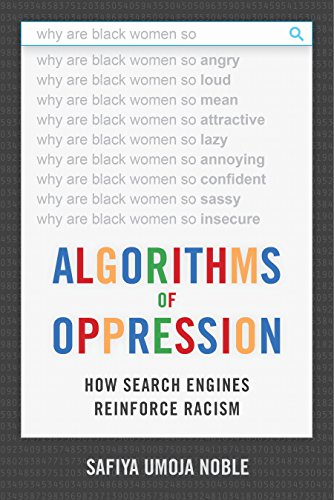
Algorithms of Oppression - by Safiya Umoja Noble


In the aftermath of Hurricane Katrina (one of the most devastating natural disasters of the 21st century) my husband learned an important lesson about doing Google image searches in front of a class. Typing in "Katrina" into the search box he (and the class) were bombarded with pictures of buxom women. This was literally just days after the hurricane struck and news of horrific flooding and drownings were still the top news stories of the day. Noble explains that similar results are returned when one types in the words "black girls".

However much we might want to believe that machines will provide neutral results, the fact remains that algorithms are written by people (mostly young, white men) who wittingly or not, program in their own biases.

My own research on Google and heuristics demonstrates exactly what conventional wisdom tells us: that people are more likely to click on links that appear at the top of a search result list. If people don't see what they want they assume it isn't there. It is very unlikely that someone will look beyond the first screen of results.

This is not only a problem in Google, but in library databases as well. Providing the example of searching the term "black history" in the ARTstor database the author shows a result page full of European and White American artists.

There was a lot to say about libraries and librarians in this work. In some places there is praise for our work, and recognition of our value. In others the author offers fair criticism and suggestions about where we can do some reflection and reparation where outdated language and systems are used.

A few years ago, I gave a presentation in which I compared librarians to colonizers. By creating an ambiguous and arbitrary system of organization and classification, and putting ourselves in charge of it, and, furthermore placing those on the margins in a position that requires them to come to us for assistance we are regulating knowledge, and determining who gets a piece of it. Noble goes even further explaining how the Dewey Decimal System itself, along with the standardized subject headings, were created so as to oppress. Citing the work of Hope A. Olsen from the the School of Information Studies at the University or Wisconsin, Milwaukee Noble explains that

Those who have the power to design systems - classification or technical - hold the ability to prioritize hierarchical schemes that privilege certain types of information over others. 

As recently as 2016 the term "Illegal Alien" was being used as a Library of Congress Subject Heading (LCSH). Students at the Dartmouth College were successful in their bid to have the term removed. The headings "Noncitizen" and "Unauthorized Immigration" are now used. The move was not without controversy and included a threat to the funding of the Library of Congress in the form of  HR 4926 "Stopping Partisan Policy at the Library of Congress Act". Librarians have recognized our own use of outdated and offensive language before, replacing the heading "Jewish question" with "Jews" and "Yellow Peril" with "Asian Americans".

Privilege and bias are also evident in the Dewey Decimal Classification system. For instance over 80% of the 200 range  numbers is used for Christian religions although only about a third of people worldwide identify as Christians.

Librarians, however, also can be credited for discovering and resolving some of these problems. I was reminded of this article, recently shared with me: Remembering the Howard University Librarian who Decolonized the Way Books were Catalogued".  It is important to note that the librarian was a woman of color, highlighting the necessity of a diverse population when designing and creating systems.

In her conclusion Noble envisions a new type of search engine, one in which
...all of our results were delivered in  a visual rainbow of color that symbolized a controlled set of categories such that everything on the screen that was red was pornographic, everything that was green was business or commerce related, everything in orange was entertainment, and so forth. In this kind of scenario, we could see the entire indexable web and click on the colors we are interested in and go deeply into the shades we want to see...In my own imagination and in a project I am attempting to build, access to information on the web could be designed akin to the color-picker tool or some other highly transparent interface, so that users could find nuanced shades of information and easily identify borderlands between news and entertainment, or entertainment and pornography, or journalism and academic scholarship.
This is indeed an ambitious project, and I would add that all caveats for design would apply. Such an undertaking would need a large, diverse group of people to categorize. As well I would be cautious about cutting into the autonomy of the users. What is pornography to some is art to others. Letting an algorithm decide what is scholarship and what is journalism can also be problematic. Some scholarship isn't really scholarship, and some journalism isn't really journalism. No matter what search engine is used everyone should use deliberation and do their due diligence in making selections about sources.

On the final page Noble reminds us that
Now more than ever we need libraries, universities, schools, and information resources that will help bolster and further expand democracy for all, rather than shrink the landscape of participation along racial, religious, and gendered lines.