Showing posts with label Scotland. Show all posts

Thursday, July 9, 2020

Mobile Library - by David Whitehouse


Mistreated by his father, and missing his only friend Sunny, Bobby takes off on a road trip with Val Reed and her daughter Rosa in a recently de-commissioned bookmobile. Val had been charged with the weekly cleaning of the Mobile Library and allowed Bobby and Rosa to come with her while she worked so they could read books (and take some home, as long as they brought them back). As she works, Val explains to the children that not all mobile libraries are trucks; in some parts of the world they use animals. In Kenya they use camels and in Zimbabwe they have a library cart pulled by a donkey and in Thailand they use elephants. Val also explains that in Norway they have a library boat that "can take the books to all of the old people who live on little islands" (see my post on Swamplandia! for a fun library boat read) and more about book mobiles can be found here

Val makes clear to Bobby that she is not the librarian, although she wishes she were. She does tell a gas station clerk that she is the librarian when he questions her about driving the big truck "I wouldn't make much of a truck driver with these little, feminine arms, now would I?" she offers by way of explanation. Neither is she afraid to shush like a pro those who say inappropriate things.

When Val learns that the mobile library service has been stopped "because it costs too much money" the she decides to take the children off on an adventure, disguising the truck with some stolen paint. Val's biggest concern with the closing of the mobile library was the loss of  "the stories...[and] discoveries they had made in them...they had cheered a victorious hero and willed a villain's comeuppance...Parts of themselves they'd never noticed absent, concealed in the ink on the page". Bobby likewise had pangs of missing the library even before it closed.
Despite the many ways his imagination had been opened up by the mobile library, he could not imagine wanting to be anywhere else, with anyone else. The mere thought of it filled his bones with the inexorable ache of yearning.
In addition to missing his friend Sunny Bobby is also missing his mother, who left the family some time before. Bobby had been collecting pieces of his mother's clothing, hair, and other relics so that when she returned they would be able recreate everything just as it had been. Bobby considered himself his mother's archivist, and kept his files hidden under his bed. They are the only thing he takes with him from home when he starts on his grand adventure.

There are a lot of references to other works (mostly children's books) both subtle and overt in this one.

Thursday, December 6, 2018

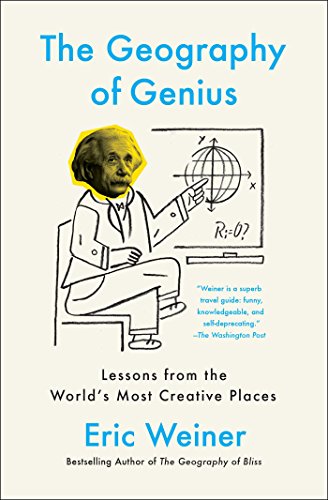
The Geography of Genius - by Eric Weiner


Nine years ago I embarked on a project of reading "Year Of" books. One of the books I read, together with my geographer husband, was Eric Weiner's Geography of Bliss in which the author sought out the world's happiest places. When we discovered that Weiner had written another geography book we downloaded it and listened to it together during our regular drives between Bridgewater and Fairhaven. In The Geography of Genius Weiner visits places that were once hotbeds of creativity, or in the case of Silicon Valley, still are.

Of course libraries are essential elements when discussing genius and Weiner mentions them no fewer than twenty times.

Twice he used the library as a metaphor:

  • In Athens, Greece he decides to take a walk, as was the wont of many of the great thinkers who hailed from that city. His host, Tony, "approves of walking". However, it appears to Weiner that "this approval does not extend beyond the realm of the theoretical as Tony's expanding belly "says more about the divide between ancient and modern Athens than a library's worth of books".
  • It seems that the stereotype of the shushing librarian will be around for quite some time. Weiner uses the image to explain that working in a quiet space may in fact not be conducive to creative thinking. And that it is in fact the moderate noise levels found in coffee houses that make them ideal places to incubate ideas.

Importantly, Weiner also points out that libraries are not just places for books, but for programs and as gathering centers as well when he sees people queuing for a lecture at the National Library in Edinburgh, Scotland.

Libraries weren't always a public resource. Early libraries were by membership or subscription only. Today public libraries are recognized as the People's University. Block printing during the Song Dynasty (969 to 1276 AD) in Hangzhou China brought information to the masses. "Soon, thousands of titles, on all sorts of topics, were published each year. One library alone, at the Imperial Palace, housed some eighty thousand scrolls."

In Calcutta he discusses colonization with this description of Job Charnock - a seventeenth-century English sea captain, who married an Indian woman.
He wore loose, baggy Kurtas, smoked a hookah...and drank the local libation, a potent moonshine called arrack. Job Charnock, founder of Calcutta, son a English aristocrats, proud servant of the queen, went native.
That might come as a surprise given our image of the British and their attempts to rule India without interacting with India.
Charnock was the exception to those who agreed with Lord Macaulay "a senior official in the Raj, who infamously said that a single shelf of a good European library was worth the whole native literature of India and Arabia."

The same type of European-superiority thinking is evident in Joshua Hammer's work The Bad-Ass Librarians of Timbuktu as well.

Throughout his travels the author sings the praises of several librarians who helped him along the way:
  • In Hangzhou, China a librarian named Norman delivers a difficult-to-find copy of the English translation of Brush Talks from Dream Brook by eleventh-century genius Shen Kuo to Weiner's hotel "with all the furtive intrigue of a drug deal or CIA drop".
  • During a visit to the archives Laurentian Library in Florence (designed by Michelangelo) he speaks with Dr. Shelia Baker who is excited about a recent discovery of a letter written by Galileo to a friend. She also explains that to those who lived in the 15th century a book cost as much in relative terms as a car does today. Books were status symbols. Scholars were people who owned many books (even if they never read them).
  • In the Silicon Valley Archives where he walks "into a majestic room, brimming with wooden cabinets and history" a librarian hands him a cardboard box filled with correspondence from Fred Terman's days at the Harvard Radio Research Laboratory during World War II.
  • And, finally, in the acknowledgements Weiner thanks Kathleen McNamara director of Georgetown University's Mortara Center for providing "that most valuable of gifts: a library card."
Smart people use libraries.

Wednesday, December 16, 2015

The Library Window - by Margaret Oliphant


Reading is cyclical. I had barely just started reading The Meaning of the Library: A Cultural History, edited by Alice Crawford, when I found out about this story (mentioned on pg. xv of the Introduction) written in 1896. A library ghost story, this is a metaphor for all the mysteries in libraries, those solved as well as those yet to be discovered. Is there a false window in the Library, or is it a view into another world? The entire story is embedded below. A synopsis can be found here. 


Thursday, October 16, 2014

Miss Peregrine's Home for Peculiar Children - by Ransom Riggs


Using real vintage photographs Ransom Riggs creates an eerie story of time travel and creepy kids. Miss Peregrine's charges live in a "loop" in which it is always September 3, 1940. They are visited by Jacob, whose grandfather once lived among them. Jacob tells them about the future, and gives them the sad news that his grandfather, Abe, has died. Jacob discovers that he, too, is "peculiar" and learns that the stories his grandfather told him growing up (about kids with such gifts as the ability to levitate, and invisibility) were all true.

After Jacob witnesses his grandfather's death, and swears he saw a real monster kill him, Jacob's parents send him to Dr. Golan who recommends a visit to the library to see if he can make any sense of his grandfather's last words. He falls asleep over some of Ralph Waldo Emerson's writing, and wakes up screaming, upon which he is "unceremoniously ejected from the library."

Also at Dr. Golan's suggestion, Jacob and his father travel to Scotland to visit the place his grandfather lived. There he finds a library in Miss Peregrine's home. The first time it appears in the present day in an abandoned and bombed out building where "the creep of moisture had bowed the shelves into crooked smiles". He sees it again as it appeared in 1940 where it was in "a real classroom". He finds in the library the Map of Days (easy to find because it was "the largest one in the library").

A good spooky read for October. I plan to read the sequel.