Showing posts with label ohio. Show all posts

Tuesday, February 9, 2021

When Truth Mattered - by Robert Giles

Published last year for the 50th anniversary of the Kent State Shootings author Robert Giles describes how the Akron Beacon Journal (the local paper that covered the protest and the shootings as they happened) worked to ensure that the reporting was accurate and true. 

On May 4, 1970 four students at Kent State University were murdered and nine others wounded when National Guardsmen fired on a peaceful demonstration against the Vietnam war. Of course in 1970 there was no internet, and no one had a cell phone, so newspaper reporters and photojournalists who were on the scene were entrusted to report the events. Live reports came in via landline telephones to the newspaper offices, that were then turned into stories by news writers. What is clear from this work is that misinformation, and indeed the deliberate spreading of disinformation are not new phenomena. Stories that two Guardsmen were among the dead who were "taken to the hospital, but someone switched their uniforms for hippie clothing" resonated with contemporary rumors that antifa dressed as Trump supporters in MAGA hats were really responsible for breeching the Capitol last month. Of course this book was published prior to the events of January 6, and as I was reading I couldn't help but wonder how the events would get reported if they happened today. I was not alone in questioning this. The final chapter of the book "The Meaning" explores this.

Initially the crush of digital information would be unmanageable for editors and news directors to sort out...Before long, though, differences would emerge. Common facts would no longer be universally accepted. The cultural wars of the time would twist reason and truth in the emerging search for blame. Each witness would possess personal evidence they would carry with them for a lifetime.

The digital images would shape memories; some would become weapons for taking sides, framing opinions, and inserting bias.

Algorithms would create a moment in which hundreds, maybe thousands, would be clicking, trying to tell the story...

The Beacon Journal had resources to quell some of the early rumors. Early reports indicated that a sniper among the protesters had shot at the Guardsmen prior to their opening fire. Evidence in the form of a bullet hole in a metal sculpture on the campus seemed to corroborate this.

To the untrained eye, the shape of the bullet hole - about the size of a penny - affirmed the sniper theory. Metal from the hole splayed in the direction of the Guardsmen as they fired their rifles. The smaller smoother edge was on the other side of the sculpture, away from the soldiers. This seemed to clinch the sniper argument...

The newspaper, however, had the resources to perform its own forensic testing and demonstrate that a metal plate when shot by an M-1 rifle and .30 caliber ammunition "identical to that used by the National Guard" caused the metal to splay out "from where the bullet had entered the the steel plate, rather than from the exit" thereby providing evidence that the bullet came from the direction the Guardsmen were firing. 

I can't imagine that a local newspaper today would have the resources to conduct this kind of investigative journalism. Where the Beacon Journal had a staff of hundreds, contemporary newspapers may employ dozens. Furthermore, I wonder whether providing this kind of evidence would even matter. When Obama produced his long-form birth certificate (exactly the evidence that "birthers" claimed would stop the madness) those same deniers refused to believe what they saw.

Of course no discussion of Kent State would be complete without mentioning of the Cosby, Stills, Nash, and Young song "Ohio". For this blogger the most relevant information I learned about the song from Giles' book is that it was initially censored after it was recorded. When it was released in June 1970 some AM radio stations refused to play it. It did, however, find a place on the air on some underground FM stations and ultimately became the well known protest song it is today.

The Beacon Journal received a Pulitzer Prize in 1971 for its reporting of the events at Kent State. Giles describes his visit (in 2018) to Colombia University's Rare Book and Manuscript library, where the Pulitzer Prize Collection is housed, in order to do research for his book. The reverential tone of this passage makes clear the importance of librarians and archives in keeping our history and telling our stories.

Getting access to the Pulitzer Prize newspaper files was an elaborate process. We were accompanied to our destination in the University's Butler Library. Our first task was to establish our identity. The librarian explained the limits on material that could be taken into the "reading room". This was even quieter than most library spaces...Glass doors gave a full view into the reading area

The librarian gave each of us a pair of white gloves to wear in our search of the material. She explained that we each had to use a No.2 lead pencil to write notes from our research...

On a final note I have this story of my own to tell. Five years ago I was in Nicaragua and spoke to a muralist who was touching up an outdoor painting. The artwork depicted a shooting on a college campus with four students dead. I asked him about it and he told me it was an incident from the 1950s in which the government brought in the military to a student protest. I told him about Kent State Shooting and pointed out the striking comparisons between it and the event he described. He told me he hadn't heard about the Kent State shootings, but he really wasn't surprised to learn about them because since he'd created the mural he'd spoken to people from all over the world who had described similar events in their own countries.

In an age of fake news, and misinformation this work makes clear the importance of a free press. 


Friday, July 3, 2020

Monumental Mobility: The Memory Work of Massasoit - by Lisa Blee & Jean M. O'Brien


I read this for a faculty book discussion at the university where I work. It has local interest as the original statue of Massasoit (8sâmeeqan) is located on Coles Hill in Plymouth, Massachusetts about 20 miles from the university. Created by artist Cyrus Dallin in 1921 to commemorate the 300th anniversary of the landing of the Pilgrims, replicas of the statue can now be be found in Dayton, Ohio; Kansas City, Missouri; Provo Utah; Springville, Utah and on the lawn of the Howard B. Lee Library at Brigham Young University (BYU), where students refer to the monument as "the naked Indian" and are scandalized over that fact that 8sâmeeqan doesn't adhere to BYU's dress code. One student with whom the authors spoke suggested that the statue be moved near the gym "to align with student-athletes in their sometimes-skimpy BYU-issued gym shorts". However, the student also pointed out that such a location "could be interpreted as the rival university's 'Ute' mascot and serve as target practice...".  

The original statue was commissioned by the Improved Order of Red Men, a fraternal organization still in existence and "limited to physically, mentally, and morally sound" white men. Its headquarters are located in Waco, Texas, and the authors made good use of its research library there. The Red Men Museum and Library also owns some 11-inch replicas of the statue commissioned as a fund-raising effort just before the statue's unveiling.

It was certainly an interesting time to read and discuss this book, not only because we are now recognizing the 400th anniversary of the Pilgrims' landing, an anniversary celebration that has been in the works for many years, and will now take place virtually, but also because we are witnessing the destruction of monuments to colonizers, and taking part in a larger discussion of the meaning of monuments to those who build them, those who visit them, and those who remove them.

The final chapter of the book "Marketing" explores how the statue has been exploited, along with other memorials, to make Plymouth a tourist destination - America's Hometown (and I know some Washingtonians who would dispute that moniker). The authors describe several tours available to tourists, some that provide a Pilgrim-centric view, and others that "challenge...expectations for a celebratory settler origin story." The traveling exhibit Captured! 1614 opened in 2014 in the Plymouth Public Library. 
Created under the guidance of Mashpee Wampanoag Paula Peters with a team of Wampanoag designers, researchers, and historical interpreters...the exhibit panels and series of short films...Captured! 1614 presents the Patuxet Wampanoag perspective on the slaving expedition of Thomas Hunt, who seized twenty men and boys from Patuxet, including Tisquantum...for sale in Spain...According to Peters, the reception of the exhibit has been overwhelmingly positive among Wampanoag communities and non-Indian viewers.
Excellent scholarship written for everyone.

Monday, May 20, 2019

Everything I Never Told You - by Celeste Ng


Lydia Lee has a lot of pressure on her. Her mother (Marilyn) wants her to be a doctor (a dream she did not fulfill herself) and her Chinese-American father (James) wants her to be popular and to fit in (a dream he never realized). When their daughter's body is discovered at the bottom of  Middlewood Lake the Lees must come to grips with her death. The omniscient narrator gives the reader insight into each of the other members of the family and their histories, as well  as Jack, a classmate, and a person of interest in Lydia's disappearance. Readers eventually know for sure what happened. The Lees, however, are never convinced.

The story takes place during the late spring and summer of 1977. A time when Nath Lee, Lydia's older brother, is looking forward to starting Harvard. Harvard played an important role in the Lee family history; it is where Marilyn and James met in 1957 (in the history department which "had the peaceful quiet of a library"); and it was where James, notoriously, did not get hired once he earned his Ph.D.

Just before his sister's death Nath visited the Harvard campus where he
wandered awestruck, trying to take it all in: the fluted pillars of the enormous library, the red brick of the buildings against the bright green of the lawns, the sweet chalk smell that lingered in each lecture hall.
It is clear that James also remains in awe of Harvard. And that perhaps his son's acceptance is a vindication for him.

James' upbringing in Iowa, where he was the only person of Asian descent at the elite boarding school where his parents worked as a groundskeeper and kitchen worker made him long to be like everyone else. He surprised everyone at Lloyd Academy by passing the admission test, which allowed him to attend the school for free as the child of employees. He had no trouble answering the exam questions having learned so much from reading "all the books his father had bought, a nickel a bag, at library book sales."

Nath also took advantage of the library growing up. As a child he managed to get the librarian to allow him to borrow books from the adult section, and remained engrossed in learning about outer space, physics, and flight mechanics throughout his high school years.

And, finally, on a non-library note I feel compelled, as the wife of a geographer, to snark about this bit of undeserved Harvard fascination:

James' teaching assistant Louisa is less than impressed with some of the responses she found on student exams and tells him
I hope the summer students will be better... A few people insisted that that the Cape-to-Cairo Railroad was in Europe. For college students, they have surprising trouble with geography.
To which James responds:
Well, this isn't Harvard, that's for sure.
Except that it appears that where geography is concerned Middlewood College may indeed be able to hold a candle to our friends in Cambridge. Harvard, in fact, infamously got rid of its Geography department in 1948 when University President, and homophobe, James Conant declared geography "not an academic department".

This YouTube video give us some insight about the current state of geographic understanding at Harvard.

Tuesday, April 16, 2019

The Public (the movie)


I've been waiting well over a year to see this. It finally showed up in theaters earlier this month, just in time for National Library Week. I spent most of National Library Week attending the Association of College and Research Libraries (ACRL) national conference in Cleveland, and was glad to wrap up my time in the Rock & Roll Capital of the World at the Cedar Lee Theater in Cleveland Heights. As a former Ohioan it was a special treat to see this Ohio-based film in the state where it was filmed.

Written and directed by and starring Emilio Estevez, this film tells the story of  librarian Stuart Goodson who works at the Public Library of Cincinnati and Hamilton County. During an especially cold spell in the city a population of homeless men decide to occupy the library overnight as they have no where else to go to escape the bitter temperatures when the building closes. Goodson stands with his patrons and likewise refuses to leave the library. Speculation from law enforcement, local politicians, and the media about what is happening inside the barricaded building leads to misinformation, and some "fake news" reporting.

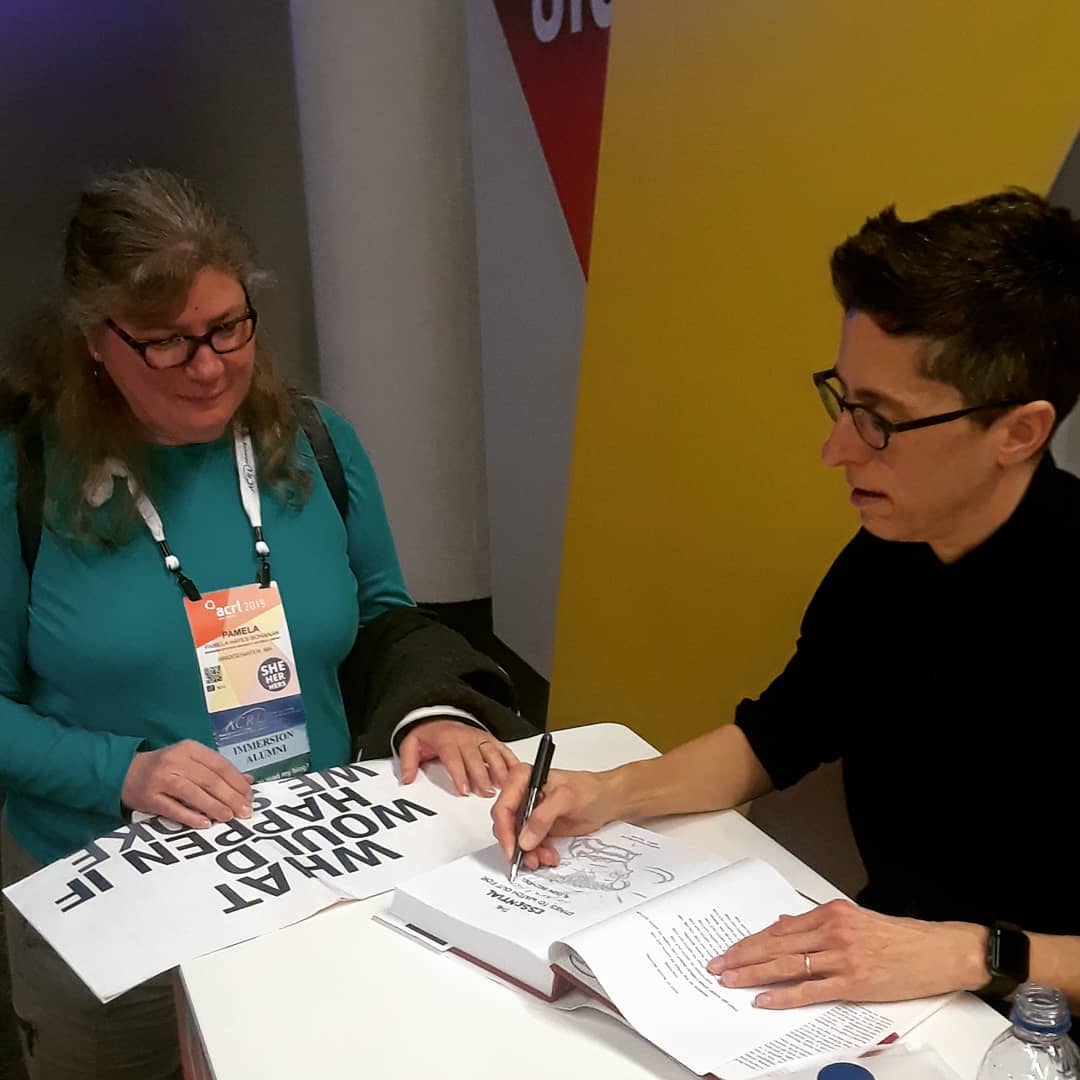
The last thing I did at the ACRL conference was attend the keynote address and book signing by Alison Bechdel. I had her sign my copy of Essential Dykes to Watch Out For From there my husband and I had lunch and then made our way to the theatre. I must say that was getting a bit worried that this film would not pass the Bechdel Test, but ultimately it came through (but just barely). It really would have been especially tragic to watch a failing movie on the very day that I met Bechdel. It seems a film about a profession that is dominated by women could have done better than to just squeak by. Nevertheless, I enjoyed this film. It was well acted, well directed, and had a good surprise ending.

More about Alison Bechdel's keynote can be found here.

Passing the Bechdel Test with Alison Bechdel


Monday, July 30, 2018

Eligible - by Curtis Sittenfeld


The cover tells us that this is "A Modern Retelling of Pride and Prejudice". Like so many others, I read Austen's P&P in college. Not only that, but I wrote my own "modern retelling" of the tale for a writing assignment. I don't remember the novel very well, nor much of what I wrote in my own version; however, I do recall writing about some "scandalous" affair involving a teen pregnancy and a hasty marriage (based on the true woeful tale of a girl in my high school, and her catholic-school boyfriend). Like Austen's novel this one revolves around a gold-digging mother (well, let's call her "upwardly mobile") wanting to marry off her five daughters.

Eligible is written by someone with a lot more writing experience than I had as a college freshman. She also has a lot more material to work with in the 21st century than I would have even known to consider in 1986. This is to say that Sittenfeld's has written a richer and funnier story than I did, with more interesting characters.

Sittenfeld's classic biting critique of modern life is as evident in this as it is in her other works. And also like her other works, the library is part of the scene, but doesn't necessarily play a role. The favorite daughter, Liz, works for a women's magazine. Her first job in publishing had been as a fact-checker for a prestigious magazine, where she first met her (married) boyfriend, Jasper.
They had started their job using computers with spotty Internet connections, back when fact-checking  meant visiting the public library or waiting anxiously for the return of phone calls.
Mr. Bennet frequents Cincinnati's Mercantile Library to do research and explore the genealogy of his family. And Liz uses the public library to check out an audio book she hopes will keep her parents occupied on a long car drive.

One need not have read the original Pride and Prejudice to enjoy this wicked version. Fans of the Austen's work will find all the expected characters including Mr. Bingley (here a reality television star) and Mr. Darcy (a surgeon). An excellent summer read. I will have to revisit the original now.

Thursday, November 30, 2017

Little Fires Everywhere - by Celeste Ng


The first time I heard of Shaker Heights, Ohio was in 1987. I was temping in an office in downtown Baltimore, sending surveys to the company's clients. I remember typing "Shaker Heights, Ohio" onto an envelope and wondering where it was in relation to Oxford, Ohio - the college town to which I was about to move (216 miles, BTW). After I moved to Ohio I heard a lot more about Shaker Heights, a wealthy suburb of Cleveland from whence a fair number of students who attended Miami University of Ohio (one of the so-called "public ivies") hailed.

Developed as a planned community, Shaker Heights has some rather strict zoning laws, and for resident Elena Richardson the orderly layout of the city mirrors the careful planning of her own life: education, marriage, job, children. She didn't count on her youngest child, Izzy, to be a black sheep, and likewise never dreamed of the disruption that her new neighbor, Mia and Mia's daughter Pearl, would bring into her life.

As I wrote in my Stepford Wives post some years ago "you can't have a perfect town, if it doesn't have a library". Shaker Heights of course has a public library - a safe place to which teenager can ride a bike alone, or that offers a convenient lie as to his whereabouts; where an artist can find a biography of Eleanor Roosevelt; where an adoptive mother can take her infant to story hour; or a social worker can arrange a visit for the birth mother of that same baby to have a court-ordered visitation. The public library in Ng's books functions as all of these.

Shaker Heights' excellent schools also have libraries, of course, and attorney Ed Lim knew that there were very few books with Asian characters to be found in them, one exception being The Five Chinese Brothers which Lim's daughter checked out in second grade and had caused her to return "home deeply troubled". Ng's story takes place in the late 1990s, a time when emphasis on diversity in schools was just emerging, before people "would talk about books as mirrors and windows".

Teenager Pearl has spent her whole life traveling with her artist mother from place to place, sometimes moving twice a year and "had spent most of her childhood in libraries, taking refuge among the shelves as a new girl bouncing from school to school, absorbing books as if they were air".

The fact that libraries are often places of stability and comfort can belie the fact that they can also be places of controversy. Is the library really a good place to have a supervised visit? What books are appropriate for young people to read, and what should be the fate of those that are troubling?

There is definitely a shake up in Shaker Heights.

Friday, July 14, 2017

Post-Traumatic Church Syndrome - by Reba Riley


In my quest to find a religiously-themed, yet light-hearted story for a possible One Book One Community Read I came across Riley's book. Like Jared Brock's A Year of Living Prayerfully Riley makes a "year of" project out of exploring a variety of religions. The purpose of her search, however, is quite different than Brock's, and she also is more willing to examine faiths beyond those with a Judeo-Christian history including Muslims, Wiccans, and Native American spiritualities.

An interesting connection between her book and Brock's however is that both are living with a chronic, undiagnosed illness. The Sickness, as Riley calls it, sometimes prevents her from researching as much as she might before attending a service. For instance she was surprised to learn that visiting a synagogue on Yom Kippur without a ticket just wasn't a thing.

She does mention doing research on several occasions, including twice using a library, even checking out a book on one occasion!

Riley's year goes from her 29th birthday to her 30th attainment day. I cringed when she referred to this as her 29th year. It was her 30th. The day a person is born they begin their first year, which ends the day before their first birthday. Their second year begins, then, on their first birthday, and so on. Her mistake though is common. Let's agree to stop this madness here and now.

Despite my issues with her counting of years, I enjoyed the book. It is funny, and the author kept the focus on herself. It is definitely a contender for One Book One Community.

Friday, March 31, 2017

I Hadn't Meant to Tell You This - by Jacqueline Woodson


This young adult novel tells the story of Marie who befriends the new white girl (Lena) at her predominantly black middle school. Lena confides to Marie that her (Lena's) father is sexually abusing her and Marie promises not to tell anyone Lena's secret. Their friendship is challenged on many fronts and Marie learns some difficult truths.

Marie's single father dates Rose, the town librarian (who doesn't actually appear in the book). However, the town library has a small role in this work as Lena's sister's (Dion's) "favorite place in the world. She actually had a temper tantrum if...picked up too early." The library is likely a safe place for the little girl who lives with a neglectful and abusive parent.

Tuesday, February 28, 2017

Mary Hartman, Mary Hartman - the television show, Season one episodes 1-9

Back in the mid 1970s, two soap opera spoofs aired that pushed the limits of parody. Soap was a weekly, prime time show that my whole family enjoyed watching. Mary Hartman, Mary Hartman really went a step further, a daily show that aired during a regular daytime drama slot. The show, however, was far from regular. The usual melodrama found on a soap was compounded and all sets, characters, and scripts were exaggerated. The title character, played by Louise Lasser, represented a suburban housewife in a blue collar family who, in addition to facing the usual stresses of marriage and raising a pre-teen daughter, also confronts the challenges of a mass murderer in the neighborhood, an exhibitionist grandfather, and a host of other problems.

The show is really quite sophisticated in its humor, and without a laugh track the audience is left on its own to figure out what is funny. Exaggerations and stereotypes comprise much of the farce. Re-watching the show now, four decades since it first aired, I commented to my husband that the sets look less like they were created in the '70s and more like they were created in the '90s to look like the '70s. That's quite a trick! Librarian stereotypes are, of course, some of my favorite things to write about, and this show managed to represent two different librarian clichés over two episodes. Episode five ends with our heroine receiving a phone call from a short, bespectacled, older, bun-headed, shusher-type (Iris Korn) informing her that the books she wanted had come in. She goes on to read the titles out loud, all of which fall along the lines of  'Your Orgasm and You', and other sexual self-help titles. The start of the following episode finds Mary arriving at the library to find a rather effeminate male librarian (Ken Olfson) behind the desk. She asks to speak to the "lady librarian" but is informed that she has left. While Mary pretends that the stack of martial aids that were set aside are not really for her, the librarian pretends that he simply cannot check them out to her since they were set aside for someone else. Ultimately Mary manages to wrest the books away from the library and bring them home, where they almost become another character in the story. Mary's husband Tom (Greg Mullavey) is embarrassed when a friend from work notices the books in the kitchen. Tom confronts Mary about them, and is incensed when she doesn't immediately return them from whence they came.

There is practically enough material here to write an entire Master's Degree thesis.

There are two more discs of episodes coming to my mailbox from Netflix. If there is any more drama about libraries or library books you will find out here.

Stay tuned...

Thursday, March 17, 2016

Carsick - by John Waters


Baltimore, Maryland holds a special place in my heart. It is not only the land of my birth, it is also where I met, fell in love with, and married my husband. If all this weren't enough to make me feel good about the place it also is the home of movie director John Waters. My husband James and I are long-time fans of Waters and enjoyed reading his book about hitchhiking from his home in Baltimore to his home in San Francisco together. The book is divided into three sections. The first is a fantasy  trip called "The Best that Could Happen"; the second a fantasy trip entitled "The Worst the Could Happen"; and the third called "The Real Thing". Fantasy chapters included rides with celebrities, alien abductions, magic farts, and some rather poopy pants. None of this will surprise those who are familiar with Waters' work. The third section was actually the most surprising. It is where Waters cynicism is least evident. He was genuinely grateful for all who picked him up, even if only going a few blocks. He was also touched by the number of straight men he met who spoke lovingly, and affectionately of their wives, and enjoyed the company of all who rode with him.

Of course as much as I enjoy any book, it does not find a place on this blog without at least touching on some aspect of libraries. Waters' book makes the cut for his fantasy chapter "Bernice" in which a renegade librarian who runs her own bookmobile-type service delivers paperback porn (without cover art) to niche collectors. They visit one of her clients, Cash, who lives in a house made entirely out of cover-less paperback smut. (I don't know if such a house actually exists anywhere, but I do know there is a house in Rockport, Massachusetts made entirely out of newspapers).

What I especially liked about this chapter was that Waters says he knows "how wild librarians can be" having been a keynote speaker at "several of their conferences." Since I was a librarian at a conference in which Waters was the keynote speaker (the Association of College and Research Libraries 2007 conference in Baltimore) it was almost like reading about myself - wild librarian that I am.

I marked one other passage in this book for blogging, even though it had nothing to do with libraries. It did, however, have to do with Baltimore nostalgia. Those who have seen John Waters know about his iconic mustache. During his "real" trip, he frets that it is starting to get a little bushy, and compares himself to "Baltimore's longest-running TV weatherman", Bob Turk. It is not just that I remember Bob Turk, in 1975 an eleven-year old me was invited to read a story on-the-air that I wrote for his local Christmas special program. It is one of my best childhood memories.

Bob Turk
John Waters

This was a fun and quick read. Fans of John Waters will not be disappointed.

Tuesday, September 16, 2014

Escape from Mr. Lemoncello's Library - by Chris Grabenstein


The fictitious town of Alexandriaville, Ohio has been without a public library for twelve years. The old library had been "torn down to make room for an elevated parking garage...many said the Internet had rendered the 'old-fashioned' library obsolete." To celebrate the opening of the new town library (designed by famous game-maker, and most favorite native son, Mr. Luigi Lemoncello) all twelve-year olds are invited to enter a contest to be the first to get library cards and to spend the night at the library. Kyle Keeley along with eleven of his classmates win much more than they bargained for when they learn that getting out of the library will require them to use their library skills, game skills, and to cooperate with each other. 

Kyle and his friends learn that the library has a lot more to offer than shelves full of books. They archive local history, have community meeting spaces, games, and cool science-y stuff as well. They also have librarians who will help you find what you need (and in fact, I must point out that Grabenstein dedicated this book to "the late Jeanette P. Myers, and all the other librarians who help us find whatever we're looking for").

I loved that two of the characters (Miguel and Andrew) were aides in the school library, and I also liked that the team Kyle formed had more girls and than boys on it. So often in popular culture I notice that groups of friends have one token girl (think "Harry Potter") but this one had a nice mix, with everyone in the group able to contribute something, and everyone able to learn something as well. 

There were two cool librarians in this work: the town's new head librarian Dr. Yanina Zinchenko described as tall with a breathy voice "with just a hint of a Russian accent." The other is Mrs. Gail Tobin, librarian when young Luigi Lemoncello was a lad who "looked a little like Princess Leia...except she had an old-fashioned bubble-top hairdo, cat's-eye glasses, and a tweed jacket with patches on the elbows...she'd be a hundred and ten if she were still alive." She appears as a hologram to the winners of the contest and assists them in navigating the space.

The games conclude on Mr. Lemoncello's birthday who says "there's no place [he'd] rather be on [his] big day than inside a library, surrounded by books."

Rife with allusions to other books (both classic and more recent favorites) this work is a true celebration of everything that is fun about books, reading, libraries, and librarians. 


Monday, February 13, 2012

Seedfolks - by Paul Fleishman


Seedfolks tells the story of the growth of a community garden in Cleveland, Ohio through a series of thirteen vignettes, each from the point of view of a different character. Over the course of a growing season the neighborhood comes together to build the garden, which is started in a vacant lot with a handful of lima bean seeds by a young vietnamese girl. The neighbors overcome language and cultural barriers in order to empty the lot of trash, solve the problem of getting water to the plants, fight crime, and to teach each other how to garden. The final vignette, told by Florence, serves as an epilogue as it is made clear that she is remembering the "seedfolks" who started the garden, "before there were spigots and hoses, and the toolshed, and new soil. And before landlords started charging more for apartments that look on the garden." Florence, as it turns out, is a retired librarian! Library was also used as a metaphor in the story of  Virgil, a pre-teen whose father has a plan to grow baby lettuce and sell it to up-scale restaurants. When the two find their lettuce wilting, the father (a taxi driver) starts asking all of his fares for their advice - "[h]is cab was like a library for him".

While the message of the book is positive overall, the author does not pretend that everything is perfect inside the garden. One gardener, Sam, notices that even while the garden helps to bring people together, the neighborhood has recreated itself inside its walls "the blacks on one side, the whites on the other, the Central Americans and Asians toward the back...Each group kept to itself". A homeless man who used the lot to sleep in is displaced, and as people start to worry about others stealing their crops chicken wire and "Keep Out" signs go up.

This this was a rather short book (69 pages) so I read it in both English and Spanish (Semillas) and I learned some new Spanish vocabulary including "bieldo" (pitchfork). Both library references were retained in the Spanish version as well.