Showing posts with label coffee. Show all posts

Thursday, March 21, 2024

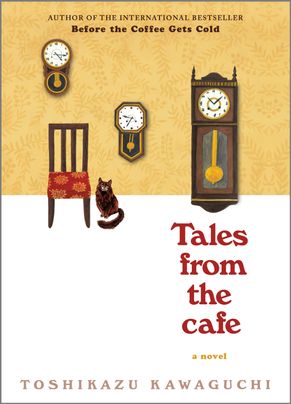
Tales from the Cafe - by Toshikazu Kawaguchi


During the early days of the pandemic James and I read Kawaguchi's book Before the Coffee Gets Cold which told of a coffee shop (Funiculi Funicula) that allowed customers to time travel, as long as they returned to the present "before the coffee gets cold". There were other quirky rules to follow as well, including where a would-be time traveler could sit - only in a seat otherwise occupied by a ghost. The ghost (aka the woman in the white dress) sits all day and reads, except for one daily trip to the toilet (why a ghost needs to use the bathroom is a question asked, but not answered). It is during this brief window each day that someone else might get a chance to time travel. I did not blog about this thoroughly enjoyable book when we read it because, alas, it had no libraries.

Tales from the Cafe has more stories from café Funiculi Funicula with this important change to the set up 

Until a couple of years ago, the woman in the dress read a novel entitled Lovers over and over again. One day, Miki remarked, "Doesn't she get bored reading the same novel?" and presented her own picture book to the woman in the dress.

This led coffee shop employee Kazu to the idea that she could provide new reading material to the woman in the dress with regular visits to the library. The woman in the dress accepted the fresh books, but without ever any acknowledgement of gratitude. Nevertheless Kazu continues to go the library once a week.

Both this book and Before the Coffee Gets Cold are episodic, with a unifying storyline.

A book about finding happiness. 

Monday, December 10, 2012

A Secret History of Coffee, Coca & Cola - by Ricard Cortés


Several years ago my husband James decided to teach a new course about coffee. His idea was to teach students about everything that went into making their daily cup, from the plant, to the labor, to the processing and roasting, to the grinding and brewing. He asked me if I had any ideas for what to call the course. I suggested the provocative title "The Secret Life of Coffee". It has become a rather popular course offering here at Bridgewater State University. Of course, the title of this book immediately caught my eye when I noticed its review come across my desk. Cortés makes connections between the three title plants explaining how and why each has been forbidden in different times and places. The last part of the book explains about Coca-Cola's secret ingredient - "Merchandise No.5" and how Harry J. Anslinger, commissioner of the US Federal Bureau of Narcotics, in the 1930s  helped Coca-Cola  maintain its access to the coca plant, even as it was banned in the rest of the country. Using incredible reproductions of letters and other documents (Cortés recreated them all with his own pen and pencil illustrations) the author shows some remarkable correspondence demonstrating some rather corrupt practices.

Although this work has the look of a child's picture book, it is anything but. Heavily researched with extensive references, Cortés could not have made the book "without the help of librarians, especially of the New York Public Libraries; the National Archives at College Park, Maryland; the Special Collections Library of Pennsylvania State University; the New York Academy of Medicine Library; the Drug Policy Alliance; the Horticultural Society of New York; and the Brooklyn Public Library."

Monday, November 14, 2011

52 Loaves - by William Alexander

As a foodie, and a librarian, I have kept several blogs. My first foray into blogging was a year-long project called My Year of Reading "Year Of" books  in which I commented on books that came from projects such as Alexander's: a one year memoir, or "stunt lit". In this work Alexander documents his efforts in baking one loaf of bread a week for one year. Since my own year-of stunt, er, project  is over, though, (having taken place in 2009) I could not write about this work on that blog. I think when I requested this book from interlibrary loan, I intended to review it on my food blog: "Una Nueva Receta Cada Semana (One New Recipe a Week)" but it lost its spot there as soon as I saw the word "library" used for the first time, which was in the Prologue, on page 2! Alexander describes explaining to a TSA official why he is bringing a sourdough starter, which looks suspiciously like a plastic explosive, onto a plane to Paris. "A thirteen-hundred-year-old monastery in France is expecting this...[t]hey managed to keep science, religion, and the arts alive during the Dark Ages, even risking their lives to protect their library (emphasis mine) from the barbarians who burned everything else in sight. After thirteen centuries, though, they've forgotten how to make bread." Well, there we have it. Libraries are more important than bread. I always knew as much, as clearly the monks did as well. This of course made any other mention of libraries in the work anti-climactic, but in the interest of being complete I include them all here.

It was a good 130 pages later that libraries were mentioned for the second time (to be honest I was beginning to despair that I'd see them again in this work). I was pleased though to see that the author thoughtfully brought a loaf of bread to the librarian at his research institute along with "a long list of interlibrary loan requests" - a nice gesture to someone who is, undoubtedly, underpaid. I did not have to wait nearly as long to find the next mention of libraries: a mere 12 pages later Alexander explains that although he really tried to like one of my favorite books, Zen and the Art of Motorcycle Maintenance, which he was listening to on CD, he found it "stilted, pedantic, and preachy" and "with genunie horror" realized that his writing was becoming too much like Persig's (at which point he "slammed the lid on the CD case and returned it to the library"). It is a bit ironic, then, that one of the pull quotes on the back of the edition I read says "[w]hat Zen and the Art of Motorcycle  Maintenance did for, well, motorcycles, William Alexander's 52 Loaves will do for bread...." The monastery's library makes a reprise when Alexander finds himself there, and again, explains the importance of preservation of knowledge, and once more when one of the monks informs Alexander that the monastery's library has a signed copy of Patrick Leigh Fermor's memoir A Time to Keep Silence.

These few, though thoughtfully chosen, references to libraries demonstrate yet again the importance of these hallowed institutions in our lives.

I cannot close this post without writing about one other very important thing: coffee. I almost gagged when I read that the monastery used instant coffee, and worse, that our hero was prepared to drink it except that the hot water dispenser "hadn't yet been switched on." Please folks, don't try this at home. See my husband's "Caring for Coffee" page if you want a cup of joe. Perhaps what Alexander did for the monks with bread, James can do with coffee. I don't think I'd mind a trip to Normandy.
  

Tuesday, August 9, 2011

First We Have Coffee - by Margaret Jensen

Although I very much enjoy memoir as a genre, I usually try to avoid sappy ones, such as Jensen's. It is the story of a Norwegian immigrant family during the early and mid 20th century. James and I picked it up from our church's used book sale. We were drawn by the book's title, and the 50-cent price was right. James immediately set in to reading it as part of his coffee culture research, and within minutes read me this line from the book: "Mama was reminded of the advice her mother had given her earlier in the day: "Take him as he is and you will be happy. He loves God, the library - and you - in that order." So, I knew I would have to read this as well. And while there is no competition between how often coffee is mentioned (on almost every page!) to how many times libraries are (about 12) it is clear that libraries were important to Jensen's father ("Papa") - a Baptist minister. He often must be hustled out of the New York Public Library at closing, and his excitement at being offered a position in Chicago, after many years of serving in Saskatchewan, is induced partially by the thought of the big-city library. When her father is finally sent back to New York, he tells his now-grown daughter to visit so he can show her the sights. He begins by saying "Tomorrow I'll take you to the library..." Carnegie Hall, the Statue of Liberty Radio City and Coney Island can wait until after this most important stop. Of her father's death Jensen and her siblings "couldn't grieve...in [their] imaginations [they] saw him in the libraries in heaven, talking with his beloved authors."

James' "coffee take" on this work can be found on his "Environmental Geography" blog.