Showing posts with label race. Show all posts

Wednesday, July 2, 2025

Apex Hides the Hurt - by Colson Whitehead

A nomenclature consultant is paid to name things, mainly products, but in this satire the unnamed hero is hired to pick a new name for the town of Winthrop. Winthrop has a hotel, a bar, and of course a library. In fact one of the town's former librarians wrote a history of the town. This is provided to the consultant who supposes that "writing your town's local history was the librarian version of climbing Everest". Maybe so, as long as it doesn't get too badly edited for not being "ass-kissy" enough. 

While the consultant does meet one of the librarians (Beverly) and has some between-the-stacks type fantasies about her, he doesn't really get to use the library as it is being moved from one building to another during his visit.  Descriptions of the nearly empty space have a definite dystopian air

The place was a husk. The books were gone. Where he would usually be intimidated by an army of daunting spines, there were only dust-ball rinds and Dewey decimal grave markers. As if by consensus, all the educational posters and maps had cast out their top right-hand corner tacks so that their undersides bowed over like blades of grass. Nothing would be referenced this afternoon, save indomitable market forces.

Even the globe was gone. Over there on a table in the corner he saw the stand, the bronze pincers that once held the world in place, but the world was gone.

One would be forgiven for thinking that this was a description of a contemporary library once Moms for Liberty had their way with it. 

Beverly "a young white chick with dyed black hair [and] twenty or forty bracelets on her wrists...made an unlikely librarian, stereotype-wise". Nevertheless the consultant decides that she must be wearing "one bracelet for every shush".

A quick fun read that I picked up at my local library.

Thursday, June 5, 2025

Mockingbird Summer - by Lynda Rutledge

 In 1964 Ms. Delacorte public librarian in High Cotton, Texas suggests newly-minted teenager Kate "Corky" Corcoran read To Kill a Mockingbird. Corky shares the book with her brother, Mack who has just completed his first year of college; and with her new friend, America who otherwise cannot use the library in the segregated town.  

Through the lenses of these characters we see how each creates their own meaning of Harper Lee's work. Corky's journey includes learning what the word "rape" means as well as a discovery that although the story took place three decades prior it really wasn't so long ago as the same battles were still being fought in the segregated south.

The Civil Rights bill forms a backdrop to the story and Corky's mother Belle is expecting to benefit herself from the legislation as it also includes rights for women. Belle is looking forward to taking a job at the public library, in defiance of her husband.

Friday, January 10, 2025

The Scandalous Summer of Sissy LeBlanc - by Loraine Despres


Set in the summer of 1956 (with a bit of backtracking to fall 1941) Sissy LeBlanc (neé Thompson) is surprised when her high school sweetheart returns to Gentry, Louisiana and thus begins her scandalous summer. 

As a  high school student Sissy uses the library as an excuse to get out of the house in order to "take care" of an unwanted pregnancy.

As an adult Sissy helps her mixed-race cousin, Clara, to use the public library which was "open to all" but only allowed "white folks" to check out books. A sympathetic librarian "who believed it was her Christian duty to eradicate ignorance wherever she found it...liked Clara, a smart, sensible teenager and a credit to her race...[and] took it upon herself to break the rules and allow her checkout privileges".

Wednesday, February 14, 2024

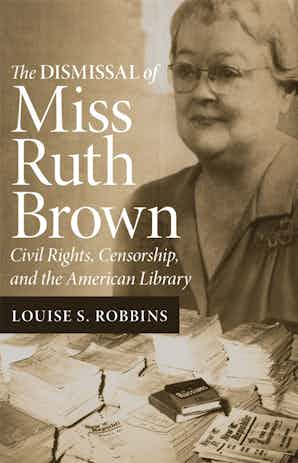
The Dismissal of Miss Ruth Brown - by Louise S. Robbins


Eight years ago I wrote about the film Storm Center. I recently learned that this film, produced at the height of McCarthyism, was loosely based on the case of Ruth Brown, who was fired from her job as librarian at the Bartlesville (Oklahoma) Public Library in 1950. Robbins' book even contains a rather thorough summary of the movie. Bette Davis (who played ousted librarian Alicia Hull) was questioned about taking the role by at least one parent, Anne Smart. 

Smart sent Davis a "report of the book controversy" she was causing in Marin County [California]...Her report depicted in "vivid detail...the type of material being given to our children in some schools. [The report]...made its way around the country for for several years [and contained] the names of authors "all extremely well listed as to their communist and/or communist front affiliations by various government investigating committees."

The more things change... 

Brown was an outspoken civil rights activist in her town. Her racial justice work during the height of McCarthyism made her an easy target. Charges that she was circulating "subversive" materials was a façade for the real reason of her dismissal.

The back cover blurb of this work (published in 2000) reads 

The fundamental issues of the Brown case make it especially pertinent today when differences - in race, gender, class, and national origin - are again feared and as challenges to materials in library collections again escalate. Ruth Brown's story helps us understand the matrix of personal, community, state, and national forces that can lead to censorship, intolerance, and the suppression of individual rights

This description is even more eerily prescient today. As are discussions in the book of neutrality, academic freedom, freedom of acquisition, freedom of access (especially to controversial materials) and the blatant sexism. 

Ruth Brown was one of the women, mostly white and middle-class, who made up 88.8 percent of the allied profession of librarianship in 1950. For a salary less than a man would receive, she organized and maintained a comfortable homelike space where people, especially young people, went for wholesome enlightenment (emphasis mine). The professional role of the librarian gave communities low-cost female employees (emphasis mine) to provide healthy recreational and informational reading while it extended the margins of the domestic sphere without exploding them. The librarian's role did not transgress boundaries as long as the homelike space and the materials and activities organized in it remained safe, comforting, and submissive to the prevailing ideology...

The more things change... 

The Library Bill of Rights was originally adopted by the American Library Association (ALA) in 1939 to ensure access to information (even what some might consider harmful or dangerous) to all. "The ALA articulated the importance of allowing citizens to decide for themselves what they should read, an idea Brown expressed in her interview with the city commission". This is a stark contrast to the description of the "stereotypical" librarian 

in Alice I. Byran's 1952 research report, The Public Librarian...[who] was "rather submissive in social situations" and lacked self confidence. "Indiscreet" was not part of the lexicon by which librarians, especially female librarians, were described. In fact female librarians have been characterized as discreet to a fault in book selection practices, "ruthless in their own censorship." Marjorie Fiske's 1959 classic , Book Selection and Censorship, depicted its mostly female subjects as anxious and fearful, avoiding challenges to library materials through self-censorship.

The more things change... 

 And on a final note, we see the same ideological concerns in libraries today as libraries in Montana and Georgia cut ties with the ALA over president Emily Drabinski's identity as a Marxist lesbian.

The more things change...

Thursday, January 18, 2024

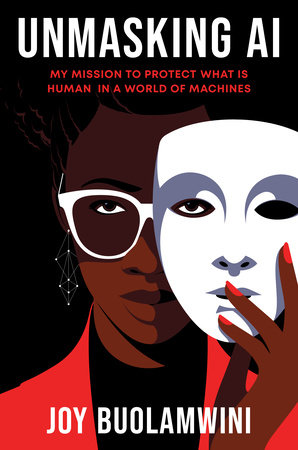
Unmasking AI - by Joy Buolamwini


Algorithms are created by humans. Humans are flawed and have biases, these flaws and biases are programmed into algorithms, perhaps not explicitly, but with consequences nonetheless.

As a graduate student at the Massachusetts Institute of Technology (MIT) Buolamwini, using an open-source face tracking library to work on a project, discovers that facial recognition programs are especially bad at recognizing black and brown faces. Her research eventually brought her to The White House, to testify before Congress, to National Television, and Netflix. And ultimately to become founder of the Algorithmic Justice League. She mentions the use of code libraries on several occasions.

She describes volunteering as an undergraduate at the Carter Center on a project to eradicate tropical diseases. Visiting the Jimmy Carter Presidential Library in Athens, Georgia she 

walked through the gardens near...the library [and] saw a piece of art that offered hope - a bronze statue of a child leading a blind elder using a stick they both held. Sightless Among Miracles had been donated to the center to underscore the effort to support the global control of onchocerciasis (river blindness).

Perhaps the most disheartening (for me) passage was this

After two years on the MIT campus I was finally making my way to the Hayden Library. With online access to almost all the resources I needed, I had yet to step foot into a campus library. After printing out results on archival paper that felt soft yet sturdy to the touch and hunting down last-minute typos, I felt ready to submit my master's thesis.

While I recognize that online resources have allowed us to put libraries into users' pockets, which is decidedly more convenient for all, it doesn't mean the physical library isn't important as a place. And since I'm required to be in my office most of the time, even though almost everyone is using the library remotely, I do wish more people would take advantage of the space.  

Friday, November 17, 2023

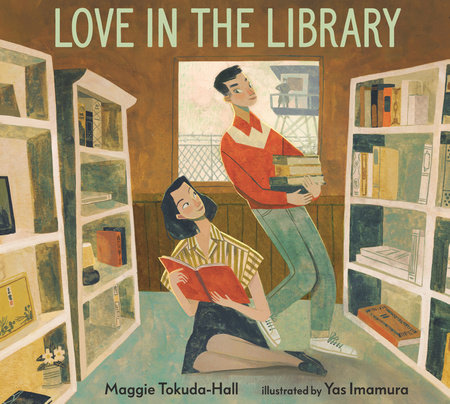
Love in the Library - by Maggie Tokuda-Hall


In her Author's Note Tokuda-Hall tells the readers that this is the story of her maternal grandparents who met in Minidoka, a Japanese incarceration camp in Idaho. Tama (her grandmother) was the camp librarian, although "she didn't know how to be a librarian...In the camps people did the jobs that needed doing." Her grandmother had taken the job because "she liked books". George (Tokuda-Hall's grandfather) came every day to check out books. Tama questioned whether he could actually be reading all the long books he checked out. No, he wasn't reading them all. He was "only human". And the realization that she was the real reason he came every day dawned on her. Their love grew amidst their  whispers. 

George's "voice was so big it barely fit in the library..." Tama "held up her finger to remind him of the rules. They were in a library, after all."  

The Author's note also connects the story of Minidoka to current events. 

As much as I would hope this would be a story of a distant past, it is not. It's very much the story of America here and now. The racism the put my grandparents into Minidoka is the same hate that keeps children in cages on our border. It's the myth of white supremacy that brought slavery to our past and allows the police to murder Black people in our present. It's the same fear that brings Muslim bans. It's the same contempt that creates voter suppression, medical apartheid, and food deserts. The same cruelty that carved reservations out of stolen, sovereign land, that paved the Trail of Tears. Hate is not a virus; it is an American tradition.

Tokuda-Hall's author's note sparked controversy when Scholastic asked her to edit it in order to include the work in Scholastic's diversity-focused Rising Voices collection earlier this year. Tokuda-Hall refused and Scholastic ultimately issued an apology. More information about the request, Tokuda-Hall's response, and a link to the apology can be found in this article from Publisher's Weekly  

Wednesday, July 5, 2023

Class Act - by Jerry Craft

Jerry Craft's sequel to New Kid continues the story of friends Jordan and Drew at the prestigious Riverdale Academy Day School in the Bronx. Jordan and Drew have a hard time fitting in to the mostly white school. 

The Riverdale School's Morgan Library is "state of the art" at least that's what Principal Mr. Roche tells some potential students from the underserved Cardi De Academy. The students from Cardi De respond that their library "is six boxes of old books...five of them...on Martin Luther King". 

Jordan and Drew are asked by Librarian Miss Brickner to "help pick out diverse books for the library", they are initially eager to help but when they suggest that graphic novels be included she retorts that "graphic novels aren't real books". I always like to see a bit of metafiction in a book.

Both New Kid and Class Act have been challenged in a number of school districts across the country, most notably in Katy, Texas where an event with Craft was cancelled in 2021 after a parent complained that the books advocated Critical Race Theory (something that the author had never even heard of before).

 I picked this book up from a Little Free Library  with this cool sticker on it.


Monday, May 22, 2023

Our Missing Hearts - by Celeste Ng

This dystopian novel, reminiscent of The Handmaid's Tale, gives us a glimpse of what happens when prejudices go unchecked. As we watch the far right cycle through villanzing every marginalized group, (landing most recently on the LGBTQ+ community) this work is prescient in more ways than one.

In Our Missing Hearts Anti-Asian sentiment is sanctioned by the government through PACT (the Preserving American Cultures and Traditions Act). PACT also encourages citizens to report their neighbors for un-American activities (broadly defined) and allows great leeway in banning books. Children are removed from their homes and permanently re-placed if their parents are deemed to be un-American. Current news from Florida and Texas regarding trans children echoes this story line. Ng's book centers on a mixed race family: Asian-American mother Margaret; Caucasian father (Ethan); and their son Bird (aka Noah).

When Margaret's little-known (and apolitical) book of poetry unwittingly becomes a symbol of a protest movement Margaret goes on the lam leaving Bird and Ethan behind in hopes of keeping father and son together even as she cannot be with them. When asked about Margaret's whereabouts Bird and Ethan always answer that they do not know, and that she is no longer a part of the family.

There is much in this book about libraries and censorship. Although libraries exist they are largely empty (of people and books). Described as a "ghost town" the public library is still a sanctuary for Bird (and his friend Sadie). The librarian helps Bird to find a book based on only a vague description. They use an old card catalog to find it but the book has been removed from the library. As was his mother’s poetry book - Our Missing Hearts. The librarian tells him “We don’t burn books here this is America…we pulp them. She says his mother’s book was probably turned into toilet paper and wiped someone’s butt a long time ago. Although they do not traffic much in books, the librarians are still connecting people and information. "The brain of a librarian is a capacious place." 

The public librarians are part of a subversive group that provides information to parents whose children have been “re-placed” - surreptitiously passing notes between the pages of interlibrary loan books. The librarians also hide Sadie away from her foster family as she tries to reunite with her parents. Train and bus schedule information is provided to Bird at the library. The librarian tells him that she is only letting him know how to find the information: what he does with it is his business. 

Likewise classrooms are described with empty bookshelves because “books are outdated the minute they're published”. However, students are informed by their teachers that books haven’t been banned, obviously, because that would contradict the first amendment. Rather, the books have been removed so as not to expose students to harmful ideas. This is eerily reminiscent of a viral video that recently made the rounds online of an empty school library in Florida.


Ethan shelves books in a Harvard University library. A PhD, he used to teach linguistics there, but lost the job over Margaret's "politics".  As a linguist, Ethan is especially interested in word derivations. He enjoys explaining where words come from (in multiple languages) to his son. The book included an explanation about the derivation of the word library coming from the word for tree bark, something I had never known before.


Monday, May 15, 2023

You'll Never Believe What Happened to Lacey : Crazy Stories about Racism - by Amber Ruffin and Lacey Lamar


Sisters Ruffin and Lamar grew up in Omaha, Nebraska. Their cringeworthy anecdotes about race and racism focus mainly on Lamar's experiences working there, but also about growing up in Omaha in the '80s and '90s. The audiobook is read by the authors and it is well worth a listen. The sisters laugh together and enjoy some easy banter as they tell their tales.

Of course any library tale will pique my interest. There was only one in this book, but it caused me to do a lot of thinking. It centered on Ruffin's elementary school library. A lover of arts and crafts, Ruffin borrowed a craft book that included instructions for making a Gollywog doll. She was unaware of the racist nature of the craft and innocently asked her mother about making one. Her mother's swift response included not only a call to the school librarian to complain, but also an admonishment to her daughter to use only the books they had at home from then on.

As I said, I had to think about this episode quite a bit to determine what to say about it, especially in light of the wave of book banning happening across the country. I will begin by saying that Ruffin's mother was perfectly within her rights to contact the school and complain about the book. Furthermore, schools should have processes in place for book reconsideration, and they in fact count on parents to bring books to their attention that may not belong in the collection. Not all book removal constitutes book banning. Books are discarded from libraries for a myriad of reasons. Perhaps they are out of date, worn out, or otherwise no longer appropriate for a particular audience or collection. "Weeding" is part of the process of keeping a library relevant.  

However, removal of individual titles, with cause, is not what we are witnessing in schools today. Instead hundreds of books that the censors have not read are being summarily removed from classrooms and school libraries (and indeed public libraries). Those who would remove books from libraries under the guise of "parental rights" are full of shit. They already have the right to request that their child not have access to certain books. Meanwhile, they are preventing other parents who would like their children to have access from doing so. 

I was surprised that Ruffin's mother told her daughter not to use the library any more over this one incident. Of course any parent can contact their child's school and request that they not be allowed to check out specific books (or any books for that matter), and they are also within their rights to tell their own child not to use the library any more. I would argue, however, that students should be given (relatively) unrestricted access to their school and public libraries. Young people need to be able to explore difficult topics at their own pace. Librarians, teachers, and parents can be guides but ultimately everyone should be able to access the information they need when they need it - without judgement.  See my post Why I Let my Daughter Read Twilight Books for additional thoughts on this. (Note that the post is 10 years old and my "daughter" now identifies as non-binary and uses he/him pronouns).

You'll Never Believe What Happened to Lacey is the One Book One Community selection for the Bridgewaters for summer 2023.


Wednesday, June 29, 2022

Hell of a Book - by Jason Mott


Add this book to the likes of The Seven Minutes, Inkheart, Commonwealth, and The Blind Assassin - books about fictitious books with the same name.

This work begins with a typical comedic scenario involving an author, and one of his fans in flagrante delicto being discovered by the woman's husband. The cuckold then chases the naked author into an elevator and the author then winds up  in bed with the front desk clerk. The book takes a turn, however, and themes of race, and mental illness come to the fore.

Over the course of  a book tour the unnamed author (the narrator) is confronted by the demons of his past, as well as the ghost of a young black boy who was killed by a police officer. The author is never quite sure what is real and what he is imagining, leaving the reader to consider all possibilities. 


Tuesday, March 8, 2022

The Yellow House - by Sarah M. Broom


My husband and I attended Broom's virtual session last year at Boston University's Anti-Racist Book Festival. We had not heard of her before, but she piqued our interest, and we ordered the book on Audible and listened to it together. The Yellow House is a memoir not only about the specific house in New Orleans where the author grew up, it is a book about our relationships with the places that form us. 

The youngest of twelve children, Sarah was born into the Yellow House where she lived with many of her siblings, although some of the oldest never lived there. The Yellow House was located in New Orleans Eastpart of the city's Ninth Ward. Hurricane Katrina was the second Hurricane the author, and the Yellow House experienced. As a baby Broom and her family were evacuated when Hurricane Betsy rampaged their home in 1965.

Although her school libraries get barely a passing mention, as a college student at the University of North Texas (where the "cost of [her] ignorance about college was high") she was
ravenous about learning, nearly living at the Willis Library where [she] spent seven or eight hours at a time hunched in a cubicle reading books about subjects fellow students seemed already to know.
After graduation, and a Master's degree from the University of California, Berkeley, Broom moved to New York to take a job with O Magazine. There she met Samantha Power, author of A Problem from Hell at an author event at the New York Public Library. Power convinces Broom to go to Burundi (a small African country mostly known as a neighbor to Rwanda). 

Bloom eventually makes her way back to New Orleans where she researches the history of the (now destroyed) yellow house at the New Orleans Public Library. 
To find the history of the Yellow House, I had to search original deeds, chains of titles, successions. I stalked the Conveyance Office, the Office of Vital Records, the Real Estate and Records Office in city hall, the Notarial Archives, and libraries. The search was full of cross-referencing and confusion.

I arrived many mornings at the main branch of the New Orleans Public Library in the business district, just across from city hall, and waited in line for the doors to open. If you didn't know better, you'd think the city was full of people eager to read, but actually the line was full of homeless people who had slept outdoors and were trying to get to the bathrooms. 
Broom goes on to describe posted rules of using the library that include the following "disallowed" behaviors: stalking patrons; using or exchanging drugs; bathing; shaving, washing up, or washing clothes in bathroom sinks; bad smells; oblivious  transmission of germs or excessive coughing; preaching or forcing your ideas on others. Also disallowed: weapons and shopping carts. "Most of these things still happened anyway...The library staff spent much of the time policing, which made it hard to get research assistance". 

Any library worker in public service can relate to this. Too much of our time is devoted to policing behavior. Many administrators, as well as library users, are unable to understand our work as anything beyond study hall monitors. We actually would prefer to help people with research rather than spending our time explaining how to use a photocopier, refilling printer paper, or (most recently) incessantly reminding people to wear their masks above their nose.

Find out more about Sarah Broom at https://www.sarahmbroom.com/

Thursday, January 20, 2022

Picket Fences (the television show) "Elective Conduct" Season 3 Episode 6


My husband and I were happy to discover that all four seasons of the 1990s television show Picket Fences were available through Hulu. We remembered this thought-provoking, quirky drama series fondly. While we are enjoying re-watching, we were not especially surprised to discover that not all of the stories aged well, and we are  having very different conversations about the show than we did 30 years ago.

The third season begins with the fictitious town of Rome, Wisconsin receiving a federal court order to desegregate its schools via the forced bussing of  Black students from the (not fictitious) city of Green Bay. The (mostly) white residents of Rome face their prejudices, and liberal-minded Mayor pro tem Jill Brock calls in the local police in an attempt to stop the students from getting off the bus. Her plan is thwarted with a countermove by the National Guard (a la Little Rock). The story arc exploring race and racism continues for several episodes.

Episode 6 opens with fifth-grade students reading their reports for Multicultural Awareness Day. The teacher is cringe-ily dressed in stereotypical Native American garb and a girl reads her report indicating that Chinese people in the United States are best known for their restaurants, and are "good fighters". The Mayor's son Zachary reads his report on "Why White Kids Should Help Black Kids", citing academic achievement gaps, and indicating that these gaps are because of small brains that only think about sex. He is cut off by said cringe-worthy teacher, taken to the principal's office, and suspended. 

It turns out that he does have citations for his assertions. The achievement gap statistics came from the Educational Testing Service, and the information about brain size came from the eleventh edition of the Encyclopedia Britannica

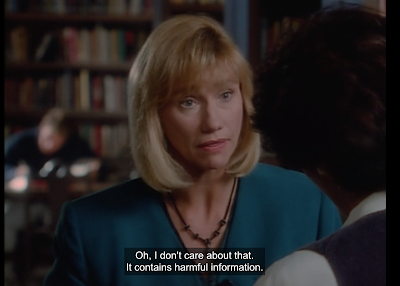
Cut to Jill Brock in a library speaking to the librarian (in what appears to be the public library). Brock has the offending volume of the Britannica in her hand, reads from it, and asks why it is in the library. The librarian explains that the 1911 edition is a "classic" and that "museums would kill for this set". Jill insists that it be removed because it "contains racial material". The librarian counters by suggesting that by those standards Mark Twain should be removed as well. She actually uses the N-word (on what at the time of original airing would have been network television).  Brock is able to get her son reinstated by demonstrating that the information came from a book in the library. She also gives him a good "talking to".

Wow. A lot to unpack here.

Let's start with the fact that the mayor wanted the book removed because it contained "racial material". Books about race, or written by people of color are being especially targeted in the United States today. Challenges are coming from the left and the right. And we are seeing classics such as To Kill A Mockingbird being questioned. Learning to question what we read in books is essential to a good education. We cannot question what we aren't allowed to see, however.

Deselection (or "weeding") of materials is part of the professional work of librarians. Libraries should have living collection development policies which outline what kind of materials will be held in the library, as well as what will not. Additionally, the policy should explain when/how/what kind of materials will be removed. Reasons for pulling books are myriad and include that they might be out of date, however, that is not the only consideration. Some works are classics, or perhaps are kept because they have value to historians. There is a lot that can be done with a challenged book between outright removal and leaving it on open stacks to be found by impressionable fifth graders who have not received appropriate research guidance. For instance, the encyclopedia set in question might be moved to a special collections room where it is accessible to scholars, but not necessarily to elementary school students, or it could simply be moved to a higher shelf, where it can't be reached by children without assistance, while keeping a current set in a more accessible place. What shouldn't be done, though, is for the Mayor to come barging in, insisting that a book be removed without input of the library board and without any kind of public hearing.

I will say this for young Zachary - I liked that he clearly used at least two sources and synthesized them. He also had full citations, such that his mother was able to find the exact quote in question. That's what citations are for.

Saturday, August 28, 2021

A Ride to Remember: A Civil Rights Story - by Sharon Langley and Amy Nathan


When I was very young my family and I enjoyed visits to Gwynn Oak Amusement Park in Baltimore, Maryland. Hurricane Agnes destroyed the park in 1972 and it was not rebuilt. Rather than an amusement park, it now is a park of the type one might go for a picnic, or to fly a kite. 

Gwynn Oak Park opened in 1893 and like many amusement parks at the time it was segregated.I was unaware that the park had not been desegregated until 1963 when I heard about this book and attended a webinar about it last year. You can watch the webinar here.

My parents moved to Baltimore from the midwest in January of 1962 and started their family. My older sister was born in late September of the same year which made this story, about a girl who was 11 months old on August 28, 1963, especially relevant for me. Sharon Langley was the first African American to ride the Carousel at Gwynn Oak Park on the day it was desegregated. 

Langley explains segregation in this work via a conversation between herself and her parents about her family's role in desegregation.
For a long time, black and white kids couldn't do many things together. They couldn't go to the same schools or to the same restaurants and libraries or even sit together at the movies. It was the law.
    "Why didn't somebody do something about those kinds of laws?" I asked.
    "They did," said Mama.
    "We did," said Daddy.
    Many people - both blacks and whites - knew that segregation was unfair and just plain wrong.
    Some people said, Just wait. Times will change.
    But others said, Why wait? What's wrong with now? They held protests at restaurants, stores, and movie theaters. They tried to get officials and courts to make new laws to create a better city - a place that would welcome and include all people.
    By the time I was born, some unfair laws had changed in Baltimore. Kids could go to the same schools and libraries, restaurants, and some movie theaters, too - no matter the color of their skin. "But the amusement park just wouldn't budge," said Daddy. 

Beautifully illustrated by Coretta Scott King Award winner Floyd Cooper this book tells a story of segregation and desegregation appropriate for young readers.

Wednesday, April 7, 2021

Ready to Fly: How Sylvia Townsend Became the Bookmobile Ballerina - by Lea Lyon and A. LaFaye

This week is National Library Week and today is National Bookmobile Day. Ready to Fly tells the story of Sylvia Townsend who grew up in a segregated America in the 1950s. She desperately wanted to take ballet lessons, but her family could not afford them so when the bookmobile rolls into her town she asks the librarian to help her find books on ballet. She checks out new books each time the bookmobile comes and helps the other girls in her neighborhood to learn ballet too. Young Sylvia learns to dance so well that a teacher offers to pay for her ballet lessons. However, her dreams are almost crushed when she is denied a place in the "whites only" classes. Ready to give up she is given another chance to take classes when she and her friends perform in the school talent show and learn that a famous dance instructor was in the audience. 

Tuesday, March 30, 2021

Steeped in the Blood of Racism: Black Power, Law and Order, and the 1970 Shootings at Jackson State College - by Nancy Bristow

Just after midnight on May 15, 1970 two young black men, James Green and Phillip Gibbs, were killed by police fire on the Jackson State College campus in Mississippi. Several other students were wounded and a women's dorm at the historically black college was left riddled with bullet holes. 

While often likened to the killings at Kent State University (see my post on When Truth Mattered by Robert Giles) on May 4 of the same year, the shootings at Jackson State were not the result of a Vietnam War protest, 

but rather another chapter in the long history of state violence against African Americans, a story inseparable from their identities as students attending a black college in the capital city of the nation's most racially repressive state.

 Roy Wilkins the national director of the NAACP stated in 1963 that 

There is no state with a record which approaches that of Mississippi in inhumanity, murder, brutality, and racial hatred. [It was] absolutely at the bottom of the list.

Despite the passage of the Civil Rights Act six years before the shootings little had changed in Mississippi. And at Jackson State where "the administration, controlled by the state's all-white Board of Trustees of Institutions of Higher Learning, worked hard to keep the campus quiescent" even as a growing number of students and faculty were starting to protest. 

While there was local and national coverage of the event at the time, including reports in the New York Times, the Los Angeles Times, and even an article in Playboy magazine the tragedy has largely been forgotten since, even as the shootings at Kent State University which happened less than two weeks earlier are remembered each year on its anniversary. There are other parallels with the Kent State shooting, including false reports of rock throwing and sniper fire before police opened fire.

Bristow's book places the shootings within the historical context of a state founded on enslavement, racism, segregation, and white supremacy.

Of particular interest to this blogger was that in 1961 students from another historically black institution, Tougaloo College "attempted to desegregate the downtown's white library with a 'study-in'" as part of a protest of the city's Civil War Centennial celebration.

The students began by visiting the local black library to request volumes they knew the branch did not hold before entering the white library to request those same books. The police were quick to arrive, arresting nine students...They spent the night in the city jail before being released on bail...On the evening following the "study-in" youth from around the city protested the arrest of the group they dubbed the "Tougaloo Nine". At Jackson State College perhaps as many as 800 students gathered outside the campus library...President Reddix attempted to disperse the students and was undone when they resisted. Eventually he was seen just "snatching students at random and shoving them toward a [campus] policeman or deal with orders to expel them".

Documents about the shootings can be found at the College archives, and on display at the library, but "they do not captivate attention as they once did". Even annual memorial events draw low attendance. Although largely forgotten by society at large, the victims still remember. They remember the loss of friends and family, and they live with their own wounds both physical and psychological. There was no justice for the victims of the Jackson State shootings. There were no indictments against any member of law enforcement present that night, and a civil case brought by five of the victims and their families found for the defendants. Although the decision was appealed and a three judge panel found that "the barrage of gunfire far exceeded the response that was appropriate" it was further determined that "despite their guilt, the state and local governments, their officials, and their law enforcement personnel were insulated by 'sovereign immunity', the doctrine protecting the state and its representatives from suits or any penalties that could result". This same doctrine is still in place today and what still allows law enforcement to murder people of color with impunity.


Wednesday, August 21, 2019

American Dreamer - by Adriana Herrera


The most important criterion I have when I make my selection for Read-A-Romance-Month is that the book have a librarian as one of the main characters. Of course many books fill the bill, but since I only read 1-2 books of the genre per year any book I select has to be extra. Herrera's book made the final cut for this gringa bilingual librarian because Jude Fuller.

When blond librarian Jude surprises the swarthy Ernesto (Nesto) Vasquez (owner of the Afro-Caribbean food truck parked outside the library) by flirting with him in Spanish Nesto falls hard. The two waste no time in beginning a hot and steamy relationship. So lucky that it turns out they are neighbors, too!

This one follows the expected three point romance plot with a "boy meets boy" twist. I also liked that in lieu of the "sassy gay friend" we so often see in boy-girl romances Herrera gives that role to the meddling Carmen, smart-aleck straight friend to Jude. And, of course, I loved that Herrera recognizes that not only do librarians have sex, it can actually be intense.

I have to admit though that the millennial main characters in this book stressed this baby boomer out a bit. They worked 12-14 hour days and then came home and seemed to have energy for acrobatic sex at 11:00 at night. I was always worried that they would oversleep the next day, or simply burn themselves out.

Find out more about the author and her works at https://adrianaherreraromance.com/

Wednesday, January 9, 2019

Schomburg: The Man Who Built a Library - by Carole Boston Weatherford


Going to elementary school in the 1970s meant that for one week in February each year we would celebrate Black History. It seemed that there were only two people worthy of recognition whom we would study each year: George Washington Carver and Benjamin Banneker (the latter was especially important to us because he was from Baltimore County Maryland, where my school was located). It did not occur to me that there might be more to history than what we were taught. Women (neither black nor white) were barely mentioned in any kind of historical context.

Even as Black History Week expanded to Black History Month there was little discussion of the contributions of those other than white men in building our country. We did discuss slavery, but recognition of contributions of individuals of color were rare.

Growing up in Puerto Rico in the late 19th century Arturo Schomburg was explicitly taught that "Africa's sons and daughters had no history, no heroes worth noting". A lover of books and reading, Schomburg set out to find the history that he knew was there. Like me he learned about Benjamin Banneker. Unlike me, however, he learned about a scholar whereas I simply learned of a native son. I'm not even sure I knew why he was famous beyond the fact that he had been a free black man during a time of slavery. Learning about Banneker began a lifelong quest for Schomburg to find out all he could about African Americans. His passion lead him to poet Phillis Wheatley, abolitionist Frederick Douglass, and whaler Paul Cuffee. He also found some surprises about famous people who were descendants of Africans, among them naturalist John James Audubon, author Alexandre Dumas, and composer Ludwig van Beethoven. He collected all he could and soon had an enormous selection of literature.

A true mover and shaker of the Harlem Renaissance he rubbed elbows with W.E.B. DuBois, and Booker T. Washington. His vast collection of literature by Black authors and about Black history and was purchased by the Carnegie Corporation in 1926 and donated to the New York Public Library.
If Harlem was the heart of African-American culture, 135th Street branch of the New York Public Library was the mind. If the library were a university, its alumni would include the Harlem Renaissance figures who lost themselves amid its stacks and wrote in a quiet room downstairs. Schomburg's collection...would become the cornerstone of the Division of Negro History Literature and Prints.
It included more than five thousand books, several thousand pamphlets, plus priceless prints and papers.
He went on to found the Fisk University Library's Negro Collection in 1931, and then returned to the 135th Street branch of the New York Public Library where
Arturo became the guardian of his collection. His peculiar method of shelving books arranged them by size and color, like a bouquet. In fact, he fired a new librarian for using the standard Dewey Decimal System. 
Any librarian can tell an anecdote about a patron who couldn't remember the title or author of the book they wanted, but they knew the color of the cover, so we won't necessarily shake our heads at Schomburg's methods. The Dewey Decimal System has plenty of drawbacks, too.

Beyond demonstrating the importance of libraries, this work also shows the importance of books as "windows and mirrors" on multiple levels. 
 

Monday, December 17, 2018

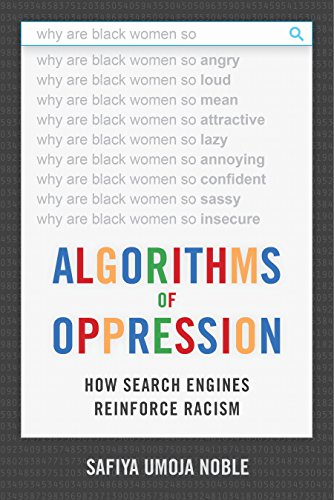
Algorithms of Oppression - by Safiya Umoja Noble


In the aftermath of Hurricane Katrina (one of the most devastating natural disasters of the 21st century) my husband learned an important lesson about doing Google image searches in front of a class. Typing in "Katrina" into the search box he (and the class) were bombarded with pictures of buxom women. This was literally just days after the hurricane struck and news of horrific flooding and drownings were still the top news stories of the day. Noble explains that similar results are returned when one types in the words "black girls".

However much we might want to believe that machines will provide neutral results, the fact remains that algorithms are written by people (mostly young, white men) who wittingly or not, program in their own biases.

My own research on Google and heuristics demonstrates exactly what conventional wisdom tells us: that people are more likely to click on links that appear at the top of a search result list. If people don't see what they want they assume it isn't there. It is very unlikely that someone will look beyond the first screen of results.

This is not only a problem in Google, but in library databases as well. Providing the example of searching the term "black history" in the ARTstor database the author shows a result page full of European and White American artists.

There was a lot to say about libraries and librarians in this work. In some places there is praise for our work, and recognition of our value. In others the author offers fair criticism and suggestions about where we can do some reflection and reparation where outdated language and systems are used.

A few years ago, I gave a presentation in which I compared librarians to colonizers. By creating an ambiguous and arbitrary system of organization and classification, and putting ourselves in charge of it, and, furthermore placing those on the margins in a position that requires them to come to us for assistance we are regulating knowledge, and determining who gets a piece of it. Noble goes even further explaining how the Dewey Decimal System itself, along with the standardized subject headings, were created so as to oppress. Citing the work of Hope A. Olsen from the the School of Information Studies at the University or Wisconsin, Milwaukee Noble explains that

Those who have the power to design systems - classification or technical - hold the ability to prioritize hierarchical schemes that privilege certain types of information over others. 

As recently as 2016 the term "Illegal Alien" was being used as a Library of Congress Subject Heading (LCSH). Students at the Dartmouth College were successful in their bid to have the term removed. The headings "Noncitizen" and "Unauthorized Immigration" are now used. The move was not without controversy and included a threat to the funding of the Library of Congress in the form of  HR 4926 "Stopping Partisan Policy at the Library of Congress Act". Librarians have recognized our own use of outdated and offensive language before, replacing the heading "Jewish question" with "Jews" and "Yellow Peril" with "Asian Americans".

Privilege and bias are also evident in the Dewey Decimal Classification system. For instance over 80% of the 200 range  numbers is used for Christian religions although only about a third of people worldwide identify as Christians.

Librarians, however, also can be credited for discovering and resolving some of these problems. I was reminded of this article, recently shared with me: Remembering the Howard University Librarian who Decolonized the Way Books were Catalogued".  It is important to note that the librarian was a woman of color, highlighting the necessity of a diverse population when designing and creating systems.

In her conclusion Noble envisions a new type of search engine, one in which
...all of our results were delivered in  a visual rainbow of color that symbolized a controlled set of categories such that everything on the screen that was red was pornographic, everything that was green was business or commerce related, everything in orange was entertainment, and so forth. In this kind of scenario, we could see the entire indexable web and click on the colors we are interested in and go deeply into the shades we want to see...In my own imagination and in a project I am attempting to build, access to information on the web could be designed akin to the color-picker tool or some other highly transparent interface, so that users could find nuanced shades of information and easily identify borderlands between news and entertainment, or entertainment and pornography, or journalism and academic scholarship.
This is indeed an ambitious project, and I would add that all caveats for design would apply. Such an undertaking would need a large, diverse group of people to categorize. As well I would be cautious about cutting into the autonomy of the users. What is pornography to some is art to others. Letting an algorithm decide what is scholarship and what is journalism can also be problematic. Some scholarship isn't really scholarship, and some journalism isn't really journalism. No matter what search engine is used everyone should use deliberation and do their due diligence in making selections about sources.

On the final page Noble reminds us that
Now more than ever we need libraries, universities, schools, and information resources that will help bolster and further expand democracy for all, rather than shrink the landscape of participation along racial, religious, and gendered lines.

Wednesday, August 1, 2018

Americanah - by Chimamanda Ngozi Adichie


Adichie's book tells the story of Ifemelu, a Nigerian woman who immigrates to the United States, and then, after becoming a U.S. citizen, returns to Nigeria. As a smart, savvy young woman it should go without saying that Ifemelu is also a library user.

Ifemelu and her boyfriend Obinze first use the library only as a place to meet, but she becomes a more active user after she moves to the United States for college. Obinze (an "Americophile") sends her a reading list of American writers he believes she should read. After already having found The Adventures of Huckleberry Finn "unreadable nonsense" she wasn't expecting to find an author she liked, but
She hungered to understand everything about America...Obinze suggested...American books, novels and histories and biographies. In his first e-mail to her...he gave her a list of books. The Fire Next Time was the first. She stood by the library shelf and skimmed the opening chapter, braced for boredom, but slowly she moved to a couch and sat down and kept reading until three-quarters of the book was gone, then she stopped and took down every James Baldwin title on the shelf. She spent her free hours in the library, so wondrously well lit; the sweep of computers, the large clean, airy reading spaces, the welcoming brightness of it all, seemed like a sinful decadence...in those weeks...she discovered the rows and rows of books with their leathery smell and their promise of pleasures unknown...
Well, who needs a man?

Ifemelu is not the only one in this story who uses the library. There are at at least three other characters who are clearly patrons. One of these is Blaine, a boyfriend in her adult years, who not only uses the library, but also defends a library employee at Yale, where Blaine is a professor of Political Science. Blaine is a friend of Mr. White, a "rheumy-eyed" security guard "with skin so dark it had an undertone of blueberries". When a white employee mistakenly suspects that Mr. White is involved in a drug deal and calls the police Blaine organizes a protest after the university responds to the incident with a statement that it was "a simple mistake that wasn't racial at all".

An especially curious passage to read in the summer of "Permit Patty", "Bar-B-Q Becky" and "Coupon Carl".

I think that perhaps Adichie's last mention of the library in this work is my favorite of all time. Ifemelu applies for a research fellowship at Princeton University. When she reads her acceptance, hands shaking, she discovers that "the pay is good, the requirements easy: she was expected to live in Princeton and use the library and give a public talk at the end of the year." All I could think was that the only thing I could think of that would be even better than having a job as a librarian, would be to to be paid just to use the library.

Friday, March 31, 2017

I Hadn't Meant to Tell You This - by Jacqueline Woodson


This young adult novel tells the story of Marie who befriends the new white girl (Lena) at her predominantly black middle school. Lena confides to Marie that her (Lena's) father is sexually abusing her and Marie promises not to tell anyone Lena's secret. Their friendship is challenged on many fronts and Marie learns some difficult truths.

Marie's single father dates Rose, the town librarian (who doesn't actually appear in the book). However, the town library has a small role in this work as Lena's sister's (Dion's) "favorite place in the world. She actually had a temper tantrum if...picked up too early." The library is likely a safe place for the little girl who lives with a neglectful and abusive parent.