Showing posts with label Italy. Show all posts

Friday, September 10, 2021

My Brilliant Friend - by Elena Ferrante


This coming of age story follows best friends Elena and Lila as they grow up outside of Naples, Italy in the 1950s. The two girls are the smartest in their class at school. While Elena is provided the opportunity to continue with her formal schooling beyond grammar school, Lila realizes that she must continue her education at "the people's university" - the public library. She figures out that she can borrow a lot more books than would normally be allowed by procuring library cards for everyone in her family, and then using them only for herself. Everyone in Lila's family is later invited to the library to be honored for being such avid readers. It would appear that Lila, her brother, mother, and father have come in first, second, third, and fourth for the most books read. Elena is also invited to the recognition ceremony for coming in fifth. No one from Lila's family (including Lila) comes to the ceremony and Elena accepts the awards for all.

The first book in a four-part series. This has also be adapted for television  - currently available on HBOMax.


Thursday, December 6, 2018

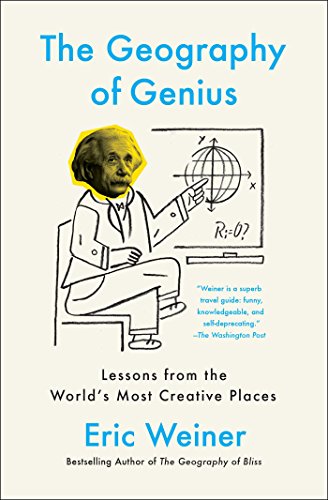
The Geography of Genius - by Eric Weiner


Nine years ago I embarked on a project of reading "Year Of" books. One of the books I read, together with my geographer husband, was Eric Weiner's Geography of Bliss in which the author sought out the world's happiest places. When we discovered that Weiner had written another geography book we downloaded it and listened to it together during our regular drives between Bridgewater and Fairhaven. In The Geography of Genius Weiner visits places that were once hotbeds of creativity, or in the case of Silicon Valley, still are.

Of course libraries are essential elements when discussing genius and Weiner mentions them no fewer than twenty times.

Twice he used the library as a metaphor:

  • In Athens, Greece he decides to take a walk, as was the wont of many of the great thinkers who hailed from that city. His host, Tony, "approves of walking". However, it appears to Weiner that "this approval does not extend beyond the realm of the theoretical as Tony's expanding belly "says more about the divide between ancient and modern Athens than a library's worth of books".
  • It seems that the stereotype of the shushing librarian will be around for quite some time. Weiner uses the image to explain that working in a quiet space may in fact not be conducive to creative thinking. And that it is in fact the moderate noise levels found in coffee houses that make them ideal places to incubate ideas.

Importantly, Weiner also points out that libraries are not just places for books, but for programs and as gathering centers as well when he sees people queuing for a lecture at the National Library in Edinburgh, Scotland.

Libraries weren't always a public resource. Early libraries were by membership or subscription only. Today public libraries are recognized as the People's University. Block printing during the Song Dynasty (969 to 1276 AD) in Hangzhou China brought information to the masses. "Soon, thousands of titles, on all sorts of topics, were published each year. One library alone, at the Imperial Palace, housed some eighty thousand scrolls."

In Calcutta he discusses colonization with this description of Job Charnock - a seventeenth-century English sea captain, who married an Indian woman.
He wore loose, baggy Kurtas, smoked a hookah...and drank the local libation, a potent moonshine called arrack. Job Charnock, founder of Calcutta, son a English aristocrats, proud servant of the queen, went native.
That might come as a surprise given our image of the British and their attempts to rule India without interacting with India.
Charnock was the exception to those who agreed with Lord Macaulay "a senior official in the Raj, who infamously said that a single shelf of a good European library was worth the whole native literature of India and Arabia."

The same type of European-superiority thinking is evident in Joshua Hammer's work The Bad-Ass Librarians of Timbuktu as well.

Throughout his travels the author sings the praises of several librarians who helped him along the way:
  • In Hangzhou, China a librarian named Norman delivers a difficult-to-find copy of the English translation of Brush Talks from Dream Brook by eleventh-century genius Shen Kuo to Weiner's hotel "with all the furtive intrigue of a drug deal or CIA drop".
  • During a visit to the archives Laurentian Library in Florence (designed by Michelangelo) he speaks with Dr. Shelia Baker who is excited about a recent discovery of a letter written by Galileo to a friend. She also explains that to those who lived in the 15th century a book cost as much in relative terms as a car does today. Books were status symbols. Scholars were people who owned many books (even if they never read them).
  • In the Silicon Valley Archives where he walks "into a majestic room, brimming with wooden cabinets and history" a librarian hands him a cardboard box filled with correspondence from Fred Terman's days at the Harvard Radio Research Laboratory during World War II.
  • And, finally, in the acknowledgements Weiner thanks Kathleen McNamara director of Georgetown University's Mortara Center for providing "that most valuable of gifts: a library card."
Smart people use libraries.

Wednesday, June 14, 2017

A Year of Living Prayerfully - by Jared Brock


Our One Book One Community (OBOC) steering committee is looking for a light-hearted book with a spiritual theme to read next spring. We had a suggestion of Religious Literacy: What Every American Needs to Know - And Doesn't by Stephen Prothero which I started to read, and do like, but I am not sure it is a good choice for a community read. Our community likes to read stories, and Prothero's book is not only not a "story" it is also rather didactic (as the title would suggest). These are two things that make the book a less-than-ideal choice for OBOC. With this in mind I started to look for other books - specifically something with a plot. Then I remembered that during my "Year of Reading 'Year of' Books" I read two religiously-themed humorous books that were about spiritual quests: The Year of Living Biblically by A.J. Jacobs; and My Jesus Year by Benyamin Cohen. I correctly surmised that more such books must have been written the last few years and selected Brock's book as one that had potential for OBOC. Brock's story features a genuine inquiry into what prayer means. He travels across the globe, often with this wife, to talk to religious leaders about their own spiritual journeys and ultimately finds more questions than answers.

As a Unitarian Universalist I respect and support each person's search for truth and meaning (see our fourth principle). I was intrigued with Brock's quest, and especially appreciated his final comments regarding having more to learn
After an intense year of learning about prayer from some of the best sources on earth, I don't feel like I'm further along. If anything, I feel like a first-year university student-I now know all the things I don't know-all the things I haven't yet learned, understood, or experienced. I am not, in any way, a prayer expert. I'm a failing student who's playing catch up, at best. Rather than coming to the end of a journey, I've only just begun.
As he continues his inquiry I hope he branches out beyond Judeo-Christian traditions. His interactions with Muslims were limited and I don't recall him meeting with any imams. Nor did he talk to any Buddhists (he did meet with one who had converted to Christianity) or Hindus. Likewise, his dealings with women religious leaders were rather narrow. I think the woman with whom he had the longest conversation was Rachel Phelps-Hockenbarger, daughter of Fred Phelps of the infamous Westboro Baptist Church. I have to give him credit for his perseverance in getting the interview, though.

Brock's travels took him to, Israel, several parts of Europe, his native Canada, the United States, and also to North and South Korea. I was impressed with his courage in voyaging to North Korea, and his refusal to bow down to the body of Kim Il-Sung. There were no visits to any African or Latin American countries, however, and I suspect that if he had spoken to someone in Central or South America about liberation theology, or talked to anyone in Africa about colonialism, or attended a religious ceremony on an Indian reservation in the United States, he might not have simply and naively accepted the comments he found in Christianity Today that
Missionaries brought about reforms, fought colonialism, taught people to read, and rallied support for struggling peoples around the world. The conclusion the article makes is striking: "Want a blossoming democracy today? The solution is simple-if you have a time machine: Send a 19th-century missionary."
I was, of course, glad to see that he began his globe-trotting voyages at his local library. On page one Brock tells us
Michelle and I decided to live prayerfully for an entire year. It was a nice, shiny idea. But where should we start? 
With For Dummies, obviously. I borrowed a copy of Christian Prayer for Dummies from the library.
After reading a bit of the work though, he found himself unimpressed and
called it quits, returning the book to the library, where [he] assumed it would remain until next year's Friends of the library book sale. 
He also visited the library at the Monastery of Vatopedi (and even borrowed a book there) and while on Mount Athos talked to Father Philotheos who, when asked to define prayer, responded
Prayer isn't one thing...You can read a whole university library full of books that have been written just on the Jesus Prayer.
Brock made at least one other attempt to visit a library while on his journeys. Sadly, however he found the library (and the museum) at Monte Cassino closed (this after he paid his entrance fee). The gift shop, however, was open.

Ultimately, I think I will keep up my own search for a One Book One Community read and look for something that explores religion beyond what one will find in the Judeo-Christian traditions.