Showing posts with label young adult books. Show all posts

Friday, February 27, 2026

Wake Now in the Fire - by Jarrett Dapier & AJ Dungo

This very recently published graphic novel is a fictionalized account of real events. In 2013 Chicago Public School (CPS) removed all copies of Marjane Satrapi's Persepolis from classrooms. Once administrators determined that they didn't want the book to be used as part of the curriculum it was removed from classrooms, even as classes were being conducted. (A very similar situation occurred in the Tucson Unified School District (TUSD) around the same time.) The predictable refrain of "we're not banning books" from CPS Administration was evident. The CEO (yes CEO!) of the Chicago Public Schools at the time Barbara Byrd-Bennett claimed to know nothing about the removal of the books, and insisted that CPS is "not in the business of censorship". Turns out she was lying on both counts. Moreover, in 2015 Byrd-Bennett was convicted on bribery charges and spent time in federal prison.

Teachers, librarians, and students worked together to ensure that the book remained in the library, even as it was removed from classrooms. However, CPS was also working at the time to shut down most of the school libraries in the district.

The book doesn't shy away from an explanation that book banners come in both the red and blue variety. A student asks how such a thing can happen in bright blue Chicago. His teacher responds

Censorship is, unfortunately, something humans do. Humans in communist dictatorships, humans in right-wing theocracies, humans in red towns, blue towns...It's an instinct we seem to have for different reasons. 

A graphic novel about the banning of a graphic novel. I do like things that are meta. 

And I don't expect we will have to wait long before the book banners start challenging this one, too.

Monday, July 21, 2025

Calm - by S.J. Baker

I picked up this YA Dystopian novel from a local Little Free Library. In this fool's paradise the government has drugged the water supply to keep everyone lulled into a sense of complacecny and from having any feelings (good or bad). Of course books in this world are also hard to come by. And as with any dystopia there are resistors. Tiegan, a young dyed-in-the-wool Resistor who is running from the Servants remembers that her own home had a "little store [of books]...hidden in the cupboard...even though their very presence in the house meant danger."

Something else worth mentioning about this book it that it recognizes that when on the lam menstruating people may have trouble managing their periods. It was frankly refreshing to read a book that appreciated this problem.


Thursday, June 5, 2025

Mockingbird Summer - by Lynda Rutledge

 In 1964 Ms. Delacorte public librarian in High Cotton, Texas suggests newly-minted teenager Kate "Corky" Corcoran read To Kill a Mockingbird. Corky shares the book with her brother, Mack who has just completed his first year of college; and with her new friend, America who otherwise cannot use the library in the segregated town.  

Through the lenses of these characters we see how each creates their own meaning of Harper Lee's work. Corky's journey includes learning what the word "rape" means as well as a discovery that although the story took place three decades prior it really wasn't so long ago as the same battles were still being fought in the segregated south.

The Civil Rights bill forms a backdrop to the story and Corky's mother Belle is expecting to benefit herself from the legislation as it also includes rights for women. Belle is looking forward to taking a job at the public library, in defiance of her husband.

96 Miles - by J.L. Esplin

A mysterious power outage leaves brothers John and Stew to survive in the Nevada desert without their father. With the help of neighbors they are able to attend a community meeting at their school library. 

Although I understand the importance of libraries as meeting places, I almost skipped posting about this book, as it was the only time a library appeared in the work. However, later in the novel, when I read that their small school housed grades K-12 and had 47 students total I realized the magnitude of the fact that the school even had a library, and in fact had a librarian. In a time when school librarians are being considered superfluous, and school libraries are closing due to lack of staff, we see a world in which libraries are clearly understood to be the essential spaces that we know them to be.

Tuesday, December 10, 2024

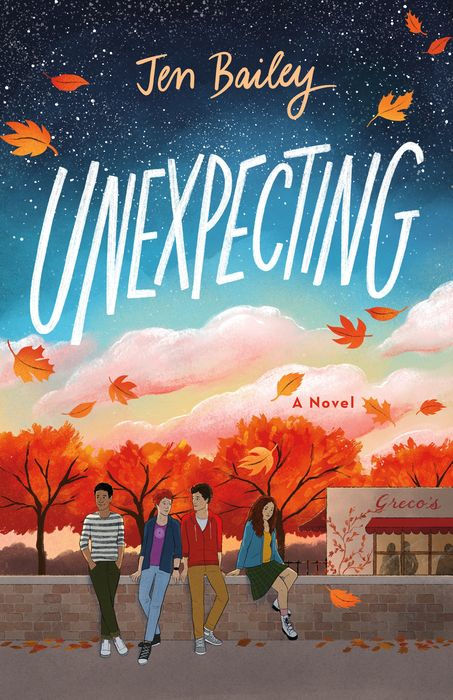
Unexpecting - by Jen Bailey


When teenagers Ben and Maxie decide to have sex (almost on a dare) they are dismayed to discover that the act resulted in a pregnancy. The fact Ben is gay adds an additional level of bewilderment to those who know him. Maxie (whose mother works at the public library) is ambivalent about the pregnancy and is under pressure from her parents to give the baby up for adoption. Ben, however, wants to raise the baby with the help of his mother and step-father. His mother provides some level of support for this idea, with the stipulation that Ben attend parenting and childbirth classes. Ben also checks out books on these topics from the public library. 

A twenty-first century take on the 1977 classic He's My Baby Now by Jeannette Eyerly. Eyerly's book was adapted into the 1980 ABC After School Special "Schoolboy Father" starring a very young Rob Lowe.

Wednesday, July 31, 2024

The Hero and the Crown - by Robin McKinley


Fire-haired Aerin, daughter of a king and a witch creates kenet, a salve that protects the user from dragon fire. Aerin becomes a dragon killer. The little-used royal library becomes a place where she not only discovers that she can read, but can learn as well.

One of the sixty books about dragons I'm reading this year Year of the Dragon, in which I turned sixty.

Friday, June 28, 2024

Gay the Pray Away - by Natalie Naudus


Valerie and her brother are homeschooled with a curriculum sanctioned by the Institute of God's Basic Principles, a conservative Christian organization headed by Ben Goddard - a not-so-subtle camouflage of the Institute of Basic Life Principles once headed by Bill Gothard. Valerie has always been taught to obey her parents and the church's teachings. The seventeen-year-old is expected to marry and begin having children when she completes her studies in God's Training Academy. She interacts mostly with others from her church, and rarely talks to people outside of her insular world. Her haven is the public library - a place she is able to visit while supervised by her mother (who once organized a protest against it for "sexualizing children"). Valerie has learned to select books with innocuous covers so that her parents don't question her reading choices. It is through library books that she first learns about bisexual and other queer folks and begins to question her own identity. When she meets Riley, a "troubled youth" who got kicked out of her private Christian school for kissing a girl, she realizes that there is much that she still needs to learn. With the help of the public library's internet she begins to explore new territory, the freedom she experiences leads her to make some difficult decisions. 

This book reminded me of Pearl Abraham's The Romance Reader (which I read when it was first published almost 30 years ago). Abraham's work tells of a girl growing up in a strict Hasidic community who sneaks to the library to read romance novels.


Thursday, May 30, 2024

The Girl Who Drank the Moon - by Kelly Barnhill

My reading goal for 2024 is to read sixty books about dragons in honor of my sixtieth birthday during this Year of the Dragon. Kelly Barnhill’s Newbery Award winning book features a magical girl (Luna) who keeps a tiny dragon for a pet. 

Luna was rescued as an infant from certain death by a witch. She had been left as a sacrifice by her village - all part of an evil plot by the town Elders and the Sisters of the Star meant to keep the rest of the villagers in line. 

The Sisters are the only ones with access to the libraries, the only ones that is except for their parade of apprentices who were always sent away “once they became aware of how much learning there was to be had in the libraries of the Tower, and they became hungry for it”. The Sisters knew, of course, that "the last thing they needed was to allow the populace to be getting ideas. Ideas, after all, are dangerous." When the Sisters and the Elders are finally conquered their apprentice (Wyn) is the person who opens the library to all because "knowledge is powerful, but it is a terrible power when it is hoarded and hidden".


Wednesday, January 10, 2024

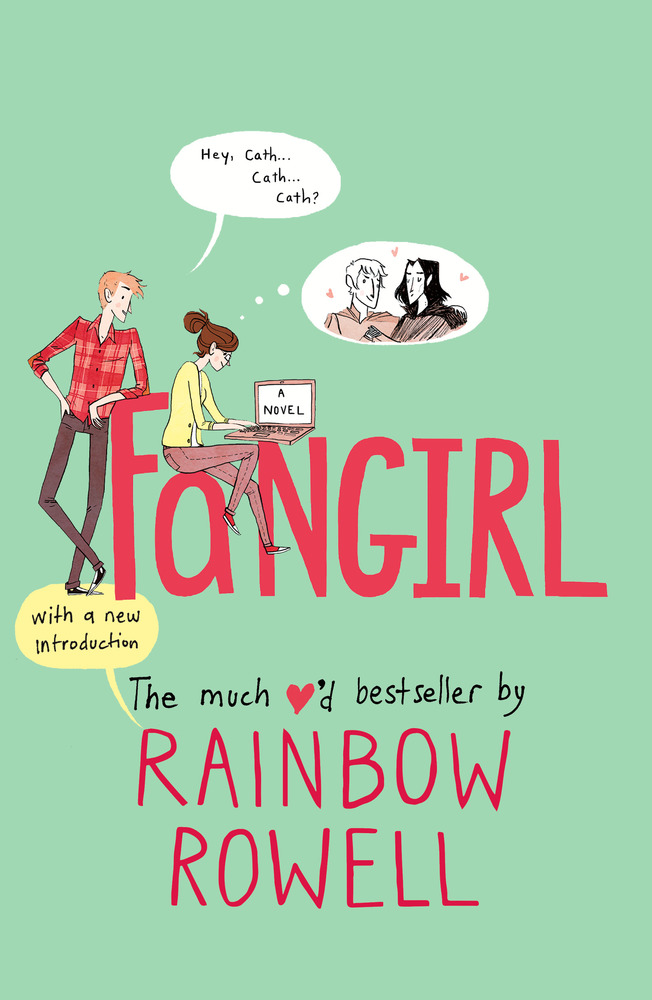
Fangirl - by Rainbow Rowell


Cath and her twin sister Wren are starting college at the University of Nebraska - Lincoln, but in different dorms. Cath is less than thrilled about this arrangement and is more than a bit intimidated by her roommate Reagan. At least she still has her fanfiction to disappear into. Cath and Wren used to write Simon Snow fanfiction together, but Wren lost interest and Cath now writes on her own. 

After getting special permission to take a 300-level fiction writing class Cath meets Nick and the two become writing partners. Nick works at Love Library "(That was the actual name; thank you for your donation, Mayor Don Lathrop Love)" shelving books, although he clearly doesn't take the job seriously enough. He left a cart full of books at the end of his shift because he was doing his homework instead of shelving. When Cath points this out he assures her that "the morning girl can do it. It'll remind her that she's alive". This turns out to be a bit of foreshadowing as we discover that Nick is all to happy to take credit for work that women do.

Cath mostly holds her own in the upper-level writing class, but is taken aback by an accusation of plagiarism when she uses some of her fan fiction as a basis for one of the writing assignments. Her professor is understanding, but will not change the failing grade, or allow Cath to rewrite the assignment. I disagree that what Cath turned in was plagiarized. If she had turned in the same story and used different character names her professor would probably never have realized. Also, I turned in a similar assignment myself as a graduate student (re-wrote a scene from a novel from a different character's point of view). My professor loved it. I got an A.

Cath spends a lot of time in the library, and her full nerd-dom is clear when we discover that she has a bit of a fantasy about "being trapped in a library overnight." She even writes a Simon Snow scene that takes place between the stacks.

Cath finds love (or something like it) with Levi. One of their early bonding experiences involves Cath reading The Outsiders aloud to Levi who has trouble with reading to himself. And really who doesn't love The Outsiders? I've said it before and I'll say it again: reading aloud with another person is never a bad idea. You will always have something to talk about.

Tuesday, July 11, 2023

Forever - by Judy Blume


Prior to the release of the much-awaited film version of Are You There God It's Me Margaret I watched the Judy Blume Forever documentary which featured interviews with the beloved author as well as many who grew up reading her books. In discussing the controversial Forever (who could forget Ralph?) one of the featured interviewees indicated that she realized re-reading the book as an adult that Michael really was a "dick". Gauntlet thrown. I had to read it again myself. I expect it has been over 40 years since I read it, but I know I read it several times as a teenager. My single Mom was cool about it and I didn't have to hide under the covers to read it. 

Reading it as an almost-sixty-year old it is clear that Michael is rather controlling, and the awkward sex scenes were definitely more cringe-worthy than I remembered. I laughed when I read the description of Katherine's mother as five foot six inches and 109 pounds and how concerned she was that her thighs were getting flabby. I also am five foot six, but I weigh twice that. Thankfully, I gave up worrying about flab ages ago. One thing I'd not remembered is that Katherine's mother is also a librarian. So there's that.

Wednesday, July 5, 2023

Class Act - by Jerry Craft

Jerry Craft's sequel to New Kid continues the story of friends Jordan and Drew at the prestigious Riverdale Academy Day School in the Bronx. Jordan and Drew have a hard time fitting in to the mostly white school. 

The Riverdale School's Morgan Library is "state of the art" at least that's what Principal Mr. Roche tells some potential students from the underserved Cardi De Academy. The students from Cardi De respond that their library "is six boxes of old books...five of them...on Martin Luther King". 

Jordan and Drew are asked by Librarian Miss Brickner to "help pick out diverse books for the library", they are initially eager to help but when they suggest that graphic novels be included she retorts that "graphic novels aren't real books". I always like to see a bit of metafiction in a book.

Both New Kid and Class Act have been challenged in a number of school districts across the country, most notably in Katy, Texas where an event with Craft was cancelled in 2021 after a parent complained that the books advocated Critical Race Theory (something that the author had never even heard of before).

 I picked this book up from a Little Free Library  with this cool sticker on it.


Wednesday, June 28, 2023

Attack of the Black Rectangles - by A.S. King

When Mac and his friends are assigned to read Jane Yolen's The Devil's Arithmetic in their sixth-grade lit circle they are interested in the story about a young girl who time travels to a World War II concentration camp. They are taken aback when they discover that two pages of the copies they've been given by their teacher have redacted passages. Several words have been blacked out with ink. They set out to find out who defaced their books, and what they were trying to hide. Finding out the original text was accomplished by locating a copy at the local bookstore. They had first tried the local public library but all copies were checked out. 

Mac and his comrades discover that their own teacher was responsible for the censorship. They are rightly insulted when they find out that some adults were concerned that they would be made uncomfortable by the references to the main character's breasts and chest. They point out that the book makes clear the horrors of the Holocaust and if they are able to handle this information they can most certainly handle reading words describing body parts.

There is a lot to this rather short novel. It is a story not only of censorship, but also of empowerment, and child agency. Mac and his classmates stage a protest, and show up at the school board meeting with prepared speeches in order to make their case. When I became a parent I was often surprised when I read information describing what my toddler, or preschooler, or school aged child, or middle schooler wasn't able to understand and think that my child didn't seem confused by those things. I would often think back to my own childhood remembering what I did understand at those ages. Kids really are smarter (and more determined) then society gives them credit for.

A final lesson Mac learns is that people are multi-dimensional. While he disagrees with his teacher on many issues he also recognizes that she does have his interests at heart. He has the same realization about his classmate Aaron with whom he generally does not get along, but finds is an ally in the fight against censorship.

Although fiction, the book is based on a true event, and references the book banning cases from York, Pennsylvania in 2021.

My husband and I listened to this as an audiobook. Our next listen will be The Devil's Arithmetic!

Friday, February 3, 2023

The Librarian of Auschwitz - by Antonio Iturbe

People like to share memes with me about book collecting and book hoarding. These are meant to be humorous, but I generally don't find them especially funny. I do have quite a few books in my house, but I do not let them take over. I often read books from the library and then return them, or when I buy them I have a "one in, one out" policy. Purged books go to free book shelves, or are donated to libraries. They are shared. Books are meant to be read and shared, not simply put on display. I thought a lot about all of this as I read The Librarian of Auschwitz. This novel is based on the real story of Dita Kraus who, along with her family was sent to the family camp at Auschwitz-Birknenau during the Holocaust. Although she was only 14 years old Dita was asked to be the clandestine librarian at the clandestine school run by fellow prisoner Fredy Hirsch. She took on the task although the punishment for keeping the books would surely have been death had she been discovered. The eight tattered books entrusted to Dita's care were shared among the classes at the school, and otherwise hidden beneath a floor board. All the books had value, even the Russian grammar book, written in Cyrillic which no one in the camp read.

Early in the book the forbidden works are described as dangerous although they do not have "a sharp point, a blade or heavy end". 

Throughout history all dictators, tyrants, and oppressors, whatever their ideology - whether Aryan, black, oriental, Arab, Slav or any other racial background; whether defenders of popular revolutions, or the privileges of upper classes, or God's mandate, or martial law - have had one thing in common: the vicious persecution of books. Books are extremely dangerous; they make people think.

Even among the prisoners there was concern about what was to be found in some of the books. Fredy Hirsch tried to warn Dita off reading The Good Soldier Svejk, telling her that it was "not appropriate for children, especially girls". To which our heroine responds "Do you honestly believe that after observing on a daily basis the dozens of people entering the gas chambers...[that] what I read in a novel might shock me?". The same book is demonized by some other prisoners, and again Dita puts them in their place.

Reading this in light of the unprecedented book-banning that we are seeing in the United States today makes it especially chilling. Concerns about what someone might find in a book seem rather ridiculous in a country where children are gunned down in their classrooms and by police. 

In addition to the eight books, the school also runs a "library on legs". Similar to the human books in Ray Bradbury's Fahrenheit 451, people who have memorized stories share them verbally.

Before being sent to the Auschwitz Dita and her family were first sent to the ghetto in Terezín, a place with a library-on-wheels, a trolley pushed through the streets which was generally "warmly welcomed" although the "books were often stolen, and not always so they could be read. They were also used as toilet paper or as fuel for the stoves".

One of the books entrusted to Dita is H.G. Wells The Time Machine. Dita determines that Wells was right, time machines do exist, in the form of books. Furthermore, she realizes that books can take us "much farther than any pair of shoes".


Friday, December 9, 2022

I Kissed Shara Wheeler - by Casey McQuiston


Being out and queer at Willowgrove Christian Academy is hard enough for Chloe Green without also having Shara Wheeler, the Principal's "perfect" daughter as her rival for class valedictorian. To complicate matters further, Shara disappears after she steals a kiss from Chole. That Shara had previously been presumed to be straight (the girlfriend of a star football player, no less) confounds everyone. Chole, Smith (Shara's boyfriend), and their friend Rory begin a search for Shara based on some rather complicated clues. 

No YA novel would be complete without some action taking place in the school library. Rory and Chloe sneak into the Principal's office after hours via the library air duct. They are able to get a key to the library from Chloe's friend Georgia who works as a library aide, although Georgia is unaware of what they were planning. While the ruse of traveling through air ducts is comically common in fiction, I don't know anyone IRL who has ever done it, although apparently it has been used with some success. Read about one case here.

Chloe and Shara have a unique library connection but only Chloe knows about it until close to the end of the book. Chloe witnesses Shara throwing away her bejeweled cross necklace in the library trashcan, which Chloe retrieves and then keeps. There are other mentions of studying and meeting in the library sprinkled throughout, but my favorite use of the library was this metaphor, written by Chloe's friend Georgia for a creative writing assignment
There's a girl with brown eyes who reminds me of the first book I ever loved. When I look at her, I feel like there might be another universe in her. I imagine her on a shelf too high for me to reach, or peeking out of someone else's backpack, or at the end of a long wait at the library. I know there are other books that are easier to get my hands on, but none are half as good as her. Every part of her seems to have a purpose, a specific meaning, an exact reason for being...

Another fun romp from the author of Red, White, and Royal Blue.


Wednesday, November 30, 2022

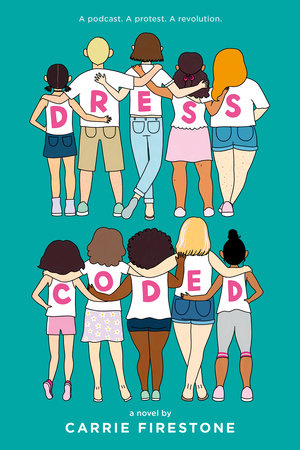
Dress Coded - by Carrie Firestone


I do love Little Free Libraries, of which there are about half a dozen near our weekend home in Fairhaven, Massachusetts. I found this book in the LFL located closest to our house. This novel tells of Molly Frost and her comrades at Fisher Middle School who are sick of having their clothing monitored. Shorts and skirts that aren't longer than the end of one's fingertips, bare shoulders, and other "distracting" attire is cause for being "coded". When Molly's friend Olivia is humiliated by the principal for exposing her shoulders because she removed her sweatshirt to tie around her waist to hide the period blood on her white pants Molly starts a podcast to protest. The protest gains serious momentum which ends with an Occupation in the schoolyard.

The school library, the public library, and a "fantasy library" where Molly imagines a decent older brother who protects her from the bullies who pelt her with ice balls are all part of this story.

Molly's mother attends a lecture at the local public library on "how guinea fowl and possums are better than chemicals for managing ticks."

The school library is a place where parents meet to discuss an upcoming end-of-year trip; where (girl) students are sent to have their clothing scrutinized; and where Molly and her friend Navya meet to write their speech for the School Board meeting. While writing their notes they find an ally in Mr. Beam, the school librarian, who "drops a blue folder on the table, winks, adjusts his tie, and walks away...It's stacked with articles about dress code protests and how, by law, student dress codes cannot be evenly enforced". You can always count on a librarian for assistance with subversive activity.


Thursday, December 9, 2021

The Time of Green Magic - by Hilary McKay

When Abi's father remarries and they move, along with her new step-mother and step-brothers, to a tall, narrow, ivy-covered house with colored glass in the windows, and an arched front door with a lantern "straight out of Narnia" her grandmother in Jamaica tells her "So much ivy, so much news! What a time of green magic". Abi and her new siblings soon discover that there is magic in the house as they begin to experience things they are reading in books. Abi gets wet reading about a raft, and animals from the stories begin to appear. 

Abi seeks the help of her father, Theo, a nurse to find out if books can be magic.

'At the hospital', said Abi, 'do people ever come in because of books?'

'They'd be disappointed if they did,' said Theo. 'We're a bloodbath-and-counseling service, not a library. We've got a few kids' picture books and Willy-the-mop keeps a stack of newspapers for emergency puddles, but that's about it.'

'Yes, but do people ever come in because they've had accidents with books?'

'Ah...Right, got you! Yes. Yes they do. Books are dangerous things'.

And Theo goes on to explain how people hurt themselves by reading while walking, or dropping books on their toes, or getting locked into libraries after they close and "get injured breaking their way out". Frustrated, Abi tries harder to explain that she is more interested in magic. Theo then describes how children have hurt themselves by "trying to get through the backs of wardrobes...or "running trolleys into brick walls..."Sitting on broomsticks and launching themselves out of bedroom windows! Bothering dragons!"

Of course books are magic. But are they dangerous? Current events would tell us that they are. Right now, all over the country organized groups are attempting to have whole categories of books removed from school libraries. Books with LGBTQ themes or race or racism are being especially targeted. It is important to note, however, that these attacks are coming from the left and the right. It seems that the word "harmful" has become a catch-all term for any book that someone doesn't like, and is afraid that someone else might.

Although this was about the magic of books there was only one  other place, near the very end of the story, where a library was mentioned. Abi's stepbrother Max goes to the library to find a book that he hopes will help recreate some of the magic he had experienced with their French nanny. 

I found this one in a Little Free Library. It was a quick fun read.  

Monday, March 29, 2021

Beyond the Bright Sea - by Lauren Wolk

In the early twentieth century twelve-year-old Crow lives on an isolated island off of Cape Cod with Osh, who found her as a newborn in a boat. Their neighbor Miss Maggie is one of her few other companions. Curious about where she came from Crow asks questions and wonders why others decline to shake her hand, why she is refused admittance to the local school on Cuttyhunk, and why the librarian told Miss Maggie that if books were meant for Crow's hands then she could keep them rather than returning. Crow ultimately unravels the mystery of her origins and discovers her legacy when she learns about the patients in a hospital that was once located on a nearby island. 

The public library does have some information in its archives that Miss Maggie uses to help Crow do some research. They also find an address for a doctor who used to work in the hospital. Crow posts a letter for the first time when she writes to the doctor to see if she can find out more about where she came from.

While this is not a book I would normally pick up, it is the current selection for our One Book One Community program and I am looking forward to hearing the author speak next month.


Monday, January 11, 2021

Everything All at Once - by Katrina Leno

About to graduate from high school Lottie is mourning the death of her favorite aunt (Helen) a famous children's book author. Aunt Helen's books are about a pair of immortal siblings (Alvin and Margo Hatter) and are wildly popular among people of all ages. There are of course those who do not like her books "the Anti-Hatters [who] burn the books on YouTube...They say the idea of immortality is a sin against God".

Aunt Helen donated half of her estate to "various charities and libraries of her choosing". She clearly understands the importance of libraries to authors. Some authors seem to think that libraries are somehow stealing royalites from them.

Aunt Helen also had owned the "most expansive private library" of anyone Lottie knew. Helen was even "featured on the front page of Libraries International twelve separate times". Lottie is emphatic in her instance that "Libraries International was an actual magazine". I, however, could find no evidence that such a magazine exists.

We don't actually see much of Lottie using the library although she does meet her friend Sam at one. Sam travels a lot and tells her that he gets a library card wherever he goes "that's important" he tells her.


I am Not Your Perfect Mexican Daughter - by Erika L. Sanchez

Living in the shadow of her dead older sister (Olga) Julia Reyes navigates high school, family, first love, and friendships. Although she is indeed not perfect (but it turns out neither was Olga) she does at least understand the importance of libraries. 

She uses the old standby lie of "I'm going to the library" so she can instead interrogate Olga's best friend Angie about a hotel key and sexy underwear she found among Olga's things.

Julia gets into trouble quite often and by her own account "between the ages of thirteen to fifteen [she'd] spent about forty-five percent of [her] life grounded". She further explains that sometimes when she punished she isn't even allowed to go to the library "the cruelest kind of torture". She also claims she "can't get pregnant at the library" but she obviously has never worked in one and discovered the kinds of things that library workers all to often find indicating that perhaps someone did get pregnant.

Julia really does love books and dreams of becoming so rich someday that she has "a library so big that [she'll] need a ladder to reach all [her] books".

The Ballad of Songbirds and Snakes - by Susanne Collins

 I read the first three Hunger Games books some years ago. I don't remember if I read them before or after I started this blog, but I somehow doubt any of them would have made the cut to be included here. So I was surprised when this one did. This prequel tells the story of Cornelius Snow and is set decades before the original series - during the 10th Hunger Games.

My husband and I listened to the audio version of this and I didn't download the text so I only have my faulty memory to aid me in writing this post. I recall students being sent to the school library to work on a group project. Disdain for group work appears to be a universal truth.