Showing posts with label time travel. Show all posts

Thursday, March 21, 2024

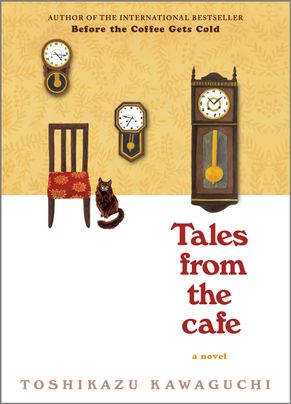
Tales from the Cafe - by Toshikazu Kawaguchi


During the early days of the pandemic James and I read Kawaguchi's book Before the Coffee Gets Cold which told of a coffee shop (Funiculi Funicula) that allowed customers to time travel, as long as they returned to the present "before the coffee gets cold". There were other quirky rules to follow as well, including where a would-be time traveler could sit - only in a seat otherwise occupied by a ghost. The ghost (aka the woman in the white dress) sits all day and reads, except for one daily trip to the toilet (why a ghost needs to use the bathroom is a question asked, but not answered). It is during this brief window each day that someone else might get a chance to time travel. I did not blog about this thoroughly enjoyable book when we read it because, alas, it had no libraries.

Tales from the Cafe has more stories from café Funiculi Funicula with this important change to the set up 

Until a couple of years ago, the woman in the dress read a novel entitled Lovers over and over again. One day, Miki remarked, "Doesn't she get bored reading the same novel?" and presented her own picture book to the woman in the dress.

This led coffee shop employee Kazu to the idea that she could provide new reading material to the woman in the dress with regular visits to the library. The woman in the dress accepted the fresh books, but without ever any acknowledgement of gratitude. Nevertheless Kazu continues to go the library once a week.

Both this book and Before the Coffee Gets Cold are episodic, with a unifying storyline.

A book about finding happiness. 

Wednesday, May 24, 2023

"Future Library" from Margaret Atwood's Burning Questions collection

I have read many of Margaret Atwood's works, but there are many others that are still on my "To Be Read" list. While I would like to be able to read them all before I die, I know this will not be possible. As the first author invited to be part of Katie Paterson's Future Library project, a 100-year endeavor, not even Atwood herself will live to see her contribution published. Neither for that matter will Paterson. Paterson's project is a leap of faith. Each year between 2014-2114 different authors will be invited to submit their works to be published, printed on paper made from a forest growing in Norway, when the project ends. 

Atwood's short essay about the Future Library explores questions of Time Travel, language, and climate change. "Will any human beings be waiting to receive it? Will there be a 'Norway'? Will there be a 'forest'? Will there be a 'library'?" she asks, and offers hope that they will.

Since she wrote this piece in 2015 she could not have known that libraries would be under such a threat as they are today, only eight years later. I can only hope that the censorship contagion in the United States does not make its way to Norway. 

Friday, January 13, 2023

Back to the Future Part III (the movie)

Well, it seems that it has been over seven years since I last watched a Back to the Future movie (when I watched Part II in honor of Back to the Future day). While my adult child was visiting recently the whole family enjoyed watching the whole trilogy. Like Part II, Part III features a trip to the library archive to look up some history of Hill Valley. The library itself appears to be closed, so I'm not sure how Marty and Doc Brown got in. 

Many people (my own child for instance) find the third part to be the best of the bunch. I disagree and say the original is still the best (which is not to say that all three are a lot of fun). After watching we came up with a myriad of questions about inconsistencies, and the logistics of time travel. It really is best not to wonder too hard about all of this. Better to just enjoy the ride.

One thing that Part II has over parts I and III is that it passes the Bechdel test. Marty's mother (Lorraine) talks to his daughter (Marlene) about pizza. Part three does not pass, although there is a strong female character in Clara (Mary Steenburgen).

Friday, May 14, 2021

The Midnight Library - by Matt Haig

Full of regrets, recently unemployed, and grieving the death of her cat Volts,  Nora Seed decides to take her own life. In the twilight world between the life and death Nora is surprised to find herself in a library and face-to-face with Mrs Elm, her school librarian from many years before, the person who had told her that her father had died when she was fourteen years old.

The Midnight Library is filled with green books, each one represents a life Nora didn't live in the multiverse. She can pick out any book and find out what her life would have been like if she had made different choices at each of her turning points. There are many possible lives that Nora is given the opportunity to visit. Would she like to be a rock star? a pub owner? a glaciologist? a vintner? What if she had married Dan rather than canceling at the last minute? What if she had just gone on that coffee date with Ash, where would she be now? Is there any world in which Volts is still alive?

Nora also meets other "sliders" - those like her who are moving between lives not lived. Each "slider" has their own guide and space in which to explore their lives. Not all sliders travel via library books - Hugo travels through old VHS tapes in a video store, with his deceased uncle as a guide, for instance. 

In the aptly titled chapter "God and other Librarians" the omniscience of Mrs Elm as Nora's guide is made abundantly clear, as is her role as a librarian. She explains to Nora that "The library has strict rules. Books are precious. You have to treat them carefully." 

The librarian stereotype is on display as well when Mrs Elm admonishes Nora to "Please be quiet...This is a library".

Ultimately Nora wishes to escape the Midnight Library, especially when she realizes that it is about to self destruct, but how does one do that when there are no doors? Mrs Elm to the rescue: "Who needs a door when you have a book?" she asks.

A new spin on an old theme. Anyone who grew up watching The Wizard of Oz won't be surprised by the ending.


Wednesday, June 17, 2020

La biblioteca mágica - por Valeria Cavajal Vasco


According to amazon I bought this book on April 30, so I must have purchased it for Día de los niños/Día de los libros (aka "Día" or Children's Day/Book Day). I do recall specifically looking for a library-centric, Spanish-language book to read. I usually pick a picture book to blog about for Día but this year I selected a chapter book, so it took me a bit longer to read it.  This is the story of friends Emma, Park, Paige, and Liam who want to take a summer vacation together, but first they need to earn some money. Paige and Park find work at a local store, and Liam gets a job with his uncle. Emma is worried that she will be the only one who won't be earning any money, until her mother helps her land a job at the local library el "único lugar al que muy pocos adolescentes irían a pedir trabajo", as well as "el lugar más aburrido del pueblo" (for those who are Spanish-language challenged, that translates to 'the only place that few adolescents would ask for work'; and 'the most boring place in town').

Emma, however, discovers that the library is far from boring. In a library lover's version of Night at the Museum Emma learns that those who work the night shift have the ability to visit the characters in the books. Beginning with Caperucita roja (Little Red Riding Hood), she moves on to Peter Pan,  Harry Potter; and Crepúsculo (Twilight), among others. From each book she also brings back a souvenir (Red Riding Hood's Cape and Peter Pan's sword, for instance). Far from boring, Emma finds that she not only looks forward to going to work in the library she is more interested in her work than in hanging out with her friends. She is reluctant to tell them about the library's secret until she learns that the mayor wants to close the library because nobody visits it, and it isn't a money maker. With the help of her friends and the other library employees, she comes up with a plan to save the library.

I must say I was left a little wanting with the resolution they came up with which I saw as stop gap at best, and had nothing to do with magic. No one wanted to reveal the library's secret for fear of exploiting it. However, if I were writing the ending to this book the friends would have sparked interest in the library, and helped it to make money without letting anyone in on the secret by  strategically visiting books, bringing back cool relics, and selling them. In fact I thought this solution was so obvious I really was stunned that it wasn't how the book ended.


Tuesday, March 3, 2020

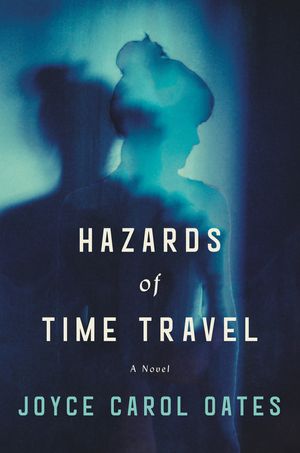
Hazards of Time Travel - by Joyce Carol Oates


In a dystopian future, class valedictorian Adriane Strohl  is arrested for treason and "questioning authority" on the eve of her high school graduation. She is sentenced to live in Zone Nine - 1959 Wainscotia, Wisconsin - as university student Mary Ellen Enright at Wainscotia State University for four years.

Adriane's brother Roddy works in the Media Dissemination Bureau "an old brownstone building formerly the Pennsboro Public Library, in the days when 'books' existed to be held in the hand-and read!" Not only have old libraries been repurposed, the information they held has been destroyed.
The old, "outdated" (that is "unpatriotic") history books had all been destroyed, my father said. Hunted down in the most remote outposts-obscure rural libraries in the Dakotas, below-ground stacks in great university libraries, microfilm in what had been the Library of Congress. "Outdated"/"unpatriotic" information was deleted from all computers and from all accessible memory-only reconstituted history and information were allowed...  
There are some contradictory passages in the book as to whether public libraries in the Reconstituted North American States exist. Adriane specifically says that "there were no longer 'libraries' in NAS-23" but also indicates in a previous passage that she was able to take out books from the public library marked "YA" (for young adults). YA books "had to be approved by the Youth Entertainment Board, and were really suitable for grade school." She was unable to take out books labeled "A" for adults. The books were actually eBooks and all had to be approved by the Homeland Security Information Bureau.

Adriane, ironically, however, finds herself working in a real library once she is sent back in time. As a "thrifty" scholarship girl "Mary Ellen" has a job at the university's geology library. And she is awestruck at the main university library
a vast brownstone building of numerous floors descending even into the earth, filled with row upon row of "stacks" containing "books" to be touched, and opened, by hand. And in reading rooms, high ceilings, myriad lights, and polished floors - and students!
"Mary Ellen" does some research on her professor (and fellow exile) Ira Wolfman in the college library by searching the "long clumsy drawers, under the heading PSYCHOLOGY, 20TH Century".

She spends much time in the university library and wondered at all the information that was not restricted by the government. She remarks on this "freedom" while also recognizing the irony that Zone Nine "did not feel like freedom".

With shades of Marge Piercy's Woman on the Edge of Time and Thornton Wilder's Our Town this thriller leaves the reader with a lot of questions about what is real, what we know, and what we believe.

Tuesday, September 3, 2019

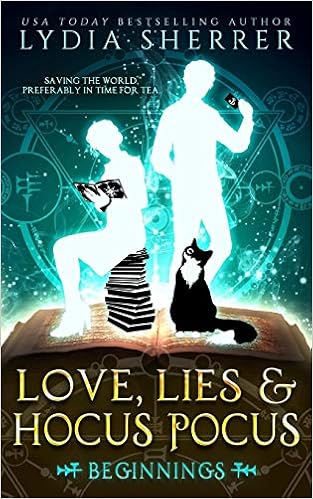
Loves, Lies, and Hocus Pocus: Beginnings - by Lydia Sherrer


Gotta love a magical librarian.

Lily Singer only had a vague sense that she was different growing up in Alabama with her mother, step-father, and step-siblings. She knew little about her birth father and her mother was evasive about him. Feeling like an outsider, she left home as soon as she could and ultimately became a librarian landing a job in the Archives at the Agnes Scott College McCain Library. The description of her office was enough to make me question the verisimilitude of the story, although the College and library are indeed real places.
Her office was a spacious room on the first floor, with a high ceiling and expansive windows. Tall bookshelves covered most of the other three walls, and a large, mahogany desk dominated the center of the room...The desk's dark wood surface was polished to a shine...
Also hard to believe is that not only has twenty-five year old Lily landed the prestigious position of Administrative Coordinator/Archives Manager, she did so without ever earning an advanced degree. While she has "four-years undergraduate work-study in the stacks" as well as a "BA in history and a minor in classics", generally such a position in an academic library in the 21st century would require, at the very least, a Master's of Library and Information Science (MLIS) degree. In Lily's case it looks like nepotism of the wizarding sort played a large part in her procuring the position.
Of course, Lily's love of books, organized nature, and library experience weren't the only reasons behind Madam Barrington's choice. The real reason was she'd needed someone to to take over as curator of the "Basement"- a secret archive beneath the McCain Library containing a private collection of occult books on magic, wizardry, and arcane science. Being a wizard herself, Madam Barrington had recognized Lily's innate ability soon after she'd begun her freshman year. 
This book contains two stories (or "episodes"). In each we find Lily using both her wisdom and her wizardry to solve a magical problem.

Wednesday, March 6, 2019

The Umbrella Academy (the television series)


When the surviving children of Reginald Hargreeves reunite for his funeral they discover that the apocalypse is nigh. While attempting to save the world they discover secrets that threaten much more than family unity.

Beyond binge-worthy, this dark comedy series begs to be binged. Keeping track of the multitude of characters, each with their own dysfunction, superpower, and history is enough reason to watch this without breaking. Throw in some time travel and flashbacks and it becomes an absolute necessity.

While it is made clear that scenes that take place in the present day do indeed transpire in 2019, it is a parallel world of 2019 than the one viewers know. It is a world with no cell phones; one in which our superheroes must use their wired house phone, or find a pay telephone when not at home, in order to communicate with one another when they are not together. It is likewise a world without Google. A world in which if one wants to find out about their sister's new suitor, for instance, one would have to go to the public library and use the newspaper on microfiche to find out more about him. An excellent use of library resources. There is one other scene over the 10 episodes that takes place in the public library, one in which a couple of judgmental librarians wonder where the parents of the drunk teenager are.

A wonderful cast and a good story with some truly unexpected twists and surprises.

Monday, October 31, 2016

Harry Potter and the Cursed Child - based on a story by J.K. Rowling, John Tiffany & Jack Thorne


I spent the weekend before Halloween reading the eighth book in the Harry Potter series - a script rather than a novel. Harry and his friends (and enemies, and frenemies) return as adults with jobs, children, and presumably mortgages, and all the other impedimenta (pun intended!) of grown up life.

The story begins where the epilogue of book seven left off - at Platform 9 3/4 with Harry and Ginny's son Albus Severus heading to Hogwarts for the first time. Albus develops a unlikely friendship with Scorpius Malfoy, son of Draco, and it is quickly made clear that it's the Potter kid who is the bad influence in this duo.

There is a lot here to entertain Potter fans. I enjoyed the work, and there were plenty of allusions to the rest of the series including fun with the invisibility cloak, the Marauder's Map, and Time Turners.

Libraries and books are key in this work. Hermione (now the Minister for Magic) not surprisingly has a large library in her office, and as Scorpius points out "There are some serious books here. Banned books. Cursed Books" including some that are "not even allowed in Hogwarts!" even in the Restricted Section.

So what we see is that Hermione, who in book five so enthusiastically points out that "if [Professor Umbridge] could have done one thing to make absolutely sure that every single person in this school will read your interview, it was banning it!", now is a practitioner of  censorship herself. It appears that like many book banners she believes that she can handle the information found in the threatening works, but must protect from others from the dangers within. This is not the only place in the story where we see the government hiding information from its people. So scary, really.

There are two scenes in the story that take place in the Hogwarts library. The librarian's role is most disappointing. The unnamed librarian has exactly one line.

All together now, let's hear it...

"Ssshhh!"

Sheesh.

Tuesday, February 16, 2016

Everything Matters! - by Ron Currie, Jr.


What would you do if you knew the exact date and time the world would come to an end? Who would you tell? When? Why? and How? These are the questions that trouble Junior Thibodeau, who has known since before he was born that a comet would hit the earth during his 37th year and obliterate all life. His knowledge of this haunts him and leads to problems with drug abuse and alienates him from his family and his girlfriend. The chapters are told in the first person from alternating perspectives of Junior, his family members and other acquaintances, with occasional interruptions of the omniscient "voice" that Junior hears telling him things about the past, present and future, sometimes simply providing information, other times offering advice that he sometimes takes and sometimes doesn't.

Junior uses the library several times on his way to doomsday. He does research on how to cure his father's lung cancer and takes his young daughter Ruby to the public library where she learns about the fragility of the environment and has her own existential crisis. Ruby knows nothing about how the world will end. Does it matter?

In addition to the library related passages, I marked another of particular interest to me. Junior's father is advised to go to Brockton Hospital for cancer treatment. This is intriguing not just in the fact that someone living in Maine would be sent not to Boston for world-class cancer care, but to a little-known city just south of it (and just to the north of Bridgewater, where I live). Brockton is a real place, it is, in fact, the city where my daughter was born. And Brockton Hospital is a place that I have received minor surgery (although it is not where I delivered my daughter). I don't think I've ever read a novel that mentioned Brockton before. It was serendipity that I picked out this book to read from my local library. I read the jacket flap and liked that it appeared to have a surreal quality. There was no indication that it might have a bit of local interest.

A story of supernatural forces, time travel, parallel universes, infinity, conspiracies, choices, and second chances.

Thursday, October 22, 2015

Back to the Future Part II - the movie


Like so many others yesterday I watched Back to the Future Part II - it was Back to the Future Day, after all. In BttF2 our heroes Doc Brown and Marty McFly travel across six decades. Beginning on October 26, 1985, then on to October 21, 2015, and back to 1985, and finally backwards in time to November 12, 1955. The most important thing that happens in any of this is that Doc Brown uses the Public Library (in 1985) and uses the newspaper archive there to discover that Marty's father had been murdered 12 years prior, and that he (Brown) had been committed to a psychiatric hospital (questions still remain about why that was front page news). Sadly, I must also say that it appears that Brown stole the bound periodicals in order to show them to Marty (perhaps he checked them out, but generally libraries don't circulate archival newspaper), and it is clear that Marty tore the page with his father's story out of the book! Whatever good reason the Doc and Marty think they had for stealing and defacing public property, this behavior cannot be condoned.

Thursday, October 16, 2014

Miss Peregrine's Home for Peculiar Children - by Ransom Riggs


Using real vintage photographs Ransom Riggs creates an eerie story of time travel and creepy kids. Miss Peregrine's charges live in a "loop" in which it is always September 3, 1940. They are visited by Jacob, whose grandfather once lived among them. Jacob tells them about the future, and gives them the sad news that his grandfather, Abe, has died. Jacob discovers that he, too, is "peculiar" and learns that the stories his grandfather told him growing up (about kids with such gifts as the ability to levitate, and invisibility) were all true.

After Jacob witnesses his grandfather's death, and swears he saw a real monster kill him, Jacob's parents send him to Dr. Golan who recommends a visit to the library to see if he can make any sense of his grandfather's last words. He falls asleep over some of Ralph Waldo Emerson's writing, and wakes up screaming, upon which he is "unceremoniously ejected from the library."

Also at Dr. Golan's suggestion, Jacob and his father travel to Scotland to visit the place his grandfather lived. There he finds a library in Miss Peregrine's home. The first time it appears in the present day in an abandoned and bombed out building where "the creep of moisture had bowed the shelves into crooked smiles". He sees it again as it appeared in 1940 where it was in "a real classroom". He finds in the library the Map of Days (easy to find because it was "the largest one in the library").

A good spooky read for October. I plan to read the sequel.

Wednesday, August 6, 2014

Sex Criminals (Volume 1) One Weird Thing - by Matt Fraction and Chip Zdarsky


I appreciate a book that recognizes that librarians are sexual beings. I also appreciate a book that recognizes the superhero status of librarians. In Sex Criminals authors Fraction and Zdarsky have created a librarian character (Suzie) whose superpowers are activated when she reaches orgasm. Suzie can make time stop whenever she comes. She meets her match in Jon, who has the same gift she does. The two decide to use their power to become modern day Robin Hoods - robbing from the rich (the evil banks) and giving to the poor (the about-to-be foreclosed library).

The authors clearly appreciate a good library (and a good librarian). And they make a bit of a dig at the woeful status of sex information a young person might discover at school. Remembering her quest for information when she discovers her special secret Suzie asks
Ever try to utilize the resources of the public school system to learn about sex? No wonder so many dumb kids get knocked up. Nobody knows anything and if they do, they're legally bound from telling you.
However, she "falls in love with libraries" when she gets the assistance she needs from a non-judgmental and super helpful public librarian. (This is clearly what inspired her to become a librarian herself).

There are five books in this series. Although I found this fun, I don't plan on reading the rest. I get the gist.

Monday, June 30, 2014

Something Wicked this Way Comes - by Ray Bradbury


Earlier this month I posted about the movie Something Wicked this Way Comes and I mentioned that I had not read the book, so I needed to rectify that situation. I had the same trouble following the book as I did the movie, although I followed enough to know that there were some plot points that were changed when the story went from page to screen. However, the important thing remained. One of the main characters, Charles Holloway, is the town librarian, and he helps to save the town from evil (but isn't that what all librarians do?). The library is truly described as a magical place
Out in the world, not much happened. But here in the special night, a land bricked with paper and leather, anything might happen, always did. Listen! and you heard ten thousand people screaming so high only dogs feathered their ears. A million folk ran toting cannons, sharpening guillotines; Chines, four abreast, marched on forever.
What is also clear in the book, is that Mr. Halloway met his wife in the library. As he tells it to his son, Will
I looked up from my great self-wrestling match one night when your mother came to the library for a book and got me instead. And I saw then and there you take a man half-bad and a woman half-bad and put their two good halves together and you got one human all good to share between.
The library also becomes is a hiding place for Will and his friend Jim. And Mr. Halloway actually uses it the old-fashioned way - to do research. He tells the two boys he knows something evil is afoot and that he is going to
"check police records on carnivals, newspaper files at the library, books, old folios, everything that might fit..." in order to come up with a plan to foil the plans of the wicked ones.

When the boys return to the library to find out the plan Will is afraid to go in, and his young mind invents some wild scenarios about what might happen
'The library' said Will 'I'm afraid of it, now' All the books he thought, perched there, hundreds of years old, peeling skin, leaning on each other like ten million vultures. Walk along the dark stacks and all the gold titles shine their eyes at you. Between old carnival, old library and his own father everything old...well...
'I know Dad's in there, but is it Dad? I mean, what if they came, changed him, made him bad, promised him something they can't give but he thinks they can, and we go in there and some day fifty years from now someone opens a book in there an you and me drop out, like two dry moth wings on the floor, Jim, someone pressed and hid us between pages, and no one ever guessed where we went-'
Ultimately the fear of being outside the library overcomes the fear of being in it.

A lot of the action takes place in the library, and some of it is scary, but ultimately the librarian understands what is happening and what needs to be done.

A story about the evil in all of us.

Tuesday, June 24, 2014

Something Wicked this Way Comes - the movie


I saw this on a list of "library movies". I was worried that it would be scary, and watched it before it got dark out. Then I found out it was a Disney flick. Made in 1983 James pointed out a couple of things that were rather Back-to-the Future-y (1985) especially with regard to time travel and lightning bolts. Neither one of us really understood what was going on in this adaptation of Ray Bradbury's novel (which I have not read). However, we did ultimately get this important message from the film: the town librarian (Jason Robards) saved the day!

Thursday, March 6, 2014

Man in the Empty Suit - by Sean Ferrell


Each time travel story has its own set of rules. Sometimes, one of the rules is something along the lines of  'do not to let a former self see your older self' (a la Back to the Future). Other times this isn't a problem. For instance in The Time Traveler's Wife  time traveler Henry DeTramble not only meets former selves, he mentors them, lets them know what is about to happen, and even engages in circle jerks with them. He is aware that what will be will be, and he cannot change his fate. The unnamed traveler in Ferrell's book not only meets his other selves he actively works to change their fates, and thereby "untethers" himself from many of the selves he meets at the annual convention he arranges for himself on his birthday. His desire to save himself from the pain of a broken nose results in various parallel life trajectories, and alternate realities (again refer to Back to the Future movies for more of how this happens) with some disastrous results. One good thing that happens as the result of all of this, however, is that our Time Traveler finds work at the New York Public Library of the future (year 2071), where our hero literally works for food, an irony that was not lost on this librarian.

The narrator's job is in the "book exchange" where the workers search for books and send them to "those who need them." The books are placed in precariously high stacks and when the narrator asks how they find the randomly placed books again, he learns that "The books just seem to know to go where they'll be found". Well, that would certainly make a lot of  library jobs easier.

There are several other scenes in the library, all seem to involve some sort of confusion, yet are strangely comforting to the Time Traveler. Again, this librarian could easily relate to the feeling.

As with most time travel stories, it is best not to over think this one. It would be too easy to drive yourself crazy with questions about logical fallacies, something else the narrator himself recognizes.


Wednesday, July 31, 2013

Harry Potter and the Prisoner of Azkaban - by J.K. Rowling


Last year I started a tradition of posting about Harry Potter on his birthday. Until 2017 I will re-read one of the books in the series each year, after that I will either have to start a new tradition, or re-blog, or figure out something else Potter related to blog about on July 31. But, anyway, as for this year I can write about book three.

While our friends appear to use the library less often in this work than in books one and two, and that nasty old stereotype Madam Pince doesn't show up at all, we do know that Harry and Herminone occasionally studied there. The library often offered a convenient excuse as a place to go for refuge, or as an easy lie. We also know that Hermione, Ron and Harry did use it to research legal information as to how they might save the poor old hippogriff Buckbeak from execution in his case against the Committee for the Disposal of Dangerous Creatures.

Well, here's hoping book four is more library-centric.

Sunday, December 23, 2012

The Time Machine - by H.G. Wells


I have seen two movies based on this work (The Time Machine (2002); and Time After Time (1979)). Neither has too much in common with Well's original story; however, the 2002 movie not only shares the exact title, it, like the book, has a library. The movie boasts a librarian as well: Orlando Jones Vox #NY-114. According to the Librarians in the Movies Filmography webpage  Jones Vox is
a very cool virtual librarian of the future who is the compendium of (no less than) All Human Knowledge. He describes himself as a "third generation fusion card photonic with verbal and visual link capabilities connected to every database on the planet." He does a reference interview and even holds story time for kids. We first encounter him in 2030, then later about 800,000 years into the future (although his source of power is never explained).
There is nothing quite so groovy in the book, the futuristic library is only mentioned one time, and there is no librarian in the dusty, deserted place. However, the hallowed space is given a bit of a build up, and is located in a place the Time Traveler calls The Palace of Green Porcelain (emphasis mine). What appears at first to be a museum of archaeology the Time Traveler discovers, to some delight, that it also "possibly" contains "historical galleries; [and] ....even a library!" Which he says "would be vastly more interesting than this spectacle of old-time geology in decay."

I saw Time After Time over 30 years ago, and I remember the gist (Jack the Ripper escapes into the future with H.G. Wells in hot pursuit), but I cannot recall if there is a library or librarian. I have added this to my Netflix list and will update this post, if necessary, once I have watched it again.

A free e-book available at Project Gutenberg.