Back in my library school days (early 1990s) I worked for
author Tom Miller, who at the time was working on his book
Trading with the Enemy: A Yankee Travels through Castro's Cuba. I learned a lot about Cuba while I was helping with research and fact checking, and ultimately reading the book, in which one finds my name on the acknowledgement page. It is not the only book I am acknowledged in, but it was the first.
In the summer of 2012 I received an e-mail from my former employer announcing that he was leading a tour of "Literary Havana" in January of 2013. I didn't think I would be able to go and almost forgot about it until November of that year when my husband remembered an unused bank account that still had some funds in it. We closed the account, and the next thing I knew I was applying for a license to visit Cuba: so close, yet so inaccessible. The
Trading with the Enemy Act was passed in 1917 to stop U.S. trade with hostile nations during World War I. President Kennedy used it in 1963 to end trade with Communist Cuba. Since that time United States citizens have been unable to freely travel to Cuba. Currently it is the only country with which the U.S. has these economic sanctions.Citizens of other countries may freely travel to and from Cuba as well. I was able to travel to Cuba as an academic researcher.
Planes, Trains, but no Automobiles
My travels began on January 5, when I caught the Commuter Rail from my home in Bridgewater, Massachusetts to Boston. I walked to the train platform from my home, and had to run just a bit when I heard the train whistle blow before I reached the platform. Once I arrived at
Boston's South Station, I took the
Silver Line to Logan airport, which brought me right to the American Airlines terminal. I caught my flight to Miami, where I stayed overnight for my flight to Havana the next day. Tom had contacted all travelers to let them know we were to meet with him, and our Cuba Tours & Travel guide (Frank) at 10:00 a.m. Our flight wasn't leaving until 1:00 so I thought this was unnecessarily early, until I started standing in all the lines. One line to get our tickets, another to have our bags weighted and ticketed, and another one for boarding passes. The flight itself was short, just about an hour. Arrival at the Jos
é Mart
í airport seemed like a step back in time. Rather than exiting the plane via a jetway, we walked down metal steps, and made our way to the bright blue and yellow building through open air. Once inside the building more lines awaited us: one to get our tourist visas, another for passport check, then customs, baggage claim, and money exchange. Americans cannot use credit or debit cards in Cuba, so everything must be paid in cash. The CUC (Cuban Convertible Peso) is the money used in the tourism trade. There is a 12% fee for converting American Dollars. I had converted my US dollars to Canadian dollars at the Boston airport, but I am not sure it helped. Knowing that I could not fall back on my credit card immediately made me nervous about spending any money.
Callejón de Jamel
A center for Afro-Cuban culture, Callej
ón de Jamel was our first stop - a pastiche of colorful murals, sculptures, deep thoughts written on the walls, and surprisingly comfortable benches cut from old bathtubs. The alley also has music and dance on Sunday afternoons - something we had apparently just missed. The callej
ón was started in the 1990s, a subversive act at a time when creating artwork that was not government approved was not allowed. This was followed by a wonderful dinner starting with m
ojitos - Cuba's national drink. The meal also included lobster, shrimp, strawberry ice cream and rum. We were entertained by street musicians, as we were at virtually every restaurant meal thereafter.
A morning stroll
The next morning I took a sunrise walk along the Malec
ón (the sea wall in Old Havana) with fellow traveler Bob. During our walk saw some young men fishing, some ginormous oars and some other rather beautiful scenery. While walking back to our hotel a young man approached us and asked if we had any soap or shampoo, and informed us that he could get into trouble for talking to us. We had no soap or shampoo for him.
 |
| Boats along the Malecon |
 |
| The Malecon at sunrise |
Hand made books
Following breakfast at our hotel we took the bus to
Matanzas where we visited Ediciones Vigía publishing house. All the books are small runs (200 copies) and hand made from recycled paper, found materials, fabric, etc. Each worker receives one copy of the book as a gift; the author receives 25 copies; 7 go to the publishing house library; the rest get sold for 5-50 cucs. I did get to visit the house library.
 |
| Books on display |
 |
| Our tour guide shows us some of the books - photo credit Angela Giron |
 |
| Wearable art |
 |
| Workers create some of the books |
Matanzas also had a public library, which was seemingly open, but not really. I walked in and was directed to leave immediately. It appears they were doing some reorganization and renovation.
We did not stop at a beach on the way back to the hotel. We were told that we were not to be at any beach, and were not to tell anyone if we did stop at a beach.
 |
| In the hotel common area the morning after our first night - empty wine glasses and cigar stubs demonstrate that people actually use the space for visiting and conversing. |
Getting in touch with James, who was traveling in Nicaragua at the time, was a bit of a challenge. I first attempted to call the Nicaragua tour guide with instructions on how to make the international call from the hotel, but had no luck. My next stop was the cyber cafe at the hotel where internet time could be purchased for about $1.00 per minute. I bought a 30-minute cyber card which I decided I would need to use judiciously to make it last for the entire trip. I had to wait an extremely long time for my turn to use the computers, and remembered reading in Miller's book about the culture of queuing in Cuba. There really isn't a line, each person just knows who is before them. When I finally was called into the computer room I had to wait some more as only two of the four computers were accessible with the ticket I purchased. Eventually I was able to log in, check my messages and send James an e-mail. I spent 15 minutes online, saving the remaining time on my card for later in the week.
Dinner was at a beautiful
"paladar" - a privately owned restaurant often in someone's home. These are legal now, but were not in 2003, when
James was in Cuba. The restaurant was quite elegant. For 30 cucs we had mojitos, wine, water, tapas, bread, our main course, dessert and coffee. At the end of the evening the waiter brought out some old-fashioned costume jewelry so that each woman could select a piece. We were also each offered a Cuban cigar, which I declined. When the bus dropped us off after dinner we encountered the same young man who wanted soap and shampoo, this time he was hawking cigars.
 |
| Place setting |
 |
| Interior decor |
 |
| Enjoying our meal - photo credit Angela Giron |
 |
| My selected piece of jewelry |
Old Havana
The agenda the next morning was a walking tour of Old Havana with Isabel the architect. She told us all about the old buildings in each of the four squares, one of which especially reminded me of New Orleans. She explained that the government was working to restore a lot of the old buildings in order to promote more tourism.
 |
| A mailbox on the side of one of the buildings |
Isabel's take on the rationing system (each citizen is given a ration book for staples, regardless of need) is that she shouldn't get a book, as she has plenty of means for getting what she needs, and that the rations should be reserved for more vulnerable populations. She appeared completely unfazed by the fact that she was taxed at 10% in order to put money into children's cancer treatment. I think a lot about the rhetoric our country has about "caring for children" but when it comes to paying for basic needs or health care for children we become very vocal about not wanting our taxes raised and start throwing the word "Socialism" around.
Our tour ended with a visit to a lovely scale model of Old Havana.
 |
| Image from authenticubatours.com |
 |
| I did not see nearly as many street dogs in Cuba as I see in other Latin American countries. Many who appear to be street dogs at first glance, are actually wearing large tags indicating that they have been sterilized and that they live in some non-house type place (a museum, for instance). |
 |
| Cool old cars are easy to spot in Old Havana. I got to ride in a '57 Chevy myself, but it was not as well kept as some others are. |
 |
| View from inside one of the four plazas of Old Havana |
 |
| Taller de Grafica - Museum, Art Gallery, Print Shop |
A Busman's Holiday
There was one other librarian on the trip and we took the opportunity to visit the public library in Old Havana together, where we met the world's most gregarious children's librarian. Although he was in the middle of inventory he took the time to talk with us and tell us about his programs. Much of what we saw was exactly what one would expect to see in the children's room of a library, kids' books displays, and a story hour set up. The librarian explained that young children could pick out their own books, but teens and adults have to fill out a request form and have the book retrieved. He was very excited to tell us about his birthday program and how he celebrates author's birthdays with the children, and then sends the author a birthday message via e-mail.
 |
| My fellow librarian, Naomi, poses in front of the card catalog. There were some computers in the library, but this lo-tech method was the way to find out what books were available. |
 |
Some children's books on display. Most of these were Spanish translations of books that would probably recognizable to most children's librarians. On this table for instance is "Sarah Sencilla y Alta" (Sarah Plain and Tall by Patricia MacLachlin) and "Me Llamo Bud, No Buddy" (Bud, Not Buddy by Christopher Paul Curtis).
|
 |
| After visiting the Public Library we made our pilgrimage to Ambos Mundos hotel, where Hemingway often stayed while in Havana. His room is now a museum which can be visited for 2 CUCs. |
The following day we were to take a ferry across the bay, but when we arrived at the dock found that the bridge that was supposed to bring the fuel to the boat broke, we ended up taking the bus around instead. We visited an Afro-Cuban church and a museum of Afro-Cuban religion. The church's patron saint was Regla who appears to be black, and holds a white baby Jesus. The information I read indicated, however, that although she looked black it was because ebony was a "Noble" wood, rather than due to any ethnic or racial reasons. I am having my doubts about that, but I admit to not fully understanding everything I saw and read.
Lunch was a family-style meal of salad, rice, beans, crab, octopus, fish, shrimp, rabbit and pork (I tried all except the last two) and flan for dessert. We dined outside a midst a cool breeze and some caged birds (parrots, parakeets, cockatiels) along with some free-flying birds.
 |
| Neighborhood outside of our restaurant |
Lunch was followed by a visit to
Finca la Vigía (Hemingway's Estate). Dinner with some
fellow travelers at Jardín de Eden (Garden of Eden) "a Jewish restaurant in the Cuban Style". We all laughed about the pork rolls on the menu. The restaurant was part of a culinary or hospitality school. It was clear we were being served by students - very polite, but not good at service. Dinner was followed by a salsa lesson at the home of Tom's niece, Jennifer. The cab we took to get there was a privately owned '57 Chevy, with bench seats, floral upholstery, and no seat belts. The driver (the original owner) really reminisced about what a fine machine it was back in the day.
Jewish Cultural Center
The highlight of Day 6 of our tour was a visit to the Jewish Cultural Center where we met with the friendly and funny Adele, whom Tom wrote about in his book. We met her in the Center's library where she explained about the history of Jews on the island. The small lending library was little-used, and rather cramped. It seemed to be storing things during what appeared to be a renovation in another part of the Center.
 |
| Interior scenes of the Jewish Cultural Center Library. Adele told us that one of the recent acquisitions was a Spanish translation of Harry Potter, at the request of one of the young members. |
Adele told us about a Jewish American who is imprisoned in Cuba for bringing a satellite phone into the country (illegal in Cuba). At the time he had served 3 years of a 15-year sentence. I did not know about him before. Nor did I know about the
Cuban Five - five Cuban nationals who are imprisoned in Florida for the past 15 years. Adele also explained to us about Castro's loosening up on religious restrictions, and his two visits to the Center. She also chatted in Yiddish with one of the other members of our tour group, a woman who coincidentally was also named Adele.
We spent a genteel afternoon in the rooftop apartment of poet Reyna María Rodriguez. She answered our questions and treated us to a poetry reading, along with her translator. When asked how she knew her translator translated things properly she spoke about trust and confidence gained from working together. When asked about censorship she did tell us that something from her most recent work had been removed. She seemed philosophical about it, explaining that she was glad the rest of the work had been published, and that after all, she does choose to work in Cuba.
Chinatown
Day Seven of our tour began with a visit to the National Art Gallery. I think we were all disappointed not to have had more time there. I was intrigued by two paintings I saw of Joseph holding the baby Jesus. I don't recall ever having seen portraits of Joseph without Mary. In both paintings a cross was visible. Seemed a bit macabre. This was followed by a lunch at a Chinese restaurant (tomato and egg soup, and eggrolls) and a walking tour. Tom's wife Regla (a Cuban native) had joined the tour by this time and led us through Chinatown. She told us about an old Chinese laundry where she used to take her father's shirts to be washed by hand. It was called "laundry by train" because each person had a job and the clothes moved along them like an assembly line. We visited a Catholic Church (Nuestra Senora de la Caridad, the patron saint of Cuba). Although it was in the middle of Chinatown, Regla told us that it was built before the neighborhood became Chinatown.
 |
| Chinatown restaurant |
 |
| Chinatown Senior Center |
Afro-Cuban religion
The following day began with an Afro-Cuban religious ceremony. We were taken to a park, and then the worshipers asked their ancestors for permission to enter via some drumming and singing. Once permission was granted (I am not sure how they knew when it happened) we walked down to the water where a white cloth was laid out in front of a tree and some artifacts and fruit were placed on it (the cloth). Then two ice- blue colored taper candles were lit and placed in front of the cloth. The drumming and singing began again. There were four drummers (all men) and four women who took turns dancing. Yellow, green, and white were the dominant colors of the clothing and hats they all wore, although the young woman in a brown tank top, and skin-tight leopard patterned pants certainly caught my eye. One of the drummers came and gave everyone a sunflower but when he got to me he paused and instead took a pink flower and made a circular motion around my stomach with it. I could not help but think that he must have believed I was pregnant. Meanwhile a woman in a long yellow and white gingham skirt was wading in the water pulling out rocks, and these, too, were distributed to the participants. After the music ended, the candles were extinguished and thrown into the water. The fruit likewise was tossed in, but not before it was waved in front of my stomach and that of Jennifer (of salsa lesson fame) whom I knew for a fact was pregnant at the time. I verified with Relga that the flower and the fruit were rituals used for pregnant women. I assured her that I was not expecting, and then she asked if I hoped to become pregnant again I answered in the negative. "Well, then be careful" was her response! Well, it's been a year since then. So far, so good!
And in the "It's a Small World" Department, a woman from another tour group from Iowa State recognized me! She and I apparently overlapped as members of the Unitarian Universalist Church of Tucson for a few months back in 1994!
Lunch was at El Aljibe: sangria, salad, appetizers, rice and beans, chicken and french fries. And by far the best music we heard. I actually bought a CD from these guys.
 |
| Great music! |
We had a free afternoon, so I visited the Natural History Museum, and did some shopping. Admission to the museum was 3 CUCs. I certainly would have been disappointed if I had paid any more than that. The exhibits were mostly taxidermied animals, and a few fossils. I was able to give my Spanish-reading skills a workout though. I think I read every exhibit explanation. Even so, I got through the whole museum in under and hour.
I bought a book and a map from some street vendors. I haggled a bit, but didn't get very good deals. I also bought two lovely crocheted tops from a little storefront shop where I spoke at length with the proprietress, who appeared impressed with my Spanish-speaking abilities. I also found a little open-air market up the street from our hotel where I was able to buy two pairs of earrings for one CUC.
Our final dinner was at a private art studio. We enjoyed viewing the artwork and then dining in the courtyard with an open bar. The food, artwork, and atmosphere were all exceptionally elegant.
Escuela de Arte
Our last day was spent wandering the grounds of the abandoned National Art Schools -the subject of the film
Unfinished Spaces. Originally commissioned to be built by Castro and Guevara, politics got in the way of completion. Efforts have been made at restoration, but those too, have fallen by the wayside.
 |
| Escuela de Arte |
 |
| Blogger poses in the space that should have been the library |
 |
| Beautiful natural light patterns in the library space were created by this skylight. |
 |
| We climbed 126 steps for a beautiful view |
 |
We were told the original architecture was based on an image of a goddess with many breasts, and had a lot of sensual curves. Looking down on the buildings from above, this becomes obvious.
|
 |
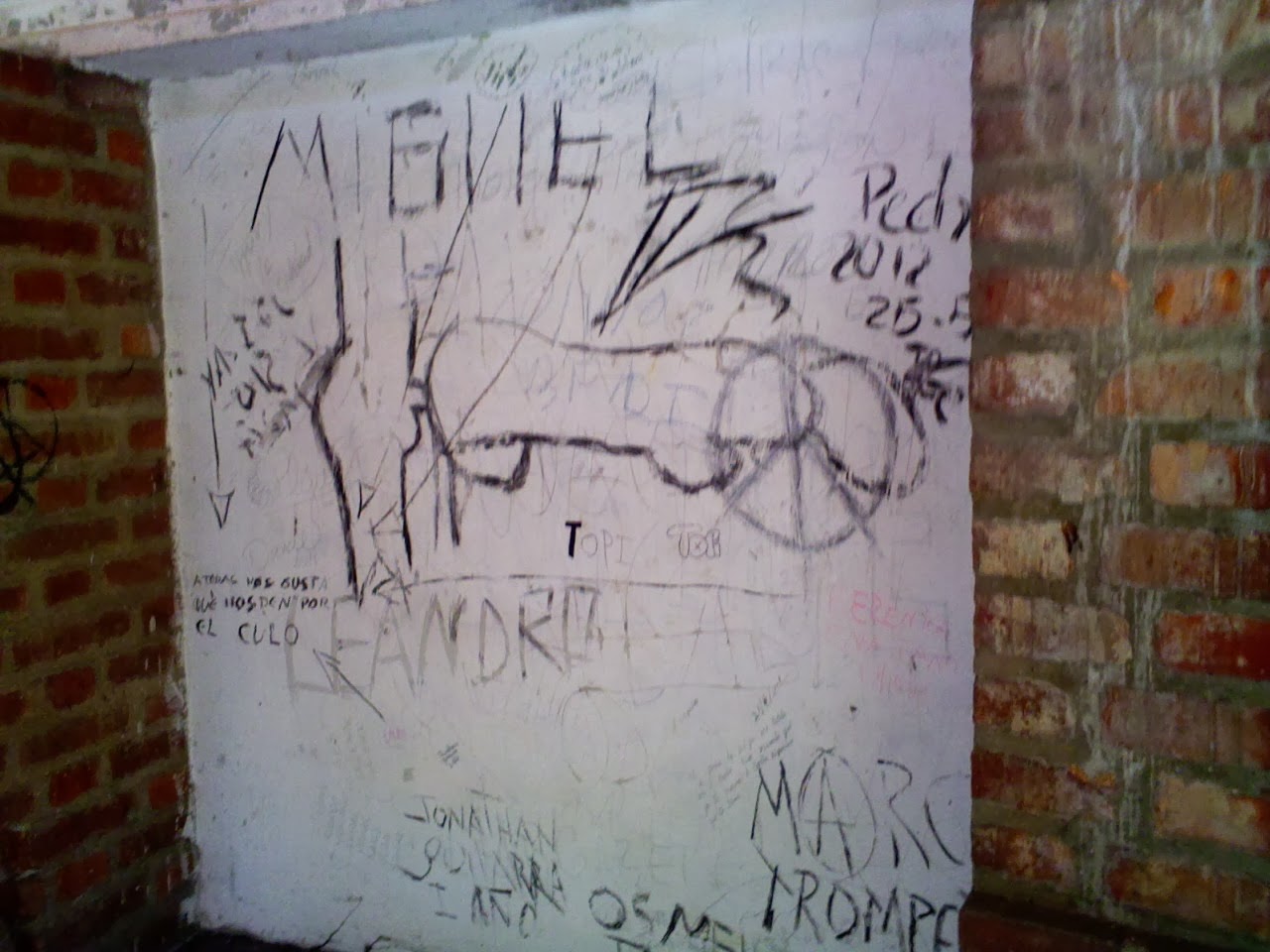
| Graffiti inside the buildings demonstrates the neglect, which was also evident by the litter (including used condoms) we saw. When we asked about a bathroom we were told "the whole place is a bathroom". I learned I could hold my pee for up to three hours. |
Random Photos
 |
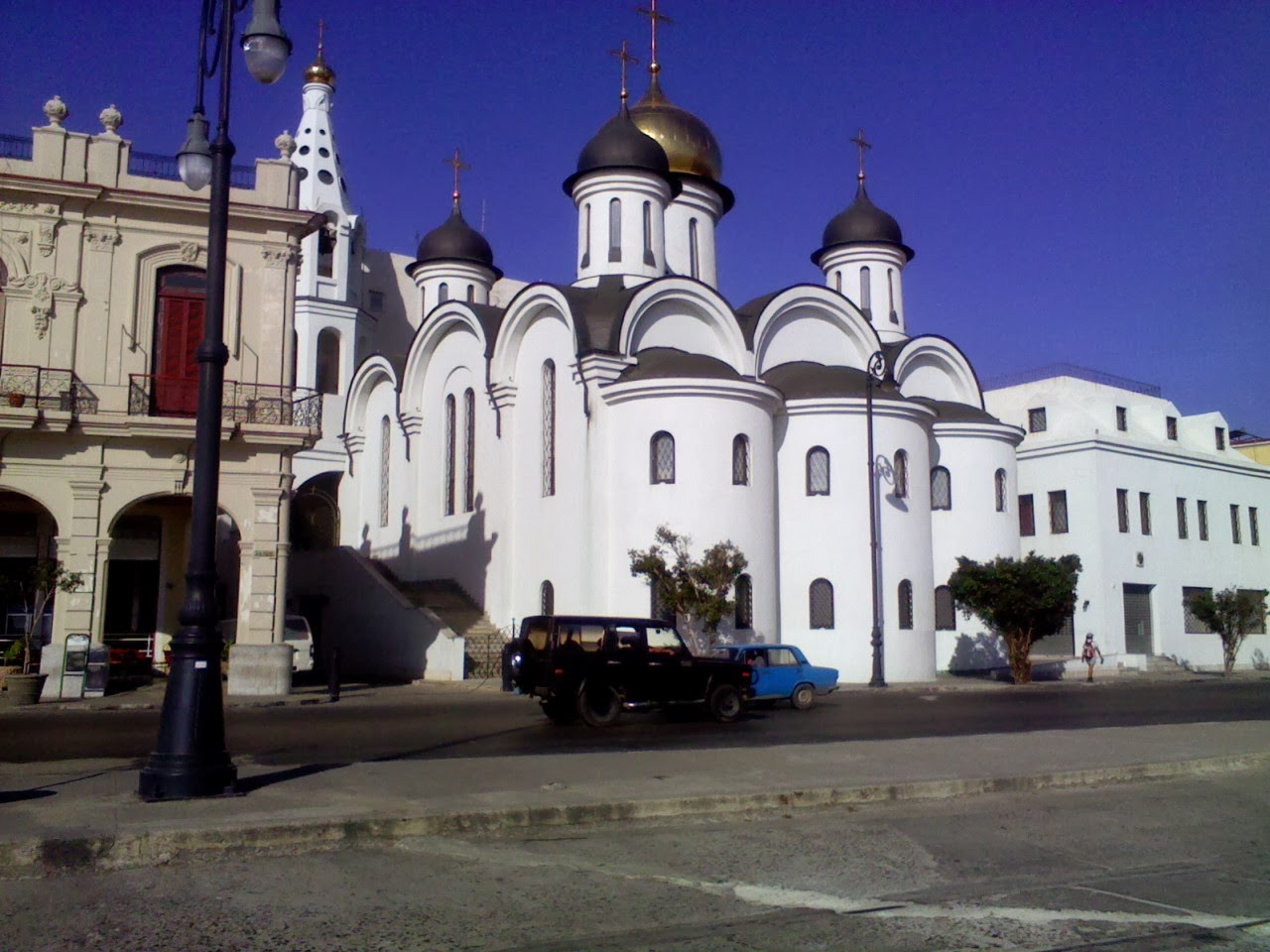
| I am not remembering what this beautiful building was. Perhaps the Eastern Orthodox church? |
 |
| Demolition, Cuba style |
 |
The ubiquitous Che Guevara. His image was everywhere.
Translation: In the world there is need of men who criticize less, and do more, who promise less and work more, who say now, not tomorrow. |
 |
| I can't remember where I saw this one - somewhere in Old Havana I think. |
Final Thoughts
"People are more alike than different."
This is one of the
Guiding Principles of the Polus Center for Social & Economic Development in Clinton, Massachusetts. It is something that I try to keep in mind when traveling. While it is too easy, especially when traveling in the only Communist country in the west, to see the differences, there are still some universal truths. People enjoy visiting the libraries, and museums; they appreciate art and literature. They also enjoy going to bars, and shows, and dances in the evenings. Statues honoring heroes can be found in parks and public squares. A blank wall will attract graffiti artists. People everywhere love their families and want what is best for them. The questions Isabel raised surrounding the distribution of ration books are the same ones we might ask about Social Security benefits. Social and political changes are taking place in Cuba. Restrictions on travel may be loosened and more American citizens may find their way to this warm and wonderful island. I am grateful to have had this opportunity and hope that this experience will soon be available to more of my denizens.