Showing posts with label dystopia. Show all posts

Monday, July 21, 2025

Calm - by S.J. Baker

I picked up this YA Dystopian novel from a local Little Free Library. In this fool's paradise the government has drugged the water supply to keep everyone lulled into a sense of complacecny and from having any feelings (good or bad). Of course books in this world are also hard to come by. And as with any dystopia there are resistors. Tiegan, a young dyed-in-the-wool Resistor who is running from the Servants remembers that her own home had a "little store [of books]...hidden in the cupboard...even though their very presence in the house meant danger."

Something else worth mentioning about this book it that it recognizes that when on the lam menstruating people may have trouble managing their periods. It was frankly refreshing to read a book that appreciated this problem.


Friday, August 2, 2024

The Chaperone - by M Hendrix


In the tradition of Margaret Atwood's The Handmaid's Tale Hendrix creates a New America, one in which women are second class citizens and all teenage girls are required to have a chaperone when they go out in public. Chaperone's are exclusively other women who have decided to take one of the few jobs available to them.

Stella's Chaperone (Sister Laura) is not averse to bending the rules for her charge. Sister Laura sometimes disappears when she and Stella are at the library so that Stella can steal a few moments with her crush, Mateo.

It is intriguing that there even is a public library in New America. But of course there are also a lot of forbidden books. Sister Laura passes some of this literature along to Stella, helpfully suggesting that she hide the taboo works between the covers of some of the other books in her room.

It appears a revolution is afoot!

Tuesday, August 1, 2023

There's Something for Everyone at the Library

!Barbie Spoiler Alert!

My husband returned from a two-week trip to the Amazon last week so I took a few days off of work for us to spend together. When he asked what I'd like to do on Wednesday I told him I wanted to see the Barbie movie. Sporting his pink oxford shirt he purchased the tickets online and we set off our local theater (which thankfully is never crowded). We both thoroughly enjoyed the film.


I am always happy to see someone use a library in a film and Ken wasted no time finding one in The Real World to do research about the patriarchy. He then used the information to brainwash the Barbies to turn  Barbieland into an unrecognizable dystopia. 

The same week that I saw the Barbie movie I revisited a favorite book from my childhood - Fuzzies: A Folk Fable for All Ages. First published in 1971 this hippie-dip book tells of a beautiful valley where everyone is happy all the time (because they have Fuzzies). Their beautiful utopia is disrupted by the evil Juanita the witch who, after doing some research at the library, comes up with a plan to convince the people of the valley that there is a shortage of Fuzzies. The sharing stops and the hoarding begins.


If a person based their opinions of libraries only on these two works, they might believe that libraries are bad things. But never forget, libraries are for everyone. Ken took advantage of what he learned at the library, but  there was nothing stopping Barbie from accessing the same information. I would argue that it would have been to her advantage to read the same things Ken did. Knowing what you are fighting against provides a strong advantage. As for the people of the valley, I expect that keeping strictly to themselves and never learning about what else was going on in the world worked to their disadvantage. Books can be mirrors or windows. 

Wednesday, July 12, 2023

Saha - by Cho Nam-Joo


In a fictional dystopian place called Town people live in a caste system based on class and privilege. Those who are fortunate enough to be born into the L category are full citizens and live a Brahman-like life. Sahas are the Untouchables. In between are the L2s who can only stay on renewable work visas. Sahas are named for the building they live in. A place where community matters and odd jobs are the only way to earn money. The economic system depends on the three classes, even as Sahas are not officially recognized citizens. Town is run by a nebulous Council of Ministers that manipulates the Sahas and uses them for nefarious research. When Woomi, a girl who is a test subject for this research (aka "the Master Key because she survived a Covid-like pandemic in utero) starts looking for answers she discovers that her data is being stored in a library but is not quite sure how to access it. Breaking into the library she finds a Fahrenheit 451 - esque data storage system wherein people are trained to memorize the data. Woomi talks to her "data storage unit" who tells her that it is "painful to know so much and have to retain it all." Furthermore, "accuracy plummeted" when "the data storage unit realized the information was not being accessed fairly or used in productive ways".

The book is a bit frustrating in that it simply stops, rather than ends. There is no resolution.

The reviews I read all indicated that this work was not as good as the author's other work Kim Jiyoung: Born 1982, but I liked it better.

Monday, May 22, 2023

Our Missing Hearts - by Celeste Ng

This dystopian novel, reminiscent of The Handmaid's Tale, gives us a glimpse of what happens when prejudices go unchecked. As we watch the far right cycle through villanzing every marginalized group, (landing most recently on the LGBTQ+ community) this work is prescient in more ways than one.

In Our Missing Hearts Anti-Asian sentiment is sanctioned by the government through PACT (the Preserving American Cultures and Traditions Act). PACT also encourages citizens to report their neighbors for un-American activities (broadly defined) and allows great leeway in banning books. Children are removed from their homes and permanently re-placed if their parents are deemed to be un-American. Current news from Florida and Texas regarding trans children echoes this story line. Ng's book centers on a mixed race family: Asian-American mother Margaret; Caucasian father (Ethan); and their son Bird (aka Noah).

When Margaret's little-known (and apolitical) book of poetry unwittingly becomes a symbol of a protest movement Margaret goes on the lam leaving Bird and Ethan behind in hopes of keeping father and son together even as she cannot be with them. When asked about Margaret's whereabouts Bird and Ethan always answer that they do not know, and that she is no longer a part of the family.

There is much in this book about libraries and censorship. Although libraries exist they are largely empty (of people and books). Described as a "ghost town" the public library is still a sanctuary for Bird (and his friend Sadie). The librarian helps Bird to find a book based on only a vague description. They use an old card catalog to find it but the book has been removed from the library. As was his mother’s poetry book - Our Missing Hearts. The librarian tells him “We don’t burn books here this is America…we pulp them. She says his mother’s book was probably turned into toilet paper and wiped someone’s butt a long time ago. Although they do not traffic much in books, the librarians are still connecting people and information. "The brain of a librarian is a capacious place." 

The public librarians are part of a subversive group that provides information to parents whose children have been “re-placed” - surreptitiously passing notes between the pages of interlibrary loan books. The librarians also hide Sadie away from her foster family as she tries to reunite with her parents. Train and bus schedule information is provided to Bird at the library. The librarian tells him that she is only letting him know how to find the information: what he does with it is his business. 

Likewise classrooms are described with empty bookshelves because “books are outdated the minute they're published”. However, students are informed by their teachers that books haven’t been banned, obviously, because that would contradict the first amendment. Rather, the books have been removed so as not to expose students to harmful ideas. This is eerily reminiscent of a viral video that recently made the rounds online of an empty school library in Florida.


Ethan shelves books in a Harvard University library. A PhD, he used to teach linguistics there, but lost the job over Margaret's "politics".  As a linguist, Ethan is especially interested in word derivations. He enjoys explaining where words come from (in multiple languages) to his son. The book included an explanation about the derivation of the word library coming from the word for tree bark, something I had never known before.


Monday, April 4, 2022

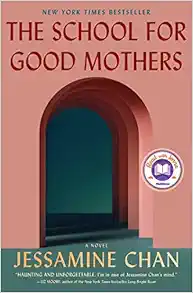
The School for Good Mothers - by Jessamine Chan


Bringing together ideas from The Stepford Wives, The Handmaid's Tale, and the movie A.I. Jessamine Chan finds a new way to scare the bejesus out of all of us.

Frida Liu is a single mother trying to co-parent her toddler (Harriet) as best she can with her ex-husband (Gust) and his live-in girlfriend (Susanna). During the Labor Day weekend Frida is unable to console the eighteen-month-old who is suffering from an ear infection. Neither is able to get much sleep over the three days. Frida, at her wit's end, leaves the house, and her daughter unattended, for two hours. The police are called when the neighbors hear the baby's incessant crying. After several months of invasive monitoring, and limited supervised visits with her daughter, Frida is sent to a facility where she can be rehabilitated as a mother. The year-long stay involves learning to parent with a creepy robot surrogate for her daughter, on a defunct university campus.

Mentions of libraries are infrequent and tend to be nefarious in nature. Frida is told not to do research at the library prior to her court hearing, lest she be monitored; the former music and dance library on the prison campus is empty; one mother is being rehabilitated for having allowed her eight-year-old to walk home from the  local library alone (a four-block distance). Frida gets one 10-minute video visit with Harriet a week which take place in the former campus library. Even these become depressing events. On the rare occasions when Frida's phone privileges aren't rescinded and she is able to connect with Harriet, Gust and Susanna, the calls are fraught.

A truly chilling tale for the twenty-first century.

Monday, December 20, 2021

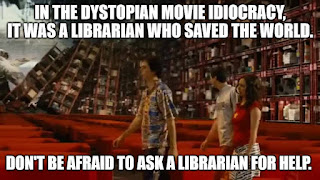
Idiocracy - the movie


I learned about this film through the Librarian Memes Facebook Group. I also learned that it was available to watch for free on YouTube - albeit with ads, which I very much try to avoid. I bit the bullet though and my husband and I watched (with the occasional short interruptions). This film stars Luke Wilson as Joe Bauers (the librarian) and Maya Rudolph as Rita (a sex worker). Joe and Rita agree to be part of a top secret military experiment on suspended animation. Scheduled to be awakened after one year, instead they wake up 500 years later, to a world where these two rather average people are the smartest in the country. 

A few comments about this work:

  • It miserably fails the Bechdel Test.

  • Joe's title as a librarian is questionable - he works in a library which means he may or may not be a librarian. According to his supervisor he doesn't do anything but sit on his ass. Library stereotypes will live forever.

  • While Joe is given the title as the smartest person on earth when he wakes up, I expect it was actually Rita. Joe takes an IQ test which Rita is never given the chance to do. But, anyway, he must be smarter, right? Because he's a man, right? 


Wednesday, October 30, 2019

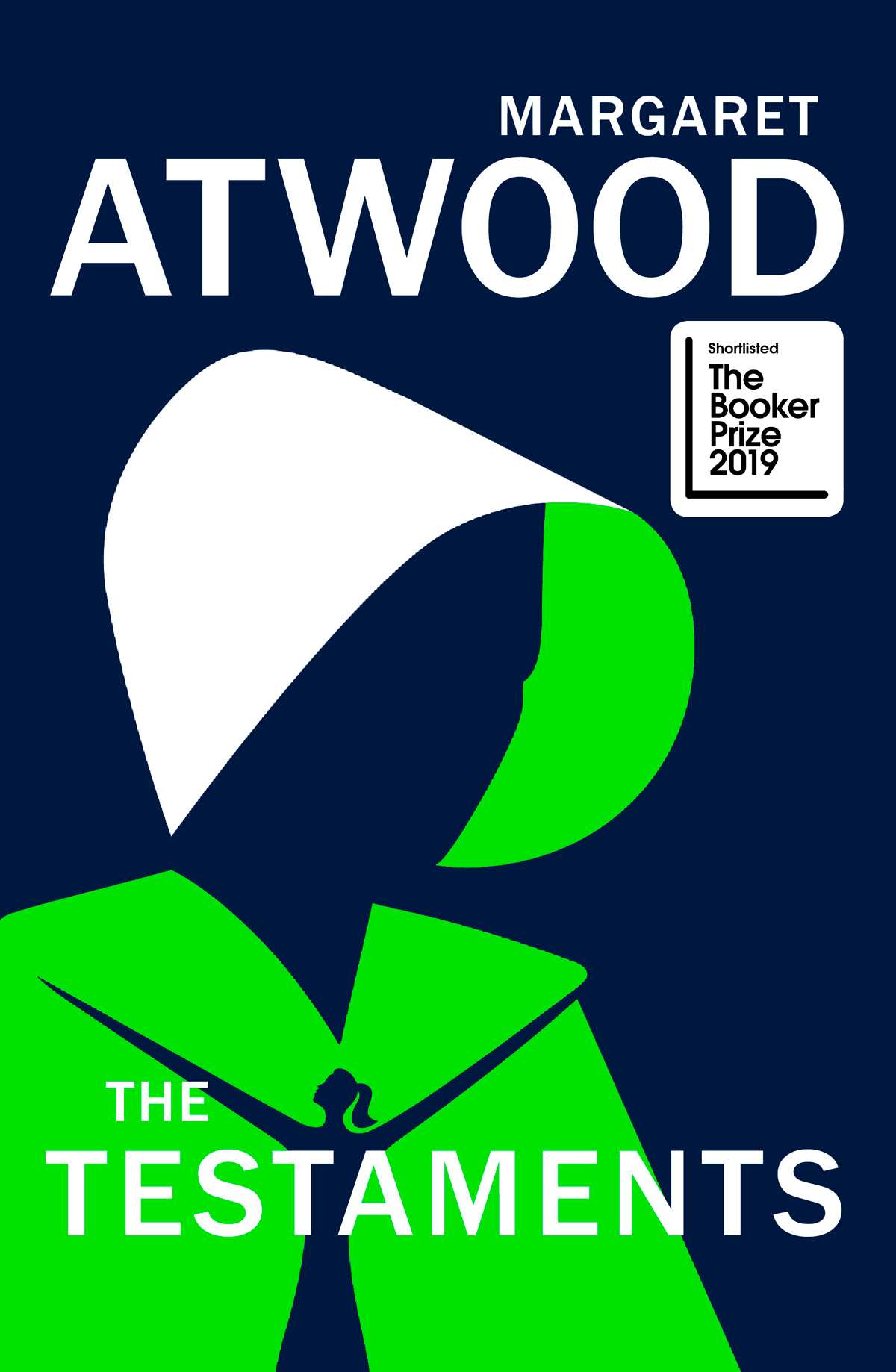
The Testaments - by Margaret Atwood


Among Harry Potter fans there is a stretch of time known as the three-year-summer - the period between July 2000 and June 2003. It references the spacing between the fourth and fifth books in the series. It was a difficult time for us to be sure, but it was nothing compared to the 35-year wait Atwood fans endured for this sequel to The Handmaid's Tale.

This was well worth the wait. While not a continuation of Offred's story we do discover what happened to her and the baby she was carrying. Instead this is a novel in three voices.

The first is Aunt Lydia by way of the Ardua Hall Holograph, a clandestine memoir, secretly written, a la Winston Smith in George Orwell's 1984. The difference here is that Aunt Lydia is less likely to be discovered by the cameras because, as she tells us "I know where they are, having placed them myself". The other two voices are those of Agnes Jemima a young woman who grew up in Gilead; and Daisy, who grew up in Canada where she learned about Gilead through her parents and her lessons at school. Both of these young women have several different aliases.

Aunt Lydia lives in Ardua Hall, along with all the other aunts in the city. Each evening she heads to her "private sanctum" in the Hildegard library "one of the few libraries remaining after the enthusiastic book-burnings that have been going on..." The Ardua Hall library has different rooms with different levels of access. Aunt Lydia has access to all - the General section where new supplicants learn to read; the Reading room "where the Bibles brood in the darkness of their locked boxes, glowing with arcane energy"; and the Bloodlines Genealogical Archives with their classified files. Aunt Lydia knows that knowledge is power, something that clearly the Commanders of Gilead are also quite aware, otherwise they would have no reason to deny the ability to read to women. Even some of the Aunts believe that reading can be too dangerous. The residents of Ardua Hall know all too well the story of poor Aunt Lily who neither wanted to marry nor stay in Ardua Hall instead "she wanted to live on her own and work on a farm. Aunt Elizabeth and Aunt Vidala said this was what came of reading too early...before her mind was strengthened enough to reject [the wrong ideas] and there were a lot of questionable books that should be destroyed".

Daisy and Aunt Lydia both describe visiting their school libraries as a children, and both tell of a specific book they remember from their respective school libraries. Contrary to the experiences of Aunt Lydia and Daisy, going to a library is privilege that Agnes Jemima never had. Her experiences in a library (a word she never even heard as a child) would come later in her life. When she does enter a library for the first time she is overwhelmed
It's hard to describe the feeling this gave me. The first time I passed through its doors, I felt as if a golden key had been given to me - a key that would unlock one secret door after another, revealing to me the riches that lay within. 
Eventually, Agnes does some work in the Hildegard library, as does her friend Becka (aka Aunt Immortell). Agnes' job is to make "fair copies of Aunt Lydia's speeches". It is through working on this task that she discovers some disturbing information about her family. Someone who knows that knowledge is power begins slipping files with classified information in between the files of speeches to be copied.

We don't know much about what Becka's job in the library is, except that she sometimes has "night duty" there. Aunt Lydia does mention that there is a "night librarian" on duty whom she greets on the way to her sanctum.

Aunt Lydia uses the library as a cover on behalf of two residents of Ardua Hall when it is discovered that they are not at lunch. Aunt Lydia knows their whereabouts but instead tells the others "I believe they are fasting...I glimpsed them in the Hildegard Library yesterday, studying their Bibles".

Reading and writing are forbidden for women and girls in Gilead, with the exception of the Aunts. Books were apparently their consolation prize for not being able to have husband or babies. As Agnes Jemima tells us "the Aunts were not married; they were not allowed to be. That was why they could have writing and books". I've thought about this passage a lot as a person who loves reading and writing and who is also a woman who has had a husband for 33 years. For me the choice of family or literacy seems a particularly grim game of  "Would you rather..." If I had never fallen in love with my husband in the first place the answer would be clear, but given the choice of leaving my husband or keeping my privilege of literacy what would I do?

Of course the Aunts don't really make this choice. They don't leave their husbands, they never had them to begin with.  They have their books and writing, and they have each other for company. Although Aunt Lydia doesn't have close friends among the other Aunts, she understands that she needs their companionship. As she discovered when placed in solitary confinement prior to facing her own Hobson's Choice of Aunt-hood or death "One person alone is not a full person: we exist in relation to others. I was one person: I risked becoming no person".

Across from Ardua Hall, the Eyes also have headquarters in what used to be a library. Aunt Lydia tells us that "It now shelters no books but their (the Eyes) own, the original contents having been burned or, if valuable, added to the private collections of various sticky-fingered Commanders."

As with The Handmaid's Tale, The Testaments ends with an epilogue in the form of an academic conference. Here we read the transcripts of The Thirteenth Symposium of Gileadean Studies, International Historical Association Convention, Passamaquoddy, Maine, June 29-30, 2197. The keynote speaker is Professor James Darcy Pieixoto who immediately, condescendingly, points out that the Chair of the Symposium, Professor Maryanne Crescent Moon, would never have had that position in Gilead, and  that in fact "women are usurping leadership positions to...a terrifying extent".

As in The Handmaid's Tale Pieixoto is the only male narrator, and similar to his comments in that novel, he begins by questioning the authenticity of the recently discovered holograph, and the two witness testimonies (discovered in the library of the Innu University in Sheshatshiu, Labrador), but ultimately, charitably suggests "why not take them at their word?" The testimonies were discovered by a graduate student, a woman - Mia Smith, who shared them with her professor, who of course first questioned their authenticity. Once a team of graduate students followed the route described in the transcripts, and validated certain details Peixioto ready to take on the work of doing the seminal research on them - talk about a usurper.


Friday, May 3, 2019

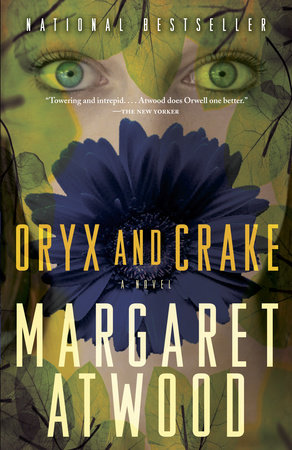
Oryx and Crake - by Margaret Atwood


I first read this work when it was published in 2003. It is the first book of a trilogy, and I've been planning on reading the other two (The Year of the Flood and Maddaddam) but it had been so long since I read this one that I wanted to re-read it before delving in to the other two. My husband and I took the opportunity for a read aloud and will finish the trilogy together.

This is the story of Snowman (aka Jimmy), his best friend Crake, and their shared lover, Oryx. The novel alternates between a time in the near future where the bio-tech industry is running just about everything, including schools; and a bit more distant future, after just about everything has been destroyed. In the former time Jimmy goes to school, schools that even have libraries. Each mention of his school library is about technology. He uses computers and CD ROMs, but never mentions a hard-copy book. When Jimmy graduates he goes to a third-rate college - The Martha Graham Academy - which focuses on the humanities rather than STEM. Martha Graham's library is full of mildewing books, unlike the
better libraries, at institutions with more money, [which] had long ago burned their actual books and kept everything on CD-ROM, but Martha Graham was behind the times in that, as in everything.  
  After graduation Jimmy
snared a job at the Martha Graham library, going through old books and earmarking them for destruction while deciding which should remain on earth in digital form...he lost his post halfway through because he couldn't bear to throw anything out.
Ah, Jimmy, every librarian feels your pain. Just as gardens need weeding to keep them healthy, we know we need to "weed" our collections, too. But throwing out books just seems sacrilegious. What to do?

Tuesday, March 14, 2017

Brave New World - by Aldous Huxley


A few weeks ago I read an article by Margaret Atwood explaining why we should all read Brave New World at which point I realized I had no choice but to look it up in the catalog of the library where I worked, find the call number, walk up the two flights of stairs to retrieve it, and check it out.

The brave new world described in the book is painted as a "utopia", but readers easily see it for the dystopia that it is. Humans are created, rather than born, each to a specific caste (Alpha, Beta, Gamma, Delta, or Epsilon) for which they are programmed to believe is better than the others. Everyone is happy with their lot, and regularly provided drugs and sex to keep them happy. Everyone also knows that "everyone belongs to everyone else". Worst of all books are censored.

 We learn early on that Deltas are conditioned to hate books. (Presumably this is true of Epsilons, and perhaps Gammas as well). This was because "you couldn't have lower-caste people wasting the Community's time over books, and that there was always the risk of their reading something which might undesirably decondition one of their reflexes". While not verboten for the upper-castes, books are still considered a waste because "you can't consume much if you sit still and read books." And even at Eton (where you can find the Alpha Double Pluses) the library "contains only books of reference. If...young people need distraction, they can get it at the feelies."

Ultimately we learn what is almost always true about those who would keep certain books from others - that those in charge have access to all of them. The censors believe that they alone can handle the information within. The masses simply cannot understand them, and those who might understand may be attracted to them, and then might not like the new things the controllers want them to like.

In the end the propaganda of the Brave New World isn't so new. The same rhetoric has been around for centuries, and still continues today.


Monday, March 10, 2014

Divergent-by Veronica Roth


On one of my rare visits to a movie theater last year I saw a trailer for the movie Divergent. It looked like a movie right up my cup of tea with a strong female lead in a dystopian society. And, it turns out, it was based on a book. I always like to read a book before I see a movie based on it, so I read this one in anticipation of the movie's opening later this month.

The setting for this work is some unspecified future time: Chicago, Illinois. Each member of society takes a test at age 16 to determine which faction of society they belong in. There are five factions: Abnegation (the selfless); Amity (the peaceful); Candor (the honest); Dauntless (the brave); and Erudite (the intellectual). Once a person chooses their faction it is theirs for life. There is no crossing over. Those who do not easily fall into one of the factions are called "Divergent" and are considered a danger to the society. The story follows Divergent Beatrice (later called simply "Tris") as she tries to hide from the powers that be.

Overall the story was pretty good and I read it quickly, but I must say I was put off by the fact that the Erudite were the villans in this story, and the only mention of a library was as the headquarters of the Erudite. It all seemed like just more anti-intellectual rhetoric to me. And while not every book I've read about libraries necessarily exalts them, reading about a library as the temple of evil distracted me from enjoying the rest of the book.

I do see the appeal of this work. A novel for young adults, I imagine that most who read it will want to identify with the "divergents", those who do not easily fit into one category - those who can be selfless, and peaceful, and honest, and brave, and smart. I don't think I will rush out to the theater to see the movie though. Perhaps I will watch it when it comes out on Netflix. I am on the fence about reading the rest of the trilogy.

Tuesday, September 24, 2013

Banned Books Week - The Handmaid's Tale by Margaret Atwood


I have a clear memory of myself, as a college student who had recently been introduced to feminism and feminist literature, picking this book off of a cart of new stock at the bookstore where I worked and being drawn in by the cover illustration. Why were those nuns wearing red habits? The description on the back cover of a dystopian world intrigued me. The story stayed with me long after I read it. Some books are pure escape, and even if I remember that I read them, I don't always remember what they were about, but this one haunted me. Each time I've read it (this was at least my fouth go round) I've experienced a new realization that the world is growing ever closer to the chilling reality faced by the narrator, Handmaid Offred. In this day of "legitmate rape" arguments as an excuse for the constant picking away at women's rights to birth control and abortion, and "Islamic fanatic" blaming, this books hits dangerously close to home.

My most recent revisit of this work, in honor of banned books week, was prompted by this article which mentions that it has a book burning scene (which I had not remembered) and which, ironically, takes place in the "time before" and, in fact, our narrator actually participated in the destruction herself. It must have been some time since I last read this. Surely I have not read it since my now 16-year-old daughter was born, before I moved to Massachusetts. I don't recall having the same "triggers" I felt while reading it this time around. The loss felt by Offred when her daughter was taken from her, and the realization that the story takes place in Boston, only about 30 miles from where I now live, prompted me to have a lot more to say than I might have.

When I became a mother, I became a "Mom" to the rest of the world. "You're Paloma's Mom" people would say, or "the Moms can wait over there" once our roles of chauffeur to whatever event had been fulfilled. I found out that some foods were "Mom approved" as were some activities, and others weren't. I couldn't quite put my finger on why all of this creeped me out. I didn't mind my daughter calling me "Mom" as an endearment, but I really resented that to others "Mom" was the only thing that identified me. In The Handmaid's Tale I noticed that women were only defined by one role: Wife, Martha, Handmaid, Aunt. Each of these was capitalized no matter where it fell in the sentence, and whether it was being used as a title or not. However, the same was not true of the men. Some of them had multiple roles, so they could be a husband, (with a small "h") as well as a Commander, and have a first name. I guess I saw the use of "Mom" as a stripping away of my other identities: my first name; my profession as a librarian; my roles as wife, daughter, sister, world traveler, beer brewer, recorder player...

Reading this work again in a post-Boston-Marathon-bombing world, a world in which "if you see something, say something" has created at least three different situations on my campus in which an unattended backpack was reported to police within a one-week period, the "you can never be too safe" cry really resonates. Imagine, a backpack on a college campus! Sound the alarm! I, frankly, did not feel especially safe when one of the "non-bombs" prompted my own street to be cordoned off. It is truly disconcerting to have a police officer tell you that you cannot enter your own home. Following these incidents backpacks were banned at my university's graduation ceremony.

Our narrator explains that during the transition from the "time before" to her present that "newspapers were censored and some were closed down for security reasons they said. The roadblocks began to appear, and Identipasses. Everyone approved of that, since it was obvious you couldn't be too careful." The Handmaids are told by the Aunts there is "freedom to and freedom from". They had experienced "freedom to" before, "in the days of anarchy" now they would experience "freedom from". Of course the Aunts meant they would experience freedom from objectification, and freedom from pornography, but the Handmaids also experienced freedom from ever having to think for themselves again, from getting to read or write, from feeling loved. And they actually didn't get to experience "freedom from" objectification either.

There is also a more surreal aspect to reading the book this time around. Previously, I felt as if I was reading about a time in the not-too-distant future, but this time it felt more like reading about a future-that-was-already-passed. Much like reading Orwell's 1984 now would feel. It is hard to tell what time period for the work is set in. It was written in the 1980s, and references to any decade stop in the 1990s. It is hard to ascertain since the author could not have known about DVDs or cell phones and other technologies that came just after the publication of the work. Are they not mentioned because their time had come and gone, or because Atwood could not have imagined such things? Paper money is not used at all, all commercial transactions are electronic, but Polaroid pictures still exist. The Epilogue, which takes place in the year 2195, refers to the story being found on a cassette tapes, and specifically says such tapes became obsolete in the '80s or '90s, after CDs became popular, and a machine having to be made that could play such devices. This makes reading it a bit more eerie than the first few times I read it.

Loss of information is a definite theme in this work. Reading or writing anything is forbidden for women, so that even playing a game of scrabble becomes an illicit fling.

The Commander has his own library, although the word is not used. It is the place where he summons his Handmaid to come and meet him clandestinely through a signal from his chauffeur, Nick. Offred wonders what Nick gets out of it
How does he feel, pimping in this ambiguous way for the Commander? Does it fill him with disgust, or make him want more of me, want me more? Because he has no idea what really goes on in there, among the books. Acts of perversion, for all he knows. The Commander and me, covering each other with ink, licking it off, or making love on stacks of forbidden newsprint.
The Commander explains to Offred why it is okay for some to read, but not others. His reasoning is something I hear often. Certain materials can fall into the "wrong hands". The censors, however, are able to handle the information.

"'What's dangerous in the hands of the multitudes', he said, with what may or may not have been irony, 'is safe enough for those whose motives are...'

'Beyond reproach' I said."

Even the Bible is edited, and changed.
Blessed be the poor in spirit, for theirs is the kingdom of heaven. Blessed are the merciful. Blessed be the meek. Blessed are the silent. I knew they made that up, I knew it was wrong, and they left things out, too, but there was no way of checking.
Because, as Offred explains, the Bible in the Commander's home is kept locked up. "It is an incendiary device: who knows what we'd make of it, if we ever got our hands on it? We can be read to from it, by him, but we cannot read."

Offred's mother was a feminist. She was a single mother by choice, protested at anti-abortion rallys,  and gave her daughter a "pop up book of sexual organs by the time [she] was four". She burned porn magazines  and brought her daughter along to the burning. The censorship of pornography is one place where the continuum of liberal and conservative will sometimes come together. Religious Right and Feminist Left make strange bedfellows here.There are those in the religious right who would have burned the pop up books as well. Those who are burning the magazines are described in terms such as "ecstatic","happy", "cheerful". The event is likened to Christmas. A holiday. The Commander allows Offred to read some of the forbidden artifacts from "the time before" during their secret meetings and she tells us that "The Vogue magazine should have been destroyed. There were house-to-house searches, bonfires..." Again, we see both the right and left wings using the same tactic: burning what they don't like.Who gets to decide? What information are we willing to be "free from".

Much of the setting is in and around the area of Harvard Square, which I doubt I would have fully realized on any of the other times I read this book. Harvard University has become some kind of government headquarters. The University Library itself has become a place for a different sort of enlightenment.
We file onto the wide lawn in front of what used to be the library. The white steps going up are the same, the main entrance is unaltered. There's a wooden stage erected on the lawn, something like the one they used every spring, for commencement, in the time before....But this stage is not the same after all, because of the three wooden posts that stand on it, with loops of rope.
Offred and her denizens are forced to watch as three of their own become object lessons. Earlier in the book she describes the library as she remembered it from "the time before" as a "temple".

The Handmaid worked in a library in her previous life. She transferred books to computer discs "to cut down on storage space and replacement costs".
Discers, we called oursevles. We called the library a discotheque... After the books were transferred they were supposed to go to the shredder..."
Offred, along with all the other women who worked in the library were dismissed en masse. The Library director had told them "If there's any trouble the books might be lost". Of course all the books were lost anyway.

Again, I have to imagine what Atwood thinks about what all the advances in technology would bring. Today e-books aren't stored on discs, they are in the ether of cyberspace. I even read The Handmaid's Tale in electronic format which I borrowed from my public library. In an expected, yet almost unreal twist, it disappeared from my iPad after seven days.

Those who say libraries don't matter because everything is online do not understand that once everything is online it is easier to control. The Chinese and Cuban governments already know this. Searching Google in China results in many links that are "unavailable". Cubans simply don't have access to the internet.

Like Ray Bradbury's Fahrenheit 451 the banning of this book is truly ironic. The Handmaid's Tale has been challenged on grounds of being anti-Christian, sexually explicit, and violent. One parent in Guilford County, North Carolina had this to say about the book "I was not happy with what I found because I did not find anything inspirational, anything to help our young people." Find out more here. While I concede that the book does denigrate a certain type of Christian (those who would wield their riches and power over those less fortunate hmmmm.....), and is sexually explicit as well as violent, but un-inspirational? My goodness, it inspired me to write one of my longest blog posts yet! Last week the Guilford County School Board voted to retain the book on the reading list.


Friday, September 30, 2011

Fahrenheit 451 - by Ray Bradbury - September 30

No celebration of Banned Books Week would be complete without some mention of Ray Bradbury's dystopian novel about a world in which all books are burned. This was Bridgewater, Massachusetts' One Book One Community selection for fall Fall 2008. We planned all of our events to coincide with Banned Books Week, including a reading, and discussion of information loss from author Junot Diaz; as well as a Banned Books Bonfire. We, of course, did not burn any books, but rather read banned books by the light of the flames.

There are no librarians in this book, and all the libraries in it are private, and illegal. Those who love books enough to hoard them in their homes are bound and removed when discovered, and then the firemen are brought in to destroy all their reading material. Bradbury says this work is often misinterpreted, and is not really about censorship, but rather about "how television destroys interest in reading literature". Read more here.

According to the author's introduction in this "Special Edition" created for the "Long Beach Reads One Book" program, the book was written in a library on a typewriter Bradbury rented for .10 a half hour in the early 1950s. It started out as a short story called "The Fireman". The title of the novel comes from the temperature at which paper burns. Bradbury first called the Physics department at UCLA to find out this bit of trivia, when they could not provide the answer he contacted the USC chemistry department, still no luck, finally he called the LA fire department who provided the information. Of course, had he asked a reference librarian in the first place one call would have been all he needed!

Ironic, of course, is that this book is among one of the most censored. Reasons for challenging this work include references to drunkeness, smoking cigarettes, "dirty talk" and the use of "damn" and "hell". In 1992 some students at Venado Middle School in California received copies of this book with some of these "offensive" words blacked out.