Showing posts with label higher education. Show all posts

Wednesday, November 18, 2020

Change the Subject - the movie

Change the Subject trailer

I received an email last week letting me know that Indiana University Bloomington was sponsoring a free screening of this film. I had not heard of the documentary before, but I did know the story of the Dartmouth College students who took on the Library of Congress (LoC) in order to have the pejorative catalog subject heading "Illegal Aliens" changed to Undocumented Immigrants. I was surprised to learn that the change has not yet happened (see this page from the Library of Congress Subject Headings). I followed the story at the time and remembered that Republicans in Congress (for the first time ever) decided to get involved with decisions on LoC subject headings. It is not unusual for Library of Congress Subject Headings to change as language and mores change, but in this case some lawmakers decided that this was too much and amounted to "political correctness run amok". Calls were made for more transparency in the process for changing LoC Subject headings (again, this had never been the case before). 

What both parties here understand is this: words matter. Language matters. 

The film follows the students from the CoFired (Coalition for Immigration Reform and Equality at Dartmouth) Student Group as they go from discovering that the subject heading exists to talking to the College librarians about it (and librarians' own awakening about the term) to the students' realization that the heading did not originate with Dartmouth's Baker-Berry Library but rather that the headings came from the authority of the Library of Congress and so they took their case to the United States Capitol.  

The term inspirational was used to describe the students. 

Inspirational? 

Yes. 

These students in fact inspired me to contact the editors of the popular Opposing Viewpoints database (Cengage) in 2017 when I discovered that the term "illegal aliens" was used as a heading in the database. I pointed out that the Library of Congress was considering changing their subject heading and that surely the editors of the database were aware of this. Furthermore, I suggested that the heading was judgmental, which seemed to be contrary to the purpose of the Opposing Viewpoints database - to inspire discussion. Unlike the Library of Congress Cengage did indeed "change the subject" after I sent them my message. The term "Undocumented Immigrants" is now used in the database.

Screenshot from Opposing Viewpoints database

I will continue to follow this story. Perhaps we will see a change in 2021.


Monday, May 20, 2019

Everything I Never Told You - by Celeste Ng


Lydia Lee has a lot of pressure on her. Her mother (Marilyn) wants her to be a doctor (a dream she did not fulfill herself) and her Chinese-American father (James) wants her to be popular and to fit in (a dream he never realized). When their daughter's body is discovered at the bottom of  Middlewood Lake the Lees must come to grips with her death. The omniscient narrator gives the reader insight into each of the other members of the family and their histories, as well  as Jack, a classmate, and a person of interest in Lydia's disappearance. Readers eventually know for sure what happened. The Lees, however, are never convinced.

The story takes place during the late spring and summer of 1977. A time when Nath Lee, Lydia's older brother, is looking forward to starting Harvard. Harvard played an important role in the Lee family history; it is where Marilyn and James met in 1957 (in the history department which "had the peaceful quiet of a library"); and it was where James, notoriously, did not get hired once he earned his Ph.D.

Just before his sister's death Nath visited the Harvard campus where he
wandered awestruck, trying to take it all in: the fluted pillars of the enormous library, the red brick of the buildings against the bright green of the lawns, the sweet chalk smell that lingered in each lecture hall.
It is clear that James also remains in awe of Harvard. And that perhaps his son's acceptance is a vindication for him.

James' upbringing in Iowa, where he was the only person of Asian descent at the elite boarding school where his parents worked as a groundskeeper and kitchen worker made him long to be like everyone else. He surprised everyone at Lloyd Academy by passing the admission test, which allowed him to attend the school for free as the child of employees. He had no trouble answering the exam questions having learned so much from reading "all the books his father had bought, a nickel a bag, at library book sales."

Nath also took advantage of the library growing up. As a child he managed to get the librarian to allow him to borrow books from the adult section, and remained engrossed in learning about outer space, physics, and flight mechanics throughout his high school years.

And, finally, on a non-library note I feel compelled, as the wife of a geographer, to snark about this bit of undeserved Harvard fascination:

James' teaching assistant Louisa is less than impressed with some of the responses she found on student exams and tells him
I hope the summer students will be better... A few people insisted that that the Cape-to-Cairo Railroad was in Europe. For college students, they have surprising trouble with geography.
To which James responds:
Well, this isn't Harvard, that's for sure.
Except that it appears that where geography is concerned Middlewood College may indeed be able to hold a candle to our friends in Cambridge. Harvard, in fact, infamously got rid of its Geography department in 1948 when University President, and homophobe, James Conant declared geography "not an academic department".

This YouTube video give us some insight about the current state of geographic understanding at Harvard.

Tuesday, April 23, 2019

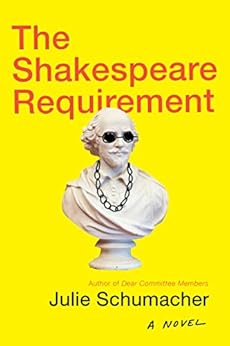
The Shakespeare Requirement - by Julie Schumacher


Picking up where Dear Committee Members left off, our still beleaguered professor Jason T. Fitger finds himself chair of the English Department and unable to get his colleagues to agree on the Statement of Vision (SoV) required by the University Administration in order to get a budget, schedule an event, or anything else. While searching for previous SoVs  Fitger discovers, among other things in the departmental files, "miscellaneous library fines". It is not clear if these fines belonged to the previous Chair (one Ted Boti) or if they were for a whole host of faculty from the English department.

We are also introduced to young Angela Vackrey, one of Fitger's advisees. Angela is a first-generation, home-schooled freshman. A bright, if naive, fish out of water.

Her first impressions of Payne University include a survey of some of the buildings, including the library. She likens the tendrils of ivy on the brick facade to "witches fingers".

This sinister view of the library is revisited later when Fitger is attacked by a "frigid cascade of slush" which "slipped down" the "sloping overhang" and "landed with a slap against Fitger's neck".

The menacing feel of Library at Payne University wasn't limited to the outside of the building.
the building was sadly in need of modernization. Its towering metal rows of floor-to-ceiling shelves created a catacomb-like effect, and the overhead lights, cued to old-fashioned timers, had a way of clicking off all at once, leaving patrons stranded in the airless dark.
It was "known as a place where undergraduates went to nap (and, some said, to engage in intercourse in the group study rooms)". 

The foreboding continues as pencils are imagined as murder weapons in the "gloomy" space of a faculty carrel.

I'm sure, however, that despite all of this, the President of Payne University hails the Library as "the heart and soul of the university".

Go ahead and google the phrase "library heart and soul of university" and see what I'm talking about.

Thursday, April 12, 2018

Educated - by Tara Westover


Raised and home-schooled by survivalist parents in the Idaho mountains Tara Westover rejected her family's admonishments not to go to college and enrolled in Brigham Young University (BYU) before she turned 18. Ultimately she becomes a Cambridge-educated PhD, but not without painfully examining her role in the family. Her father's conspiracy theories about universities and the Illuminati were made known to her long before she thought about going to college herself. Her mother had taken charge of her children's homeschooling, which mostly consisted of letting them learn what they wanted when they wanted, and included occasional trips to "the Carnegie library in the center of town".

Westover recognized that she was one of the least disciplined of her siblings when it came to "doing school" which gave her a lot of reason to doubt her abilities when she arrived at BYU. Her misgivings were magnified when she discovered that her classmates had an understanding of US culture and history that she did not share. Her realization that everyone else knew what the Holocaust was, for instance, caused her not only embarrassment, but also opened her eyes to the fact that her peers shared a collective knowledge that she was missing. She did not even know what she did not know.

If Westover had anxieties about her place at BYU they were only compounded when she arrived at Cambridge. Upon her arrival on campus she and her denizens were invited to take a tour of the chapel, including the roof. She describes the experience of watching her classmates, and her professor fight the wind on top of the building as they cling to the wall while she climbs higher. Finally explaining to her professor that "she'd roofed [her] share of hay sheds" and that
The wind is just wind. You could withstand these gusts on the ground, so you can withstand them in the air. There is no difference. Except the difference you make in your head...I'm just standing...You are all trying to compensate...You've made yourselves vulnerable. If you could just control your panic, this wind would be nothing.
Even this insight though, was accompanied by apprehension
I wanted the mind of a scholar, but it seemed that Dr. Kerry saw in me the mind of a roofer. The other students belonged in a library; I belonged on a crane.
Her ultimate success in earning her PhD demonstrates that she certainly did belong in a library, and the final third of the book (from the time she lands in Cambridge for the first time) is scattered with references to using it. This stands in stark contrast to the first 200 (plus) pages, where there is only one.

Wednesday, September 2, 2015

The Nature of College - by James J. Farrell

Just in time for Back to School! I read this book in preparation for the fall semester during which I will be teaching a course called Sustainability 101. Students in the class will be assigned this book along with Colin Beavan's No Impact Man (which it pains me to say doesn't mention libraries at all).

Anyway, I digress. I read this in preparation for teaching the class, but it was especially thought-provoking for me to read as I sent my own daughter off to college for the first time. Farrell's book looks at the many resources a college student uses in given day. My daughter's college helpfully provided us a list of things she would need for her dorm, and in case they forgot to include anything Target had a special section of the store labeled dorm "essentials" - things such as string lights and welcome mats. I must admit that I found it easier just to load up the cart than to critique the list (or argue with my daughter). I think I ultimately talked her out of one thing. And so before she even got to college we had amassed a bounty of  "things" for her to take with her. I have honestly decided just to bury my own head in the sand rather than calculating the environmental cost of it all.

Farrell's book mentions libraries a few times, generally as part of a list of places a student might go. They are not specifically analyzed in terms of what resources they use, or help conserve, however.

Thursday, January 3, 2013

The Librarian - by Larry Beinhart


Beware the librarian who knows too much! In this political thriller university librarian, David Goldberg, finds himself targeted by Homeland Security for information he allegedly learned by helping an eccentric billionaire archive his papers. He is framed for bestiality (of all things) and goes into hiding in order to save his own life.

This book reads like a handbook for buying an election. Big spenders, behind the scene's deals, and top secret documents combined with Beinhart's thinly veiled characters, and real-life events, made me feel almost as paranoid as the poor librarians who were being stalked (and murdered) in this work.

This book boasts at least four different kinds of libraries: the university library where Goldberg works; the Library of Congress; a community college library; and the private library of billionaire Bill Stowe described as
...wonderful, the literary portion of the dream that was the house. While we [the university library] were closing earlier and earlier and cutting Sundays and holidays and our walls were blank and barren and the steel shelves were unadorned and it all flickered under that shuttering light that flourescents put out, this had mahogany shelves and tungsten lighting and fine comfortable furniture. 
So clear here that rich people deserve good libraries, and the rest of us do not. This point is also made evident earlier in the story when Goldberg must fire one of his librarians. He tells her
The chancellor of the university has a privately funded study that he received from the Heritage Institute, on libraries...and it says that there are far too many physical volumes. That all this can be replaced, except for some rare volumes of historic value, perhaps, by a great cyber library, one library for all accessed from our home and office PCs. That would cut down on the need for almost all librarians, except for cyber ones and it would make all this space available...for classrooms or dorm rooms, which actually earn money.
Those who make these comments really make clear that they either don't understand, or don't care, that libraries are places where those who don't have homes, or offices, can get access to information.

In addition to Goldberg, there are several other librarians in this work. Bookish Elaina Whisthoven (the one who is fired) is described in a rather stereotypical way
Elaina Whisthoven loved books and presumed they would love her back and she wanted to serve humanity, so she became a librarian. She wore large glasses and had large curls that were always clean and always brushed and never styled. She lived like a nun  on her meager starting salary in a room she rented from a retired professor and his elderly wife...
Whereas, head librarian, Inga Lokisborg
with an accent as thick as hand-cut bread [is] a crone, judgmental, and by librarian standards, fierce. The lines on her face are like the fissures in layered shale, her eyes, overall, are the color of slate, but there are chips in them the color of bluestone...
She also has a surprising sexual secret.

Finally we learn briefly about hapless librarian Larry Berk "a wonderful man whom God has mistaken for Job."

There is a lot of commentary in this work about different kinds of information, and knowledge, and how it is used (or not) in order to create reality. This page-turning dark comedy will make anyone who reads it think twice about what they believe they know.

Wednesday, May 30, 2012

In the Basement of the Ivory Tower - by Professor X


This book is not the first thing that Professor X penned about the myth of "education for everyone". His essay of the same title appeared in the Atlantic Monthly about four years ago. X caught quite a bit of flack for suggesting that there were any students who didn't belong in college, so the fact that he expanded on this essay to write a full-length book to say the same thing is pretty brave. Professor X is an adjunct (part-time) English instructor at two different colleges - a private college, and a community college. In both places he teaches students who don't seem to understand the basics of grammar, won't make suggested changes on drafts, and for whom his night classes are just one more thing on their long lists of things to do (along with working full-time and tucking their children in to bed). He tells of students who will never pass English 101, and eventually cut their losses and give up on college. Unfortunately, these students are now saddled with student loan debts for an education that they barely ever started, much less completed. The author discusses the reasons why a college education is considered necessary for so many jobs, and often the reason is simply that there are so many college graduates that an employer may as well hire one as not. It is an "inflated credential".

Professor X writes about public libraries and college libraries in this work. He sees his local "beautiful little jewel" of a public library as an important part of the idyllic existence he dreamed of when he and his wife bought a house they could not afford (which prompted him to look for the part-time teaching gigs). But in most places where I read a passage about college library I could almost hear the author give a dejected sigh:
  • "...the library is so lightly used..."
  • "I went to the college library and checked out a collection of [Shirley Jackson's] short stories. The book hadn't been borrowed for decades..."
  • "I always do an introductory class on research. We all trudge down (emphasis mine) to the library and sit at the computer terminals".
  • "I once had a student who handed in a paper late, and this was his explanation: he got a late start because he couldn't find (emphasis in original) the college library."
  • "Once, as we started to do research, one of my students found the name and call number of a book she wanted to use. She dutifully wrote it all down on a slip. 'So what do I do now?' she wondered. 'Give it to a librarian'."
  • "Last week, I visited the campus library. I found I could hardly work because of the noise."
While there are quite a few passages about libraries, librarians are barely mentioned at all. After taking the time to "trudge down" to the library the students don't have a training session with an actual librarian; X demonstrates the databases himself, indicating that "it doesn't take...long to demonstrate how to search for newspaper and journal articles on Lexis-Nexis, EbscoHost, and Academic Search Elite". Perhaps if he asked a librarian (who probably would take some time with the databases) for assistance he might get better results from students. His anecdote regarding the little used Shirley Jackson book did include a librarian whose "eyes widened in horror when she saw the [Social Security] numbers" and names of the students on the "quaint checkout card" from the 1960s in the back of the book. The librarian "shredded the card and eyed [X] with great suspicion".

Professor X is nostalgic for his own college days when one could read entire journals in hard copy, not just single articles from a database; and students saw their professors doing their own research at the library. I think what X probably doesn't realize is that there have always been more studious and less studious students, and those who love to be in the library browsing the stacks, and those who don't. And professors have always bemoaned students who seemed uninterested in learning for learning sake, and wondered what they were doing in college at all.

The author quotes an article from The Chronicle of Higher Education which suggests that the library be included on tours for prospective students. (Are there really schools that don't include it?) And that "they should be welcomed by a librarian who delivers the message that the library is critically important to each student's academic experience." I will say that Maxwell library is included on the Bridgewater State University campus tour, but we have been unable to convince those in admissions that someone who works in the library should be given a chance to address the baseball-cap bedecked troops that move through the building. Instead we bite our tongues as we hear as the backwards-walking student leaders use words such as "nonsense" to describe the research process, or confide, in a conspiratorial tone, that they've never actually checked a book out of the library.

Reading this book I found myself feeling as cynical as Professor X does about teaching in higher education. Much of what he writes about are things I've observed myself, but the book does have some glimmers of hope as well. I read of community college students who worked hard, and learned a lot, who otherwise would not have been able to afford to go to college, and the author does some reflection on his teaching and recognizes what he has done, or not, that did or didn't work well.

I think the most important lesson I took from this work is that I am indeed happy in my small house deep in the "student ghetto" of Bridgewater. I often think about how much quieter the big houses, farther from the center of town, must be but X has provided me with a cautionary tale of what happens when one goes  looking for greener grass. He demonstrates well how paying for a big house, when he was quite content in his previous (smaller) one, precluded him for actually being able to live in it.