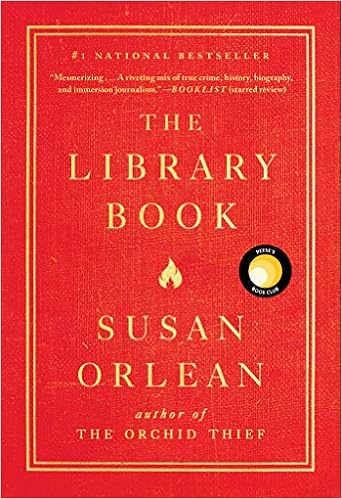
This book started showing up all over my Facebook feed late last year. Excerpts, interviews, and recommendations came from friends, family, and organizations. Everything I saw gave me reason to believe that I would love this book. And I did.
Of course it would have been right and good (and indeed, most meta) for me to have gotten a copy of this from a library, but I knew that there would be a long waiting list, and I really couldn't wait, so I purchased and downloaded an e-version onto my iPad. I read it out loud with my husband. We both thoroughly enjoyed it.
Normally when I read a book I mark any passage I find about libraries, so that I can easily find them when I am done reading it in order to write my blog post. It is not so simple when I read a book entirely about libraries. If I were to mark every relevant page I would essentially have to re-read the entire book, and I'd still be hard pressed to figure out what to write about here. So I was forced to make some hard decisions. As it is, I marked over sixty pages, so not even everything I found especially noteworthy made the final cut.
In this ode to libraries Orlean weaves together her own relationship with public libraries with the story of the Los Angeles Public Library (LAPL) and the fire that destroyed the Central Branch in 1986. The tale includes the history of the LAPL begining in the 19th century. Replete with quirky characters including early library director Henry Lummis, and Harry Peak, the man who was arrested for, but never convicted of, starting the fire.
Library Love
Orlean's own love affair with libraries began when she was a child when she went to her local public library regularly with her mother, and they would discuss what books they checked out on the way home. She explains that her family owned very few books because her parents knew that they could get what they wanted for free at the library. In college she eschewed the library and began buying books, to the point that she only had wistful memories of the library. A school project for her first grade son brought her again to the public library
As my son and I drove to meet the librarian I was flooded by a sense of absolute familiarity, a gut-level recollection of this journey, of parent and child on their way to the library. I had taken this trip so many times before, but now it was turned on its head, and I was the parent bringing my child on that special trip...when we stepped in, the thunderbolt of recognition struck me so hard that it made me gasp.
From there Orlean rediscovers her love of libraries, and discovers some things that aren't quite so lovable about them as well. For instance, we see that sexism in libraries has a long history with the tale of Mary Jones who lost her job as director just because they wanted to hire someone else (a man)
Mary Jones' story begins with Mary Foy who was hired in 1880 when
the library was still an organization run by, and catering to, men. Women were not yet allowed to have their own library cards and were permitted only in the Ladies' Room. No library in the country had a female head librarian, and only a quarter of all American library employees were women. The feminization of librarianship was still a decade away.
Foy served as library director until 1884 when she was removed to make room for Jessie Gavitt, daughter of a "popular rancher". It was further determined that "Foy's father was doing well enough financially that he could now afford to take care of her". A succession of women ran the library until 1905 when Mary Jones, then director, was asked to resign by the library board who believed that "it would be in everyone's best interest to have a man run the library." The man they had in mind was an unconventional fellow named Charles Fletcher Lummis. He was offered the job of director at twice the pay of Jones.
Lummis had been in Los Angeles since 1885, when he walked there from his home in Ohio to take a job as a journalist. He dressed in a "manner that was not typical for a Caucasian male of the 1880s. His favorite outfit was a three-button suit coat and trousers made of bright green wide-wale corduroy, which he wore with a red-and-black patterned cummerbund."
A philanderer, he was "the focus of endless gossip...reckless, dramatic, quixotic, romantic, and perhaps a bit of a tall-tale teller".
Eventually, Lummis' offensive ways became too much, and in 1910 he was asked to leave.
Fire
The story of the fire is interwoven with the story of the enigmatic Harry Peak who some believed started the fire. Ultimately, it was never determined who set the fire, or for that matter if it was arson at all. Harry Peak, however, always remained a person of interest. He was questioned several times, and even arrested and ultimately had over a dozen stories regarding his whereabouts on the day in question. Sometimes he produced an alibi, other times he put himself near the library (but not in it) and at other times he confessed to the crime.
In describing the fire the author made excellent use of allusion, letting her readers know that "The temperature reached
451 degrees and the books began smoldering".
Censorship, book burning, and information loss is the topic of chapter 9 in this book. From Egypt's Great Library of Alexandria, to the Spanish Inquisition, to the colonizers in the Americas destroying Aztec codices, to what George Orwell called that "most characteristic of [Nazi] activit[ies]" - the burning of books. The
Feuersprüche (Fire Incantations)
was a pet project of Joseph Goebbels, the Nazi Party's propaganda chief, who understood how fundamental books were to Jewish culture, theology, and identity. Burning Jewish books, in his opinion was an ideal form of bloodless torture, demonstration the limitlessness of German control...The irony of the Feuersprüche was that they [the Nazi's] treated books as seriously as Jews did. To feel the need to destroy them acknowledged the potency and value of books, and recognized the steadfast Jewish attachment to them.
In describing the LAPL fire and its aftermath the author demonstrates how the burning of books, information loss, and the investigation effected those who worked in the library.
Twenty-four of Central's 250 librarians...asked for transfers to other branches. A survey of the remaining staff asked what the most stressful aspect of the fire was. The answers were dire. They included: "Feeling of powerlessness, helplessness brought about by confusion...feeling of isolation of having to work in an almost empty shell of a building that was once a vital place"; Being afraid that, even though nobody was killed in the fire, somebody is going to be killed or badly hurt..."; and "Feeling like a refugee. Holes ripped in an organic entity."...
Furthermore the "librarians complained of eye infections, breathing difficulties, skin irritation, and post-traumatic stress disorder."
Random Musings
Rather than giving each chapter a title, the author started each chapter with a bibliography of books (along with their Dewey Decimal Call numbers) that were related to the upcoming pages. When I noticed inclusion of a book I'd read (or better yet blogged about - such as chapter thirty's
Bibliotech) I was sure to mark it. Chapter fourteen's list caught my attention with the inclusion of
Map Librarianship: An introduction by Mary Lynette Larsgaard. The very book that served as my textbook in 1991 when I took a course on Map Librarianship at the University of Arizona Graduate Library School. A few years ago I found the text in packed away in box at home and used it to make a book-themed Christmas decoration.
Last Christmas when I put this on display at the library I overheard one student say to another "Look at that, they ruined a perfectly good book to make a decoration". While I agree on principle that we shouldn't destroy books, I also think that making art from out-of-date textbooks is a wonderful use of these works (and frankly, this would otherwise have simply be sent to the recycling bin).
The rumors of the demise of libraries are long standing, as evidenced by LAPL's Senior Librarian Glen Creason's reporting that when he entered library school in 1979 (on a whim, hoping to meet women) that the head of the
RAND Corporation announced that libraries would soon be obsolete.
Perhaps one of my favorite anecdotes in the book is the story about a CBS radio program called
Americans at Work that aired during the Great Depression and featured plays about different professions. One of the plays was about a young woman (Helen) wanting to become a librarian. Her mother insists that it is a job for "older ladies who need to help out a bit". Then Helen's uncle comes to the rescue explaining that "a librarian's got to be a right modern smart girl nowadays."
Some things, of course, are universal in libraries. I was especially interested to read about the problem with getting an employee parking lot, something that was an ongoing issue when I worked at the McAllen (Texas) Public Library in the mid 1990s and that people who call asking questions that they can easily "google" the answer to goes on every where.
Orlean had my husband and I crying a bit at the end when she explains why she wanted to write the book
to tell about a place I love that doesn't belong to me but feels like it is mine, and how that feels marvelous and exceptional. All the things that are wrong in the world seem conquered by a library's simple unspoken promise: Here I am, please tell me your story; here is my story, please listen.