Showing posts with label Wisconsin. Show all posts

Friday, August 14, 2026

The Cartographers - by Peng Shepherd

This supernatural story about the Map Division at the New York Public Library was a natural choice for this librarian to read aloud to her geographer husband. The book was recommended to us by one of our friends.

While we are hardly experts, we do know a bit more than your average Joe about maps and mapmaking, so we were familiar with the concept of a phantom settlement - a place on a map that doesn't exist in real life. Mapmakers of yore sometimes included these "paper towns" in order to catch copyright infringers. 

But what if the phantom settlements were real, if only a person had the right map that could lead them there? Some spunky graduate students (aka "The Cartographers)" discover just such a place on a decades-old gas station highway map. Nell Young discovers a rare copy of the map after her father dies in his office at the New York Public Library. Her investigation into his death leads her to some impossible places!

While the Map Division of the NYPL is at the center of this mystery, there are other libraries in this work as well: 

  • Nell reads her mother's obituary using old library microfilm machines.
  • A robbery at a high school in Scranton, Pennsylvania left an employee with a broken leg and the geography section in shambles. 
  • The Cartographers, doing some research through newspapers stories in the Rockland (NY) Public Library, learn of a string of robberies nationwide in libraries, schools, gas stations, museums, and even private homes. They suspect that someone is hunting down copies of what they call the "Agloe map".
A fun summer read.

Tuesday, December 10, 2024

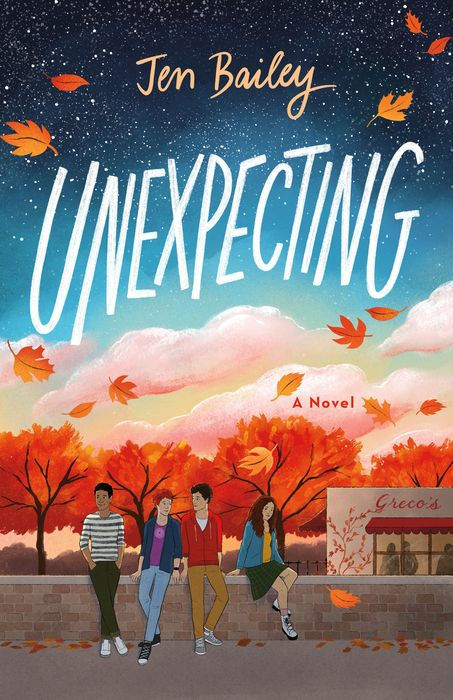
Unexpecting - by Jen Bailey


When teenagers Ben and Maxie decide to have sex (almost on a dare) they are dismayed to discover that the act resulted in a pregnancy. The fact Ben is gay adds an additional level of bewilderment to those who know him. Maxie (whose mother works at the public library) is ambivalent about the pregnancy and is under pressure from her parents to give the baby up for adoption. Ben, however, wants to raise the baby with the help of his mother and step-father. His mother provides some level of support for this idea, with the stipulation that Ben attend parenting and childbirth classes. Ben also checks out books on these topics from the public library. 

A twenty-first century take on the 1977 classic He's My Baby Now by Jeannette Eyerly. Eyerly's book was adapted into the 1980 ABC After School Special "Schoolboy Father" starring a very young Rob Lowe.

Thursday, October 20, 2022

A Sand County Almanac - by Aldo Leopold


I'd been meaning to read this for a long time. It had been just sitting there on my shelf for ever so long. My husband read it decades ago, and although my intentions were always there, there was always something else I wanted to read. Now its time has finally come.

This was really a mood piece. The nature descriptions were soothing and poetic. I felt much like I was simply floating in a dream, awakened now and then by the word "library". Often this is used metaphorically. Leopold understands that landscapes, like so many things can be "read".

The autobiography of an old board is a kind of literature not yet taught on campuses, but any riverbank farm is a library where he who hammers or saws may read at will. Come high water, there is always an accession of new books.
...he who owns a veteran bur oak owns more than a tree. He owns a historical library, and a reserved seat in the theater of evolution.
        A farmer and his son are out in the yard, pulling a crosscut saw through the innards of an ancient cottonwood. The tree is so large and so old that only a foot of blade is left to pull on.                Time was when that tree was a buoy in the prairie sea. George Rogers Clark may have camped under it; buffalo may have nooned in its shade, switching flies. Every spring it roosted fluttering pigeons. It is the best historical library short of the State College, but once a year it sheds cotton on the farmer's window screens. 
    This state of doubt about the fundamentals of human population behavior lends exceptional value, to the only available analogue: the higher animals. [Paul] Errington, among others, has pointed out the cultural value of these animal analogues. For centuries this rich library of knowledge has been inaccessible to us because we did not know when or how to look for it. Ecology is now teaching us to search in animal populations for analogies to our own problems.
Perhaps, though, my favorite was this:
If I were to tell a preacher of an adjoining church that the road crew had been burning history books in his cemetery, under the guise of mowing weeds, he would be amazed and uncomprehending. How could a weed be a book?
Librarians know well that books themselves can be weeds. Our shelves are gardens, and outdated books are removed in order to make our gardens grow.

Literacy can take many forms. The ability to read, and interpret the printed word is but one. The ability to read and interpret our surroundings is another. It is a literacy that even when this book was written over 70 years ago we were losing. We have lost more ground since.

Like Rachel Carson's Silent Spring and Robin Wall Kimmerer's Braiding Sweetgrass, this work uses exquisite prose to explain science to the layperson.

Wednesday, July 6, 2022

Holly & Ivy (the movie)


Melody (Janel Parrish), a young, eager, recent library school graduate moves to Chippewa Falls, Wisconsin and starts haunting the Bridgewater Branch of the public library hoping to get a job. She keeps hopping around with ideas for the endlessly patient children's librarian (Anne Sward) even though it has been explained to her, repeatedly, that there is no funding for any new hires. Meanwhile, she befriends her neighbor Nina (Marisol Nichols) and Nina's daughters (Holly and Ivy). Of course, in true Hallmark Christmas movie fashion, there is also a dreamy new beau, Adam (Jeremy Jordan). As the movie takes place during the Christmas season all of the following take place over a few weeks: we learn that Nina is dying and has no family who will be able to care for her daughters when she is gone; Melody is a foster child who had only herself to rely on; Melody bought a fixer-upper house that needs serious renovation; Adam is both a building contractor (what his parents want) and a furniture builder (his true passion). There are a lot of deadlines that stretch credulity, and of course everything comes together just in time for the holidays. 

My father-in-law recommended this movie for its librarian-theme, its Wisconsin setting, as well as its Bridgewater connection. 

Thursday, January 20, 2022

Picket Fences (the television show) "Elective Conduct" Season 3 Episode 6


My husband and I were happy to discover that all four seasons of the 1990s television show Picket Fences were available through Hulu. We remembered this thought-provoking, quirky drama series fondly. While we are enjoying re-watching, we were not especially surprised to discover that not all of the stories aged well, and we are  having very different conversations about the show than we did 30 years ago.

The third season begins with the fictitious town of Rome, Wisconsin receiving a federal court order to desegregate its schools via the forced bussing of  Black students from the (not fictitious) city of Green Bay. The (mostly) white residents of Rome face their prejudices, and liberal-minded Mayor pro tem Jill Brock calls in the local police in an attempt to stop the students from getting off the bus. Her plan is thwarted with a countermove by the National Guard (a la Little Rock). The story arc exploring race and racism continues for several episodes.

Episode 6 opens with fifth-grade students reading their reports for Multicultural Awareness Day. The teacher is cringe-ily dressed in stereotypical Native American garb and a girl reads her report indicating that Chinese people in the United States are best known for their restaurants, and are "good fighters". The Mayor's son Zachary reads his report on "Why White Kids Should Help Black Kids", citing academic achievement gaps, and indicating that these gaps are because of small brains that only think about sex. He is cut off by said cringe-worthy teacher, taken to the principal's office, and suspended. 

It turns out that he does have citations for his assertions. The achievement gap statistics came from the Educational Testing Service, and the information about brain size came from the eleventh edition of the Encyclopedia Britannica. 

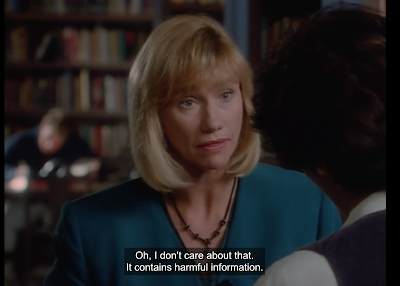
Cut to Jill Brock in a library speaking to the librarian (in what appears to be the public library). Brock has the offending volume of the Britannica in her hand, reads from it, and asks why it is in the library. The librarian explains that the 1911 edition is a "classic" and that "museums would kill for this set". Jill insists that it be removed because it "contains racial material". The librarian counters by suggesting that by those standards Mark Twain should be removed as well. She actually uses the N-word (on what at the time of original airing would have been network television).  Brock is able to get her son reinstated by demonstrating that the information came from a book in the library. She also gives him a good "talking to".

Wow. A lot to unpack here.

Let's start with the fact that the mayor wanted the book removed because it contained "racial material". Books about race, or written by people of color are being especially targeted in the United States today. Challenges are coming from the left and the right. And we are seeing classics such as To Kill A Mockingbird being questioned. Learning to question what we read in books is essential to a good education. We cannot question what we aren't allowed to see, however.

Deselection (or "weeding") of materials is part of the professional work of librarians. Libraries should have living collection development policies which outline what kind of materials will be held in the library, as well as what will not. Additionally, the policy should explain when/how/what kind of materials will be removed. Reasons for pulling books are myriad and include that they might be out of date, however, that is not the only consideration. Some works are classics, or perhaps are kept because they have value to historians. There is a lot that can be done with a challenged book between outright removal and leaving it on open stacks to be found by impressionable fifth graders who have not received appropriate research guidance. For instance, the encyclopedia set in question might be moved to a special collections room where it is accessible to scholars, but not necessarily to elementary school students, or it could simply be moved to a higher shelf, where it can't be reached by children without assistance, while keeping a current set in a more accessible place. What shouldn't be done, though, is for the Mayor to come barging in, insisting that a book be removed without input of the library board and without any kind of public hearing.

I will say this for young Zachary - I liked that he clearly used at least two sources and synthesized them. He also had full citations, such that his mother was able to find the exact quote in question. That's what citations are for.

Tuesday, December 29, 2020

The Great Believers - by Rebekah Makkai

This is the third book by Makkai I've blogged about. The first (The Borrower) was the most librarian-centric, but also the most librarian-disparaging. While the present work, and The Hundred-Year House each only mention libraries a few times they are as places where research and scholarship is done. 

The storyline in The Great Believers alternates between two time periods the mid 1980s to early 1990s (during the AIDS crisis) and the year 2015. It follows the story of Fiona (whose brother Nico died of AIDS). It also tells of Nico's friends, all of whom were touched by the pandemic. One of the characters we learn the most about is Yale, whose job as a schmoozer at Northwestern University takes him to Door County, Wisconsin to meet with Mrs. Nora Lerner the widow of a Northwestern alum (and great-aunt to Nora and Nico). Nora Lerner wants to donate some original art pieces to the University gallery. Yale spends quite bit of time with her finding out about the works, which she obtained directly from the artists in Paris in the early twentieth century. As she describes what life was like in 1919 Paris Yale begins to empathize with her as she tells of all her friends dying either in the war, or from the Spanish flu and he recognizes how this parallels his own life.

Yale and his intern (Roman) use the Door County public library to make photocopies of some of Mrs. Lerner's documents. Most of the artists are well known in the art community except for one, Ranko Novak. Lerner stipulates that all the artwork must be displayed, or none of it can. In doing research about the artists Roman discovers a library book containing a "literal footnote" about Novak. 

This was published in 2018, before our current pandemic. It almost seemed surreal to read it in 2020.


Tuesday, March 3, 2020

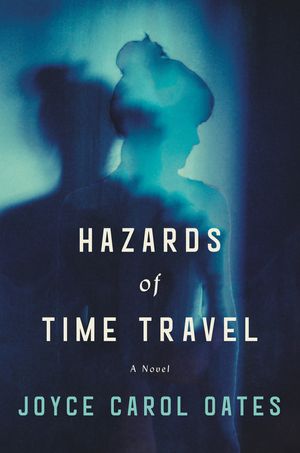
Hazards of Time Travel - by Joyce Carol Oates


In a dystopian future, class valedictorian Adriane Strohl  is arrested for treason and "questioning authority" on the eve of her high school graduation. She is sentenced to live in Zone Nine - 1959 Wainscotia, Wisconsin - as university student Mary Ellen Enright at Wainscotia State University for four years.

Adriane's brother Roddy works in the Media Dissemination Bureau "an old brownstone building formerly the Pennsboro Public Library, in the days when 'books' existed to be held in the hand-and read!" Not only have old libraries been repurposed, the information they held has been destroyed.
The old, "outdated" (that is "unpatriotic") history books had all been destroyed, my father said. Hunted down in the most remote outposts-obscure rural libraries in the Dakotas, below-ground stacks in great university libraries, microfilm in what had been the Library of Congress. "Outdated"/"unpatriotic" information was deleted from all computers and from all accessible memory-only reconstituted history and information were allowed...  
There are some contradictory passages in the book as to whether public libraries in the Reconstituted North American States exist. Adriane specifically says that "there were no longer 'libraries' in NAS-23" but also indicates in a previous passage that she was able to take out books from the public library marked "YA" (for young adults). YA books "had to be approved by the Youth Entertainment Board, and were really suitable for grade school." She was unable to take out books labeled "A" for adults. The books were actually eBooks and all had to be approved by the Homeland Security Information Bureau.

Adriane, ironically, however, finds herself working in a real library once she is sent back in time. As a "thrifty" scholarship girl "Mary Ellen" has a job at the university's geology library. And she is awestruck at the main university library
a vast brownstone building of numerous floors descending even into the earth, filled with row upon row of "stacks" containing "books" to be touched, and opened, by hand. And in reading rooms, high ceilings, myriad lights, and polished floors - and students!
"Mary Ellen" does some research on her professor (and fellow exile) Ira Wolfman in the college library by searching the "long clumsy drawers, under the heading PSYCHOLOGY, 20TH Century".

She spends much time in the university library and wondered at all the information that was not restricted by the government. She remarks on this "freedom" while also recognizing the irony that Zone Nine "did not feel like freedom".

With shades of Marge Piercy's Woman on the Edge of Time and Thornton Wilder's Our Town this thriller leaves the reader with a lot of questions about what is real, what we know, and what we believe.

Tuesday, May 21, 2019

Who Killed the Fonz? - by James Boice


Mystery Month May continues with the gang from Happy Days. Unwilling to believe that the motorcycle crash that killed their super cool friend was an accident Richie, Potsie, and Ralph take on the Milwaukee political machine.

Set in the 1980s the paunchy, middle-aged friends start their own investigation into the accident and discover something much more sinister than they could have imagined.

There is a lot of re-hashing of individual plot lines from the old television show including the infamous jumping of the shark. For this blogger, however, the most important reminder was that Richie and Lori Beth met at their college library. So important was this detail, in fact, that it is mentioned twice in this rather short novel.

Fans of the show will likely enjoy this nostalgia trip. And you can be sure that, dead or alive, Fonzie will always save the day.

Wednesday, February 7, 2018

Anywhere But Here - by Mona Simpson


Set in the 1970s Simpson's story tells of an aspiring teen actress (Ann), who leaves her home in Bay City, Wisconsin, along with her flighty mother (Adele) to find their way in Beverly Hills. Adele's inability to hold a job for very long, and her obsession with finding a husband make for a difficult journey to stardom. When Ann finally does get a break Adele attempts to sabotage it.

Not a very library-centric book, but Ann and Adele do use the public library a few times, and Adele also suggests that Ann go school early one day to study in the library instead of riding in with her classmates. Not surprisingly Ann (a rather mediocre student) declines this advice in favor of hanging out with her friends until her first class.

In perhaps one of the craziest uses of a public library I've read about, Ann's grandmother (Lillian) relates a tale of a man she knew who performed surgery on himself, in the hopes of making himself better looking.
...this man found a way to sneak into the public library at night...he was afraid for people to see him - and read up all about plastic surgery. He wanted to remake his face to be better. He got hold of needles and suture somehow and from studying these books he changed himself. I suppose he used mirrors to see. He said it took months, most of the winter. He had to wait for one part to heal before touching another. And he did it. Well, you can imagine the ruckus...it was a miracle the man hadn't killed himself...there were no infections, only clear, healed scars...There was a write up with a picture in the newspaper and a couple other doctors came to see. But it all died down, because the truth was, he still had such an ugly, ugly face.
We'll file this under "don't try this at home, folks."