Showing posts with label California. Show all posts

Wednesday, October 7, 2026

Occulted - by Amy Rose, Ryan Estrada, Jeongmin Lee

One of Amy Rose's early memories is of seeing Comet Hale-Bopp streak through the sky in 1997. The next day she learned of the mass suicide of members of the Heaven's Gate cult. It was when she began to realize that perhaps the temple she lived in with her mother was part of a cult as well.

One of the ways the cult's leader ("They") controlled their followers was by limiting information. They had a library, but did not allow others to access it. Amy sometimes snuck in to read. It was in They's library that Amy learned what a cult was and how the leaders were able to manipulate people into following them. They disliked Amy and had her sent to live with another family outside of the temple. Jeanie and Derek were not part of They's cult and made sure Amy got to go to the library regularly where she could pick out whatever books she wanted. 

Occulted: "An astronomical term for when something is concealed from view"

The title of the book is layered in meaning. The definition provided above is from the last page of the book. Rose points out that "the temple tried to conceal so much of the beauty of the world with control and fear. They told us the only way to grow was to stay hidden."

Book banners also seem to believe that by hiding information they are somehow facilitating growth. Concerns from the left and the right about book content use the same language. Suggesting that certain books are "harmful" or "problematic". As Ira Wells points out in his book On Book Banning 

Book banning harms some children by depriving them of information or narratives that may have enriched their lives. It harms other by whitewashing or severing them from history and presenting a sanitized version of reality. It impairs their development as democratic citizens, teaching them that when confronted with a disagreeable or upsetting viewpoint, the solution is to ban, silence, or prohibit.

Rose was indeed harmed by not having access to books and information. Going to the library was her salvation.

Thursday, March 26, 2026

The Library of Lost Dollhouses - by Elise Hooper

Along with being unprepared for a test, and being naked in public, one of my recurring dreams is that of finding a secret room in my house. 

Hooper's book asks us to imagine finding a secret room in a library that holds secret dollhouses, each of which holds its own secrets. 

There are two timelines in this story: World War I Europe, and present day San Francisco. When Tildy Barrows, curator at Belva Curtis LeFarge Library and Museum, discovers a hidden room in the museum with two exceptionally decorated dollhouses created by artist Cora Hale it takes her on an unexpected journey that intersects with her own family history. 

The museum, along with its eccentric founder is loosely based on Boston's Isabella Stewart Gardner Museum. Just as Gardner left instructions to keep her art collection exactly as she left it, LeFarge likewise "left very strict provisions for how...the library was to be managed". Barrows is sure that this does NOT include digitizing the book collection to make room for more art. 

It turns out that Barrows was right. In fact LeFarge once insisted that raising a child in the Library was an exceptionally good idea. 

Libraries are the prefect place to grow up. Just think how smart she'll be.

Furthermore, the McCarthy-era heiress had this to say about a child being trouble in a library 

Any trouble a young person can find in a library is the best kind of trouble

And Hale, who knew LeFarge quite well, had this to say about libraries

Libraries are viewed as such solemn places-but why? Reading is magic. Think of the imagination and sense of adventure that readers employ every thine they crack open a book. There are few places filled with more magic than libraries, no about about it.

I am not sure what psychologists say about what the "secret room" dream means. I have always interpreted it to mean that I am not meeting my potential. But perhaps the dream is about revealing something I have kept hidden.  Just as every book has as many interpretations as there are readers, dreams are multi-layered and can mean different things to different dreamers. I think will need to think about my hidden room dreams a bit more.

Monday, September 29, 2025

Forever, Interrupted - by Taylor Jenkins Reid

After eloping with her boyfriend, librarian Elsie Porter finds herself a young widow when her husband is struck by a car ten days into their marriage. 

The fact that Elsie was a librarian was almost not relevant to the story. It is clear that she likes her job, but isn't passionate about it. A few scenes do take place at the library, including a plot-turning episode in which she punches out a patron, but I imagine any employer would have put her on leave after such an incident. There is also an almost "between the stacks" moment, right there in the World Religions section.

I found it noteworthy that she lives in a nice apartment that she is able to afford on her own. It was refreshing to read a story that doesn't harp on low pay. Some librarians actually do make decent money.

Wednesday, November 1, 2023

The Wishing Game - by Meg Shaffer


The description I read of this book before I listened to it was that it was like Willy Wonka and the Chocolate Factory, but with books. That was pretty accurate. 

A gay hermit (Jack Masterson) who writes the wildly popular Clock Island series of children's books announces that he is writing another book after a very long hiatus. Furthermore, he announces that he is running a contest in which the contestants will be invited to his house on the real Clock Island and the winner will receive the only copy of the new book in existence to do with what they will. Lucy Hart is one of the lucky few invited to compete for the book. Her fervent wish is that she will be able to sell the book so she will have enough money to adopt Christopher, a boy in foster care. She gains more than she could have ever expected by the time the game is over.

My husband and I listened to this on audio. It was a good story, and of course featured some libraries. The story also alludes to the current wave of book banning, with Jack Masterson explaining why he has stayed in the closet. He doesn't want his identity as a gay man to prevent people from purchasing his books (or worse, removing them from library shelves).

This book is for everyone who is still waiting for their Hogwart's letter, or searching in the back of their closet for an opening to another world. 

Monday, August 21, 2023

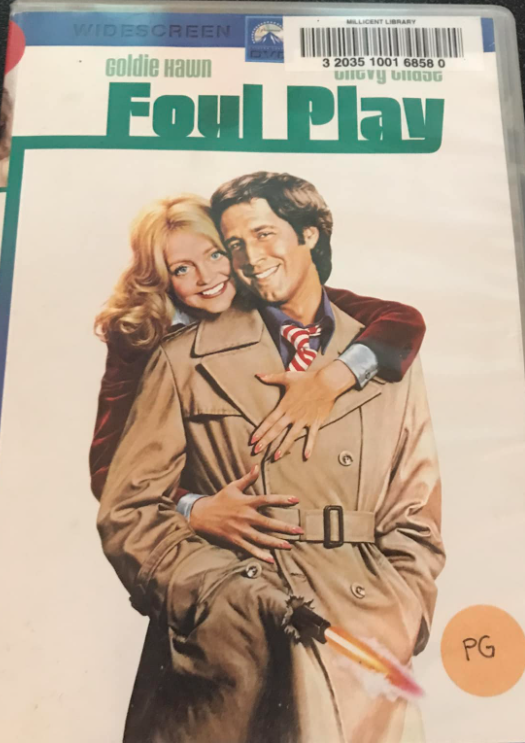
Foul Play - the movie


When divorced librarian Gloria Mundy (Goldie Hawn) becomes unwittingly involved in a murder, Detective Tony Carlson (Chevy Chase) is assigned to protect her. Hilarity ensues.

Set in San Francisco this screwball comedy wouldn't be complete without a car chase scene involving steep hills. Also included at no extra charge: a domino-type collapse of bookshelves. I will say that the librarians in the film (all women) were serious about research, and I believe the film does actually pass the Bechdel test (albeit just barely).

I remember seeing this film in theaters back in 1978. I remembered virtually nothing about it except the opening scene featuring Hawn driving along the Pacific Coast Highway with the lilting tones of Barry Manilow singing "Ready to Take a Chance Again" as a soundtrack. 

The murder plot involves a group called The Tax the Churches league who plan to assassinate the Pope. While I would not advocate murder, I have to agree that it is past time to tax churches. As we see the Religious Right (and, frankly, left) trying to influence laws, and elections the IRS should seriously be looking into revoking some 501(c)(3) exemptions.

One of my husband's rowing friends mentioned that this film was what interested him in getting a houseboat (something he still dreams about).  Tony certainly has a nice one - a real '70s chick magnet with spiral staircase, dark paneling, and a bar. How could a young librarian resist?

When we decided to watch this we discovered it wasn't available on any of our streaming services (even for a fee). Our local public library to the rescue! Thanks to the Millicent Public Library in Fairhaven we were able to procure this on DVD - for free!

Friday, July 7, 2023

Gender Queer: A Memoir - by Maia Kobabe


Note: The author of this work uses gender neutral Spivak Pronouns.

Topping the list of banned and challenged books for 2022 Kobabe's graphic memoir explores how e discovered eir identity as a nonbinary person starting as a toddler.

Although a late bloomer as a reader, as a teenager Kobabe discovered queer books at the library and began to read voraciously. E describes a feeling "as if lightning was coming from the pages...Electricity flowing directly into my palms" when reading gay sex scenes in the Fake Series of books by Sanami Matoh; and the Last Herald Mage Trilogy by Mercedes Lackey.

Like Alison Bechdel (who also wrote a queer graphic memor - Fun Home) Kobabe worked in eir college library, where e came out as bi-sexual for the first time. The college library is also a space where e tries sexting for the first time. Libraries are safe spaces to try new things.

As a cartoonist Kobabe taught one-day comics workshops to junior high students at local public libraries. Keenly aware of the current political climate, e ultimately decides not to share eir pronouns, nor share that e is nonbinary with the students. E questions this decision and wonders if e is doing a disservice to them, especially as e recognizes how much it would have meant to em if e had had a nonbinary or trans teacher in junior high. The importance of representation is a crucial theme of this work, and is one of the reasons censors want to keep others from reading it.

By far my favorite part of the book is a scene in which Kobabe meets eir cousin's new baby for the first time. Cousin Josh, and his wife, Faith ask what the baby should call his grown nonbinary relative. Kobabe responds "I don't know a good gender-neutral term for 'aunt'...Can I be his librarian? Or cartoonist?"

Find out more about this book at its author from the New York Times.


Friday, January 13, 2023

Back to the Future Part III (the movie)

Well, it seems that it has been over seven years since I last watched a Back to the Future movie (when I watched Part II in honor of Back to the Future day). While my adult child was visiting recently the whole family enjoyed watching the whole trilogy. Like Part II, Part III features a trip to the library archive to look up some history of Hill Valley. The library itself appears to be closed, so I'm not sure how Marty and Doc Brown got in. 

Many people (my own child for instance) find the third part to be the best of the bunch. I disagree and say the original is still the best (which is not to say that all three are a lot of fun). After watching we came up with a myriad of questions about inconsistencies, and the logistics of time travel. It really is best not to wonder too hard about all of this. Better to just enjoy the ride.

One thing that Part II has over parts I and III is that it passes the Bechdel test. Marty's mother (Lorraine) talks to his daughter (Marlene) about pizza. Part three does not pass, although there is a strong female character in Clara (Mary Steenburgen).

Monday, October 24, 2022

The Book of Form and Emptiness - by Ruth Ozeki

Please note: Because I listened to this book, there may be misspellings in character names, and quotes may not be exactly as written in the print version.

There are too many levels of meta in this one for me to follow them all. The book, in addition to narrating the lives of the characters, is also narrating itself.  

A host of rich characters populates this book: these include Corey, a children's librarian; Annabelle, a would-be librarian who had to leave library school when she became pregnant; Benny, Annabelle's son - a truant who hears voices and uses the local public library to hide out; Aikon a decluttering guru and bestselling author; and a band of colorful library patrons. 

After Annabelle's husband, Kenji, dies in a freak accident she has a hard time coping with raising her son, doing her job clipping news stories for clients, and running her home. As she begins to hoard, Benny struggles with his own mental illness and he begins to have auditory hallucinations. He and his mother share a love for libraries and both find refuge in their local public library. 

I listened to this book on audio, and there was so much in it, I will limit myself here to commenting only on the notes I made while listening.

I start with my favorite quote from the book. Librarian Corey shows up to help Annabelle clear out her house wearing a shirt that reads: "Librarian - because bad-ass motherfucker isn't an official job title".

As she attempts to console Annabelle, who is feeling completely overwhelmed and begins to sob, Corey "shushes" her. As a librarian she, of course, knows from shushing.

The books in the library calmed the voices in Benny's head. Books are described as sacred, and the libraries as temples. Stopping at the library on the way back from a psychiatrist appointment was a treat.

In an attempt to "liberate" the voices from his body, Benny injures himself with a thumbtack. Thumbtacks are described as dangerous, but not as dangerous as books. This was especially striking to me as I consider the new age of book banning that we are currently experiencing. Although I cannot recall the exact context of this description of dangerous books in Ozeki's work, it is appropriate to say that some believe that the ideas found in books are more dangerous than any of the myriad real life-threatening dangers we face daily.

Although Annabelle didn't finish library school, she clearly has a librarian's keen sense for finding elusive information. When Benny disappears she is aware that he may be with his friend who calls herself The Aleph. Searching Aleph alone wasn't enough to find her. Annabelle knew to search for "The Aleph". 

The Aleph is an artist who specializes in snow globes. The best one she makes is one for Benny that features a library scene with books and letters floating in the water.

The question "What is real?" is at the center of this work. It is a question Benny explores at the behest of The B-Man one of the eccentric patrons of the public library. It is what makes this work so meta. Is the book narrating itself, or is it Benny's head? 

Tuesday, March 8, 2022

The Yellow House - by Sarah M. Broom


My husband and I attended Broom's virtual session last year at Boston University's Anti-Racist Book Festival. We had not heard of her before, but she piqued our interest, and we ordered the book on Audible and listened to it together. The Yellow House is a memoir not only about the specific house in New Orleans where the author grew up, it is a book about our relationships with the places that form us. 

The youngest of twelve children, Sarah was born into the Yellow House where she lived with many of her siblings, although some of the oldest never lived there. The Yellow House was located in New Orleans East, part of the city's Ninth Ward. Hurricane Katrina was the second Hurricane the author, and the Yellow House experienced. As a baby Broom and her family were evacuated when Hurricane Betsy rampaged their home in 1965.

Although her school libraries get barely a passing mention, as a college student at the University of North Texas (where the "cost of [her] ignorance about college was high") she was
ravenous about learning, nearly living at the Willis Library where [she] spent seven or eight hours at a time hunched in a cubicle reading books about subjects fellow students seemed already to know.
After graduation, and a Master's degree from the University of California, Berkeley, Broom moved to New York to take a job with O Magazine. There she met Samantha Power, author of A Problem from Hell at an author event at the New York Public Library. Power convinces Broom to go to Burundi (a small African country mostly known as a neighbor to Rwanda). 

Bloom eventually makes her way back to New Orleans where she researches the history of the (now destroyed) yellow house at the New Orleans Public Library. 
To find the history of the Yellow House, I had to search original deeds, chains of titles, successions. I stalked the Conveyance Office, the Office of Vital Records, the Real Estate and Records Office in city hall, the Notarial Archives, and libraries. The search was full of cross-referencing and confusion.

I arrived many mornings at the main branch of the New Orleans Public Library in the business district, just across from city hall, and waited in line for the doors to open. If you didn't know better, you'd think the city was full of people eager to read, but actually the line was full of homeless people who had slept outdoors and were trying to get to the bathrooms. 
Broom goes on to describe posted rules of using the library that include the following "disallowed" behaviors: stalking patrons; using or exchanging drugs; bathing; shaving, washing up, or washing clothes in bathroom sinks; bad smells; oblivious  transmission of germs or excessive coughing; preaching or forcing your ideas on others. Also disallowed: weapons and shopping carts. "Most of these things still happened anyway...The library staff spent much of the time policing, which made it hard to get research assistance". 

Any library worker in public service can relate to this. Too much of our time is devoted to policing behavior. Many administrators, as well as library users, are unable to understand our work as anything beyond study hall monitors. We actually would prefer to help people with research rather than spending our time explaining how to use a photocopier, refilling printer paper, or (most recently) incessantly reminding people to wear their masks above their nose.

Find out more about Sarah Broom at https://www.sarahmbroom.com/

Wednesday, December 8, 2021

America for Beginners - by Leah Franqui

Recently widowed Mrs. Pavil Sengupta of Kolkata, India decides to venture out of her bubble and travel to the United States in search of answers about her deceased gay son Rahi. She employs the First Class India USA Destination Tour Company to hire her a tour guide (Satya) and a traveling companion (Rebecca) for her trip. The three set off on a cross-country trip and learn not only about the United States, but some things about themselves as well.

One of the stops on their trip was the Corning Museum of Glass in New York. Mrs. Sengupta asks her guides if  there were "many places like this...places where things can be studied"? To which Rebecca responds "Oh, yeah. Tons. My dad always said growing up he learned more in museums and libraries than anywhere else".

Mrs. Sengupta does make a stop in a library at the end of her trip, at UC Berkeley, where she reverently "touched the pages of [Rahi's] thesis, printed, bound, and carefully stored in the university library".

I marked one other passage of this book while I was reading it, although it had nothing to do with libraries. This is my only book blog, so I have no where to vent on this particular topic but here: 

During a regrettable night of drinking in New Orleans' French Quarter Rebecca refuses "to have sex in a public bathroom for reasons of hygiene, good taste, and physical comfort." I have noticed recently that a public bathroom sex scene seems to be de rigueur in twenty-first century television and movies. Every time it happens I roll my eyes and make a snide comment to my husband about "here we go again". For the exact reasons that Rebecca gives, I am having a hard time believing it is as common as pop culture might lead us to believe. I can only hope that this tired trope, along with  "making up your bed to look like you're sleeping in it", and "crawling through an air duct to escape a locked room", has a  screen time to real life ratio of something like a bajillion to one.


Friday, April 16, 2021

Episodes (the television series) Seasons 1-5


I do love me some metafiction. 

Mircea Monroe isn't a librarian, but she plays an actress (Morning Randolph) who plays one on TV. 

This smart, witty, irreverent comedy stars Matt LeBlanc playing a fictional version of himself who stars in a comedy about a hockey coach at a boys' boarding school. The show (Pucks!) was imported from the UK where it was a hit, but is a bomb in the US due partially to LeBlanc's involvement.

This series has some clever twists (along with a few clichés which I think we can overlook). 

There is some interesting character development in this. Each of the characters (even the minor ones) has some depth. Monroe's character who on the surface appears to be just another plastic Hollywood type is also warm, funny, and likable. We don't see a lot of her as the librarian, other than getting made up in her stereotypical "sexy librarian" costume. 

This is a fun series. Highly recommended.


Wednesday, April 7, 2021

Ready to Fly: How Sylvia Townsend Became the Bookmobile Ballerina - by Lea Lyon and A. LaFaye

This week is National Library Week and today is National Bookmobile Day. Ready to Fly tells the story of Sylvia Townsend who grew up in a segregated America in the 1950s. She desperately wanted to take ballet lessons, but her family could not afford them so when the bookmobile rolls into her town she asks the librarian to help her find books on ballet. She checks out new books each time the bookmobile comes and helps the other girls in her neighborhood to learn ballet too. Young Sylvia learns to dance so well that a teacher offers to pay for her ballet lessons. However, her dreams are almost crushed when she is denied a place in the "whites only" classes. Ready to give up she is given another chance to take classes when she and her friends perform in the school talent show and learn that a famous dance instructor was in the audience. 

Monday, August 17, 2020

Straight Up (the movie)

When gay OCD Todd (James Sweeney) begins straightening out some mis-ordered books in the college library Rory (Katie Findlay) understandably assumes he works there. The two strike up a conversation and begin dating as Todd explores his hetero side. Well matched intellectually, neither is particularly interested in having sex.  

 An unexpectedly sweet love story. 

Tuesday, April 21, 2020

Veronica Mars - great detective, lousy librarian

photograph of Veronica Mars shelving books in the Hearst Library

I missed the Veronica Mars television series when it first aired from 2004-2007. I doubt I even knew it existed. Back then, before there was streaming television,  people had to subscribe to a cable service if they wanted to watch TV, and my husband and I refused to pay for it. The only thing we watched on the boob tube were videos available at our local Blockbuster video store. We now subscribe to Netflix and Hulu which is how I was able to binge watch this smart, sassy show about a young woman who works for her father - a Private Detective. The first two seasons we see Veronica as a high school student. In season three she is a freshman at the fictional Hearst College where she gets a job at the college library. She is disappointed at this appointment, as she feels it is inferior to working for the school newspaper, and her letdown is evident in the crappy way she answers questions. She often appears annoyed, and waves people off to the stacks rather than attempting to do a proper reference interview. Worst of all, she closes the reference desk when her boyfriend shows up so she can go bone him on the ninth floor.

The recently-made fourth season features a grown up Veronica still working with her father at his Detective agency. It also features a reference librarian from the Hearst College library. The librarian has a bit part, and is unimpressed when Veronica points out that she, herself, used to work in the library. Maybe the librarian knew her then, and was aware that she wasn't the best student worker they'd ever had.

Anyway, despite the obvious drawbacks I enjoyed this series. Veronica seriously kicks butt.

Wednesday, November 20, 2019

Enough Said - the movie


Eva (Julia Louis-Dreyfus) meets Marianne (Catherine Keener) and Albert (James Gandolfini) at a party. She becomes friends with Marianne, and begins dating Albert unaware that he is Marianne's ex-husband. Eva has heard Marianne bad-mouthing her ex on any number of occasions, and when she discovers that Marianne's ex is her new boyfriend, what she once found endearing about him, suddenly becomes annoying.

Albert works at a television and movie archive and has an uncanny ability to provide historic television lineup information for any day of the week.

Daughter of Fortune - by Isabel Allende


My summer vacation was spent in Chile and Argentina this year. I watched a total eclipse of the sun in the Elqui Valley of Chile, and visited a number of wineries in both countries. Valpariso was not far from where we stayed in Chile, and is the location of much of the action in Allende's book. The story centers on Eliza Sommers, ward of siblings Jeremy and Rose Sommers. Eliza is an adventurer and thus the novel takes the reader not only to nineteenth century Chile, but also to China, and to California during the gold rush.

Libraries play a role in several character's lives. Jacob Todd "a charismatic redhead with the most beautiful preacher's voice" who traveled to Chile from England on a bet uses the archives of the British Museum to research the the land, and discovers that
in 1810 Chile opened its doors to immigrants, who had come by the hundreds...The English quickly made fortunes as merchants and ships' outfitters... 
Todd also spent some time in the Sommers' private library trying to find out more about the Patagonia Indians, but gave up after making a "a few half-hearted sweeps through some heavy tomes" when he discovered that "it made little matter what he knew or didn't know since ignorance of the subject was universal".

The library is also a place of sanctuary at different times for Eliza and Jeremy. It also served as a place for Eliza to meet her clandestine lover.

Tao Chi'en, a Chinese doctor made use of the library of his mentor to learn the "two hundred twenty-two love positions" as well as the "countless ways of pleasing a woman". Additionally, he learned the necessary medical knowledge to make herbal medicines, and perform surgery.

This is a wonderful novel with just a touch of Allende's signature Magic Realism.

Tuesday, July 30, 2019

Finding Dorothy - by Elizabeth Letts


When I was very young everyone I knew enthusiastically anticipated the annual airing of The Wizard of Oz on network television. When our family finally got a color television set in the mid '70s I was stunned to discover that the Wizard  was filmed in black and white. My mother assured me that the color scenes were coming. It seems that the tradition of the yearly national viewing ended in 1980, around the time that the VHS tape became popular. Once anyone could record or purchase the movie to watch whenever they wanted the ritual viewing was relegated to nostalgia. As for me, I purchased the 50th anniversary edition of the tape in 1989, after I'd seen the movie perhaps 20 times. It came with some extra footage including deleted scenes, and a Wizard-themed commercial for Downy fabric softener. It also had a little booklet with trivia and other information about the filming of the movie. I still own this tape and a videocassette player on which to view it.

The movie is based on L. Frank Baum's book of the same title, the first of many books in the "Oz" series. Elizabeth Letts' book is a fictionalized account of the life of Maud Baum, widow of the author. The story alternates between 1939 and Maud's involvement in the filming of the movie and her relationship with Judy Garland, and her life in the late 1800s - growing up, meeting and marrying Frank, and raising a family with him. A dreamer with a vivid imagination L. Frank Baum wasn't exactly the person suffragist Matilda Gage had in mind to marry her daughter. Maud was one of the early co-eds accepted to Cornell University and Matilda had great plans for her. But the elder Gage also knew she had raised a daughter who would make up her own mind, and that she wasn't going to be browbeat by her mother into a decision not her own. The Baums moved a number of times as Frank chased jobs and financial opportunities. Maud always made the best of whatever life had in store for them. They never could have imagined the success they found when Frank's first "Oz" book was published.

There are several passages describing Maud's time at Cornell, including some in which she utilized the Sage library, a place she knew she could find quiet and solitude.

I was especially intrigued by the two passages regarding censorship of feminist materials. Matilda Gage was a force to be reckoned with and not one to let censorship prevent her from sharing knowledge and information. On the eve of Maud's marriage she lets her daughter in on the secret to limiting family size - information found in a booklet entitled A Woman's Companion - a book "outlawed" by Anthony Comstock "the United States postal director and...vehement anti-suffragist". The booklet advised soaking a sponge in carbolic acid and "push[ing] it all the way to the mouth of the womb" in order to prevent pregnancy. More about Anthony Comstock and his war on contraception can be found here.

As Matilda Gage nears her death she tells her daughter how she'd like her fortune distributed, a fortune that is not as big as she'd hoped. As her own book Woman, Church and State had been "banned from libraries" she did not "earn as much as [she] should have." I expect she would be happy to know that her book is now freely available online for anyone who wishes to read it.

As is often the case with historical fiction the reader wonders which parts are true and what is imagined. Letts helps with this in the Afterword, explaining how she did her research, and where she took artistic licence. One thing we learn is that women in Hollywood (and elsewhere) have been enduring sexual harassment since long before "me too" was a hashtag.


Monday, June 24, 2019

Harley Merlin and the Secret Coven - by Bella Forrest


For those who like stories about orphans who discover that they're magical, Forrest brings us a bit of a lighter series than that of J.K. Rowling. While readers who like to see a magical rumble won't be disappointed, Harley Merlin (aka Harley Smith) hasn't been cursed with having to save the entire magical and non-magical worlds, so the skirmishes she faces, while not without real danger, aren't quite as dire as those faced by Harry Potter and his friends.

While she is not fully aware of all of her talents, Harley does know that she has some extraordinary abilities. Most notably she is an empath, a gift that makes her exceptionally good at her job spotting cheaters in a Las Vegas casino. It is there that Wade Crowley observes her work, recognizes her for what she is and recruits her to join his coven. The coven has a secret entrance at the Fleet Science Center in San Diego, where Harley lands her "cover" job at the Center's Archives and Library. She is naturally skeptical that she can earn enough money "to keep [her] financially satisfied" working in a library three to four hours a day, four days a week, pointing out that she can earn $3000 in one good night at the casino. Coven director Alton Waterhouse, assures her that he will make sure to match her salary through the Library and Archives job.

Wow! That's some magic!

While we don't know what, exactly, Harley does in her job at the Library and Archives we do know that she does a bit of archival research for her own purposes, which is how she discovers that she is a Merlin (yes, that Merlin).

My husband and I listened to the Audible version of this work. Since there are already eight books out in this series (with number nine due to be released in a week) we will expect to enjoy listening to this series for a while, without the frustration of a "three-year summer" between books.

Tuesday, January 29, 2019

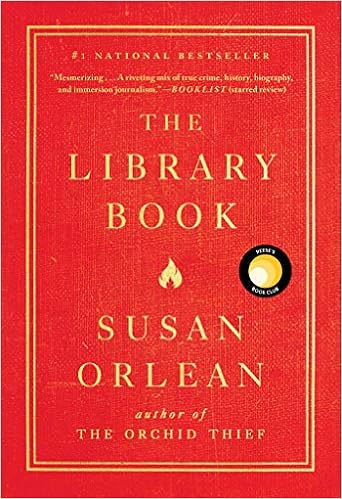
The Library Book - Susan Orlean


This book started showing up all over my Facebook feed late last year. Excerpts, interviews, and recommendations came from friends, family, and organizations. Everything I saw gave me reason to believe that I would love this book. And I did.

Of course it would have been right and good (and indeed, most meta) for me to have gotten a copy of this from a library, but I knew that there would be a long waiting list, and I really couldn't wait, so I purchased and downloaded an e-version onto my iPad. I read it out loud with my husband. We both thoroughly enjoyed it.

Normally when I read a book I mark any passage I find about libraries, so that I can easily find them when I am done reading it in order to write my blog post. It is not so simple when I read a book entirely about libraries. If I were to mark every relevant page I would essentially have to re-read the entire book, and I'd still be hard pressed to figure out what to write about here. So I was forced to make some hard decisions. As it is, I marked over sixty pages, so not even everything I found especially noteworthy made the final cut.

In this ode to libraries Orlean weaves together her own relationship with public libraries with the story of the Los Angeles Public Library (LAPL) and the fire that destroyed the Central Branch in 1986. The tale includes the history of the LAPL begining in the 19th century. Replete with quirky characters including early library director Henry Lummis, and Harry Peak, the man who was arrested for, but never convicted of, starting the fire.

Library Love

Orlean's own love affair with libraries began when she was a child when she went to her local public library regularly with her mother, and they would discuss what books they checked out on the way home. She explains that her family owned very few books because her parents knew that they could get what they wanted for free at the library. In college she eschewed the library and began buying books, to the point that she only had wistful memories of the library. A school project for her first grade son brought her again to the public library
As my son and I drove to meet the librarian I was flooded by a sense of absolute familiarity, a gut-level recollection of this journey, of parent and child on their way to the library. I had taken this trip so many times before, but now it was turned on its head, and I was the parent bringing my child on that special trip...when we stepped in, the thunderbolt of recognition struck me so hard that it made me gasp.
From there Orlean rediscovers her love of libraries, and discovers some things that aren't quite so lovable about them as well. For instance, we see that sexism in libraries has a long history with the tale of Mary Jones who lost her job as director just because they wanted to hire someone else (a man)

Mary Jones' story begins with Mary Foy who was hired in 1880 when
the library was still an organization run by, and catering to, men. Women were not yet allowed to have their own library cards and were permitted only in the Ladies' Room. No library in the country had a female head librarian, and only a quarter of all American library employees were women. The feminization of librarianship was still a decade away.  
Foy served as library director until 1884 when she was removed to make room for Jessie Gavitt, daughter of a "popular rancher". It was further determined that "Foy's father was doing well enough financially that he could now afford to take care of her". A succession of women ran the library until 1905 when Mary Jones, then director, was asked to resign by the library board who believed that "it would be in everyone's best interest to have a man run the library." The man they had in mind was an unconventional fellow named Charles Fletcher Lummis. He was offered the job of director at twice the pay of Jones.

Lummis had been in Los Angeles since 1885, when he walked there from his home in Ohio to take a job as a journalist.  He dressed in a "manner that was not typical for a Caucasian male of the 1880s. His favorite outfit was a three-button suit coat and trousers made of bright green wide-wale corduroy, which he wore with a red-and-black patterned cummerbund."

A philanderer, he was "the focus of endless gossip...reckless, dramatic, quixotic, romantic, and perhaps a bit of a tall-tale teller".

Eventually, Lummis' offensive ways became too much, and in 1910 he was asked to leave.

Fire

The story of the fire is interwoven with the story of the enigmatic Harry Peak who some believed started the fire. Ultimately, it was never determined who set the fire, or for that matter if it was arson at all. Harry Peak, however, always remained a person of interest. He was questioned several times, and even arrested and ultimately had over a dozen stories regarding his whereabouts on the day in question. Sometimes he produced an alibi, other times he put himself near the library (but not in it) and at other times he confessed to the crime.

In describing the fire the author made excellent use of allusion, letting her readers know that "The temperature reached 451 degrees and the books began smoldering".

Censorship, book burning, and information loss is the topic of chapter 9 in this book. From Egypt's Great Library of Alexandria, to the Spanish Inquisition, to the colonizers in the Americas destroying Aztec codices, to what George Orwell called that "most characteristic of [Nazi] activit[ies]" - the burning of books. The Feuersprüche (Fire Incantations)
was a pet project of Joseph Goebbels, the Nazi Party's propaganda chief, who understood how fundamental books were to Jewish culture, theology, and identity. Burning Jewish books, in his opinion was an ideal form of bloodless torture, demonstration the limitlessness of German control...The irony of the Feuersprüche was that they [the Nazi's] treated books as seriously as Jews did. To feel the need to destroy them acknowledged the potency and value of books, and recognized the steadfast Jewish attachment to them.
In describing the LAPL fire and its aftermath the author demonstrates how the burning of books, information loss, and the investigation effected those who worked in the library.
Twenty-four of Central's 250 librarians...asked for transfers to other branches. A survey of the remaining staff asked what the most stressful aspect of the fire was. The answers were dire. They included: "Feeling of powerlessness, helplessness brought about by confusion...feeling of isolation of having to work in an almost empty shell of a building that was once a vital place"; Being afraid that, even though nobody was killed in the fire, somebody is going to be killed or badly hurt..."; and "Feeling like a refugee. Holes ripped in an organic entity."...
Furthermore the "librarians complained of eye infections, breathing difficulties, skin irritation, and post-traumatic stress disorder."

Random Musings

Rather than giving each chapter a title, the author started each chapter with a bibliography of books (along with their Dewey Decimal Call numbers) that were related to the upcoming pages. When I noticed inclusion of a book I'd read (or better yet blogged about - such as chapter thirty's Bibliotech) I was sure to mark it. Chapter fourteen's list caught my attention with the inclusion of Map Librarianship: An introduction by Mary Lynette Larsgaard. The  very book that served as my textbook in 1991 when I took a course on Map Librarianship at the University of Arizona Graduate Library School. A few years ago I found the text in packed away in  box at home and used it to make a book-themed Christmas decoration.


Last Christmas when I put this on display at the library I overheard one student say to another "Look at that, they ruined a perfectly good book to make a decoration". While I agree on principle that we shouldn't destroy books, I also think that making art from out-of-date textbooks is a wonderful use of these works (and frankly, this would otherwise have simply be sent to the recycling bin).

The rumors of the demise of libraries are long standing, as evidenced by LAPL's Senior Librarian Glen Creason's reporting that when he entered library school in 1979 (on a whim, hoping to meet women) that the head of the RAND Corporation announced that libraries would soon be obsolete. 

Perhaps one of my favorite anecdotes in the book is the story about a CBS radio program called Americans at Work that aired during the Great Depression and featured plays about different professions. One of the plays was about a young woman (Helen) wanting to become a librarian. Her mother insists that it is a job for "older ladies who need to help out a bit". Then Helen's uncle comes to the rescue explaining that "a librarian's got to be a right modern smart girl nowadays."

Some things, of course, are universal in libraries. I was especially interested to read about the problem with getting an employee parking lot, something that was an ongoing issue when I worked at the McAllen (Texas) Public Library in the mid 1990s and that people who call asking questions that they can easily "google" the answer to goes on every where.

Orlean had my husband and I crying a bit at the end when she explains why she wanted to write the book
to tell about a place I love that doesn't belong to me but feels like it is mine, and how that feels marvelous and exceptional. All the things that are wrong in the world seem conquered by a library's simple unspoken promise: Here I am, please tell me your story; here is my story, please listen.


Wednesday, September 26, 2018

Soñadores - by Yuyi Morales


This one's in honor of National Hispanic Heritage Month (September 15-October 15)

Soñadores means dreamers in Spanish. In this beautifully illustrated picture book Morales tells the story of coming to the United States as a Mexican immigrant with her infant son, Kelly. The author explains in an afterword that her son is not a "Dreamer" in the sense that the word is often used today as Kelly was not undocumented, but rather that all immigrants are dreamers in that they come to a new country each bringing their own hopes - and gifts.

Morales describes how disoriented she felt coming to a new place not knowing the language or the customs. And then she discovered the library
un lugar que nunca antes habíamos visto. Misterioso. Fantástico. Incréible. Sorprendente. Inimaginable. 
a place that we had never seen. Mysterious. Fantastic. Incredible. Surprising. Unimaginable. 
She tells of the excitement of finding books, and learning to read...and dreaming.

I read this in Spanish. It is also available in an English version (Dreamers).