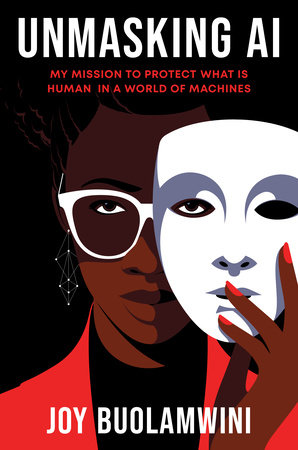
Algorithms are created by humans. Humans are flawed and have biases, these flaws and biases are programmed into algorithms, perhaps not explicitly, but with consequences nonetheless.
As a graduate student at the Massachusetts Institute of Technology (MIT) Buolamwini, using an open-source face tracking library to work on a project, discovers that facial recognition programs are especially bad at recognizing black and brown faces. Her research eventually brought her to The White House, to testify before Congress, to National Television, and Netflix. And ultimately to become founder of the Algorithmic Justice League. She mentions the use of code libraries on several occasions.
She describes volunteering as an undergraduate at the Carter Center on a project to eradicate tropical diseases. Visiting the Jimmy Carter Presidential Library in Athens, Georgia she
walked through the gardens near...the library [and] saw a piece of art that offered hope - a bronze statue of a child leading a blind elder using a stick they both held. Sightless Among Miracles had been donated to the center to underscore the effort to support the global control of onchocerciasis (river blindness).
Perhaps the most disheartening (for me) passage was this
After two years on the MIT campus I was finally making my way to the Hayden Library. With online access to almost all the resources I needed, I had yet to step foot into a campus library. After printing out results on archival paper that felt soft yet sturdy to the touch and hunting down last-minute typos, I felt ready to submit my master's thesis.
While I recognize that online resources have allowed us to put libraries into users' pockets, which is decidedly more convenient for all, it doesn't mean the physical library isn't important as a place. And since I'm required to be in my office most of the time, even though almost everyone is using the library remotely, I do wish more people would take advantage of the space.
Kelsa (Eva Reign) likes animals and flowers. She is smart and pretty and loves her friends. She is also trans. Khal (Abubakr Ali) is smitten with Kelsa who is in his art class. He is not sure how his family would take it if he dated a trans girl, and he is sure he would lose his best friend Otis (Grant Reynolds).
Ultimately, this is simply a sweet teenage romance with a standard boy meets girl, boy loses girl, boy gets girl back arc. The boy-loses-girl piece takes place in the school library, where Kelsa and Khal's loud argument earns them a severe "shushing".
Khal also has some old card catalog drawers in his bedroom. It is not clear what he uses them for, but they do look cool.
Director Billy Porter's heart shines bright in this one.
Baltimore County Public Library's #BWellRead challenge for September 2018 was to "read a book you've always meant to read". I wasn't sure how to interpret "always" but I looked back on the list I've been keeping since about the start of this century and decided that a book that's been waiting ten years to be read qualified.
I made several attempts to purchase this at an independent bookstore, which it turns out would have been appropriate since much of the action takes place in such a store. Ultimately, however, I caved and ended up getting this from Amazon. I do offer myself some absolution though as I bought something at each of the independent shops I visited.
Although this reads as a graphic novel it is, in fact, a collection of the Dykes to Watch Out For comic strips. The book includes strips originally published between 1987-2008. While each panel features an independent episode, it reads as a soap opera with characters falling in and out of love, changing careers, becoming parents, and negotiating the evolving political landscape. I had not thought about some of the old political issues that come up in this work for a long time, and likewise was reminded how long some of the stalwarts in Washington have been around making trouble. It was sort of like visiting an old "frenemy".
Despite the fact that the characters in this work are quite well read, it was not until about the midway point of this 390-page book that I found any mention of libraries at all, and it was in a fantasy sequence. Each of three roommates (Ginger, Lois, and Sparrow) imagines what it would be like to live without the other two. Ginger's daydream involves a well organized bookshelf "in Library of Congress order". I then had to read another 80-ish pages before a library comes into play again, this time for real. Mo and her paramour Sydney do it "by the book" (so to speak) right there in the HQ 70s in the University Library (the range that includes books on lesbianism). It is no doubt the excitement of this tryst that prompts Mo to apply to library school, something we discover on the very next page! It is at this point that the libraries just keep coming as we follow Mo through her acceptance, taking classes, graduation, and getting her first job - in a post PATRIOT act world.
I am posting this one in honor of National Coming Out Day.
The subtitle of this is "The Complete Guide to the Vulva and Vagina." I must say it is rather complete. Readers will find chapters (among others) on arousal; sex toys; birth control; masturbation; menstruation; vaginal health; ideas for vagina and vulva arts & crafts; and information on vagina and vulva maintenance which includes my favorite topic (NOT) - pubic hair shaving. When did this become a thing? I keep seeing articles about it on my FaceBook feed always with the authors explaining their choice to shave or not, as if there is some sort of major policy debate we have to have on this issue. Shave or don't - your partner will just be happy to see you naked.
Anyway, I did learn a lot from reading this comprehensive work. One thing I learned is that viewing Playboy, and similar magazines, is where many young women will find their first images of vulvas other than their own, and these "...may misinform women and men about what's 'normal' for women in terms of their genitals. Because people want to feel normal this is important." But what about women who find images elsewhere, for instance those who "seek out anatomy textbooks in their local libraries." The authors point out that this is not the norm.
Given how private people feel about genitals (some people call them "privates"), it is less likely that people are openly seeking out these images when they have access to a plethora of vulva images on their home computer.
They are probably right in this regard. I should, therefore, point out that librarians are trained to use the utmost discretion when assisting people with their research, and also to respect their privacy. This is actually federal law. Unfortunately, this was the one and only mention of libraries in Herbenick and Schick's book. Sigh.
During World War II millions of American women went to work in factories at jobs left by men who were fighting overseas. Spurred on by a government campaign that includedRosie the Riveter, these women also became de facto heads of household and were responsible for running the household finances. When the war ended women were not only forced out of these jobs (again, by government campaign) so that men could have them, they were also discouraged from completing their educations, so that they could instead marry young and become "housewives". Aided and abetted by women's magazines, and even the curriculum in women's colleges, the myth of the "feminine mystique" gave the post-war generation of women the message that they could best find fulfillment as wives, mothers, and housekeepers. The messages and images from the 1950s put men in the role of protectors and breadwinners, while women were told they didn't need an education, career, or even a job (Rosie the Riveter not withstanding). Having these things would not only prevent them from fully developing as women, it would also undermine their husbands' roles. In reality, of course, the women's development was stunted, and they were left to wonder what was missing from their lives.
Earlier this year the publishing and library magazines that routinely come across my desk featured articles that reflected on the 50 years since the publishing of Friedan's feminist manifesto. (A 50th- anniversary edition has been published, but I read a 10th-anniversary edition). I had heard about this classic work, and remember selling copies of it back in my college days working in a bookstore, but I had never read it. It seemed the time was right. I could not have imagined how right it was. I started writing this post even before I finished the first chapter. By the time I got to the third chapter my head was spinning. There is just so much to say about this book. As the writer of this New York Times article states some of the attitudes reflected in the work "remain unchanged". Here I point to several recent news stories:
Facebook recently lit up with protests when Swiffer co-opted the famous World War II "Rosie the Riveter" icon to sell a cleaning product.
A recentreport from the University of Chicagorevealed that in 40% of households women are the primary breadwinners. In many cases this is because there is no man present, nevertheless, four commentators from FoxNews have a meltdown over this news.' It is against nature'. 'It will destroy the American family'. The fear that the men's role as protector will be undermined is too evident. This shows little change from Friedan's statement 50 years before that "[a]t every step of the way feminists had to fight the conception that they were violating the God-given nature of women". Friedan also quotes from the book Modern Woman: The Lost Sex which claimed that "careers and higher education were leading to the 'masculization of women with enormously dangerous consequences to the home...'"
Short stories in women's magazines the 1950s & 1960s contained messages that women should be wondering why straying husbands were looking elsewhere. What could a woman do that might bring her husband back? Change her hair color? Lose some weight? Keep the house cleaner? It is her job to figure out why he is cheating, and make the necessary changes to herself! so that he'll come back. And so also says Pat Robertson, 2013.
Articles in women's magazines then (as now) featured actress not in their roles as successful career women, but as wives and mothers.(And, by the way, can we please stop using the term "baby bump"? And what's with the arrow always pointing to a celebrity's stomach, as if we wouldn't know which part of a woman's body to look at for evidence that she's pregnant!?)
Janet Maslin, the author of the aforementioned NYT article closes by saying "I have a photograph of myself with Betty Friedan. We were together on a radio show. I was there because I was a critic for The Times and I arrived at The Times because of opportunities her book created. I wish I had known how much I owed her." This statement I contrast to conservative political commentator Monica Crowley's remarks in the fabulous PBS series "Makers". Twice in her short segment Crowley refers to feminists as "so called" feminists, as if that is not what they really were (or that perhaps we no longer exist), and clearly has no recognition that she would be never have gotten where she is without benefiting from their struggle. I highly recommend watching the Makers series, BTW. All three episodes can be viewed by clicking on the link above. But what does Friedan say about libraries? Yes, Betty Friedan did write about libraries in this work. She begins with acknowledging the "Frederick Lewis Allen Room of the New York Public Library and its provision to a writer of quiet work space and continuous access to research sources" without which "this particular mother of three might never have started a book, much less finished it". She also describes sitting "for many days in the New York Public Library, going through bound volumes of American women's magazines for last twenty years." This image resonated with me because it reminded me of doing the same sort of project myself in the 1980s when I took my first Women's Studies class. I was assigned to look at women's magazines from the 1940s and remember sitting with the big bound volumes at the Enoch Pratt Free Library in Baltimore. Other students in my class were assigned to look at other decades. I remember our professor telling us that we shouldn't expect see much change in the messages over the 50-year time period we were studying, even though the images may have evolved. I was particularly interested in the fact that Friedan discovered that the magazines from the 1930s and 1940s did carry more articles about "the world outside the home" than those of the 1950s and 1960s. I was saddened to see this message about librarians in a passage in which Friedan describes the types of career-woman role models she had growing up
The only other kind of women I knew [besides housewives]...were the old-maid high-school teachers; the librarian; the one woman doctor in our town, who cut her hair like a man; and a few of my college professors. None of these women lived in the warm center of life as I had known it at home. Many had not married or had children. I dreaded being like them, even the ones who truly taught me to respect my own mind and use it, to feel that I had a part in the world. I never knew a woman, when I was growing up, who used her mind, played her own part in the world, and also had children.
I have thought about this passage a lot. It reminded me of learning about Sor Juana Ines, the Spanish mystic nun and author who lived during the 17th century. She, like her brethren, knew that the way for a woman to become educated in their day was to become a nun, which did necessarily giving up marriage and children. It is too bad that Friedan seemed to see these teacher and librarian career women as simply "old-maids", rather than as women who made a choice to become educated and have a career - a choice that allowed the women activists who came after them to build upon their work and knowledge, so that others might have a few more choices themselves. Again, it is important to acknowledge those who came before us.
In interviewing young college women in 1959 Friedan spoke to one senior who lamented not using the library more. She had taken to "wandering around the stacks" to find books that interested her. She wished, in fact that she had developed more interests. She had learned her freshman year to "turn up [her] nose at the library". But as a graduating senior she wished she had taken harder courses and read more. "But" she adds, "I guess those things don't matter when you're married." Another young woman, who admitted to being excited by books, and would sometimes spend all day (8 a.m. to 10 p.m.) in her college library dropped out of the honors program and stopped reading quite so much, for fear of not being able to lead a rich life which she said included marriage, children and "a nice house".
Other places libraries are mentioned were as places for women to volunteer. Remarkably, she also notes that the more interesting volunteer jobs-
the leadership of the cooperative nurseries, the free libraries, the school board posts, even the PTA presidencies - are filled by men. The housewife who doesn't "have time" to take serious responsibility in the community, like the woman who doesn't "have time" to pursue a professional career, evades a serious commitment through which she might finally realize herself; she evades it by stepping up her domestic routine until she is fully trapped.
Furthermore she notes that women who did step into these more challenging roles found a greater sense of fulfillment.
This book is a must read. Its message is clearly just as relevant today as it was 50 years ago.
In a truly paradigm-shifting work, Fine revists the nature vs. nurture debate regarding sex roles. Questioning conventional wisdom, as well as current scholarship, she delves into how society creates and reinforces gender stereotypes. Even those of us who believe we were raising our children in gender-neutral settings are easily lead into this trap. Explaining how even many feminists, like myself, simply threw up our hands in surrender when our young daughters showed serious preferences for princesses and pink, despite our best efforts to dress them in gender neutral onesies and provide them with sports equipment, Fine provides evidence to show that perhaps we weren't as neutral as we believed. Furthermore, our children are influenced by so many other outside forces we are at a loss to control them all.
In her chapter entitled "The Glass Workplace" Fine explores the question of why men are drawn to some jobs while women are drawn to other (most notably the "helping") professions, and what happens when those of one gender try to cross-over to a profession of another. It is here that I found the only mention of librarians.
...often, when men choose to enter less-prestigious female professions they quickly find rolled out for them a red carpet leading to a better-paying position within the field...sociologist Christine Williams coined the term "glass escalator" to encapsulate her discovery that men in (what are currently) traditionally female occupations like nursing, librarianship (emphasis mine), and teaching "face invisible pressures to move up their professions. As if on a moving escalator, they must work to stay in place."...Perceived as, in a sense, too competent for feminine occupations, they were tracked into more supposedly legitimate, prestigious ones.
This will come as no surprise to those of us in these professions. In my 20 plus years as a librarian, I have almost always had a male boss. On those occasions when I've worked for a woman director, she was placed in the position only in an "acting" capacity, until a permanent (male) could be found. To be fair, I have worked as a department head, and had men working as my subordinates, but the head honcho has almost always been a man.
One glaring omission from this work was a discussion of transgender children. Transgendered individuals are given minimal mention in "The Glass Workplace", but that is the only place that explores this topic.
A thought-provoking work. I am looking forward to discussing it with my colleagues in the Women's and Gender Studies Program in the fall.