Showing posts with label New Hampshire. Show all posts

Thursday, March 26, 2026

The Library of Lost Dollhouses - by Elise Hooper

Along with being unprepared for a test, and being naked in public, one of my recurring dreams is that of finding a secret room in my house. 

Hooper's book asks us to imagine finding a secret room in a library that holds secret dollhouses, each of which holds its own secrets. 

There are two timelines in this story: World War I Europe, and present day San Francisco. When Tildy Barrows, curator at Belva Curtis LeFarge Library and Museum, discovers a hidden room in the museum with two exceptionally decorated dollhouses created by artist Cora Hale it takes her on an unexpected journey that intersects with her own family history. 

The museum, along with its eccentric founder is loosely based on Boston's Isabella Stewart Gardner Museum. Just as Gardner left instructions to keep her art collection exactly as she left it, LeFarge likewise "left very strict provisions for how...the library was to be managed". Barrows is sure that this does NOT include digitizing the book collection to make room for more art. 

It turns out that Barrows was right. In fact LeFarge once insisted that raising a child in the Library was an exceptionally good idea. 

Libraries are the prefect place to grow up. Just think how smart she'll be.

Furthermore, the McCarthy-era heiress had this to say about a child being trouble in a library 

Any trouble a young person can find in a library is the best kind of trouble

And Hale, who knew LeFarge quite well, had this to say about libraries

Libraries are viewed as such solemn places-but why? Reading is magic. Think of the imagination and sense of adventure that readers employ every thine they crack open a book. There are few places filled with more magic than libraries, no about about it.

I am not sure what psychologists say about what the "secret room" dream means. I have always interpreted it to mean that I am not meeting my potential. But perhaps the dream is about revealing something I have kept hidden.  Just as every book has as many interpretations as there are readers, dreams are multi-layered and can mean different things to different dreamers. I think will need to think about my hidden room dreams a bit more.

Tuesday, September 19, 2023

I Have Some Questions for You - by Rebecca Makkai


I was intrigued by the description of this book because it reminded me of Adnan's Story which I recently read. The story of Adnan Syed's arrest, trial, and life sentence for the murder of a classmate was made famous on the Serial podcast. Because of the publicity brought on by the podcast, Syed's case was re-opened and he was subsequently found innocent. 

Makkai's book is a novel with a very similar plot. A young girl is found dead in her boarding school swimming pool and suspicions are on Omar Evans, an athletic trainer at the school. Omar is found guilty and a former student, Bodie Kane (a podcaster) brings new light to the crime many years later. Bodie questions whether the wrong person has been jailed. 

Bodie has returned to Granby School to teach a winter intersession on podcasting, when some of her students decide to do a podcast on Thalia Keith's murder, they start exploring new suspects, and ask new questions.

The school library is mentioned a few times. For instance: as a place to look up the word "lusty" in a dictionary, before one could simply go to dictionary.com to discover that it meant "healthy and strong; full of vigor"; as a place to do research back in a time when students didn't all have their own computers; a place where old yearbooks can be found; or where a schoolgirl in 1995 could borrow a map of Connecticut to find the location of the street in New Canaan where her crush lived.

The library held a special place in the history of the Granby school. Started in 1814 a young woman Arsareth Gage founded the school with twelve boys as students in a small schoolhouse. Samuel Granby built the library and chapel six years later. Ultimately Samuel Granby became a sugar daddy to the entire town.

For those on the lookout for Easter Eggs regarding the Syed case, Makkai includes a reference to "the girl whose boyfriend was definitely not working at LensCrafters that day".

Thursday, March 18, 2021

Labor Day (the movie)

On Labor Day weekend 1987 a mysterious wounded man, Frank (Josh Brolin) coerces Adele (Kate Winslet) and her son Henry (Gattlin Griffith) into bringing him into their home. When Adele and Henry learn that Frank is an escaped convict they are understandably quite fearful at first, but as Stockholm syndrome kicks in the predictable love story ensues. Once Adele and Frank's lust takes over they manage to get Henry out of the house by sending him to the library to look up information on Prince Edward Island. Adele has heard it's lovely there and so they make a plan to escape New Hampshire together to build a life in PEI. (This is of course in the days when one didn't need a passport to go to Canada.) 

I have been unsuccessful in verifying that the gorgeous interior library scenes were filmed in Fairhaven, Massachusetts' gorgeous Millicent Library, but my husband and I are both convinced that they were. The imdb page for this film lists seventeen filming locations for this movie, sixteen of which are in Massachusetts.

We did not watch this movie on Labor Day, but we did watch it from our Fairhaven home on Pi Day (3.14). This film has a wonderfully sensuous peach-pie-making scene. I found out about the movie by googling "movies about pie". The library scene was a bonus.

Wednesday, November 18, 2020

Change the Subject - the movie

Change the Subject trailer

I received an email last week letting me know that Indiana University Bloomington was sponsoring a free screening of this film. I had not heard of the documentary before, but I did know the story of the Dartmouth College students who took on the Library of Congress (LoC) in order to have the pejorative catalog subject heading "Illegal Aliens" changed to Undocumented Immigrants. I was surprised to learn that the change has not yet happened (see this page from the Library of Congress Subject Headings). I followed the story at the time and remembered that Republicans in Congress (for the first time ever) decided to get involved with decisions on LoC subject headings. It is not unusual for Library of Congress Subject Headings to change as language and mores change, but in this case some lawmakers decided that this was too much and amounted to "political correctness run amok". Calls were made for more transparency in the process for changing LoC Subject headings (again, this had never been the case before). 

What both parties here understand is this: words matter. Language matters. 

The film follows the students from the CoFired (Coalition for Immigration Reform and Equality at Dartmouth) Student Group as they go from discovering that the subject heading exists to talking to the College librarians about it (and librarians' own awakening about the term) to the students' realization that the heading did not originate with Dartmouth's Baker-Berry Library but rather that the headings came from the authority of the Library of Congress and so they took their case to the United States Capitol.  

The term inspirational was used to describe the students. 

Inspirational? 

Yes. 

These students in fact inspired me to contact the editors of the popular Opposing Viewpoints database (Cengage) in 2017 when I discovered that the term "illegal aliens" was used as a heading in the database. I pointed out that the Library of Congress was considering changing their subject heading and that surely the editors of the database were aware of this. Furthermore, I suggested that the heading was judgmental, which seemed to be contrary to the purpose of the Opposing Viewpoints database - to inspire discussion. Unlike the Library of Congress Cengage did indeed "change the subject" after I sent them my message. The term "Undocumented Immigrants" is now used in the database.

Screenshot from Opposing Viewpoints database

I will continue to follow this story. Perhaps we will see a change in 2021.


Friday, April 19, 2019

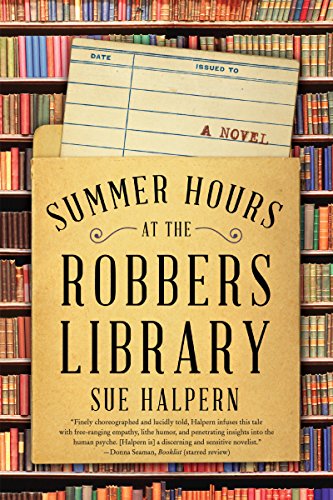
Summer Hours and the Robbers Library - by Sue Halpern


The hardest posts to write for this blog are those that are for the most library-centric books. I can't simply put a post-it note on each page that has the word library lest the entire book be marked. Writing about this book is made even harder by the fact that I read it over a month ago while I was on vacation. While I did enjoy a lot of reading (I read, or listened to, four books) while I was away  I got quite far behind on my blogging while I was on vacation last month, and returning from my trip I had so many other things I had to take care of that writing was put on the back burner.

Halpern's book tells the story of the intersecting lives of Solstice (Sunny) and Katherine (Kit) who work together at the Riverton Public (Robbers) library in New Hampshire. Kit is a forty-something reference librarian and Sunny is a fifteen-year-old who "had been sentenced to work at the...library for the summer after she was caught trying to steal a dictionary from a bookstore in the mall." Sunny procured her sentence in kids' court "the place where good kids, or kids who haven't yet gone bad, are sent when they do something wrong, or dumb, or both..."

So, while I didn't mark every time the word "library" was used, it turns out I did mark more than a few passages. Let's start with the word sesquipedalian.

When asked by the judge why she stole the book  (a dictionary of all things) her response that she didn't have enough money elicited further explanation. To which Sunny explained that she wanted to be able to look up the meaning of words she didn't know - words like sesquipedalian. Poor Sunny still didn't know what it meant because she didn't have the dictionary. Of course I could have told her the meaning of my favorite word: sesquipedalian - a foot and a half long - from the roots sesqui (one and a half) and ped (foot) - a word that essentially defines itself. But Sunny wanted to be able to look up the word herself. She was "tired of always having to ask someone when [she] didn't know the meaning of a word."

It is a bit coincidental that I marked a page that mentioned icky library vending machine food, although I had not yet written my most recent post about Dear Committee Members in which I wrote for the first time about such things.

Halpern plays a bit with stereotypes. Kit is a single (really divorced) childless middle-aged woman, who tells Sunny that she's "a big fan of silence" asked why she works in a library.

The Library Director, Barbara is described as
sturdy, with angular features and a white pageboy, handsome, not pretty - a sensible shoes kind of woman with proper manners, manners proper enough to keep her from prying into the lives of the people she worked with or trading gossip... 
There is also one instance of a "shushing" which takes place when a patron laughs loudly at learning why Sunny was "sentenced" to work in the library.

Much of the book is Kit describing her life before the Robbers Library. We find out about library school, and her first job in a library archive room, and a later job at a the Science Library at Emory University. In describing each of her jobs she does admits a dark secret that all library workers know, but don't want to admit - sometimes our work is tedious, or even boring. It is true that sometimes we wonder why the building we're sitting in, waiting for a "stray question", is even open. Or that sometimes our job is just searching fruitlessly for a missing book, or making sure people aren't destroying materials. Meanwhile, we also know that we must convince others that we are "busy" at all times, lest we lose funding, or worse, the vocational awe perceived of us by those outside our occupation.

Ultimately, though we learn that Kit recognizes the value of libraries and librarians. And that while her job may not be "as awesome as being a neurosurgeon" she knows that "putting books in the hands of readers...save[s] lives, too".

Monday, February 25, 2019

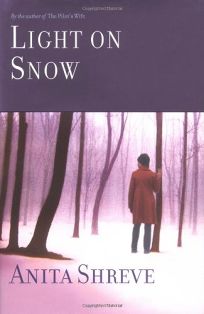
Light on Snow - by Anita Shreve


A motherless twelve-year old girl (Nicky) and her father take a walk in the woods behind their house on a snowy December afternoon. They hear what they believe to be a cat's cry, but soon recognize it as human. Following the noise they discover a newborn infant abandoned in the snow, and race to the hospital in order to save her. A police investigation follows. Two days before Christmas a young woman shows up at Nicky's house to thank her and her father for saving her baby. A snow storm prevents the stranger from leaving and over the course of her stay they learn her story. Part of the story is that the only pre-natal care the nineteen-year old received was what she learned from reading library books about pregnancy and childbirth.

She also used the local public library to read newspaper accounts of the baby's rescue, and the name of the man who saved her.

Meanwhile, Nicky begins to wonder about all the what-ifs that led to the discovery of the infant, who otherwise likely would have been found as a tiny skeleton in the spring. What if she and her father had decided not to take a walk that day? What if her mother and baby sister had not died in a car crash - she and her father would never have moved to New Hampshire in the first place. And
What if my father had not, as my mother once told me, walked into the university library one spring morning to read about the Yankees-Orioles game the night before and seen my mother at the circulation desk, studying for a chemistry exam while putting in her work-study hours, and asked her, on the spur of the moment, how he might get permission to look at a series of rare Jefferson drawings kept in the vault.
Like the title character in Judy Blume's classic Are You There God? It's Me, Margaret this book ends with the narrator getting her first period. However, Shreve's work is most definitely a bit darker than Blume's.

Monday, September 19, 2016

Between the Lines - by Jodi Picoult & Samantha van Leer


About ten years ago our town selected Picoult's My Sister's Keeper for its One Book One Community (OBOC) read. As a member of the OBOC steering committee I read it, and championed it, as I do with all our selections.Honestly, though, I wasn't crazy about it, although I could see why it appealed to so many others. And It did turn out to be a popular choice for the OBOC program. I've not been interested in reading any more of Picoult's books since then though. However, I noticed this one on display at my local public library while I was looking for another book. Picoult co-wrote this one with her teenage daughter Samantha van Leer. Since "Leer" is the Spanish word for "read" I picked it up and read the inside cover description, which specifically mentions an obsession with a library book, at which point I knew I had no choice but to read it myself.

In this fantasy tale The Purple Rose of Cairo meets Toy Story when fifteen-year-old Delilah falls for the handsome prince in an illustrated library book. She discovered the book in her school library placed "upside down and backwards", and on the wrong shelf to boot. The book also, literally, shocked her hand when she touched it. When Prince Oliver starts talking to her, and telling her all about the life he has outside of the story at first Delilah (along with her mother) thinks she must be going crazy, but it doesn't take long before Delilah and Oliver start concocting a way for him to escape the confines of his pages so they can live happily ever after. The two come up with some ingenious ideas, but discover that whatever they do causes the story to "reset" itself as soon as the book is closed, and everything goes back to the way it was. There are so many other things to consider as well. For instance, if Oliver does manage to escape from the story will still he be four inches high and two dimensional? How will he function in this other world that has computers and other electronics unknown to his people?

In one early attempt to be together Delilah and Oliver discover that the pages of the book act as a barrier between them. Oliver suggests tearing the page to see it he can get out through the rip. Delilah, however, is horrified at the idea of ripping a library book. (Somethings are more important than true love, after all). But his smile "the one that makes [her] feel like [she's] the only person in the world" convinces her to make the tiniest, most minute, infinitesimal tear"so they can test their theory on a spider Oliver found. It takes a lot of patience to make love work. Is there any way these two star-crossed lovers can be together?

Some good metafiction, and problem solving going on with this one. I liked it better than I thought I would.

Monday, January 25, 2016

The Map Thief - by Michael Blanding


My husband, James and I read this book aloud together. It was recommended by a friend as it brings together James' passion of geography and mine of books and libraries. We finished this a few weeks ago, but I held off blogging about it because I found out that we would have the opportunity to hear the author speak at the Massachusetts State Library in Boston shortly after we finished it. It was not our first visit to the State House - James goes there about once a year with his EarthView globe-, but it was the first time visiting the State Library. Blanding was witty and seemed to thoroughly enjoy speaking in the stately room. He smiled the entire time as he showed slides with maps and photographs and discussed how he did the research for his book. The Map Thief  is the true story of E. Smiley Forbes III who stole maps from the Boston Public Library, the New York Public Library, the Beinecke  and Sterling Libraries at Yale, Harvard Library, as well as the British Library. In order to pay the phenomenal debts he racked up for his home on Martha's Vineyard, as well as for his planned community Sebec, Maine, Forbes, a well-respected map dealer, began stealing rare maps in order to sell them to collectors. It was a Yale librarian, Margit Kaye, who first suspected Smiley, when she noticed a smudge mark on a map that Smiley had posted on his website - a smudge she was sure she had made! However, when she brought her suspicions to the attention of her supervisor his response was a dismissive "what do you want me to do...arrest the guy?" Ultimately it was another Yale librarian, Naomi Saito, who set in motion the events that lead to Smiley's arrest in 2005.

Blanding talked to a number of librarians and map dealers in the course of researching this book. He also explores the history of maps and mapmaking, and discusses my favorite Librarian/Geographer, Eratosthenes, head librarian of the famous Library of Alexandria in Egypt in 240 B.C.

Blanding's book also tells of how maps were recovered and then how forensics were used to determine which maps belonged to which library. I was especially interested in the clever librarians who used wormholes to identify their map of Gerard de Jode's Speculum Orbis Terrarum
For centuries libraries had been plagued with wood-boring insects that laid their eggs in the stacks. When the larvae hatched, they used the digestive enzymes in their alimentary canals the chew through wood and paper, leaving behind a tiny trail. Somewhere in its 427-year history, the Beineke's copy of the Speculum had contracted its own case of pests. In the front of the book, a dozen pages sported a small constellation of three pin-sized holes near the bottom and another hole three inches up. Now, as the librarians laid the map carefully back into the volume, those holes matched identical holes in the edge of the map where it had been held in place.
Well researched, well written, and full of real-life clever librarians, this is a title truly worthy of its place on this blog.

A post script: While the book is finished, the story is not. As recently as November of last year  the Boston Public Library  recovered a stolen map thanks to an "eagle-eyed" librarian who identified a the map based on flaws in the document.

My favorite quote from the day: "It was a battle, but it was a quiet battle because they were librarians."

Author Michael Blanding signs copies of his book, surrounded by maps, at the State Library.

Thursday, April 23, 2015

Notes From a Big Country - by Bill Bryson


This collection of essays was originally published as a series of columns about the United States for the U.K. publication the Mail on Sunday's Night and Day magazine in the late 1990s. Although some references are a bit dated now (e.g. floppy disks, woes of land-line telephones) the anecdotes were still laugh-out-loud funny. My husband and I read these together over the course of the long winter. The right-on-target observations about life in the USA in Bryson's inimitable style were the perfect antidote to the winter doldrums we experienced in New England this year. As a bonus, Bryson mentioned libraries in six of his essays

In "Well, Doctor, I was Just Trying to Lie Down" Bryson begins with some information from one of my all-time favorite reference books The Statistical Abstract of the United States. His discussion of the number of people injured (400,000) by beds, mattresses, and pillows segues into what he learned from the Abstract 's"Table No. 206: Injuries Associated with Consumer Products" which he specifically says he found in his local library while "looking up something else altogether". This is what is so great about the print version of the Abstract. It is an absolutely fabulous browsing book. Before there was FaceBook to waste time on, there was the Statistical Abstract.

Explaining American's penchant for rules in "Rule Number 1: Follow All Rules" he describes his frustration in the constant changing of rules without warning. The first time he found out about airline rules regarding showing a picture ID before boarding (and this was pre 9/11) he was at an airport checking in for a flight. He discovers that he has "all kinds of identification - a library card, credit card, Social Security card [remember when we used to carry those around with us?], health insurance card, airline ticket" all had his name, but none had his picture. He illustrates his priorities so well - here - 120 miles away from home, he did not bring a driver's license, but he did carry his library card.

American's love affair with cars is treated in "Why No One Walks". Like me, Bryson chose to live in a place "within walking distance of shops." He describes Hanover, New Hampshire as a "typical New England college town, pleasant, sedate, and compact. It has a broad green, an old-fashioned Main Street, nice college buildings with big lawns, and leafy residential streets. It is, in short, an agreeable place to stroll. Nearly everyone in town is within a level five-minute walk of the shops" yet, he explains, no one walks, except him. He walks "nearly every day...to the post office or the library or the local bookshop". Bryson and I are rare breeds here in the United States. Driving is something I know how to do, but will avoid whenever possible.

On informality in America (in "Help for the Nondesignated Individual") Bryson extols the wonders of living near the campus of Dartmouth College
one of the Ivy League colleges, like Harvard and Yale - but you would never guess it.
None of its grounds are off limits...Indeed much of it is open to the community. We can use the library attend its concerts, go to its commencement exercises if we want.
This, of course is how it should be. Living and working in a college town myself I know how contentious town/gown relations can be. Opening events, and the library, up to the local community is not only a good PR move, it is the right thing to do. One of the first papers I wrote in library school was on community use of academic libraries. I think any college or university, public or private, has an obligation to allow at least some use of its library facilities to the local community.  I am glad to say that the university library in which I work allows free borrowing privileges to anyone who lives in town.

There is little that gets my geographer husband and I more excited than reading something that entwines his passion for places and mine for books and libraries together. So you can only imagine the magical evening we had after reading "Where Scotland is and other Useful Tips" in which Bryson tells of going to the library in order to "look at the travel section." There he found "four books exclusively on Britain, plus another eight or so on Europe generally, with chapters on Britain". Ultimately he discovers that "what Americans know about Britain is pretty much nearly nothing..."

And, finally, in "The Fat of the Land" Bryson describes his misadventures in dieting and a trip to the library to find a book with a better diet than the bran and water diet one his wife invented for him. He settles on a work titled Don't Diet which he reads in "that reading area that libraries set aside for people who are strange and have nowhere else to go in the afternoons but none the less are not quite ready to be institutionalized..."

While there are no other libraries to write about, my reference librarian self would be remiss if I did not correct the mistake Bryson makes in his essay about our shared favorite holiday - Thanksgiving - in "The Best American Holiday." He provides some history of the pilgrims, and when President Lincoln declared it a national holiday in 1863 to be celebrated on the last Thursday of November, however; Bryson then goes on to say that "there it has stayed ever since." This is not quite true, in 1939 President Roosevelt moved it to the fourth Thursday of the month. While the fourth Thursday is often the last one, in years in which there are five Thursdays in the month Thanksgiving remains on the fourth. This ensures that there are always at least four full (shopping) weekends before Christmas.

While probably not what most would suggest for date night, I highly recommend reading this with a romantic partner. Laughing together is a wonderful aphrodisiac. My husband was happy to see that I found another of Bryson's books (A Short History of Nearly Everything) for us to read together. If there are any libraries in that one you will no doubt find out about it here. For more Bryson fun, I also recommend A Walk in the Woods