Showing posts with label China. Show all posts

Monday, August 16, 2021

The Book of Joy - by His Holiness the Dalai Lama, Archbishop Desmond Tutu, and Douglas Abrams


The One Book One Community selection for the fall 2021 is The Book of Joy. After so much time on lockdown (with only virtual connections) the time seemed right for a book that explores what is joyful in life. Co-author Abrams follows these two religious leaders during a week-long meeting in which they discuss how they remain positive despite their experiences living under apartheid (in the case of the Archbishop) and the extreme difficulties of living in exile (in the case of the Dalai Lama). The Dalai Lama left Tibet for India in 1959 at the age of 24. He describes how during the Cultural Revolution China pledged to wipe out the Tibetan language 
so they burned books, such as the three-hundred-volume Tibetan canon of scriptures translated from India, as well as several thousand volumes written by Tibetans themselves
On a more joyful note however, the week wraps up with a party in honor of the Dalai Lama's eightieth birthday. And what better place to have a joyful birthday celebration than in a library! The party takes place in the Tibetan Children's Village school

As our motorcade approached, we heard the children's soaring voices, their welcome song high-pitched and plaintive, yet indomitable and joyful. It was a song they had composed...The choir and school staff lined the road. All around them sat waves of students in their school uniforms...The car finally arrived at the library and the children were still singing at the top of their lungs.

This was, ironically, a rather challenging book for me. As I read news of building collapses, an earthquake, the Taliban, raging wildfires, all while facing a pandemic that won't slow down because of deliberate manipulation of truth, perhaps remaining hopeful is the best I can do for now. Joy will have to wait.

Wednesday, November 20, 2019

Daughter of Fortune - by Isabel Allende


My summer vacation was spent in Chile and Argentina this year. I watched a total eclipse of the sun in the Elqui Valley of Chile, and visited a number of wineries in both countries. Valpariso was not far from where we stayed in Chile, and is the location of much of the action in Allende's book. The story centers on Eliza Sommers, ward of siblings Jeremy and Rose Sommers. Eliza is an adventurer and thus the novel takes the reader not only to nineteenth century Chile, but also to China, and to California during the gold rush.

Libraries play a role in several character's lives. Jacob Todd "a charismatic redhead with the most beautiful preacher's voice" who traveled to Chile from England on a bet uses the archives of the British Museum to research the the land, and discovers that
in 1810 Chile opened its doors to immigrants, who had come by the hundreds...The English quickly made fortunes as merchants and ships' outfitters... 
Todd also spent some time in the Sommers' private library trying to find out more about the Patagonia Indians, but gave up after making a "a few half-hearted sweeps through some heavy tomes" when he discovered that "it made little matter what he knew or didn't know since ignorance of the subject was universal".

The library is also a place of sanctuary at different times for Eliza and Jeremy. It also served as a place for Eliza to meet her clandestine lover.

Tao Chi'en, a Chinese doctor made use of the library of his mentor to learn the "two hundred twenty-two love positions" as well as the "countless ways of pleasing a woman". Additionally, he learned the necessary medical knowledge to make herbal medicines, and perform surgery.

This is a wonderful novel with just a touch of Allende's signature Magic Realism.

Thursday, December 6, 2018

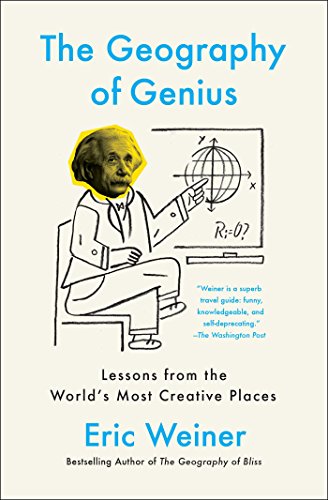
The Geography of Genius - by Eric Weiner


Nine years ago I embarked on a project of reading "Year Of" books. One of the books I read, together with my geographer husband, was Eric Weiner's Geography of Bliss in which the author sought out the world's happiest places. When we discovered that Weiner had written another geography book we downloaded it and listened to it together during our regular drives between Bridgewater and Fairhaven. In The Geography of Genius Weiner visits places that were once hotbeds of creativity, or in the case of Silicon Valley, still are.

Of course libraries are essential elements when discussing genius and Weiner mentions them no fewer than twenty times.

Twice he used the library as a metaphor:

  • In Athens, Greece he decides to take a walk, as was the wont of many of the great thinkers who hailed from that city. His host, Tony, "approves of walking". However, it appears to Weiner that "this approval does not extend beyond the realm of the theoretical as Tony's expanding belly "says more about the divide between ancient and modern Athens than a library's worth of books".
  • It seems that the stereotype of the shushing librarian will be around for quite some time. Weiner uses the image to explain that working in a quiet space may in fact not be conducive to creative thinking. And that it is in fact the moderate noise levels found in coffee houses that make them ideal places to incubate ideas.

Importantly, Weiner also points out that libraries are not just places for books, but for programs and as gathering centers as well when he sees people queuing for a lecture at the National Library in Edinburgh, Scotland.

Libraries weren't always a public resource. Early libraries were by membership or subscription only. Today public libraries are recognized as the People's University. Block printing during the Song Dynasty (969 to 1276 AD) in Hangzhou China brought information to the masses. "Soon, thousands of titles, on all sorts of topics, were published each year. One library alone, at the Imperial Palace, housed some eighty thousand scrolls."

In Calcutta he discusses colonization with this description of Job Charnock - a seventeenth-century English sea captain, who married an Indian woman.
He wore loose, baggy Kurtas, smoked a hookah...and drank the local libation, a potent moonshine called arrack. Job Charnock, founder of Calcutta, son a English aristocrats, proud servant of the queen, went native.
That might come as a surprise given our image of the British and their attempts to rule India without interacting with India.
Charnock was the exception to those who agreed with Lord Macaulay "a senior official in the Raj, who infamously said that a single shelf of a good European library was worth the whole native literature of India and Arabia."

The same type of European-superiority thinking is evident in Joshua Hammer's work The Bad-Ass Librarians of Timbuktu as well.

Throughout his travels the author sings the praises of several librarians who helped him along the way:
  • In Hangzhou, China a librarian named Norman delivers a difficult-to-find copy of the English translation of Brush Talks from Dream Brook by eleventh-century genius Shen Kuo to Weiner's hotel "with all the furtive intrigue of a drug deal or CIA drop".
  • During a visit to the archives Laurentian Library in Florence (designed by Michelangelo) he speaks with Dr. Shelia Baker who is excited about a recent discovery of a letter written by Galileo to a friend. She also explains that to those who lived in the 15th century a book cost as much in relative terms as a car does today. Books were status symbols. Scholars were people who owned many books (even if they never read them).
  • In the Silicon Valley Archives where he walks "into a majestic room, brimming with wooden cabinets and history" a librarian hands him a cardboard box filled with correspondence from Fred Terman's days at the Harvard Radio Research Laboratory during World War II.
  • And, finally, in the acknowledgements Weiner thanks Kathleen McNamara director of Georgetown University's Mortara Center for providing "that most valuable of gifts: a library card."
Smart people use libraries.

Tuesday, April 5, 2016

Avenue of Mysteries - by John Irving


John Irving is still going strong. In his most recent work he tells the story of Juan Diego Guerrero, a writer who grew up as a "pepenador" (scavenger) in the slums of Oaxaca, Mexico. Juan Diego had an advantage over the other children who lived picking things from the dump - he knew how to read (in Spanish and English). He was also the only person who could understand his clairvoyant sister's (Lupe's) unique language. Ultimately he ends up living in Iowa with his new guardians - a gay priest (Edward Bonshaw) and his transgender lover (Flor). 

Since Juan Diego is such a good reader it seems especially appropriate that when he his taken in by the Jesuits at Niños Perdidos (Lost Children) that he and Lupe sleep in what had "formerly been a small library" with most of the books still on the shelves. It is ironic, then, that it is on the Jesuits' shelves that Juan Diego reads about science and history which makes him question the teachings of the church, and what ultimately inspired him to become an author, despite the fact that 
the library of English-language literature at Lost Children was limited and generally not newer than the nineteenth-century models of the form, including the novels Father Alfonso and Father Octavio had designated for destruction in the hellfires of the basurero and those essential novels Brother Pepe or Edward Bonshaw had saved for the library's small collection of fiction
Fires at the dump (basurero) were perpetual, and Juan Diego, a lover of reading, often saved books from the inferno. "It takes an eternity to read some books, even (or especially) some books saved from burning."

Reading aloud with Bonshaw in the Niños Perdidos library is one way that the two develop a kinship. They argued about the age-appropriateness of some books, and Bonshaw's censorship of sex scenes. Flor, however, did not read. This she tells to an AIDS-ravaged Mennonite in cowboy boots and and a pink cowboy hat as the two wait for treatment at the Virology Clinic in Iowa City. She jokes that the two should rob a bank to which the cowboy responds "I know North Liberty pretty well...There's a library that sure would be easy to knock off." Flor explains that she doesn't read, and is, therefore, "not interested in sticking up a library".

Of course, any library user can tell you that there is no need to "stick up" a library. All you need is a (free!) library card and you can have anything you want!