Showing posts with label libraries. Show all posts

Monday, September 23, 2024

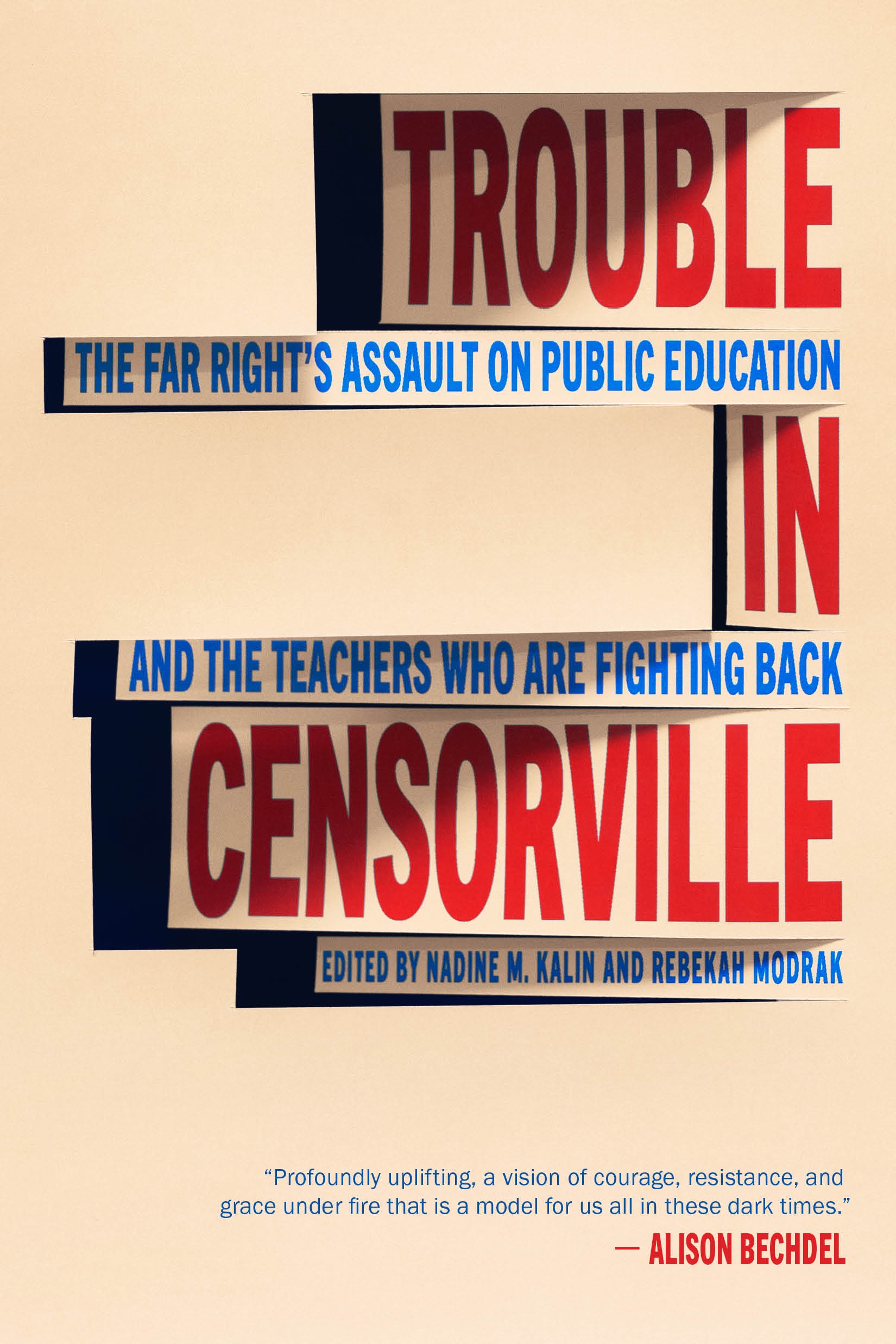
Trouble in Censorville: The Far-Right's Assault on Public Education and the Teachers who are Fighting Back - edited by Nadine M. Kalin and Rebekah Modrak


It should come as no surprise to anyone following the news, be it local or national, that book challenges are on the rise. According to PEN America there have been over 10,000 book bans in public schools in the last year.  

This book is a collection of essays by teachers and librarians across the country who have been targeted and harassed for having a diverse collection of books in their classrooms and libraries. 

I would recommend to those who are interested in this topic not to read the book in its entirety, cover to cover, over a short period of time, as I did. The tone weighed on me, even though I knew what to expect.

There is also a certain same-ness to these stories (even as each is unique), which again may weigh on the reader. It is important to note, however, that the same-ness is due to the fact that those who are attacking the educators are all using the same playbook, and attacking the same books. Allegations of pornography in the children's section and grooming young children are de riguer from those who purport to protect children.

At least two of the essays in this work were written by the same librarians I read about in The Secret Lives of Booksellers and Librarians. Notably included in both are Martha Hickson (school librarian in New Jersey) and Carolyn Foote (retired school librarian in Austin, Texas). The tone of the two works couldn't be more different, however. Overall, Secret Lives is light, whereas this one is heavy. Secret Lives is a celebration of books and reading. Censorville is a call to arms and indeed includes a list of things we can do to "resist attacks on public education". 

More information about this work, the educators who are profiled, and and additional links to more resources can be found at Censorville.com.

EveryLibrary sponsored a panel discussion with Kalin and Modrak along with some of the authors from this work which can be found online here.

Banned Books Week 2024 runs from September 22-September 28. 

Wednesday, May 24, 2023

"Future Library" from Margaret Atwood's Burning Questions collection

I have read many of Margaret Atwood's works, but there are many others that are still on my "To Be Read" list. While I would like to be able to read them all before I die, I know this will not be possible. As the first author invited to be part of Katie Paterson's Future Library project, a 100-year endeavor, not even Atwood herself will live to see her contribution published. Neither for that matter will Paterson. Paterson's project is a leap of faith. Each year between 2014-2114 different authors will be invited to submit their works to be published, printed on paper made from a forest growing in Norway, when the project ends. 

Atwood's short essay about the Future Library explores questions of Time Travel, language, and climate change. "Will any human beings be waiting to receive it? Will there be a 'Norway'? Will there be a 'forest'? Will there be a 'library'?" she asks, and offers hope that they will.

Since she wrote this piece in 2015 she could not have known that libraries would be under such a threat as they are today, only eight years later. I can only hope that the censorship contagion in the United States does not make its way to Norway. 

Tuesday, September 7, 2021

Tuesday, July 20, 2021

Miss Moore Thought Otherwise: How Anne Carroll Moore Created Libraries for Children


At the turn of the 20th century a young woman named Anne Carroll Moore enrolled in library school and got a job at the Pratt Free Library in New York City. When Moore was growing up children were restricted from using libraries. "People didn't think reading was very important for children - especially not girls." However, Miss Moore thought otherwise. After she was put in charge of all of the children's sections in New York City's thirty-six branches Moore was tasked with designing the Children's room at the new grand library that was to be built at Fifth Avenue and Forty-Second Street. The Children's room was designed especially with children in mind with special furniture, bright colors, and artwork and "new children's books in many languages". Once the room was built music programs, author talks, and other special events kept the children coming back. Her ideas have been adopted in libraries around the world.

A beautifully illustrated work.

Tuesday, January 14, 2020

Masked by Trust: Bias in Library Discovery - by Matthew Reidsma


In the spirit of Algorithms of Oppression this book provides insight into how search engine results are generated. Going beyond Google, which may "customize" results for individual users, Reidsma also explains how library databases aren't necessarily without prejudice either, even though all users will see the same results if they enter the exact same search. Auto-suggestions can likewise shape our thinking in ways we may not have anticipated. All search engines are working on algorithms that were created by people (mostly young, white men). Their own biases will necessarily become part of the algorithm, even if they do not intend it.

Reidsma cites Bonnie Nardi and Vicki O'Day's work to suggest that we rethink the metaphor of library tools to a "library ecology".
The thing about the ecology metaphor is that it highlights the interconnectedness of all these different things coming together in one place. It emphasizes the co-evolution of technology and people. Its [sic] about people and tools together.
Perhaps the most  useful reason for dropping the tool metaphor is that tools require convergent thinking. You cannot create a tool with divergent thinking, where many possibilities exist...
...by switching our focus to seeing our technological systems as ecologies, and thus using divergent thinking to address the design and engineering of these systems, we can move beyond the limitations of tool-based thinking and design systems that are made to be used by diverse people.
This gave me a bit to ponder, and will change the way I teach people to think about and use our databases.

Friday, August 9, 2019

Goin' Someplace Special - by Patricia McKissack


A post in honor of National Book Lovers Day

In the 1950s Jim Crow south, 'Trisha Ann faces a number of indignities on her way to "someplace special". She is forced to stand in the back of the "colored" section of the bus, even as she can see empty seats in the front area reserved for whites. She can't sit on the bench for "whites only" to look at the fountain her grandfather helped to build in the park, and she is forced out of the fancy Southland Hotel after she gets caught up in a crowd of people trying to catch of glimpse of a famous person. Remembering her grandmother's encouraging words help her to make the difficult trip to the library - someplace special where she is treated with respect, a place her grandmother calls "a doorway to freedom".

Winner of the Coretta Scott King Award.

Tuesday, January 29, 2019

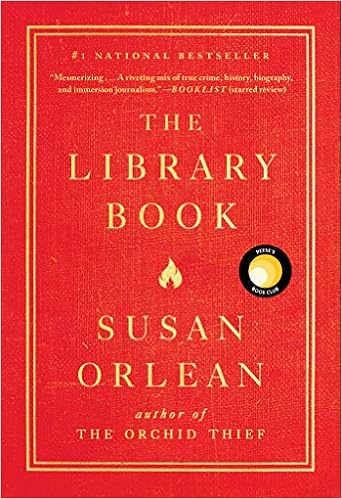
The Library Book - Susan Orlean


This book started showing up all over my Facebook feed late last year. Excerpts, interviews, and recommendations came from friends, family, and organizations. Everything I saw gave me reason to believe that I would love this book. And I did.

Of course it would have been right and good (and indeed, most meta) for me to have gotten a copy of this from a library, but I knew that there would be a long waiting list, and I really couldn't wait, so I purchased and downloaded an e-version onto my iPad. I read it out loud with my husband. We both thoroughly enjoyed it.

Normally when I read a book I mark any passage I find about libraries, so that I can easily find them when I am done reading it in order to write my blog post. It is not so simple when I read a book entirely about libraries. If I were to mark every relevant page I would essentially have to re-read the entire book, and I'd still be hard pressed to figure out what to write about here. So I was forced to make some hard decisions. As it is, I marked over sixty pages, so not even everything I found especially noteworthy made the final cut.

In this ode to libraries Orlean weaves together her own relationship with public libraries with the story of the Los Angeles Public Library (LAPL) and the fire that destroyed the Central Branch in 1986. The tale includes the history of the LAPL begining in the 19th century. Replete with quirky characters including early library director Henry Lummis, and Harry Peak, the man who was arrested for, but never convicted of, starting the fire.

Library Love

Orlean's own love affair with libraries began when she was a child when she went to her local public library regularly with her mother, and they would discuss what books they checked out on the way home. She explains that her family owned very few books because her parents knew that they could get what they wanted for free at the library. In college she eschewed the library and began buying books, to the point that she only had wistful memories of the library. A school project for her first grade son brought her again to the public library
As my son and I drove to meet the librarian I was flooded by a sense of absolute familiarity, a gut-level recollection of this journey, of parent and child on their way to the library. I had taken this trip so many times before, but now it was turned on its head, and I was the parent bringing my child on that special trip...when we stepped in, the thunderbolt of recognition struck me so hard that it made me gasp.
From there Orlean rediscovers her love of libraries, and discovers some things that aren't quite so lovable about them as well. For instance, we see that sexism in libraries has a long history with the tale of Mary Jones who lost her job as director just because they wanted to hire someone else (a man)

Mary Jones' story begins with Mary Foy who was hired in 1880 when
the library was still an organization run by, and catering to, men. Women were not yet allowed to have their own library cards and were permitted only in the Ladies' Room. No library in the country had a female head librarian, and only a quarter of all American library employees were women. The feminization of librarianship was still a decade away.  
Foy served as library director until 1884 when she was removed to make room for Jessie Gavitt, daughter of a "popular rancher". It was further determined that "Foy's father was doing well enough financially that he could now afford to take care of her". A succession of women ran the library until 1905 when Mary Jones, then director, was asked to resign by the library board who believed that "it would be in everyone's best interest to have a man run the library." The man they had in mind was an unconventional fellow named Charles Fletcher Lummis. He was offered the job of director at twice the pay of Jones.

Lummis had been in Los Angeles since 1885, when he walked there from his home in Ohio to take a job as a journalist.  He dressed in a "manner that was not typical for a Caucasian male of the 1880s. His favorite outfit was a three-button suit coat and trousers made of bright green wide-wale corduroy, which he wore with a red-and-black patterned cummerbund."

A philanderer, he was "the focus of endless gossip...reckless, dramatic, quixotic, romantic, and perhaps a bit of a tall-tale teller".

Eventually, Lummis' offensive ways became too much, and in 1910 he was asked to leave.

Fire

The story of the fire is interwoven with the story of the enigmatic Harry Peak who some believed started the fire. Ultimately, it was never determined who set the fire, or for that matter if it was arson at all. Harry Peak, however, always remained a person of interest. He was questioned several times, and even arrested and ultimately had over a dozen stories regarding his whereabouts on the day in question. Sometimes he produced an alibi, other times he put himself near the library (but not in it) and at other times he confessed to the crime.

In describing the fire the author made excellent use of allusion, letting her readers know that "The temperature reached 451 degrees and the books began smoldering".

Censorship, book burning, and information loss is the topic of chapter 9 in this book. From Egypt's Great Library of Alexandria, to the Spanish Inquisition, to the colonizers in the Americas destroying Aztec codices, to what George Orwell called that "most characteristic of [Nazi] activit[ies]" - the burning of books. The Feuersprüche (Fire Incantations)
was a pet project of Joseph Goebbels, the Nazi Party's propaganda chief, who understood how fundamental books were to Jewish culture, theology, and identity. Burning Jewish books, in his opinion was an ideal form of bloodless torture, demonstration the limitlessness of German control...The irony of the Feuersprüche was that they [the Nazi's] treated books as seriously as Jews did. To feel the need to destroy them acknowledged the potency and value of books, and recognized the steadfast Jewish attachment to them.
In describing the LAPL fire and its aftermath the author demonstrates how the burning of books, information loss, and the investigation effected those who worked in the library.
Twenty-four of Central's 250 librarians...asked for transfers to other branches. A survey of the remaining staff asked what the most stressful aspect of the fire was. The answers were dire. They included: "Feeling of powerlessness, helplessness brought about by confusion...feeling of isolation of having to work in an almost empty shell of a building that was once a vital place"; Being afraid that, even though nobody was killed in the fire, somebody is going to be killed or badly hurt..."; and "Feeling like a refugee. Holes ripped in an organic entity."...
Furthermore the "librarians complained of eye infections, breathing difficulties, skin irritation, and post-traumatic stress disorder."

Random Musings

Rather than giving each chapter a title, the author started each chapter with a bibliography of books (along with their Dewey Decimal Call numbers) that were related to the upcoming pages. When I noticed inclusion of a book I'd read (or better yet blogged about - such as chapter thirty's Bibliotech) I was sure to mark it. Chapter fourteen's list caught my attention with the inclusion of Map Librarianship: An introduction by Mary Lynette Larsgaard. The  very book that served as my textbook in 1991 when I took a course on Map Librarianship at the University of Arizona Graduate Library School. A few years ago I found the text in packed away in  box at home and used it to make a book-themed Christmas decoration.


Last Christmas when I put this on display at the library I overheard one student say to another "Look at that, they ruined a perfectly good book to make a decoration". While I agree on principle that we shouldn't destroy books, I also think that making art from out-of-date textbooks is a wonderful use of these works (and frankly, this would otherwise have simply be sent to the recycling bin).

The rumors of the demise of libraries are long standing, as evidenced by LAPL's Senior Librarian Glen Creason's reporting that when he entered library school in 1979 (on a whim, hoping to meet women) that the head of the RAND Corporation announced that libraries would soon be obsolete. 

Perhaps one of my favorite anecdotes in the book is the story about a CBS radio program called Americans at Work that aired during the Great Depression and featured plays about different professions. One of the plays was about a young woman (Helen) wanting to become a librarian. Her mother insists that it is a job for "older ladies who need to help out a bit". Then Helen's uncle comes to the rescue explaining that "a librarian's got to be a right modern smart girl nowadays."

Some things, of course, are universal in libraries. I was especially interested to read about the problem with getting an employee parking lot, something that was an ongoing issue when I worked at the McAllen (Texas) Public Library in the mid 1990s and that people who call asking questions that they can easily "google" the answer to goes on every where.

Orlean had my husband and I crying a bit at the end when she explains why she wanted to write the book
to tell about a place I love that doesn't belong to me but feels like it is mine, and how that feels marvelous and exceptional. All the things that are wrong in the world seem conquered by a library's simple unspoken promise: Here I am, please tell me your story; here is my story, please listen.

Thursday, July 26, 2018

The Library - by Sarah Stewart


A story in rhyme accompanied by beautiful illustrations tells the tale of Elizabeth Brown, book hoarder. I know some bibliophiles don't think you can have too many books, but they are wrong. One should have just enough books. Books are meant to be read, having them stacked all around prevents them from being used to their fullest potential, and makes them especially difficult to share. If people who have a lot of books want more books they should go to the library. This allows them to read more books without accumulating them.

I am happy to report that in The Library Ms. Brown ultimately does the right thing with all her books.

Monday, April 24, 2017

The Bad Ass Librarians of Timbuktu - by Joshua Hammer


This was already on my must-read list when we received it as a gift from one of my husband's geography students. This tells the story of the rich history of literature in Africa - a history which contradicted the story told in 20th century Europe "that black Africans were illiterates with no history". Instead manuscripts from medieval times
proved the opposite-that a sophisticated, freethinking society had thrived south of the Sahara at a time when much of Europe was still mired in the Middle Ages
The work of scribes who copied texts at a rate of "150 lines of calligraphy per day" is described and their pay in gold nuggets or gold dust. The ancient texts were threatened several times over the centuries, including during the French occupation at the turn of the twentieth century. Over one hundred years later it was Al-Qaeda that nearly destroyed the literary treasure.

In the ensuing years many of the manuscripts had been hidden in homes, where they were deteriorating. Abdel Kader Haidara tracked down many of these manuscripts in the 1980s and convinced the owners to donate them to Mali's libraries where they could be preserved. By "2011 the Mamma Haidara Commemorative Library in Timbuktu was fast becoming one of the world's most innovative manuscript conservation centers and a symbol of Timbuktu's cultural renaisance". In 2012 Abdel Kader Haidara once again worked to save the treasures, as he organized people to smuggle the manuscripts out of Timbuktu where they could be safe from eradication. This tale is not just about librarians, but also about the common people who risked their own safety to move the books.

Controlling information is one way that those in power attempt to keep their authority. It is an old story. One we see throughout history, and just as relevant today as our own government attempts to vilify the press while spouting "alternative facts".

This could be hard to read at times as accounts of be-headings, kidnappings, and other senseless violence were part and parcel to the story. However, it is also a tale of hope and courage. All who understood that knowledge was worth preserving were the heroes of the story and serve as examples to those who may be despairing.


Tuesday, March 22, 2016

This Book is Overdue! How Librarians and Cybrarians Can Save us All- by Marilyn Johnson


Johnson is not a librarian, but according to her jacket-cover biography she "owns multiple library cards and uses them often." She certainly does a wonderful job of singing the praises of librarians as she travels to where the librarians are to find out what they do and what makes them tick. The copyright on this work is 2010, which doesn't seem that long ago, but reading this made me realize how fast things are changing. Johnson has an entire chapter on Second Life which was all the rage not so long ago, but now has only about a million users. She also has a chapter on librarian bloggers, (which I feel a bit meta blogging about) even as I also realize that blogs aren't exactly cutting edge any more either. But while our heads spin about the speed at which information moves and technology changes, the book also illustrates some things that never change. Johnson asks us to consider this
Did you ever? I mean, did you ever think that being a librarian meant dealing with poop? Talking about it finding little piles of it in the stacks, writing about it on the Web. I certainly never thought that I would have to write about it. In fact, one of the things that appealed to me about this book was the intellectual, cerebral, almost disembodied nature of the subject of librarians in the digital age...I imagined the wired world of information and literature, full of brilliant, helpful, visionary librarians...I didn't want to be sitting in a sticky chair thinking about poop.
I don't think poop was one of the topics we discussed in any of my classes in library school, but I certainly had to deal with it as a librarian at a public library. How someone could mistake the elevator for a restroom I'm not sure, but there you have it.

I am always interested when I find a connection between books. In the case of This Book is Overdue! the connection is with The Library Book. In her chapter entitled "Gotham City" Johnson provides a bit of the history of the planning and construction of the New York Public Library, referring to several of the people mentioned in Fiske's book.

It was lovely to read such a librarian-positive book by someone who is a not a librarian herself.

Monday, January 11, 2016

Improbable Libraries - by Alex Johnson


The subtitle of this book is "A Visual Journey to the World's Most Unusual Libraries". It is indeed a visually stunning book with some fabulous photography of a variety of different kinds of libraries including some that I have blogged about before:

Little Free Libraries

I learned about libraries in airports, metro stations, and hotels. In addition to the horse-drawn carriage and the donkey-transported libraries (referenced above) I found out about a library carried by a camel (The Mongolian Children's Mobile Library) and that Boom-Boom the elephant brings books to children in rural villages in Laos (I also learned that "boom" means "book" in Lao).

A quick read with lovely pictures, this is a treat for those of us who are passionate about books and libraries.

Friday, January 8, 2016

The Meaning of the Library: A Cultural History - edited by Alice Crawford


The Millicent Library (the public library in Fairhaven, Massachusetts) looks like a castle (as do the Town Hall, High School, and Unitarian Church). I made my first visit to the beautiful Millicent Library about a month ago, although I have been spending weekends in Fairhaven regularly since August of this year. I spotted Crawford's book immediately as I walked in the building, and remembered that I had recently read a review of it. It became the first thing I checked out of the Millicent Library. Divided into three parts: The Library Through Time; The Library in Imagination; and The Library Now and in the Future each of the 12 chapters was written by a different person on a different theme. I was most interested in the second part as it included chapters on "The Library in Fiction" and "The Library in Film" (a.k.a. on this blog as "'Library' Books" and "Librarians on film", respectively) so I was surprised that it was the chapter on "The Library in Poetry" that I enjoyed the most. I generally don't read a lot of poetry, and I don't think I've seen much library poetry, but I will now most certainly be looking forward to reading Jorge Luis Borges "El guardian de los libros" (The Guardian of the Books) - in the original Spanish, of course; as well as Emily Dickinson's "In a Library".

The final chapter "The Modern Library and Global Democracy" was written by recently retired Librarian of Congress James H. Billington. He introduces the chapter by stating that 
  1. librarians are becoming more (emphasis in original) rather than less important in this new age of instant electronic communication; and
  2. libraries as places have a key role to play in building and sustaining participatory and accountable democratic societies-the kind that have historically not fought one another.
He points out that even during the Soviet era libraries in Russia "provided refuges for scholars unwilling to become propagandists...preserv[ing] and provid[ing] access both to the memory of Russia's pre-Communist past and to the experience of the post-World War II West." Further he tells of learning from a Native American chief that "long before European settlers brought books to North America, the elder of a tribe would preserve the knowledge of his people in his head the way librarians would later do in their collections. 'But we didn't call him a gatekeeper' [the word Billington used]...we called him the dream keeper". Billington uses this metaphor of "dream keeper" to round out the chapter
Wonder and silence are better for dream keepers than for image makers. Reading can balance our noisy, hurry-up, present-minded world with what Keats called "silence and slow time". Whatever else you do in life do not fail to experience the simple pleasure of being alone with a good book on a rainy day.  


Wednesday, June 10, 2015

The Little Free Library Book - by Margret Aldrich


Although the idea of  the "take a book, leave a book" shelf has been around for a while in coffee shops, resorts, and other places (my own library has one for example) the Little Free Library Movement (LFL) is relatively new (2009). This network of boxes with free books set up in front yards, parks, and other public spaces has become a worldwide phenomenon and has helped to bring together neighbors, provided reading materials to impoverished areas, and given countless crafters and woodworkers an outlet for their talents. The Little Free Library Book tells the history of the movement, and includes many stories of individual LFLs with interviews of their stewards. Color photographs of the myriad LFL designs (which includes those designed to look like houses, churches, movie theaters, cars, and even a tardis enhance the enjoyment of reading about how they were built. Each LFL steward has his or her own reasons for starting and/or maintaining the library. All of the stories told in this book were inspiring.

I was especially interested to read the story of Texas' first LFL which was also the first one to be located inside of a school. Bilingual librarian (my favorite kind of librarian) Lisa Lopez started the LFL at the Zavala Elementary School in El Paso ("rated one of the most illiterate cities in the nation"). Lopez was determined to get books into the citizen's hands and to date her efforts have led to the establishment of over fifty LFLs in the city. She has gotten students at her own school excited about reading, and sharing books by decorating and maintaining Zavala Elementary School's own Little Free Library.

Stories about communities coming together to save their LFL were also part of this work. One story that went viral among the library set last year was that of nine-year-old Spencer Collins of Leawood, Kansas whose LFL was ordered taken down when it was determined that the freestanding structure violated the city code. Booing and hissing of the Leawood City Council was fast and furious, and the decision was ultimately overturned.

I was especially interested to read the story of Joceyln and Glenn Hale (Minneapolis, Minnesota) who learned to embrace all types of literature for their LFL. They originally saw their project as a way to share classic literature, but since users are invited to "leave a book" as well as "take a book" and the offerings soon included "bodice-ripping romances, marriage and fad diet advice, and dogmatic religious books". Their first response was to cull the books that did not meet their standards but they soon realized that what they were doing was banning books. Their LFL is now a place where all types of books are shared and enjoyed.

Truly an inspirational read that has me thinking about starting my own Little Free Library. I checked the LFL map and discovered a dearth of LFLs in my neck of the woods.

I did find an LFL in Marion, Massachusetts last fall (which appears to be gone now). Find out which book I selected from it here.

Lagniappe:
Sure to put a smile on my face is reading about another book I've already blogged about. In this case Aldrich refers to Laura Damon-Moore's book The Artist's Library: A Field Guide which I reviewed here earlier this year.

Tuesday, June 2, 2015

BiblioTech : Why Libraries Matter More than Ever in the Age of Google - by John Palfrey


Last week I attended the Rhode Island Library Association (RILA) Conference in Newport. I was fortunate to be able to hear Scott Bonner (the funny and humble director of the Ferguson, Missouri Public Library) talk about how he was able to continue to serve his community during last August's crisis in the wake of the shooting death of Michael Brown by a police officer. More recently, a similar situation in my hometown of Baltimore, Maryland (where Freddy Gray died while in police custody) lead librarian Melanie Townsend Diggs to the decision to keep the Enoch Pratt Free library open even while violence erupted nearby. These examples of library as a safe community space (read more about them in American Libraries magazine) are only part of the reason that libraries still matter.

Providing computers and wifi to those who do not have home access, or are away from home is certainly another important reason why libraries still matter, but it is not just the digital access that is necessary, it is also the access to librarians who can help people navigate the internet or assist a student with completing her assignment. Alison Head and Michael Eisenberg's reasearch for Project Information Literacy demonstrates that students who consult with librarians when conducting school research are more likely to use research databases than Google for future research needs. A finding that has been confirmed by my own research. Palfrey also points out that while many coffee shops and restaurants may also offer free wifi, there are no librarians around to help patrons with their research. Furthermore, it is "simply not true that you can find everything you need through a Google search."

The idea of public libraries belonging to the people, rather than corporations, is another essential aspect. Author Dennis Gaffney is quoted in Palfrey's book
I love libraries because their names have not yet been appropriated like those of sports arenas by the the likes of Pepsi, Fleet Bank, or National Car Rental. The notion that anyone would name a community library the Tropicana Branch sounds absurd, and it should, because we own our libraries.
Palfrey goes on to explain that this means that "we are free to pursue our own interests and ideas, without fear of reprisal or economic consequence."

New information is exploding at a rate that could not have been imagined even 25 years ago. "Each day we produce 2.5 quintillion bytes of data. As a result, 90 percent of the data in the world were created in that last two years." Enter libraries and librarians who are helping to organize and manage the information, and helping people to locate what they need among the plethora of digital and print sources. Digital Public Library of America is one starting place where digital collections are being created and curated. Record preservation and record sharing is still within the purview of libraries, museums, and archivists, all of which employ people specifically trained to do so.

In his chapter on school libraries "the most common type of library in the United States" Palfrey points out that they
support all children as they learn to make sense of today's new information landscape, not just those who can afford to download any book they like onlo their Amazon Kindle. Digital savvy should not be limited to those who can pay for it, and school libraries play an essential equalizing role in this respect. 
This is true even as we continue to see stories about school libraries, and librarians being among the first to go when budgets need to be cut.

Issues of privacy are treated in the chapter "Law: Why Copyright and Privacy Matter so Much". Librarians have questioned and fought the Patriot Act, ever since it first went  into effect within weeks of the 9/11 attacks.
Librarians worry, with some reason, about what protections readers will have when the police come calling for information about books they have checked out. Librarians have long fought encroachments on civil liberties of this sort. The debate over the USA Patriot Act was a major cause célèbre for librarians, for instance. The notion that a reader's interest in a book about Islam might tip an investigation toward a particular suspect sent chills down the collective spines of librarians.
Interestingly, at the aforementioned RILA conference I attended a program on patron privacy with respect to third party vendors, and discovered that while librarians may respect patron record privacy our vendors do not necessarily share our views.

As one might imagine I marked a lot of passages in this work while I was reading it. I did not blog about everything that interested me here. Some of what interested me, but which is not included here, can be found in this video of the author speaking at the Kansas City Public Library.


Libraries do still matter - both in digital and physical space. They should remain free of charge, as well they should remain spaces for free expression.

Sunday, April 12, 2015

Emily's Runaway Imagination - by Beverly Cleary (In Honor of National Library Week)


I don't think I've read any of Beverly Cleary's books since my daughter (now seventeen) was in elementary school. I remember how much I loved that she loved the stories of spunky Ramona Quimby. Cleary's characters always seemed to be just the right mix of lovable, believable, and vulnerable yet strong. All of these adjectives describe young Emily, growing up in 1920s Oregon. During a time and a place in which a ride in a motorcar, or even eating one banana, could be a special treat, having a library in town was something that needed to be imagined before it could actually happen. Emily is jealous of her city cousin Muriel who goes to the library every week and gets books like Black Beauty to read, for free! Emily so wants to read Black Beauty, too, but Pitchfork, Oregon has no library. Emily tells her mother how much she would like to have a library in town, which prompts her mother to write a letter to the State Library in Salem to ask how to start a library. Emily is proud to be the person who stamps the letter and to take it to be posted. And she is thrilled to discover that the State Library answered the letter with a crate containing 75 books! Emily's mother becomes the town librarian and makes plans to get monetary and book donations to help the library grow.

There is so much to love about this book. I think what I like best is that Emily understands that she is an important person in her town of Pitchfork, Oregon. After all not only is her Uncle the mayor, her mother is the librarian! Emily demonstrates her love for the library in many ways: she donates the dollar of prize money she wins to purchase the book Black Beauty for the town (and, of course) is the first one to read it. She is so proud to see her name in the bookplate as the person who bought it for the town; she helps plan and attends fundraisers for the library, even if it means wearing itchy, fancy clothes; and she makes a valentine for her neighbor, Mr. Quock, when she discovers that he is going back to China and donating his house to the town to use as the library.

Published in 1961, Cleary was writing about a time that even the young baby boomer readers of the day could only have imagined themselves. However, one of the wonderful things about her stories is that they remain so relevant across time. Compare this passage
...in a year when people had no money for the picture show or for gasoline to go riding around in their automobiles they came to the library. During that hard winter there often were not enough books to go around. The state library sent three crates at a time instead of one...Mama checked books in and checked them right out again...
to this one from Forbes magazine (June 19, 2014) from the article "The End of the Story? Why Libraries Still Matter"
The public library in Kinnelon, New Jersey, is a good example of a library that is successfully transforming itself into a “tech hub” by offering free access to computers, the Internet, software, technology training, e-books and online downloads to all community members. After the recent recession, those resources played a crucial role in helping out-of-work and underemployed adults adapt to the challenging economic environment by providing computer classes, job fairs and mobile-device workshops. The library also boosted its offering of family-oriented programs, such as story-time programs, book clubs and free movie nights.
While the services have changed, the importance of the library, especially during hard times is clear. It is also important to note that library services do change. It is why libraries stay relevant even while the nay-sayers believe we can do without them.

Friday, February 20, 2015

The Artist's Library : A Field Guide - by Laura Damon-Moore and Erinn Batykefer


I found this book through a stroke of serendipity. I was talking to my husband's "Secret Life of Coffee" class (do you love that name? I thought of it!) about doing research on coffee-related themes (using the handy MaxGuide http://maxguides.bridgew.edu/coffee I created for just such work) and was explaining the difference between a subject search and a keyword search using the word "coffee". I demonstrated that the subject search would be more targeted, and that a keyword search would be broader, so that while one might find some useful books than just those a subject search would turn up, it will also necessarily produce some "false hits" including books by people with the name "Coffee", and others published by Coffee House Press. At which point the record for The Artist's Library which had only recently been added to our catalog appeared. I explained to the students that while it looked like a fabulous book (and that I was most certainly going to read it myself) it probably wouldn't have a lot of information for their research on coffee. After finishing my lesson, I returned straight to my library and checked out the book.

This work looks at the library as creative space - an "incubator" of ideas. Ideas that can be inspired by the architecture of the library, things and people we see in the library, as well as things we learn through reading. The authors provide suggestions for artists from the simple (using computers provided by the library to do creative work - a long standing tradition dating back to the time of typewriters used by writers including Ray Bradbury and Betty Friedan) to more unconventional strategies (browsing the stacks and selecting books based only the color of the cover, talking to strangers) as well as checking out the events calendar for new things to try, and collaborating with librarians to create programming, or art displays. Both the university library in which I work, and the public library for which I am a trustee provide spaces for artists to display work. The public library showcases local artists, as well as artwork created by art students (by which my own daughter has been provided a venue to showcase her work).

The authors define artist broadly as
a person who learns and uses creative tools and techniques to make new things...a professional musician, or a kid learning how to use sound-editing software in a library's digital lab...a world-renowned author, or a senior citizen taking part in a memoir-writing workshop...
With this definition I certainly find myself as part of a meta-project. This blog being my creative outlet which was inspired by the library.

I got a laugh when I read dancer/librarian ChristiWeindorf's self description of as a "bunhead". She was referring NOT to her librarian self, but rather her ballerina self.

Find out more at the Library as Incubator Project 

Lagniappe:
This video about creating art from old books has recently been making the rounds on the "library land" newsfeeds.


Friday, October 3, 2014

The Public Library : A Photographic Essay - by Robert Dawson


Dawson's breathtaking photographs show both the good and the bad of public libraries. Pictures of economic disparity and closures are contrasted with those of  hope, whimsy, innovation, and determination. From the historic Carnegie libraries, to the large modern buildings that also serve as art galleries, to the trailers, to shared post office spaces these photographs show the importance of the public library to its community. Accompanying essays written by those who love libraries support Dawson's visual work. Stories of early colonists who burned books considered blasphemous, and librarians who guarded material, rather than allowing free exchange of ideas are balanced with those who keep libraries open despite shrinking budgets, ensure that all have access to books, and introduce young people to new ideas.

A visually stunning book.

Tuesday, September 16, 2014

Escape from Mr. Lemoncello's Library - by Chris Grabenstein


The fictitious town of Alexandriaville, Ohio has been without a public library for twelve years. The old library had been "torn down to make room for an elevated parking garage...many said the Internet had rendered the 'old-fashioned' library obsolete." To celebrate the opening of the new town library (designed by famous game-maker, and most favorite native son, Mr. Luigi Lemoncello) all twelve-year olds are invited to enter a contest to be the first to get library cards and to spend the night at the library. Kyle Keeley along with eleven of his classmates win much more than they bargained for when they learn that getting out of the library will require them to use their library skills, game skills, and to cooperate with each other. 

Kyle and his friends learn that the library has a lot more to offer than shelves full of books. They archive local history, have community meeting spaces, games, and cool science-y stuff as well. They also have librarians who will help you find what you need (and in fact, I must point out that Grabenstein dedicated this book to "the late Jeanette P. Myers, and all the other librarians who help us find whatever we're looking for").

I loved that two of the characters (Miguel and Andrew) were aides in the school library, and I also liked that the team Kyle formed had more girls and than boys on it. So often in popular culture I notice that groups of friends have one token girl (think "Harry Potter") but this one had a nice mix, with everyone in the group able to contribute something, and everyone able to learn something as well. 

There were two cool librarians in this work: the town's new head librarian Dr. Yanina Zinchenko described as tall with a breathy voice "with just a hint of a Russian accent." The other is Mrs. Gail Tobin, librarian when young Luigi Lemoncello was a lad who "looked a little like Princess Leia...except she had an old-fashioned bubble-top hairdo, cat's-eye glasses, and a tweed jacket with patches on the elbows...she'd be a hundred and ten if she were still alive." She appears as a hologram to the winners of the contest and assists them in navigating the space.

The games conclude on Mr. Lemoncello's birthday who says "there's no place [he'd] rather be on [his] big day than inside a library, surrounded by books."

Rife with allusions to other books (both classic and more recent favorites) this work is a true celebration of everything that is fun about books, reading, libraries, and librarians. 


Friday, January 4, 2013

Quiet, Please: Dispatches from a Public Librarian - by Scott Douglas


Like Anne Miketa'a Library Diaries, Douglas' book is a series of essays about his work, co-workers, and the patrons at the public library where he is employed. Unlike Miketa's book, this one is funny and well-written. Rather than simply making fun of people and insulting them, Douglas reflects on what he learns from them, and how they help him grow, both professionally, and personally.

I probably could comment on something he says on just about every page, but in the interest of not making this the longest blog post ever, I make particular note of my favorite library topics:

On stereotypes
The Librarians who interviewed him for his first professional job "were distinctively librarian - large framed glasses, granny hairdos, and uptight frowns". This sentence refers the reader to one of Douglas's many footnotes which reads "the stereotypes about librarians are largely true." Sadly, I must concur. He goes on with these descriptions:

And,
"You say library (emphasis in original) and there's this iconoclastic image of an old-lady librarian telling people to be quiet and not to run." To be fair here, Douglas goes on to say how important "that iconoclastic lady" is to the library.

And,
'The librarian was the typical stereotypical librarian-ugly clunky glasses, hair in a tight bun, and clothing that could just as easily have been put on a man. She looked irritated when I asked her where I could plug in my laptop..."

He doesn't, however, cast any aspersions about himself being hip, even as a non-stereotypical young, straight, male librarian:
"I wasn't cool. I was a librarian, and not being cool was as cool as I'd ever get."

On critical thinking
As a university librarian I am often frustrated by the fact that we are supposed to teach students to be critical thinkers, but it seems we are not supposed to do it (think critically) ourselves. Administrators seem to just want us to do what we are told. Douglas makes a similar point when discussing his frustration with his courses in library school
I didn't think the school needed to get political and have faculty implement viewpoints, but I thought it was important to study the way media, both online and on TV, had radically changed the way people sought information. How can librarians teach others to think critically and objectively when they themselves are not doing it?
On censorship
The library banned MySpace.com when it became a nuisance.
It didn't take long for things to get out of hand....Teens started stealing library cards so they could get extra time [on the computer]; adults would constantly argue about why they deserved more hours; and even little fourth graders were asking older kids for advice on how to 'pimp out' their MySpace page....Ultimately, MySpace was blocked because it was slowing down the network. This wasn't the real reason. The real reason was because it was making all the librarians mad. Actually, the straw that broke the camel's back was when a manager saw a teen posting a photo of girl's nipple piercing [sic] to his page.
Popular online role playing games would meet a similar fate. When a "middle-aged mother of three kids" started spending all her time in the library playing a video game Douglas was told to
Find out what this game is and make...a list of why we should ban it. I want to get rid of that lady. If all she is doing is playing a video game then she doesn't need to be in the library
Once the website was blocked the woman stopped coming to the library, so did her children, who often came to the library to read books.

When Douglas got fed up with teens acting up in the library while he was "in charge" he banned them from using the internet unless they were doing homework. When a page points out to him that that's censorship, Douglas replies "there's a big difference between censorship and punishment". I often say that when someone says what they are doing is not censorship, you can be sure that it's censorship. I have to say that the burnt-out page saved the day on this one. He texted the library manager, who was on vacation, and tattled on Douglas, who was admonished by his manager to let the teens back on to the computers.

Last month when I blogged about The Librarian's Book of Quotes I noted the commentary I found most "thought provoking"

I have never met a public librarian who approved of
censorship or one who failed to practice it in some
measure.
--Leon Carnovsky, Library Quarterly 20 (1950)

Here, we see this in action.

On gender
When I was in library school, one of my assignments was to write about five famous librarians throughout history. I was very frustrated with the assignment, as I was determined to write only about women in this female-dominated profession, and as I was studying the early days of librarianship, I had to dig pretty deep to find someone who was not a man to write about. (Ultimately, I did succeed in my quest). Famous librarians that Douglas mentions about are:
Melvil Dewey (whom he does recognize as a "hater of women" as well as an "elitist racist dick")
John Cotton Dana
John J. Beckley
Charles Ammi Cutter

Famous women librarians are remarkably hard to find. Consider, for instance, the first hit I got when I "googled" "famous librarians". On this list of Top Twenty Five Most Famous Librarians in History, only seven are women.

I was particularly intrigued by this commentary about women in library history:
"One thing male librarians rejoiced at was the fact that they could save money by hiring women; at the time, [when children were finally allowed into libraries] women who did the same job as men at the library earned less."

"At the time"?! Give me a break! This is still true today. See the Library Journal Salary Survey.

And an interesting thing I learned from Douglas is that John Newberry's (for whom the Newberry Award is named) A Little Pretty Pocket Book is credited as being the first book in the genre of children's literature. I was surprised to learn that the book was actually marketed "with a ball for boys or a pincushion for girls". I recently read this article which looks at the gendering of toys in the 20th century. It seems we have come full circle.

And finally:
I added An Extremely Goofy Movie to my list of must-watch library movies based on Douglas's recommendation.

More on Scott Douglas at http://www.scottdouglas.org/index.htm


Thursday, September 27, 2012

Help! I'm a Prisoner in a Library - by Eth Clifford


Sisters Mary Rose and Jo-Beth become trapped in the Finton Memorial Library for Children during a snow storm. The telephone lines are dead, and the electricity has gone out. The library seems creepier still when they hear a myna bird asking their names, and the stuffed dolls on the "kid hack" seem to be staring at them. Eventually the two discover that there is another person in the building with them. At first scared of Miss Finton, the librarian who lives on the second floor in the converted mansion, the girls eventually decide it is safer to follow Miss Finton through the spooky building and discover what, exactly, is screaming like a banshee. And they get to send up a distress signal through an open window in the form of colorful fireworks they find in the basement - a bit more dramatic than the hand-made sign Jo-Beth creates to post in the front window : "Help! I'm a Prisoner in the liberry". The misspelling gave me a nice chuckle, since it is the same one I ended up using when creating the url for this blog (http://liberrybooks.blogspot.com/), after I discovered most other variations of "library books" were taken.

Although there are some tried and true stereotypes used to create Miss Finton's character, ultimately she is an endearing player in this fun adventure tale.