Showing posts with label prisons. Show all posts

Friday, November 17, 2023

Love in the Library - by Maggie Tokuda-Hall


In her Author's Note Tokuda-Hall tells the readers that this is the story of her maternal grandparents who met in Minidoka, a Japanese incarceration camp in Idaho. Tama (her grandmother) was the camp librarian, although "she didn't know how to be a librarian...In the camps people did the jobs that needed doing." Her grandmother had taken the job because "she liked books". George (Tokuda-Hall's grandfather) came every day to check out books. Tama questioned whether he could actually be reading all the long books he checked out. No, he wasn't reading them all. He was "only human". And the realization that she was the real reason he came every day dawned on her. Their love grew amidst their  whispers. 

George's "voice was so big it barely fit in the library..." Tama "held up her finger to remind him of the rules. They were in a library, after all."  

The Author's note also connects the story of Minidoka to current events. 

As much as I would hope this would be a story of a distant past, it is not. It's very much the story of America here and now. The racism the put my grandparents into Minidoka is the same hate that keeps children in cages on our border. It's the myth of white supremacy that brought slavery to our past and allows the police to murder Black people in our present. It's the same fear that brings Muslim bans. It's the same contempt that creates voter suppression, medical apartheid, and food deserts. The same cruelty that carved reservations out of stolen, sovereign land, that paved the Trail of Tears. Hate is not a virus; it is an American tradition.

Tokuda-Hall's author's note sparked controversy when Scholastic asked her to edit it in order to include the work in Scholastic's diversity-focused Rising Voices collection earlier this year. Tokuda-Hall refused and Scholastic ultimately issued an apology. More information about the request, Tokuda-Hall's response, and a link to the apology can be found in this article from Publisher's Weekly  

Saturday, August 26, 2023

Adnan's Story - by Rabia Chaudry


I was vaguely aware of the Serial podcast when it first aired in 2014 but I didn't listen to it until about a year later after an old friend told me that the story was about people who had attended the same high school (Woodlawn High in Baltimore County) that we had. Although the events described in the first season of Serial took place many years after we graduated it still made listening to the podcast especially riveting for me. 

Woodlawn High has always had a tough reputation among the Baltimore County high schools. One of my most vivid memories is of walking into the girl's restroom in the immediate aftermath of a botched self-abortion. During my time there in the late 70s and early 80s, collectively we experienced a cross burning on campus, and the (off-campus) shooting death of a fellow student by another student. Unlike the students who attended Woodlawn in 1999, there were no counselors brought in to help us process either of these events. We were simply told not to discuss them (especially not with the press, who was all over). I saw the murdered boy's girlfriend in school the next day. It didn't even surprise me. My parents would have also told me to get my butt to school if my boyfriend had been killed.

Rabia Chaudry is a friend of Adnan Syed's family and in this book provides more information about Syed's trial for the murder of his ex-girlfriend Hae Min Li. Although convicted, Syed has always maintained his innocence and last year was released after over 20 years in prison when additional evidence of his innocence was provided.

The Woodlawn branch of the Baltimore County Public Library was featured in the first episode of the podcast. Located adjacent to the campus of the high school it is an easy place to get to after school. Li's murder took place on the afternoon of January 13. Syed could not remember exactly where he was that day, but a fellow student (Asia McClain) remembered seeing him at the public library after school which would have provided the alibi that Syed needed. Unfortunately his lawyer never followed up on this information. Chaudry (herself a lawyer) explains more about how this crucial evidence was ignored, and tells of her own conversations with McClain.

Adnan's Story mentions the prison library in two different contexts: for legal research and also as a workplace.
Once, while he was assisting the prison librarian, she asked him to go drop off some books in her car. She handed him her keys and he walked out to the lot where the car stood. He was outside the prison, free and clear, in the employee parking lot. If he had wanted, he could have gotten in her car and driven away.
I selected this book as part of the University of Maryland Baltimore County's  (UMBC) Retriever's Read Bingo which includes a space to read a book by a UMBC author. While Syed and I are both Woodlawn High Alums; Chaudry and I are both UMBC alums.

Rabia Chaudry is co-host of the Undisclosed podcast.

Friday, February 3, 2023

The Librarian of Auschwitz - by Antonio Iturbe

People like to share memes with me about book collecting and book hoarding. These are meant to be humorous, but I generally don't find them especially funny. I do have quite a few books in my house, but I do not let them take over. I often read books from the library and then return them, or when I buy them I have a "one in, one out" policy. Purged books go to free book shelves, or are donated to libraries. They are shared. Books are meant to be read and shared, not simply put on display. I thought a lot about all of this as I read The Librarian of Auschwitz. This novel is based on the real story of Dita Kraus who, along with her family was sent to the family camp at Auschwitz-Birknenau during the Holocaust. Although she was only 14 years old Dita was asked to be the clandestine librarian at the clandestine school run by fellow prisoner Fredy Hirsch. She took on the task although the punishment for keeping the books would surely have been death had she been discovered. The eight tattered books entrusted to Dita's care were shared among the classes at the school, and otherwise hidden beneath a floor board. All the books had value, even the Russian grammar book, written in Cyrillic which no one in the camp read.

Early in the book the forbidden works are described as dangerous although they do not have "a sharp point, a blade or heavy end". 

Throughout history all dictators, tyrants, and oppressors, whatever their ideology - whether Aryan, black, oriental, Arab, Slav or any other racial background; whether defenders of popular revolutions, or the privileges of upper classes, or God's mandate, or martial law - have had one thing in common: the vicious persecution of books. Books are extremely dangerous; they make people think.

Even among the prisoners there was concern about what was to be found in some of the books. Fredy Hirsch tried to warn Dita off reading The Good Soldier Svejk, telling her that it was "not appropriate for children, especially girls". To which our heroine responds "Do you honestly believe that after observing on a daily basis the dozens of people entering the gas chambers...[that] what I read in a novel might shock me?". The same book is demonized by some other prisoners, and again Dita puts them in their place.

Reading this in light of the unprecedented book-banning that we are seeing in the United States today makes it especially chilling. Concerns about what someone might find in a book seem rather ridiculous in a country where children are gunned down in their classrooms and by police. 

In addition to the eight books, the school also runs a "library on legs". Similar to the human books in Ray Bradbury's Fahrenheit 451, people who have memorized stories share them verbally.

Before being sent to the Auschwitz Dita and her family were first sent to the ghetto in TerezĂ­n, a place with a library-on-wheels, a trolley pushed through the streets which was generally "warmly welcomed" although the "books were often stolen, and not always so they could be read. They were also used as toilet paper or as fuel for the stoves".

One of the books entrusted to Dita is H.G. Wells The Time Machine. Dita determines that Wells was right, time machines do exist, in the form of books. Furthermore, she realizes that books can take us "much farther than any pair of shoes".


Friday, May 13, 2022

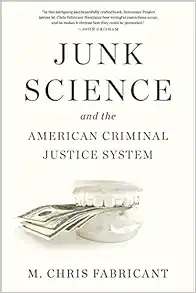
Junk Science and the American Criminal Justice System - by M. Chris Fabricant

Cover image


Written by the Director of Strategic Litigation for the Innocence Project the aptly named Fabricant explains how fabricated science has been used to convict innocent people, even in the face of overwhelming evidence to the contrary.  

The cover image of the book which shows a dental mold biting into hundred dollar bills is an allusion to the junk science of bite mark evidence. Created by a brotherhood (they were initially all men) of dentists calling themselves "diplomates" (my, that sounds important!) of the American Board of Forensic Odontology (ABFO), they asserted themselves experts on bite marks without actually having done any scientific study on the forensics of bite marks on bodies.

These "experts" would testify (usually for money) in criminal rape, murder, and assault cases indicating that bite marks found on bodies could have only been left by a one specific person (usually the defendant in a trial).

It took over thirty years for this science to be debunked while innocent people were convicted and sent to jail. The author calls this "poor people science" because it is still used, along with other discredited forensics (including ballistics, fingerprint analysis, and hair microscopy) to convict those who do not have the means to hire a good defense attorney.

A few mentions of prison libraries give this book a space on my blog, but I would have included it anyway since it is really a book about information literacy. It gave me a lot to consider regarding peer review, the gold standard of credible sources for undergraduates writing research papers. I help hundreds of such students every semester, many don't even understand what "peer review" means, they only know their professor told them to include such sources in their paper. The ABFO were peers who reviewed each other. They created their own body of experts without doing any studies, and their junk science is still being used today. 

Monday, April 4, 2022

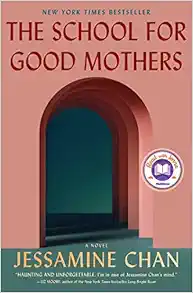
The School for Good Mothers - by Jessamine Chan


Bringing together ideas from The Stepford Wives, The Handmaid's Tale, and the movie A.I. Jessamine Chan finds a new way to scare the bejesus out of all of us.

Frida Liu is a single mother trying to co-parent her toddler (Harriet) as best she can with her ex-husband (Gust) and his live-in girlfriend (Susanna). During the Labor Day weekend Frida is unable to console the eighteen-month-old who is suffering from an ear infection. Neither is able to get much sleep over the three days. Frida, at her wit's end, leaves the house, and her daughter unattended, for two hours. The police are called when the neighbors hear the baby's incessant crying. After several months of invasive monitoring, and limited supervised visits with her daughter, Frida is sent to a facility where she can be rehabilitated as a mother. The year-long stay involves learning to parent with a creepy robot surrogate for her daughter, on a defunct university campus.

Mentions of libraries are infrequent and tend to be nefarious in nature. Frida is told not to do research at the library prior to her court hearing, lest she be monitored; the former music and dance library on the prison campus is empty; one mother is being rehabilitated for having allowed her eight-year-old to walk home from the  local library alone (a four-block distance). Frida gets one 10-minute video visit with Harriet a week which take place in the former campus library. Even these become depressing events. On the rare occasions when Frida's phone privileges aren't rescinded and she is able to connect with Harriet, Gust and Susanna, the calls are fraught.

A truly chilling tale for the twenty-first century.

Tuesday, August 13, 2019

The Care and Feeding of Ravenously Hungry Girls - by Anissa Gray


When Althea and Proctor Cochran are arrested on food-stamp fraud, and for skimming money from the fundraising charities they organized, their teen aged twin daughters, Kim and Baby Vi, are left in the care of Althea's sister Lillian. Lillian also cares for her deceased ex-husband's grandmother. Additionally, she must negotiate the relationships she has with her other siblings (Joe and Viola).

There are three types of libraries mentioned in this work: prison, public, and home. Each appears to  represent both a place of hope and of harsh reality.

Proctor uses the prison library to verify that there is a women's prison in West Virginia, when he is told he could potentially end up at a men's facility in Virginia. He writes to his wife
I was talking to our friend the other day, and he was naming off a couple of possibilities. He mentioned a prison out there in Virginia...He was going on about how he heard it was easy time out there in the federal system and I said, man, I don't know what "easy time" is. He got me and tried to make up for it by telling me about a ladies' prison out in West Virginia, and he said wouldn't it be nice if Althea ended up there?...And you know what? For a minute, your boy was happy, just imagining it. I even went to the library and looked it up. And there it was, West Virginia with what looked like a little arm, snuggled up there with Virginia. Then, it hit me: This is what it's come down to...I can't believe that this is the best we can hope for...

Althea's fellow inmate Mercedes describes a favorite teacher (Ms. Peterson) she had growing up who would stop by the house when I didn't make it to school. "And she started taking me to the library and everything like that...She took me to my first Disney movie...The Fox and the Hound."  Ms. Peterson's encouragement led Mercedes to aspire to a career drawing for Disney. But ultimately, Mercedes determines that "Some of us just got Kick Me signs tacked to our backs straight outta the womb."

When Kim runs away from Lillian's home there are a number of leads, and people reporting having seen her, including a report of
a girl sleeping in the library. From the description, Hop thought it could have been her, but when he got there whoever it was was gone.
Lillian renovated the family home following her father's death, creating a library where the living room used to be. A place "enveloped in warmth" where "orange flames writhe and rise in the stacked stone fireplace..." the warmth is deceptive to Viola, who would have left the room exactly as it was had it been up to her. She would rather remember the space as it was when he mother hosted Tupperware parties, a memory that
lives in a burst of color: green plastic bowls, pink plastic pitchers, orange plastic cups; gold couch, gold chains, gold charms; Mama's white dress; her lotioned, light brown skin.
I often see libraries in novels representing some kind of promise. It seems that these all do, too, but that the promise remains unfulfilled.

Wednesday, August 2, 2017

Orange is the New Black - by Piper Kerman


I've been intending to read Kerman's memoir ever since the debut of the Netflix series of the same name in premiered in 2013. After recently watching the fifth season, I finally got over to my public library and checked the book out. Much less edgy than the television show, Kerman's book is, nevertheless, a quick and fascinating read.

While the television show's characters Poussey (Samira Wiley) and Taystee (Danielle Brooks) might have one believe that the prison library is a hub of activity, it was in fact barely mentioned in the book. Most of Kerman's reading materials were sent to her by friends and family, so much so that she ended up with her own personal library, which she was glad to share with others. When she left the federal penitentiary in Danbury, Connecticut she donated all of her books to the prison library. She knows her books are being used when a year after her release she receives a letter from Danbury
Formal and stilted, it was from Rosemarie, and folded into it were two photographs of my grandmother. My cousin had sent them to me in prison...Rosemarie wrote that she hoped I was doing well on the outs, and that she had found these photos in a book in the library and recognized who it was. 
Photographs are among the more innocuous things found in returned library books. For some real tales from the stacks see this post from BookRiot, and this one from BuzzFeed.

Another fellow inmate, Levy, upon being released was interviewed by the Hartford Courant newspaper and described her six-month sentence as a "holiday" with a "wide range of classes" as well as "two libraries with a wide array of books and magazines, including Town and Country and People". All of this, of course was a surprise to her fellow inmates who listened to her complain and cry every day of her incarceration.

In the book's Afterword Kerman (now serving on the board of the Women's Prison Association) points out that the United States has the world's biggest prison population with 25% of the wold's prisoners, but only 5% of the world's population. Low level offenders make up a huge proportion of these inmates. She further explains
Most of the women I know from prison have lived lives that were missing opportunities many of us take for granted. It sometimes seems that we have built revolving doors between our poorest communities and correctional facilities, and created perverse financial incentives to keep those prisons full, at taxpayers' expense. America has invested heavily in prison, while the public institutions that actually prevent crime and strengthen communities - schools, hospitals, libraries, museums, community centers - go without.
Sing it, Sister!

Tuesday, October 18, 2016

Where the Heart Is - by Billie Letts


This is the third Billie Letts book I've blogged about here. Each one was found by serendipity - the first (Made in the U.S.A.) while browsing the leisure reading shelf of the library where I work, and the other (Shoot the Moon) at Somethin's Brewing Book Cafe. This one I found at The Little Free Library which recently appeared on Washington St. in Fairhaven, Massachusetts, near where my beach house is located. I was thrilled to be able to ride my bike there and pick out a book.

Of the three Letts' books this one is the most library-centric, and includes at least three different kinds of libraries (public, academic, and prison). The libraries tend to be positive forces for the characters in the books; the librarians, however leave a bit to be desired.

When seven-months-pregnant Novalee Nation is abandoned by her boyfriend at the Wal-Mart in Sequoya, Oklahoma she meets an eclectic group of people who help her out in some unexpected ways. She camps out at the store each night, and hides from the employees as they open it each morning. During the day she explores Sequoya and finds the public library "a two-story brick building with a black wrought-iron fence, the lawn planted with joseph's coat, calendula and foxglove." The first library Novalee had ever been in that "didn't have wheels under it". Inside she discovered
a room with dark wood carved into intricate designs, tall windows of thick, frosted glass and red velvet drapes held back with silver cord, chandeliers whose crystal drops caught fragments  of light transfused into rich blues and deep greens, paintings in gold frames of nude women with heavy bellies and thick thighs. And books. Racks of books, stacks of books, walls of books.
The librarian, however, was absent, as she was informed by the only other person in the building. Forney Hull turned out to be the alcoholic librarian's brother who took care of both his sister and her patrons. Forney and his sister live in the library, which before becoming the library was their childhood home. Novalee is enchanted with the idea of  being able to live at the library "to have all those books to read..." She also gets to celebrate her birthday at the library. This is the first library birthday celebration I have come across, and I had actually been wondering if I would ever find one!

Meanwhile, Novalee's good-for-nothing ex, Willy Jack (a.k.a. Billy Shadow), winds up in prison for theft. There he meets Claire Hudson, prison librarian:
She was a big woman who had to shop for queen tall pantyhose and size eleven shoes, double E. She wore dark clothes - stiff gray gabardines, navy twills and black serges...boxy suits with high necks, long sleeves and tight collars. Claire avoided garments with lace, bows and fancy buttons and she owned no jewelry, not even a watch. She held strong disdain for anything showy, allowing herself only one extravagance: Band-Aids....She wore them constantly and in abundance...She covered her warts, moles and ingrown hairs...pimples, cuts and fever blisters...burns, abrasions, hangnails and bites...eczema, psoriasis, scratches and rashes. 
Clair Hudson changes Willy Jack's life when she helps him to get a guitar to keep in his cell and he writes a song. Ultimately, though, she betrays him. It is unclear whether it is out of simple meanness, or perhaps because of some mental illness.

One other library gets a shout out - the one at Bowdoin College in Maine. No other information about the library is provided except that is is "great".

This book had a lot of surprises, and ultimately a happy ending, without being too sappy. Libraries play an important role as places of turning points for the characters.

Wednesday, January 20, 2016

The Heart Goes Last - by Margaret Atwood


Like Atwood's The Handmaid's Tale this is a brilliant piece of dystopian literature. The Heart Goes Last, however, is a bit lighter and more satirical. It tells the story of Stan and Charmaine who are living in their car until they find out about the Positron Project - an experimental community in which residents spend every other month living in prison, while their "alternates" live in their houses. There is no unemployment, and the "prisoners" are treated well and provided with good food. Stan and Charmaine start out adjusting to the life, and are glad to have a nice home for six months out of the year, but when Stan discovers that Charmaine is having an affair it sets off a chain of events that neither of them could have ever expected involving a plethora of Elvis impersonators, a knitted-blue-bear fetish, and chilling Stepford-esque experimentation.

Even dystopias have libraries. Positron has one but apparently it's picking are slim. During one of her trysts Charmaine and her paramour, Max, are so swept up in the passion we learn that
he couldn't wait, and because he couldn't neither could she. It was like the copy on the back of the most lurid novel in the limited-titles library at Positron. Swept away. Drugged with desire. Like a cyclone. Helpless moaning. All of that. She'd never known about such a force, such an energy inside herself. She'd thought it was only in books and TV, or else for other people.
Of course this one reference to the library had me questioning what kinds of books were being withheld from the good citizens of Positron. Clearly bodice-ripping sex was in, so what was out? We are left to ponder, as this was the only instance in which the library was mentioned.

Thursday, January 7, 2016

Just Mercy - by Bryan Stevenson


The 2015-16 Common Read for the Unitarian Universalist Association I will be participating in a book discussion with members of my church this month, and again with members of Messiah Baptist Church in Brockton, Massachusetts in March. This is the true story of Bryan Stevenson, founder of the Equal Justice Initiative a "private, nonprofit 501(c)(3) organization that provides legal representation to indigent defendants and prisoners who have been denied fair and just treatment in the legal system." (from the website).

This is a powerful work that tells the story of rampant corruption throughout the criminal justice system - lawyers, politicians, judges and law enforcement officials who are more concerned with appearances than in assuring that justice is served, even when there is incontrovertible evidence that the wrong person has been jailed. Sometimes Stevenson was able to have wronged convictions overturned, but sadly, too often, he watched as innocent people were executed. It is a good companion book to read with Michelle Alexander's The New Jim Crow: Mass Incarceration in the Age of Colorblindness.

I got almost to the end of this book believing it wouldn't find its way to this blog, but the final chapter "The Stonecatchers' Song of Sorrow" came through. The bar for inclusion on my blog is at least one mention of a library or librarian, and this book met that standard. In discussing the Supreme Court's decisions to ban life-imprisonment for juvenile offenders (in 2010 for non-homicide crimes and 2012 for homicide) Stevenson tells of
...several former juvenile lifers [who] had developed outstanding institutional histories with very few disciplinaries, even though they did their time with no hope of ever being released or having their institutional history reviewed. Some became trustees, mentors and advocates against violence among inmates. Others had become law librarians (emphasis mine), journalists, and gardeners.

Tuesday, March 24, 2015

Shakespeare Saved My Life: Ten Years in Solitary with the Bard - by Laura Bates


Last week my Facebook feed included a post from a fellow librarian about the Big Library Read - a global book club. Through the Big Library Read e-books are made available for two weeks, with no limit on the number of people who could check them out. I downloaded my copy and joined in.

Dr. Bates' memoir of her time teaching Shakespeare in the SHU (Secured Housing Unit), of the Wabash Valley Correctional Facility in Indiana details her relationship with inmate Larry Newman, who was sent to prison for life as a teenager. Mr. Newman not only excels as a student providing unique insights into Shakespeare's plays, he writes workbooks for other college students to use in order to help them understand the works better themselves.

It is interesting to note that a book that is essentially about reading hardly mentions libraries at all, although I expect the prisoners Bates worked with had no access to one. And the professor only includes one childhood memory of using the library herself
Our final reading assignment was The Tragedy of Macbeth. It's been a special piece of literature for me ever since I first read it at the age of ten. Well, I can't really say that I "read" it at that age, but I did check it out of my elementary school library. And I can still recall the thrill of poring over its archaic words that I knew meant something significant, that I hoped would someday mean something to me. By the time I reached high school, I was able to begin to make meaning out of the language. But it wasn't until I started teaching these plays, in prison, that their meaning would come through: beautifully crafted works of literature written hundreds of years ago that can connect with us here and now. 
I've always felt strongly that children should be able to select their own reading material from libraries. While they may pick something out that is beyond their reading or comprehension abilities, it probably won't matter. They will likely decide to put it aside, but that too is their own empowered choice. The book may serve, as young Laura Bates discovered, as a challenge, that she returned to again, and again. She could never have imagined how it would change her life.
----------------------------------------------------------------------------------------------------------------------
A few days after I posted this, I discovered this blog post on the importance of prison libraries. It is well worth the read.

Tuesday, February 24, 2015

2016: A Novel of America and the World - by Marjory Maxwell Donn


I found this work while I was sorting my late father's things. It was inscribed by the author, with thanks for the help my father had provided. His name also appeared on the acknowledgments page which indicated that he and the author had been members of the same writer's group. All of this, in addition to the fact that the author's (middle) name is the same as the name of the library in which I work caused me to immediately move this to the top of my reading list.

This book was published in 2008, so the future Donn envisioned was not far away, even when she wrote it. Although some of what is written is grim, it is not a dystopian novel, and ends on a hopeful note, even as we see that there is still plenty of work still to be done (with regards to climate change, Middle-East Peace, a safe and sustainable food supply, and political corruption). The story follows an international cast of characters from Greece, to South Africa, to Israel, and to the United States. Each is confronting both political and personal crises and their lives intersect in a number of ways. There are twelve chapters, each covering one month of the year, and each with its own Discussion Guide so that book groups can read and discuss the book in smaller chunks.

There are several places where the libraries play a role in this work. One young Palestinian, Ahmad, uses his university library to get away from the noise of his overpopulated home. He also briefly considers using the university library as a safe place to hide from some of his denizens who have attacked him and chased him into Israeli territory. His subsequent arrest prevents him from following through on the plan, however.

Ahmad is not the only character who finds himself in prison. Ahmad is released thanks to the help of his American-Jewish friend Monty Greenberg. Monty then finds himself in the federal penitentiary for airing some opinions in his monthly business column that are unpopular with the government. He finds solace in keeping a journal, and also visiting the prison library where he researches Eastern philosophies.

Esther Perlman, wife of Rabbi Avrim, is a minor character in the book. We don't know much about her outside of her family life, except for the very important fact that she is a librarian. It is evident that this is meaningful work both for her, and her husband. When Avrim loses his job and needs to look for a new congregation. He accepts "the offer of a congregation in Haifa, a big enough city that Esther was sure she could find a library job."

Bonus!
I usually don't read discussion guides, but I made an exception in this case, and was delighted to see that the author gives props to librarians under her "General Suggestions" heading
We [Donn had a partner for writing the discussion guide] have provided Web addresses for more information on the issues raised, and, in some cases, have listed books as well. Discussion leaders who do not have personal computers can look up information on the Web at their local library. Librarians have the training to help people find information, whether through books or on the Web.
Additional Bonus!
While this was not the first book I read written by a fellow Unitarian Universalist (UU) (see my post for Walden), I do believe it may be the first with a UU character. While there are many characters in the book, the action is centralized around one: Martha Greenberg (wife of Monty) who we learn at the end is neither Jewish, nor Christian, nor Muslim, but rather "...something like Unitary Universe?" Indeed, the Greenbergs are UUs who gives thanks before meals in much the same way my family does by thinking
about all the people who worked so that we could have this great dinner...especially the farm workers who planted the potatoes and then dug them out of the ground, the truck drivers who carried them and the people in our stores who sold them to us.


So happy to have had a chance to read this.

Monday, January 12, 2015

Land of Love and Drowning - by Tiphanie Yanique


I had the pleasure of hearing Ms. Yanique give a reading and Q&A last November when she visited Bridgewater State University. She read from Land of Love and Drowning which I then attempted to check out of the library where I work (which was only there because I ordered it knowing the author would be coming to campus) but someone had beaten me to it. I was finally able to check it out over the winter break. This is a wonderful tale about three generations of Bradshaws during the early and mid-twentieth century. This novel tells some of the history of the Virgin Islands while taking the reader on a journey of magic realism. The narration in the story alternates between sisters Annette and Eeona, and an omniscient narrator giving several perspectives on the family.

The Bradshaw sisters each takes advantage of the library in her own way. Older sister Eeona, living alone, uses the library in the traditional manner - finding books to read "Thrice in one week she went to the library and picked up a novel. She plowed through the books until the gas in the lamp burnt down." Annette makes use of the library's typewriter rental service to write her husband a letter requesting a divorce, she also researches baby names for her second daughter there, and decides on Eve Youme.

I remembered during the reading that the author said something about naming being the first sorcery a parent performs on a child. While I hadn't thought about it in exactly those terms I realized that she was absolutely right. When parents name their baby a certain destiny is created for the new human, and while parents may have their own ideas about meanings and monikers, it is also true that the parents' spells can come undone
...naming is a voodoo all parents do. Annette listed the child's second name as Youme. She'd spent hours in the island's library looking up baby names instead of studying for the teaching certificate. The name didn't mean "ours" as she'd first hoped. It meant "dream." But that also made sense and perhaps what was ours was all a dream anyway. Something to keep striving for or something all in our mind-depending. And as these things go on island, the child was never called Eve. She was called Youme early on, but in the islands' history she will simply be called Me. History could do that, change a person's name. History was something so simple and insistent that none of us has escaped it. 
I enjoyed the imagery, the story, the characters, and learning a bit about the Virgin Islands.

Lagniappe:
I also read Yanique's collection of short stories How to Escape from a Leper Colony. The final story in the work "Kill the Rabbits" includes one description of a prison library:
When I'm not staring out at the sea I lime in the library. I prefer the salt air to the library's a.c. but sometimes I like the quiet. I like the hard wooden chairs with firm backs. It's a small quiet place, like a vault with precious gold bullion. A vault inside the jail. The tile on the floor is scrubbed shiny and clean and my shoes squeak when I walk. They only let three of us in at a time. And we have to sit at different tables. There are only three long tables in the library. There's a computer in the corner that connects to the Internet.
There is also one librarian metaphor as Herman describes seeing his girlfriend Xica for the first time
She was in a yellow dress that was shiny and out of date-out of place in a tapas bar....She sat at the edge of a bar stool, her back so straight that she reminded me of a librarian.

Friday, November 21, 2014

Cold Case to Case Closed : Lizbeth Borden: My Story - by Rich Little and Beverly Folstad


Living in Massachusetts has piqued my interests in several things. One is the Salem witch trials, another is the Lizzie Borden ax murder case. Of course the jump rope rhyme about Lizzie Borden is well known, and I have seen at least two movies about the crime. I watched The Legend of Lizzie Borden starring Elizabeth Montgomery when it first aired on television in 1975, and more recently Lizzie Borden Took an Ax with Christina Ricci in the title role. We have also toured the Borden home in Fall River, which is now run as a (creepy) B & B. This is the first book I have read about her though. Our town's One Book One Community Committee is considering this self-published work for the spring 2015 read. Although it is subtitled "My Story" only some of the sections of this work are from Lizzie Borden's point of view. Much of it is a factual retelling of what was known, police reports, and how the trial played out. These parts of the work read like any other "true crime" book. I was, personally, much more entertained by the sections of the book that comprised the imagined words of Miss Borden. And I was especially interested in learning how important her library card was to her while she was imprisoned
In my ten months at Taunton (prison), there was seldom another woman incarcerated; the result was a very quiet environment. I spent my time reading, one of my favorite pastimes. When Emma came in on the train to visit every week, she always brought fresh reading materials. The Taunton Free library was only two blocks away; they issued me a library card which I still cherish. While shopping for jail supplies and provisions, Mrs. Wright would pick up several newly published books from the library each week.
I can only imagine that without the solace Miss Borden found in reading that her time in prison would have been akin to solitary confinement - alone with only her thoughts day after day. Books are our friends.

Tuesday, February 25, 2014

Dear Miss Breed - by Joanne Oppenheim


The internment of Japanese-American citizens during World War II is a chapter of United States history that some would prefer to pretend never happened. I remember finding out about this injustice as an adult, and wondering why it wasn't taught in any of my American History classes in school, or my class on Constitution, Citizenship and Public Issues (CCPI) - a required course for all High School Seniors in Maryland during the 1980s. It is especially baffling to me because while I was taking CCPI there were actually Congressional Hearings about the internment going on at the time. How could it not have been worthy of a class discussion?

In 1942, after the Japanese invasion of Peal Harbor San Diego Public Children's Librarian Clara Breed discovered that many of her most enthusiastic patrons, American children of Japanese descent, were going to be sent to "relocation centers" with their families. She asked them to write to her, providing them with penny postcardsasking that they let her know where they were and how they were doing. From this she began a correspondence with many of the children. She also provided them with books, toys, supplies, and material for making clothes.

Clara Breed saved the letters that the children sent her. In 1993 they were donated to the Japanese American National Museum (you can read some of the letters here), and they are the basis of this book.

The children tell stories of the substandard conditions to which they were subjected (for some their first stop after being evacuated from their comfortable middle class homes was a refurbished horse stable - still smelling of urine). Surrounded by barbed wires and armed guards the camps were poorly heated, and poorly equipped, making for an especially difficult adjustment. Even so, the children's letters are hopeful, and demonstrate strong spirits.

Also included in this work are excerpts from opinion pieces from newspapers at the time. The bigotry is clear. It is also true that some things don't change, although today we are more likely to read such comments as anonymous posts and "tweets".

This work is evidence of librarians' long-time commitment to social justice. One former correspondent explained when he was interviewed for the book that as a "neglected child" Miss Breed introduced him "to the magical world of books". Clara Breed championed the rights of an especially vulnerable population at a time when it was especially un-popular to do so. In an article written for the Horn Book magazine in 1943, Breed tells the story of her young friends. It is interesting to note the stereotypes, albeit positive ones, evident in her article, as well as the language that many will find rather politically incorrect for the 21st century.

I was especially interested to see one of the children wrote to Miss Breed about how much she enjoyed "playing library" and discovering that another one grew up to work in a library.

Interestingly, as I was finishing this book I found out about Allegiance a new musical currently being produced in New York that tells the story of the Japanese-American internment camps.


Wednesday, November 6, 2013

The Reader - the movie


An enigmatic woman, Hanna Smitz (played by Kate Winslet) helps a teenage boy, Michael Berg (David Kross) return to his home after he falls ill and the two begin an affair. Set in 1950s Germany the Hanna insists that  Michael read to her each time they meet, before they make love. Eventually she disappears from his life and the next time Michael sees Hanna she is a defendant at a Nazi war crimes trial. Hanna is sentenced and adult Michael (played by Ralph Fiennes) continues to read to her by way of recorded cassette tapes sent to her in prison.

There is one scene in the prison library in which Hanna asks for one of the books she has been listening to.

Friday, March 15, 2013

We Band of Angels - by Elizabeth M. Norman


During World War II a group of Army and Navy nurses were imprisoned in Bataan by the Japanese. The women were subjected to a starvation diet, tropical diseases, and humiliation by their captors while continuing their work as nurses. They were hailed as heroes after their rescue three years later, but found that  once the celebrations ended the military refused to give them the same honors that their male counterparts were due. Many of the women suffered long-lasting effects from the years of illness and malnutrition, which in some cases forced them to give up their military careers. This book is based on interviews, diaries and other firsthand accounts with the women who were there. The author named Helen "Cassie" Cassiani as the one she knew "best".

Growing up in Bridgewater, Massachusetts Cassie "often used [farm] work as an excuse to ignore her studies....Then one day two friends from the neighborhood sat her down in the library and showed her how to study. Soon she acquired the habit of reading-history, science stories." And from this seed grew her desire to become a nurse. Exciting to think that the library she used must be the very one for which this blogger now serves as a trustee!

Cassiani's fellow internee Eleanor Garen also found a love of the library as a child in Elkhart, Indiana. "She learned to read early and became such a bookworm that she would fill up her own library card, then take out books on her brothers' accounts."

The importance of libraries is additionally highlighted in this book by the fact that those imprisoned established their own lending libraries within the confines of the camp. The closing the library was one of the methods used by their captors to harass and demonstrate who was in charge.

This is a captivating read, especially in light of the recent decision to "allow" women in combat units. Women  serving on the front lines, in combat conditions is nothing new, as is evident in this work.

This book is the One Book One Community selection for Bridgewater in the fall of 2013.

Wednesday, February 22, 2012

Hole in My Life - by Jack Gantos

Front Cover
Gantos’ memoir about his 15 months in a federal penitentiary for drug smuggling is a cautionary tale for young people, without the cheap philosophy. My husband James and I read this aloud together and had a hard time putting it down. (I probably should mention here that the fact that we’d recently met the author did enhance our enjoyment of this work.)


We alternately cringed at Gantos’ description of picking at his stress-induced acne

I discovered pools of oil and pus under my skin. They drove me into a frenzy. I went right at them. I squeezed down on the welts with my fingers while pressing up against them with my tongue. They exploded, and coils of yellow matter and blood streamed down my face.
And laughed at his adolescent naivety

My big romance of the year was a crush on my psychology teacher, Miss Hall. I’d sit in front of her desk and make troubled-brow faces which I thought illustrated the deep-level neurosis I represented…Finally I got up the nerve to write her a letter about becoming a psychology and literature major. I didn’t dare attempt a love letter – besides I didn’t have to. Any psychology teacher would know that a soul-baring letter from her most devoted student had hidden meaning.
I believe this book may represent two firsts for this blog: the first to mention prison libraries; and the first to refer to four different kinds of libraries (public, school, and academic, in addition to prison – and if you count “genetic library” there are five).

As for his high school library, Gantos mistakenly believes that hanging out there brooding will attract girls. He does not mention actually reading any books there. The library at the University of Florida is mentioned only in passing as part of Gantos’ self-tour of the campus - just another building among the dorms and classrooms. Of his public library on St. Croix he has only this to say
…the library was little help. It was so hot and humid inside I had to scrape the mold off the spines of the books in order to read the titles. Nine out of ten books I looked up were missing. The librarians just shrugged when I mentioned the apparent theft problem. And if I complained too much they just turned up their desk radios and played at being busy.
I am not sure he saw the irony in the fact that he wound up stealing public library property himself, thereby denying others information, as he is leaving Ft. Lauderdale and has the taxi stop at the library so he can look up a newspaper article about his accomplices getting caught, and “rip[s] the story out of the paper”.

It is never a bad idea to ask a librarian for assistance, and Gantos does when he asks the prison librarian for a copy of Barron’s Guide to the Colleges hoping he can get paroled by finding a college that will accept him as a student.

Gantos invokes the librarian stereotype as he describes his release and is given an opportunity to select some clothes from the discharge closet. Eschewing more daring duds, he takes “a plain pair of dark slacks, a white shirt with a button-down collar, and a jacket with patches on the elbows” and declares “I looked like a librarian.” Jack, you flatter us. Would that librarians actually dressed so dapper.

Destruction of library property once again comes back to haunt him upon his release from prison and he discovers he cannot take his copy of The Brothers Karamazov with him because the discharge officer notices the prison library seal on the inside jacket. He had been using the book as a clandestine journal, writing between Dostoyevsky’s lines. To be fair I don’t think he realized that he would not be able to keep the book since someone brought it to him during his first days in jail saying “do whatever you want with the books…they were left in the cafeteria.” He wraps up the work wondering what became of the journal and if others ever found it, and suggesting that “maybe the library will become filled with books with the trapped world of prisoners’ thoughts concealed between the lines.” I guess my hope is that perhaps, instead, the inmates are now allowed to keep proper journals, and the library books are left intact!

Thursday, July 21, 2011

The Right to Read Upheld

Today's Baltimore Sun includes this editorial about the right to free speech, and the right to read in prison libraries.