Showing posts with label crime. Show all posts

Saturday, August 26, 2023

Adnan's Story - by Rabia Chaudry


I was vaguely aware of the Serial podcast when it first aired in 2014 but I didn't listen to it until about a year later after an old friend told me that the story was about people who had attended the same high school (Woodlawn High in Baltimore County) that we had. Although the events described in the first season of Serial took place many years after we graduated it still made listening to the podcast especially riveting for me. 

Woodlawn High has always had a tough reputation among the Baltimore County high schools. One of my most vivid memories is of walking into the girl's restroom in the immediate aftermath of a botched self-abortion. During my time there in the late 70s and early 80s, collectively we experienced a cross burning on campus, and the (off-campus) shooting death of a fellow student by another student. Unlike the students who attended Woodlawn in 1999, there were no counselors brought in to help us process either of these events. We were simply told not to discuss them (especially not with the press, who was all over). I saw the murdered boy's girlfriend in school the next day. It didn't even surprise me. My parents would have also told me to get my butt to school if my boyfriend had been killed.

Rabia Chaudry is a friend of Adnan Syed's family and in this book provides more information about Syed's trial for the murder of his ex-girlfriend Hae Min Li. Although convicted, Syed has always maintained his innocence and last year was released after over 20 years in prison when additional evidence of his innocence was provided.

The Woodlawn branch of the Baltimore County Public Library was featured in the first episode of the podcast. Located adjacent to the campus of the high school it is an easy place to get to after school. Li's murder took place on the afternoon of January 13. Syed could not remember exactly where he was that day, but a fellow student (Asia McClain) remembered seeing him at the public library after school which would have provided the alibi that Syed needed. Unfortunately his lawyer never followed up on this information. Chaudry (herself a lawyer) explains more about how this crucial evidence was ignored, and tells of her own conversations with McClain.

Adnan's Story mentions the prison library in two different contexts: for legal research and also as a workplace.
Once, while he was assisting the prison librarian, she asked him to go drop off some books in her car. She handed him her keys and he walked out to the lot where the car stood. He was outside the prison, free and clear, in the employee parking lot. If he had wanted, he could have gotten in her car and driven away.
I selected this book as part of the University of Maryland Baltimore County's  (UMBC) Retriever's Read Bingo which includes a space to read a book by a UMBC author. While Syed and I are both Woodlawn High Alums; Chaudry and I are both UMBC alums.

Rabia Chaudry is co-host of the Undisclosed podcast.

Friday, May 13, 2022

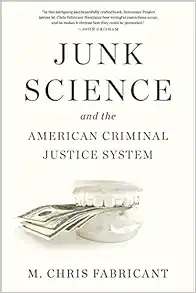
Junk Science and the American Criminal Justice System - by M. Chris Fabricant

Cover image


Written by the Director of Strategic Litigation for the Innocence Project the aptly named Fabricant explains how fabricated science has been used to convict innocent people, even in the face of overwhelming evidence to the contrary.  

The cover image of the book which shows a dental mold biting into hundred dollar bills is an allusion to the junk science of bite mark evidence. Created by a brotherhood (they were initially all men) of dentists calling themselves "diplomates" (my, that sounds important!) of the American Board of Forensic Odontology (ABFO), they asserted themselves experts on bite marks without actually having done any scientific study on the forensics of bite marks on bodies.

These "experts" would testify (usually for money) in criminal rape, murder, and assault cases indicating that bite marks found on bodies could have only been left by a one specific person (usually the defendant in a trial).

It took over thirty years for this science to be debunked while innocent people were convicted and sent to jail. The author calls this "poor people science" because it is still used, along with other discredited forensics (including ballistics, fingerprint analysis, and hair microscopy) to convict those who do not have the means to hire a good defense attorney.

A few mentions of prison libraries give this book a space on my blog, but I would have included it anyway since it is really a book about information literacy. It gave me a lot to consider regarding peer review, the gold standard of credible sources for undergraduates writing research papers. I help hundreds of such students every semester, many don't even understand what "peer review" means, they only know their professor told them to include such sources in their paper. The ABFO were peers who reviewed each other. They created their own body of experts without doing any studies, and their junk science is still being used today. 

Friday, April 19, 2019

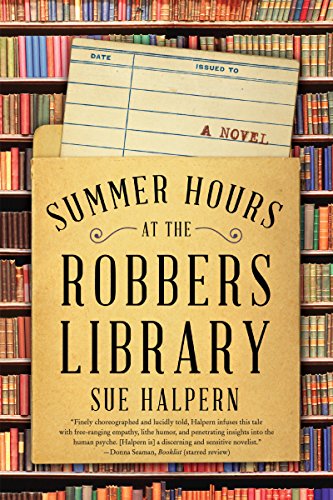
Summer Hours and the Robbers Library - by Sue Halpern


The hardest posts to write for this blog are those that are for the most library-centric books. I can't simply put a post-it note on each page that has the word library lest the entire book be marked. Writing about this book is made even harder by the fact that I read it over a month ago while I was on vacation. While I did enjoy a lot of reading (I read, or listened to, four books) while I was away  I got quite far behind on my blogging while I was on vacation last month, and returning from my trip I had so many other things I had to take care of that writing was put on the back burner.

Halpern's book tells the story of the intersecting lives of Solstice (Sunny) and Katherine (Kit) who work together at the Riverton Public (Robbers) library in New Hampshire. Kit is a forty-something reference librarian and Sunny is a fifteen-year-old who "had been sentenced to work at the...library for the summer after she was caught trying to steal a dictionary from a bookstore in the mall." Sunny procured her sentence in kids' court "the place where good kids, or kids who haven't yet gone bad, are sent when they do something wrong, or dumb, or both..."

So, while I didn't mark every time the word "library" was used, it turns out I did mark more than a few passages. Let's start with the word sesquipedalian.

When asked by the judge why she stole the book  (a dictionary of all things) her response that she didn't have enough money elicited further explanation. To which Sunny explained that she wanted to be able to look up the meaning of words she didn't know - words like sesquipedalian. Poor Sunny still didn't know what it meant because she didn't have the dictionary. Of course I could have told her the meaning of my favorite word: sesquipedalian - a foot and a half long - from the roots sesqui (one and a half) and ped (foot) - a word that essentially defines itself. But Sunny wanted to be able to look up the word herself. She was "tired of always having to ask someone when [she] didn't know the meaning of a word."

It is a bit coincidental that I marked a page that mentioned icky library vending machine food, although I had not yet written my most recent post about Dear Committee Members in which I wrote for the first time about such things.

Halpern plays a bit with stereotypes. Kit is a single (really divorced) childless middle-aged woman, who tells Sunny that she's "a big fan of silence" asked why she works in a library.

The Library Director, Barbara is described as
sturdy, with angular features and a white pageboy, handsome, not pretty - a sensible shoes kind of woman with proper manners, manners proper enough to keep her from prying into the lives of the people she worked with or trading gossip... 
There is also one instance of a "shushing" which takes place when a patron laughs loudly at learning why Sunny was "sentenced" to work in the library.

Much of the book is Kit describing her life before the Robbers Library. We find out about library school, and her first job in a library archive room, and a later job at a the Science Library at Emory University. In describing each of her jobs she does admits a dark secret that all library workers know, but don't want to admit - sometimes our work is tedious, or even boring. It is true that sometimes we wonder why the building we're sitting in, waiting for a "stray question", is even open. Or that sometimes our job is just searching fruitlessly for a missing book, or making sure people aren't destroying materials. Meanwhile, we also know that we must convince others that we are "busy" at all times, lest we lose funding, or worse, the vocational awe perceived of us by those outside our occupation.

Ultimately, though we learn that Kit recognizes the value of libraries and librarians. And that while her job may not be "as awesome as being a neurosurgeon" she knows that "putting books in the hands of readers...save[s] lives, too".

Monday, January 25, 2016

The Map Thief - by Michael Blanding


My husband, James and I read this book aloud together. It was recommended by a friend as it brings together James' passion of geography and mine of books and libraries. We finished this a few weeks ago, but I held off blogging about it because I found out that we would have the opportunity to hear the author speak at the Massachusetts State Library in Boston shortly after we finished it. It was not our first visit to the State House - James goes there about once a year with his EarthView globe-, but it was the first time visiting the State Library. Blanding was witty and seemed to thoroughly enjoy speaking in the stately room. He smiled the entire time as he showed slides with maps and photographs and discussed how he did the research for his book. The Map Thief  is the true story of E. Smiley Forbes III who stole maps from the Boston Public Library, the New York Public Library, the Beinecke  and Sterling Libraries at Yale, Harvard Library, as well as the British Library. In order to pay the phenomenal debts he racked up for his home on Martha's Vineyard, as well as for his planned community Sebec, Maine, Forbes, a well-respected map dealer, began stealing rare maps in order to sell them to collectors. It was a Yale librarian, Margit Kaye, who first suspected Smiley, when she noticed a smudge mark on a map that Smiley had posted on his website - a smudge she was sure she had made! However, when she brought her suspicions to the attention of her supervisor his response was a dismissive "what do you want me to do...arrest the guy?" Ultimately it was another Yale librarian, Naomi Saito, who set in motion the events that lead to Smiley's arrest in 2005.

Blanding talked to a number of librarians and map dealers in the course of researching this book. He also explores the history of maps and mapmaking, and discusses my favorite Librarian/Geographer, Eratosthenes, head librarian of the famous Library of Alexandria in Egypt in 240 B.C.

Blanding's book also tells of how maps were recovered and then how forensics were used to determine which maps belonged to which library. I was especially interested in the clever librarians who used wormholes to identify their map of Gerard de Jode's Speculum Orbis Terrarum
For centuries libraries had been plagued with wood-boring insects that laid their eggs in the stacks. When the larvae hatched, they used the digestive enzymes in their alimentary canals the chew through wood and paper, leaving behind a tiny trail. Somewhere in its 427-year history, the Beineke's copy of the Speculum had contracted its own case of pests. In the front of the book, a dozen pages sported a small constellation of three pin-sized holes near the bottom and another hole three inches up. Now, as the librarians laid the map carefully back into the volume, those holes matched identical holes in the edge of the map where it had been held in place.
Well researched, well written, and full of real-life clever librarians, this is a title truly worthy of its place on this blog.

A post script: While the book is finished, the story is not. As recently as November of last year  the Boston Public Library  recovered a stolen map thanks to an "eagle-eyed" librarian who identified a the map based on flaws in the document.

My favorite quote from the day: "It was a battle, but it was a quiet battle because they were librarians."

Author Michael Blanding signs copies of his book, surrounded by maps, at the State Library.

Thursday, January 7, 2016

Just Mercy - by Bryan Stevenson


The 2015-16 Common Read for the Unitarian Universalist Association I will be participating in a book discussion with members of my church this month, and again with members of Messiah Baptist Church in Brockton, Massachusetts in March. This is the true story of Bryan Stevenson, founder of the Equal Justice Initiative a "private, nonprofit 501(c)(3) organization that provides legal representation to indigent defendants and prisoners who have been denied fair and just treatment in the legal system." (from the website).

This is a powerful work that tells the story of rampant corruption throughout the criminal justice system - lawyers, politicians, judges and law enforcement officials who are more concerned with appearances than in assuring that justice is served, even when there is incontrovertible evidence that the wrong person has been jailed. Sometimes Stevenson was able to have wronged convictions overturned, but sadly, too often, he watched as innocent people were executed. It is a good companion book to read with Michelle Alexander's The New Jim Crow: Mass Incarceration in the Age of Colorblindness.

I got almost to the end of this book believing it wouldn't find its way to this blog, but the final chapter "The Stonecatchers' Song of Sorrow" came through. The bar for inclusion on my blog is at least one mention of a library or librarian, and this book met that standard. In discussing the Supreme Court's decisions to ban life-imprisonment for juvenile offenders (in 2010 for non-homicide crimes and 2012 for homicide) Stevenson tells of
...several former juvenile lifers [who] had developed outstanding institutional histories with very few disciplinaries, even though they did their time with no hope of ever being released or having their institutional history reviewed. Some became trustees, mentors and advocates against violence among inmates. Others had become law librarians (emphasis mine), journalists, and gardeners.