Showing posts with label England. Show all posts

Thursday, March 26, 2026

The Library of Lost Dollhouses - by Elise Hooper

Along with being unprepared for a test, and being naked in public, one of my recurring dreams is that of finding a secret room in my house. 

Hooper's book asks us to imagine finding a secret room in a library that holds secret dollhouses, each of which holds its own secrets. 

There are two timelines in this story: World War I Europe, and present day San Francisco. When Tildy Barrows, curator at Belva Curtis LeFarge Library and Museum, discovers a hidden room in the museum with two exceptionally decorated dollhouses created by artist Cora Hale it takes her on an unexpected journey that intersects with her own family history. 

The museum, along with its eccentric founder is loosely based on Boston's Isabella Stewart Gardner Museum. Just as Gardner left instructions to keep her art collection exactly as she left it, LeFarge likewise "left very strict provisions for how...the library was to be managed". Barrows is sure that this does NOT include digitizing the book collection to make room for more art. 

It turns out that Barrows was right. In fact LeFarge once insisted that raising a child in the Library was an exceptionally good idea. 

Libraries are the prefect place to grow up. Just think how smart she'll be.

Furthermore, the McCarthy-era heiress had this to say about a child being trouble in a library 

Any trouble a young person can find in a library is the best kind of trouble

And Hale, who knew LeFarge quite well, had this to say about libraries

Libraries are viewed as such solemn places-but why? Reading is magic. Think of the imagination and sense of adventure that readers employ every thine they crack open a book. There are few places filled with more magic than libraries, no about about it.

I am not sure what psychologists say about what the "secret room" dream means. I have always interpreted it to mean that I am not meeting my potential. But perhaps the dream is about revealing something I have kept hidden.  Just as every book has as many interpretations as there are readers, dreams are multi-layered and can mean different things to different dreamers. I think will need to think about my hidden room dreams a bit more.

Monday, July 21, 2025

Calm - by S.J. Baker

I picked up this YA Dystopian novel from a local Little Free Library. In this fool's paradise the government has drugged the water supply to keep everyone lulled into a sense of complacecny and from having any feelings (good or bad). Of course books in this world are also hard to come by. And as with any dystopia there are resistors. Tiegan, a young dyed-in-the-wool Resistor who is running from the Servants remembers that her own home had a "little store [of books]...hidden in the cupboard...even though their very presence in the house meant danger."

Something else worth mentioning about this book it that it recognizes that when on the lam menstruating people may have trouble managing their periods. It was frankly refreshing to read a book that appreciated this problem.


Tuesday, January 23, 2024

The Princess Trap - by Talia Hibbert


A twist on the fake-girlfriend trope, this romance has Ruben, a Danish Prince, convincing Cherry, an English citizen, to pretend to be his fiancée for one year. He offers to pay her an exorbitant sum of money in exchange for this service. The amount is never disclosed to the reader, but it is enough to pay for the expensive medical bills, tuition, and living expenses of Cherry's younger sister who is attending Harvard. Although they arrange a fake engagement, the sex is real, and pretty explicit. The ending is as anyone would expect.

Although Ruben is royalty he prefers living in a small house, rather than his mansion. But of course this is a fairy tale and what kind of fairy tale would Cherry be living in if their were no library in the house? Ruben offers to let her redecorate it, but Cherry apparently doesn't take him up. She does however find a bodice-ripping romance to read there, which she assumes was originally procured by Ruben's grandmother (something Ruben would rather not think about). Of course a woman reading is a rather sexy sight, so when Ruben discovers Cherry in the library reading it doesn't take long for the real bodice ripping to begin, right there amongst the books.


Monday, September 25, 2023

Carnival of Snackery: Diaries 2003-2020 - by David Sedaris


When I read Sedaris' first book of diary entries (Theft by Finding) I lamented that he did not include enough about libraries and that I hoped that the second volume would include more. Alas, this 566 page work mentioned libraries a measly seven times. The first was the sad entry on January 11, 2005
The Guardian ran a story on Gerald Allen, an Alabama state representative who wants to ban books with homosexual characters. They can still sell them in shops, but he wants them out of schools and publicly funded institutions, like libraries and state universities. If the book presents a tragic homosexual, the type who suffers and then commits suicide, that's okay. He just doesn't want the happy kind, the ones who, in his words, "promote homosexuality as a healthy and accepted lifestyle."
Which one am I? I wonder.

Other uses of the library include:
  • Waiting
  • Taking a Citizenship Test
  • As part of a tour (grandmother unimpressed that granddaughter wanted to see this)
  • A place not to practice archery
  • A place with "nothing but a coloring book and a box of crayons" - this would be a disparaging remark about George Bush (43)'s Presidential Library
My favorite was this: someone checking out a CD of  Lightnin' Hopkins' music wants to know "is that a person or a thing?" Sedaris is able to help where the librarian is not. The young man who checked the CD out kept asking himself "Does it matter?" And eventually returns to the librarian to ask "Does it matter?" "Definitely not" they librarian said. 

That's what I would have said, too.

Tuesday, January 24, 2023

Carry On - by Rainbow Rowell

I've read a lot of reviews of books by Rainbow Rowell, but until now I had not read any of her books, so when I saw this one at a Little Free Library at a neighbor's house I picked it up. 

As I started to read it, I thought it was simply a Harry Potter clone (a story about an orphan who doesn't know he's a wizard, who goes to a school for magical folks) but I figured there was probably more to it than that and did a bit of research. I learned that this is in fact some metafiction on Rowell's part. She explains how she came to write the book in an author's note at the end of the book. She begins her note with the following information

If you've read my book Fangirl, you know Simon Snow began as a fictional character in that novel.

A fictional-fictional character. Kind of an amalgam and descendant of a hundred other fictional Chosen Ones.

In Fangirl, Simon is the hero of a series of children's adventure novels written by Gemma T. Leslie - and the subject of much fanfiction written by the main character, Cath.

Rowell goes on to say that while she was able to let go of Cath and her world, she could not let go of Simon Snow, so she wrote her own story about him. 

And so I read the story on its own terms.

When Simon Snow returns to Watford for his final year of school he discovers that his nemesis (and roommate) Baz is missing. Baz's mother was once the headmistress of Watford, but was killed when Baz was very young. The ghost of Baz's mother comes looking for him in his dorm room, but finds only Simon and so she leaves a message with him asking that Baz avenge her death. When Baz does return he and Simon make a truce in order to work together to find the killer (and the expected love story ensues). Meanwhile the entire magic world is fighting an enigmatic monster called the Humdrum who is creating "dead zones" across Great Britain where magic does not work. The Mage (current headmaster at Watford) is spearheading the fight by conducting warrant-less searches of wizard homes, raiding their personal libraries looking for information to find out who is working with the Humdrum. (Books are referred to as "treasures".) The Mage insists that those who have "nothing to hide" have nothing to worry about. Baz is worried because he knows that his family keeps "banned books and dark objects". The Mage banned some books (and words!) after Baz's mother died. Simon's friend Penny is likewise concerned about what the Mage and his goons might find at her family's house. Simon insists that her family wouldn't have anything, but Penny isn't sure.

You know my mum. 'Information wants to be free.' 'There's no such thing as a bad thought.' Our library is practically as big as Watford's and better stocked. If you wanted to find something dangerous there, I'm sure you could. 

Baz notices that the books in his mother's library are out of order. This is concerning because his mother always had them sorted by subject. Baz "was always allowed to touch her books...to read any book, as long as [he] put it back in its place and promised to ask in something confused or frightened him". Well, imagine that. Rather than censoring what he could read, Baz's mother "parented" him instead.  

In addition to their home libraries Simon and his classmates use the school library regularly. This despite that fact that "most of the magickal books have been removed from the Watford library. It is not okay, however, that Simon "snuck a few bound volumes  [of The Magickal Record - "the closest thing magicians have to a newspaper...out of the library", even if he does believe his reasons are valid. 

Wednesday, May 11, 2022

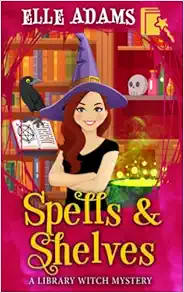
Spells & Shelves - by Elle Adams


May is Mystery Month, and I don't really like mysteries. Often people tell that they think I will like a certain mystery book, or mystery series mostly because they take place in a library, or have a librarian in them. They are almost always wrong, because really I just don't like mysteries. Each May I read one to blog about just so I can include the genre, but (and I can't say this enough) I really don't like mysteries.

I chose this one because it had a witch librarian in it, and I do like witches. For those who like books about orphans who don't know they're magical this one also fills that bill.

When Aurora (Rory) discovers that her late father was a magical person, and that she is being pursued by vampires, she moves in with her three aunts and two cousins who live and work in the library for paranormals. The women are biblio-witches they "weave spell from words". 

One thing Rory learns from her Aunt Adelaide is that the library is "semi-sentient" and I was reminded of Ranganathan's Five Laws of Library Science the fifth one of which is "A library is a growing organism". Ranganathan knew that all libraries are semi-sentient?

Of course libraries are also magical, regardless of whether they are for "normals" or "paranormals".


Friday, April 29, 2022

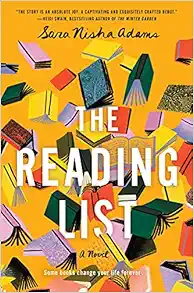
The Reading List - by Sara Nisha Adams


Libraries change lives. The books we read, the people we meet, the physical space, the programs all create the magic, and community of the library. 

When indifferent library worker Aleisha finds a reading list inside of a returned book she not only changes her own life by reading the eight books, she begins to make a difference in the lives of some of the other library patrons as well. Most notable among these is recently widowed Mukesh Patel, who has yet to return the long-overdue book his wife last read The Time Traveler's Wife. Although Mukesh was never much of a reader, his late wife Naina was an avid reader and library user. Through the magic of books (and the library) Mukesh finds a new connection with his beloved granddaughter Priya. It turns out they both love Louisa May Alcott's Little Women and Mukesh begins to think about everyone who is connected by the books they read.

One of the first things I learned in Library School were Ranganathan's Five Laws of Library Science. Although the rules were written almost a century ago, they remain quite relevant:
  • Books are for use
  • Every reader their book
  • Every book its reader
  • Save the time of the reader
  • A library is a growing organism 
Each of these laws is evident in this work about people connecting through books and libraries.

Wednesday, April 27, 2022

The Boy in the Field - by Margot Livesey

In the waning days of the 20th century, siblings Zoe, Matthew, and Duncan discover a stabbing victim left to die in a field, and their lives each take on a new direction, and each finds a use for the library. Teenage Zoe begins dating an Oxford University student. She masquerades as an undergraduate and discussing things such as the Bodleian Librar keeps her from blowing her cover. Matthew, in an attempt to find the perpetrator of the crime, searches for clues in the local papers at the public library. Duncan becomes curious about his birth mother and decides he wants to find her. Zoe suggests he look her up in the phone books at the library. Additionally, other uses of the library are sprinkled throughout the work.

Thursday, December 9, 2021

The Time of Green Magic - by Hilary McKay

When Abi's father remarries and they move, along with her new step-mother and step-brothers, to a tall, narrow, ivy-covered house with colored glass in the windows, and an arched front door with a lantern "straight out of Narnia" her grandmother in Jamaica tells her "So much ivy, so much news! What a time of green magic". Abi and her new siblings soon discover that there is magic in the house as they begin to experience things they are reading in books. Abi gets wet reading about a raft, and animals from the stories begin to appear. 

Abi seeks the help of her father, Theo, a nurse to find out if books can be magic.

'At the hospital', said Abi, 'do people ever come in because of books?'

'They'd be disappointed if they did,' said Theo. 'We're a bloodbath-and-counseling service, not a library. We've got a few kids' picture books and Willy-the-mop keeps a stack of newspapers for emergency puddles, but that's about it.'

'Yes, but do people ever come in because they've had accidents with books?'

'Ah...Right, got you! Yes. Yes they do. Books are dangerous things'.

And Theo goes on to explain how people hurt themselves by reading while walking, or dropping books on their toes, or getting locked into libraries after they close and "get injured breaking their way out". Frustrated, Abi tries harder to explain that she is more interested in magic. Theo then describes how children have hurt themselves by "trying to get through the backs of wardrobes...or "running trolleys into brick walls..."Sitting on broomsticks and launching themselves out of bedroom windows! Bothering dragons!"

Of course books are magic. But are they dangerous? Current events would tell us that they are. Right now, all over the country organized groups are attempting to have whole categories of books removed from school libraries. Books with LGBTQ themes or race or racism are being especially targeted. It is important to note, however, that these attacks are coming from the left and the right. It seems that the word "harmful" has become a catch-all term for any book that someone doesn't like, and is afraid that someone else might.

Although this was about the magic of books there was only one  other place, near the very end of the story, where a library was mentioned. Abi's stepbrother Max goes to the library to find a book that he hopes will help recreate some of the magic he had experienced with their French nanny. 

I found this one in a Little Free Library. It was a quick fun read.  

Friday, May 14, 2021

The Midnight Library - by Matt Haig

Full of regrets, recently unemployed, and grieving the death of her cat Volts,  Nora Seed decides to take her own life. In the twilight world between the life and death Nora is surprised to find herself in a library and face-to-face with Mrs Elm, her school librarian from many years before, the person who had told her that her father had died when she was fourteen years old.

The Midnight Library is filled with green books, each one represents a life Nora didn't live in the multiverse. She can pick out any book and find out what her life would have been like if she had made different choices at each of her turning points. There are many possible lives that Nora is given the opportunity to visit. Would she like to be a rock star? a pub owner? a glaciologist? a vintner? What if she had married Dan rather than canceling at the last minute? What if she had just gone on that coffee date with Ash, where would she be now? Is there any world in which Volts is still alive?

Nora also meets other "sliders" - those like her who are moving between lives not lived. Each "slider" has their own guide and space in which to explore their lives. Not all sliders travel via library books - Hugo travels through old VHS tapes in a video store, with his deceased uncle as a guide, for instance. 

In the aptly titled chapter "God and other Librarians" the omniscience of Mrs Elm as Nora's guide is made abundantly clear, as is her role as a librarian. She explains to Nora that "The library has strict rules. Books are precious. You have to treat them carefully." 

The librarian stereotype is on display as well when Mrs Elm admonishes Nora to "Please be quiet...This is a library".

Ultimately Nora wishes to escape the Midnight Library, especially when she realizes that it is about to self destruct, but how does one do that when there are no doors? Mrs Elm to the rescue: "Who needs a door when you have a book?" she asks.

A new spin on an old theme. Anyone who grew up watching The Wizard of Oz won't be surprised by the ending.


Wednesday, April 29, 2020

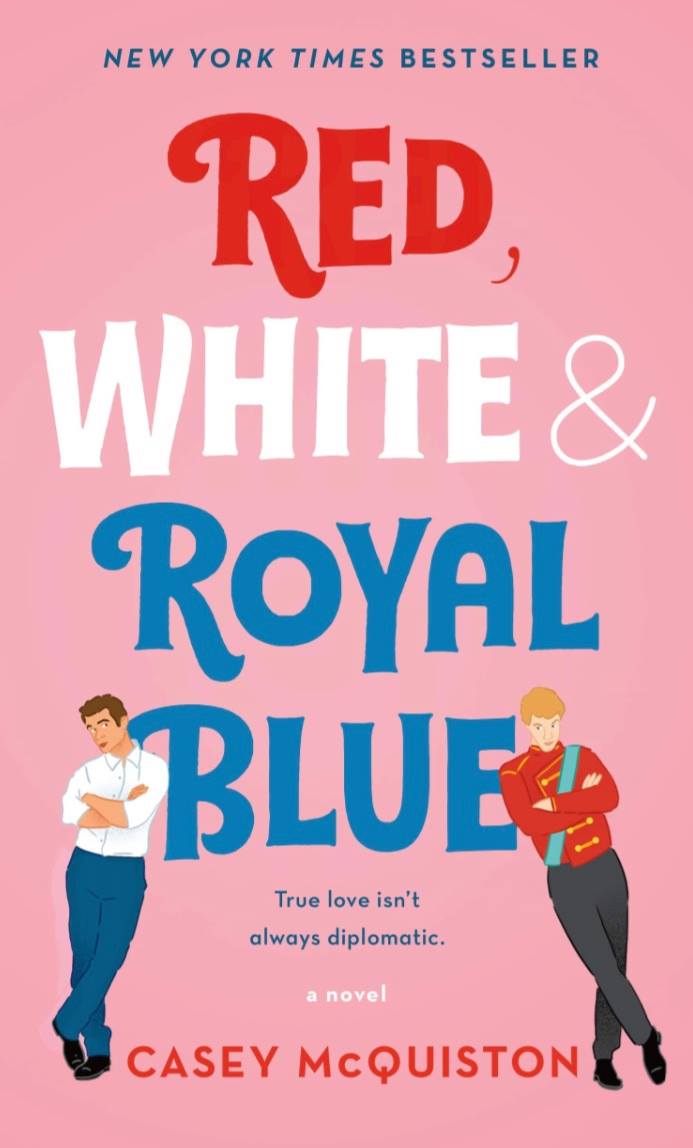
Red, White & Royal Blue - by Casey McQuiston


The Buck(ingham) Stops Here!

James and I read about this book on some listicle back in February while we were on our way to Martha's Vineyard. I remember the description said something about this being covered all over the place during the summer of 2019 and if you didn't know about this love story between the Prince of Wales and the First Son of the United States you weren't paying attention. I really don't know how I missed it. I see the book trade magazines regularly come across my desk, and this is exactly the kind of book that would have caught my eye. But here we are.

Anyway, since the trip to the "Vineyard" was pre-pandemic the local bookstore (Bunch of Grapes) was still open. We went in and purchased it with the intent that we would read it together.  The story takes place in the present day in a parallel universe in which there is no pandemic, and the country isn't being run by a completely incompetent president.

What starts as a bro-mance orchestrated for the press turns into a full on love affair when the biracial, bisexual son of the first woman president of the United States falls for Henry, the gay Prince of Wales. Not prepared to come out to their families, much less the rest of the world, the two manage their long-distance romance by making up reasons to hop across the Big Pond, as well as via chat messages and e-mail. When their steamy electronic messages get leaked to the press the two find themselves in a true diplomatic nightmare for the White House and the Crown. Can these two millennials make history with an international sex scandal?

The real nail biter for me, though, was wondering if these two would ever use a library. James and I very much enjoyed reading this, and I was truly worried that it would not find a place on this blog, as the first time a library is even mentioned is not until page 386 (of 418) and that was simply as a place that was nixed as venue for the official royal "courtship photos".
Alex has to admit, the royal photographer is being exceedingly patient about the whole thing, especially considering that they waffled through three different locations-Kensington Gardens, a stuffy Buckingham Palace Library, the courtyard of Hampton Court Palace-before they decided to screw it all for a bench in a locked-down Hyde Park.
There is a nod to the intellect of these two by way of "a pile of books" stacked up next to the bench in the photos.  The use of the indefinite article in front of "stuffy Buckingham Palace" caused James to wonder aloud just exactly how many libraries there are in the palace, and for me to follow up with, "and just how many of those are stuffy?"

Interestingly, after making me wait until the book was almost done to satisfy my frustration, the author manages to sneak in one more mention of a library - the Library of Congress of course - on page 415.

This is truly a fun romance about a well-matched pair. Equal in good looks, intellect, and political power there's no trite story about a prince pretending to be just a regular guy, or a poor admirer hoping the prince will notice them. Only the use of a library could have formed a more-perfect union between these two.

We started reading this just about the time that our governor issued the stay-at-home order for Massachusetts, and we read a bit each day. It was the perfect antidote to our work-at-home days - a little daily vacation when we could forget about what was going on in the rest of the world and simply have a laugh together.

Sexy, smart satire. Read it with someone you love.

Wednesday, January 15, 2020

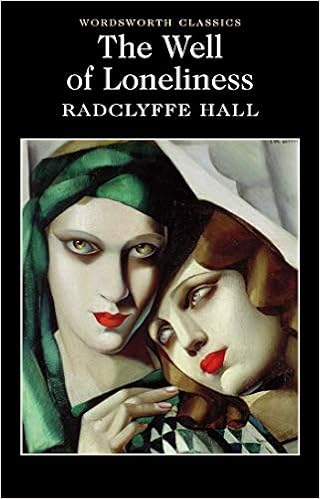
The Well of Loneliness - by Radclyffe Hall


Originally published in 1928, and promptly banned in England, this fictionalized account of the author's own life was cutting-edge lesbian writing in its day.

Born into wealth and privilege Stephen (her parents wanted a son) nevertheless has a difficult time growing up realizing that she is somehow different from her peers. As an adult she recognizes her desires, and is asked to leave the family estate (Morton) by her un-understanding mother. She had shared a love of books with her father, Sir Philip, who "had one of the finest libraries in England". Before his early death the two had read and discussed literature together. She also discovered after he died that he had divined his daughter's inclinations from having read the works of Richard Freiherr von Krafft-Ebing whose work, with her late father's marginalia, was kept on a special bookcase in his study.

Eventually Stephen settles in Paris with her partner Mary who is very much interested in Stephen's earlier life, although she would never welcomed in Morton
Mary would want to be told about Morton...she would make Stephen get out the photographs of her father, of her mother whom Mary thought lovely...Then Stephen must tell her of the life in London, and afterwards of the new house in Paris; must talk of her own career and ambitions, though Mary had not read either of her (Stephen's) novels-there had never been a library subscription.
 There was no "subscription" necessary for me to read Hall's book. I checked it out with my library card at the free public library in my town.

Thursday, April 12, 2018

Educated - by Tara Westover


Raised and home-schooled by survivalist parents in the Idaho mountains Tara Westover rejected her family's admonishments not to go to college and enrolled in Brigham Young University (BYU) before she turned 18. Ultimately she becomes a Cambridge-educated PhD, but not without painfully examining her role in the family. Her father's conspiracy theories about universities and the Illuminati were made known to her long before she thought about going to college herself. Her mother had taken charge of her children's homeschooling, which mostly consisted of letting them learn what they wanted when they wanted, and included occasional trips to "the Carnegie library in the center of town".

Westover recognized that she was one of the least disciplined of her siblings when it came to "doing school" which gave her a lot of reason to doubt her abilities when she arrived at BYU. Her misgivings were magnified when she discovered that her classmates had an understanding of US culture and history that she did not share. Her realization that everyone else knew what the Holocaust was, for instance, caused her not only embarrassment, but also opened her eyes to the fact that her peers shared a collective knowledge that she was missing. She did not even know what she did not know.

If Westover had anxieties about her place at BYU they were only compounded when she arrived at Cambridge. Upon her arrival on campus she and her denizens were invited to take a tour of the chapel, including the roof. She describes the experience of watching her classmates, and her professor fight the wind on top of the building as they cling to the wall while she climbs higher. Finally explaining to her professor that "she'd roofed [her] share of hay sheds" and that
The wind is just wind. You could withstand these gusts on the ground, so you can withstand them in the air. There is no difference. Except the difference you make in your head...I'm just standing...You are all trying to compensate...You've made yourselves vulnerable. If you could just control your panic, this wind would be nothing.
Even this insight though, was accompanied by apprehension
I wanted the mind of a scholar, but it seemed that Dr. Kerry saw in me the mind of a roofer. The other students belonged in a library; I belonged on a crane.
Her ultimate success in earning her PhD demonstrates that she certainly did belong in a library, and the final third of the book (from the time she lands in Cambridge for the first time) is scattered with references to using it. This stands in stark contrast to the first 200 (plus) pages, where there is only one.

Monday, July 31, 2017

Harry Potter and the Deathly Hallows - by J.K. Rowling


SPOILER ALERTS

Knowing that Harry Potter does not return to Hogwarts for his final year of schooling in the seventh book, I feared that there would be no libraries to blog about as I wrapped up my seven-year tribute to my favorite literary wizard. Fortunately, it turned out that my worries were for naught. Although librarian Madam Pince never makes an appearance, Harry, Ron, and Hermione demonstrate that books, and libraries are still important information resources, especially when hunting horcruxes. Hermione's "mobile library" (which she carries in a magic beaded bag) proves to be an invaluable asset, especially the book on horcruxes which she most certainly did not steal from the Hogwarts' library.
It wasn't stealing...They were still library books, even if Dumbledore had taken them from the shelves.
So right Hermione, and really Dumbledore must have known, as smart as he was, that removing books from the library only would make them that much more attractive, and as Hermione also points out, if Dumbledore hadn't wanted them to have the books he wouldn't have made getting hold of them as easy as using a simple summoning charm!

In London the friends discover, by looking at library records, that the orphanage where Tom Riddle (a.ka. Lord Voldemort) was raised had been demolished. Convinced that the Dark Lord wouldn't have hidden anything as valuable as a piece if his soul in the place he most wanted to escape anyway, the three move on.

Happy Birthday, Harry - the boy who lived! You need no horcruxes, nor hallows, nor sorcerer's stones in order to live forever. Eternal life is yours through the magic of books, as new generations of readers will discover your story.

Always.

Wednesday, July 12, 2017

Miss Peregrine's Peculiar Children (Books 2 & 3) - by Ransom Riggs


I finally got around to reading the rest of the series from Miss Peregrine's Home for Peculiar Children. When I discovered that the third book was called Library of Souls I really couldn't put it off any longer. Books two and three continue the tale of Jacob and his Peculiar friends using the same vintage photograph device as was used in book one.

Book 2 (Hollow City) is not so library-centric, with the Peculiars encountering only one library as they run through a bombed-out London during World War II seeking shelter, not only from the bombs, but from the hollows chasing them.
Still I could feel them coming. There were out in the open now, out of the cathedral, lurching after us, invisible to all but me. I wondered if even I would be able to see them here, in the dark: shadow creatures in a shadow city. 
We ran until my lungs burned. Until Olive couldn't keep up anymore and Bronwyn had to scoop her into her arms. Down long blocks of blacked-out windows staring like lidless eyes. Past a bombed library snowing ash and burning papers. Through a bombed cemetery, long-forgotten Londoners unearthed and flung into tress grinning in rotted formal wear.... 
Book three finds our heroes in an especially creepy place called Devil's Acre where murder is "tolerated with reservations" and piracy is "discouraged". "Is anything illegal here?" Addison (the talking dog) asks. "Library fines are stiff" is the reply. "Ten lashes a day, and that's just for paperbacks". Astonished that the place even has a library Addison is even more surprised to learn that there are actually two "though one won't lend because all the books are bound in human skin and quite valuable." Neither of these libraries were, however, the Library of Souls, a place where the souls of peculiars are deposited for reuse. As explained in Tales of the Peculiar, the only book in "peculiardom" ever to be banned
It was thought that peculiar souls were a precious thing in limited supply, and it would be a waste to take them with us to the grave. Instead at the end of [their] lives [they] made a pilgrimage to the library where...souls would be deposited for future use by others. Even in spiritual matters...peculiars have always been frugal-minded.
Of course special librarians "who could read peculiar souls like they were books"  are needed in order to access the souls in the mythical library, and finding one of them was near impossible as "a librarian hasn't been born for a thousand years".

Librarians really do matter.

Wednesday, June 14, 2017

A Year of Living Prayerfully - by Jared Brock


Our One Book One Community (OBOC) steering committee is looking for a light-hearted book with a spiritual theme to read next spring. We had a suggestion of Religious Literacy: What Every American Needs to Know - And Doesn't by Stephen Prothero which I started to read, and do like, but I am not sure it is a good choice for a community read. Our community likes to read stories, and Prothero's book is not only not a "story" it is also rather didactic (as the title would suggest). These are two things that make the book a less-than-ideal choice for OBOC. With this in mind I started to look for other books - specifically something with a plot. Then I remembered that during my "Year of Reading 'Year of' Books" I read two religiously-themed humorous books that were about spiritual quests: The Year of Living Biblically by A.J. Jacobs; and My Jesus Year by Benyamin Cohen. I correctly surmised that more such books must have been written the last few years and selected Brock's book as one that had potential for OBOC. Brock's story features a genuine inquiry into what prayer means. He travels across the globe, often with this wife, to talk to religious leaders about their own spiritual journeys and ultimately finds more questions than answers.

As a Unitarian Universalist I respect and support each person's search for truth and meaning (see our fourth principle). I was intrigued with Brock's quest, and especially appreciated his final comments regarding having more to learn
After an intense year of learning about prayer from some of the best sources on earth, I don't feel like I'm further along. If anything, I feel like a first-year university student-I now know all the things I don't know-all the things I haven't yet learned, understood, or experienced. I am not, in any way, a prayer expert. I'm a failing student who's playing catch up, at best. Rather than coming to the end of a journey, I've only just begun.
As he continues his inquiry I hope he branches out beyond Judeo-Christian traditions. His interactions with Muslims were limited and I don't recall him meeting with any imams. Nor did he talk to any Buddhists (he did meet with one who had converted to Christianity) or Hindus. Likewise, his dealings with women religious leaders were rather narrow. I think the woman with whom he had the longest conversation was Rachel Phelps-Hockenbarger, daughter of Fred Phelps of the infamous Westboro Baptist Church. I have to give him credit for his perseverance in getting the interview, though.

Brock's travels took him to, Israel, several parts of Europe, his native Canada, the United States, and also to North and South Korea. I was impressed with his courage in voyaging to North Korea, and his refusal to bow down to the body of Kim Il-Sung. There were no visits to any African or Latin American countries, however, and I suspect that if he had spoken to someone in Central or South America about liberation theology, or talked to anyone in Africa about colonialism, or attended a religious ceremony on an Indian reservation in the United States, he might not have simply and naively accepted the comments he found in Christianity Today that
Missionaries brought about reforms, fought colonialism, taught people to read, and rallied support for struggling peoples around the world. The conclusion the article makes is striking: "Want a blossoming democracy today? The solution is simple-if you have a time machine: Send a 19th-century missionary."
I was, of course, glad to see that he began his globe-trotting voyages at his local library. On page one Brock tells us
Michelle and I decided to live prayerfully for an entire year. It was a nice, shiny idea. But where should we start? 
With For Dummies, obviously. I borrowed a copy of Christian Prayer for Dummies from the library.
After reading a bit of the work though, he found himself unimpressed and
called it quits, returning the book to the library, where [he] assumed it would remain until next year's Friends of the library book sale. 
He also visited the library at the Monastery of Vatopedi (and even borrowed a book there) and while on Mount Athos talked to Father Philotheos who, when asked to define prayer, responded
Prayer isn't one thing...You can read a whole university library full of books that have been written just on the Jesus Prayer.
Brock made at least one other attempt to visit a library while on his journeys. Sadly, however he found the library (and the museum) at Monte Cassino closed (this after he paid his entrance fee). The gift shop, however, was open.

Ultimately, I think I will keep up my own search for a One Book One Community read and look for something that explores religion beyond what one will find in the Judeo-Christian traditions.

Tuesday, May 2, 2017

The Road to Little Dribbling - by Bill Bryson


My husband and I couldn't resist picking up Bill Bryson's latest work after so very much enjoying Notes from a Big Country and A Walk in the Woods. We weren't disappointed as we once again enjoyed some laugh-out-loud reading time together.

Following what he designates as "the Bryson Line" the author transected the United Kingdom from Bognor Regis to Cape Wrath, stopping at a variety of bergs in between, visiting tourist traps, and little known spots alike, he makes keen observations on the people and places along the way.
The Bryson Line

It is unclear whether or not he visited any libraries on this particular journey, however, he did write about things he had learned in libraries
  • Such as the fact that Dwight D. Eisenhower had a home called Telegraph Cottage on the edge of Wimbledon Common during World War II and
  • How the system of road numbering works in Britain in fact he was "surprised to learn that there is a system to British road numbering...it is not like systems elsewhere."
He also discussed libraries as part of an important part of a community
  • Even if the community never existed. Motopia "was a proposed model community based on the uniquely unexpected idea of banishing cars." Motopia, however, was to include "housing, shopping, offices, libraries, schools, and recreational space" with its inhabitants "getting from place to place on moving sidewalks or in taxi boats along lakes and a small network of canals".
  • He also points out that even when Britain was referred to "the Sick Man of Europe...there were flowerbeds in roundabouts, libraries, and post offices in every village, cottage hospitals in abundance, council housing for all who needed it" and wonders why "the richer Britain gets, the poorer it thinks itself"  
  • He notes that Canford Cliffs, while lacking many of the shops he remembered from his previous visit thirty years prior, still maintained "a lovely little library and a proper village center."
  • In a completely deserved dissing of Birmingham, which had announced "massive spending cuts" that would make two-thirds of city employees "redundant" Bryson points out that this move included halving the staffing levels at the new £189 million central library, as well as cutting its hours by 46%, among so many other things. Bryson' sarcasm about all of this is right on target
All of this is being done to save £338 million over four years. That sounds like an enormous sum, but in fact it is a saving of about £1.40 per week per citizen. I wonder what all those lucky people of Birmingham will do with that extra £1.40 flowing into their pockets every week.
American citizens would do well to pay attention. Tax cuts rarely mean that middle and working class people will benefit.

Bryson also uses libraries as metaphors, or simply uses them to make a point
  • He doesn't like it, for instance, "when a hotel puts some books in a bar and calls it The Library."
  • He remembered "the Natural History Museum as being almost empty of other visitors and very quiet, like a library" although, that aspect had changed for his recent visit. He does point out, however, that the whole country of England is quiet in comparison to the United States "like a big library".
  • He suggests that one way to "receive formal adulation" in the United States is by "paying for a hospital wing or a university library or something along those lines." The other way is to "single-handedly take out a German machine-gun nest while carrying a wounded buddy on your back at a place called Porkchop Hill or Cemetery Ridge..."  
This is an entertaining book, and would be a good choice for a vacation read.

Tuesday, March 14, 2017

Brave New World - by Aldous Huxley


A few weeks ago I read an article by Margaret Atwood explaining why we should all read Brave New World at which point I realized I had no choice but to look it up in the catalog of the library where I worked, find the call number, walk up the two flights of stairs to retrieve it, and check it out.

The brave new world described in the book is painted as a "utopia", but readers easily see it for the dystopia that it is. Humans are created, rather than born, each to a specific caste (Alpha, Beta, Gamma, Delta, or Epsilon) for which they are programmed to believe is better than the others. Everyone is happy with their lot, and regularly provided drugs and sex to keep them happy. Everyone also knows that "everyone belongs to everyone else". Worst of all books are censored.

 We learn early on that Deltas are conditioned to hate books. (Presumably this is true of Epsilons, and perhaps Gammas as well). This was because "you couldn't have lower-caste people wasting the Community's time over books, and that there was always the risk of their reading something which might undesirably decondition one of their reflexes". While not verboten for the upper-castes, books are still considered a waste because "you can't consume much if you sit still and read books." And even at Eton (where you can find the Alpha Double Pluses) the library "contains only books of reference. If...young people need distraction, they can get it at the feelies."

Ultimately we learn what is almost always true about those who would keep certain books from others - that those in charge have access to all of them. The censors believe that they alone can handle the information within. The masses simply cannot understand them, and those who might understand may be attracted to them, and then might not like the new things the controllers want them to like.

In the end the propaganda of the Brave New World isn't so new. The same rhetoric has been around for centuries, and still continues today.


Monday, October 31, 2016

Harry Potter and the Cursed Child - based on a story by J.K. Rowling, John Tiffany & Jack Thorne


I spent the weekend before Halloween reading the eighth book in the Harry Potter series - a script rather than a novel. Harry and his friends (and enemies, and frenemies) return as adults with jobs, children, and presumably mortgages, and all the other impedimenta (pun intended!) of grown up life.

The story begins where the epilogue of book seven left off - at Platform 9 3/4 with Harry and Ginny's son Albus Severus heading to Hogwarts for the first time. Albus develops a unlikely friendship with Scorpius Malfoy, son of Draco, and it is quickly made clear that it's the Potter kid who is the bad influence in this duo.

There is a lot here to entertain Potter fans. I enjoyed the work, and there were plenty of allusions to the rest of the series including fun with the invisibility cloak, the Marauder's Map, and Time Turners.

Libraries and books are key in this work. Hermione (now the Minister for Magic) not surprisingly has a large library in her office, and as Scorpius points out "There are some serious books here. Banned books. Cursed Books" including some that are "not even allowed in Hogwarts!" even in the Restricted Section.

So what we see is that Hermione, who in book five so enthusiastically points out that "if [Professor Umbridge] could have done one thing to make absolutely sure that every single person in this school will read your interview, it was banning it!", now is a practitioner of  censorship herself. It appears that like many book banners she believes that she can handle the information found in the threatening works, but must protect from others from the dangers within. This is not the only place in the story where we see the government hiding information from its people. So scary, really.

There are two scenes in the story that take place in the Hogwarts library. The librarian's role is most disappointing. The unnamed librarian has exactly one line.

All together now, let's hear it...

"Ssshhh!"

Sheesh.

Sunday, July 31, 2016

Harry Potter and the Half-Blood Prince - by J.K. Rowling


It's that time of year again - Harry Potter's birthday! This was my third go round for the sixth book in the series. I still love the stories as much as I ever did, and I still hold steadfast in my opinion that the first book is the best one.  I find the later books, like The Half-Blood Prince, are more scary than magical. Which is not to say I did not enjoy reading this one again. This was my first time reading it looking specifically for library references. The first of which appears almost halfway through the book: Harry and Hermione speak in whispers about Ron and Lavender Brown, love potions, Harry's marked-up copy of Advanced Potion-Making, and how anyone could have snuck Weasleys' Wizard Wheezes into Hogwarts. Meanwhile librarian Madam Pince "prowled the shelves behind them". She apparently prowls until closing time when she "appeared around the corner, her sunken cheeks, her skin like parchment, and her long hooked nose illuminated unflatteringly by the lamp she was carrying." At which point she notices Harry's copy of Advanced Potion-Making and deems him a "depraved boy." And, as it turned out Madam Pince was not the only one lurking. We discover near the end of the book that Draco Malfoy also overheard the conversation about sneaking in potions, providing him with an idea about how to get a bottle of poisoned Mead into the Hogwarts castle.

Even in the wizarding world the library is a good excuse when one needs a get-away plan. Harry gets tired of telling everyone how it feels to Apparate and is "forced to lie and say that he needed to return a book to the library." Likewise Harry lies to Snape when asked where he found out about the Sectumsempra curse. He says it was in a library book, when of course, it was really found in his annotated edition of Advanced Potion-Making.

Super-smart Hermione has always made tracks to the library when she needed information but in this devastating volume "the Hogwarts library...failed Hermione for the first time in living memory. She was so shocked, she even forgot that she was annoyed at Harry for his trick with the bezoar." The library does come through for her, though when she finds a "whole collection of old Prophets up there" one of which contains information about one Eileen Prince. Could the Half-Blood Prince have been a girl?

Librarian Madam Pince makes a final appearance at the end of the book during Dumbledore's funeral "standing beside Filch, she in a black veil that fell to her knees, he in an ancient black suit and tie reeking of mothballs." Well, this certainly gives one pause, doesn't it. Could Pince and Filch be an item? We know Filch is a squib, which may be to blame for his sour personality. I'm beginning to think that Madam Pince is a squib as well, and perhaps that is to what we owe her nastiness. But really, there is no reason for any librarian to feel that way. One doesn't need to work at Hogwarts to know that all libraries are magical places, after all.