Showing posts with label children's fiction. Show all posts

Thursday, April 23, 2026

The Lost Library by Rebecca Stead and Wendy Mass

Mysteries are among my least favorite genres. People love to recommend mystery novels to me though because, apparently, a lot of fictional librarians love to solve mysteries. The Lost Library is a light mystery chapter book that I did enjoy. There was no murder (although there were some friendly ghosts).

The book is told from several points of view:

  • Mortimer - a cat (also known as Goldie, Sunshine, Buffy, and Dear Cat)
  • Evan - a fifth grader who is a bit worried about going to middle school next year
  • Al - Assistant Librarian at the History House

The town of Martinville has been without a public library ever since a fire burned theirs down twenty years ago. When Al decides to install a Little Free Library on the town common Evan is intrigued by that fact that almost all of the books in it were checked in to the town library on the date of the fire. He is especially interested to discover the name of famous mystery author (H.G. Higgins) written on one of the checkout cards. He is determined to find out where the books came from, and if Higgins ever lived in Martinville.

Something I do like to see in books is a bit of metafiction. One of the first books Evan takes out of the Little Free Library is How to Write a Mystery Novel. Rather than penning his own book though, Evan uses the suggestions for writing a novel in order to solve a mystery.

Now that I have finished with the book (and my blog post) I will place this in one of the dozen Little Free Libraries in my own town for someone else to discover.


Monday, December 2, 2024

The Ogress and the Orphans - by Kelly Barnhill


My reading goal for 2024 has been to read 60 books about dragons (because it is the year of the dragon, and I turned 60). So far I have read fify-eight and a half dragon books. I have every reason to expect that I will reach my goal. I did not necessarily seek out dragon books that were also library books, although serendipitously, many did fill the bill - a list is provided at the end of the post. 

As part of the project, earlier this year I read The Girl Who Drank the Moon by Kelly Barnhill which told of a locked library. Evil doers were guarding knowledge from the riff-raff. The Ogress and the Orphans has similar themes. 

A shape shifting dragon arrives in the village of Stone-in-the-Glen in the form of a hero who vanquishes dragons and becomes the mayor. As a dragon he first burned down the library, the school and other buildings and then as mayor convinced the villagers that he saved them. Without access to books and knowledge the villagers are convinced that the mayor alone can save them. After all "books are dangerous". The village orphanage, however, still has a library and the orphans are well read, and well equipped to truly save the town from the mayor (and itself).

For another library-positive dragon book by Kelly Barnhill read When Women were Dragons. I listened to this one on audio while in the car, so I don't have specific notes about the wonderful librarians in this work, but I will say it was probably my favorite of all the dragon books I've read so far.

As promised, other dragon/library books include:

Raising Dragons by Jerdine Nolan 
Dealing with Dragons by Patricia Wrede
Fourth Wing by Rebecca Yarros
There's a Dragon in the Library by Dianne De Las Casas
The Neverending Story by Michael Ende
The Dragon in the Library by Louie Stowell
The Hero and the Crown by Robin McKinley
Daydreamer by Rob Cameron


Thursday, October 3, 2024

Ban This Book - by Alan Gratz


 When Amy Anne learns that her favorite book, From the Mixed Up Files of Mrs. Basil E. Frankweiler, along with a host of other works, has been removed from her school library she and her friends start the BBLL (Banned Books Locker Library) so that they can share the books with classmates who want to read them. As the book bans continue, and their beloved school librarian Mrs. Jones is replaced by a "shushing" imposter, they decide to fill out reconsideration requests for ALL the books in the library as a form of civil disobedience. They have no problem coming up with a reason for each book, from witchcraft to sexual content to violence to "it might confuse children", or in the case of a book of riddles, it might make kids feel bad if they can't figure out the answer. Never mind that it might make them feel good if they CAN figure it out.

Amy Anne is surprised to learn that there is a field of study called "library science" and enlists the help of Mrs. Jones to set up the BBLL. Mrs. Jones provides Amy Anne with some old equipment including a date stamp card. Once Amy has this she feels like a real librarian and only needed "a pair of glasses on a chain" to be ready for her "official librarian membership card."

One of the banned books is Judy Blume's classic work Are You There God? It's Me MargaretMrs. Jones explains that back in the day when due date stamps were used that libraries also used cards and pockets to keep track of who had checked out the books. She shows Amy Anne some old books that still have the cards and pockets. It is here that she learns that the parent behind most of the challenges (Mrs. Spencer) checked out Blume's work multiple times when she was a student at Shelbourne Elementary. Amy Anne "outs" Mrs. Spencer, which, let's face it, she kind of deserved. However, Mrs. Jones does take the opportunity to explain to Amy Anne about patron privacy.


Saturday, September 14, 2024

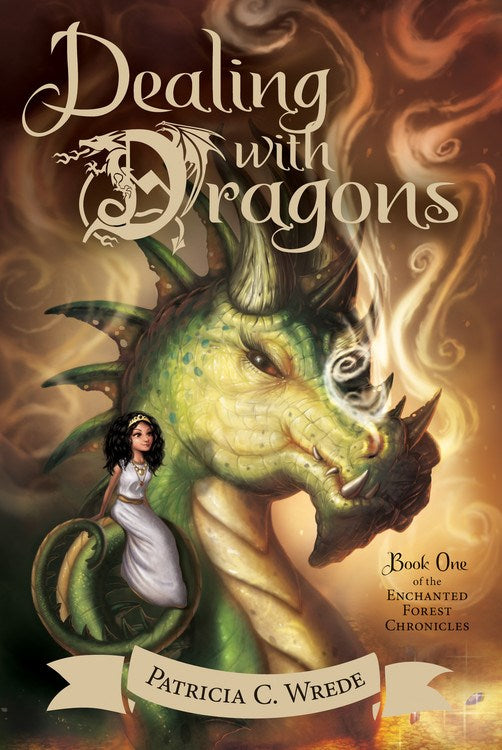
Dealing with Dragons - by Patricia Wrede


Princess Cimorene has never been interested in the traditional proper behaviors expected of those in her station. She is especially not interested in the arranged marriage her parents have planned for her. Although they have selected a handsome prince, he is a bit dull and Cimorene doesn't want to marry in any case. She goes off to live with the dragons and offers to serve the dragon Kazul. Although she has many offers from knights and princes to "rescue" her she thwarts them all.

Kazul's private library is a mess, and Cimorene takes care to organize it. She also does research in the library to find a fireproofing spell for herself. Ultimately she is given the title King's Cook and Librarian and lives happily ever after.

One of the sixty books about dragons I'm reading during this year of the dragon in which I turned sixty.

Tuesday, September 10, 2024

The Dragon in the Library - by Louie Stowell


Every library has a dragon sleeping underneath it. The dragon needs stories and quiet to keep it asleep lest it awaken and wreak havoc upon the world. It is also true that all librarians are wizards and are in charge of keeping the dragon in its dream state.

Young Kit discovers that she is a wizard when she meets Faith Braithwaite, Head Librarian of the Chatsworth Library "a boring-looking concrete building with automatic doors that didn't work right..."

I had some concerns with some of the things in this book:

In one passage Faith tells Kit and her friends that there are certain books that they keep away from the general public "because they're dangerous...[they] have power even if you're not a wizard". She goes on to explain that they can change you into a marshmallow if you're not careful, but frankly it just sounds like good old censorship to me. Dangerous books indeed!

In another Faith asks Kit and her friends to help shelve some books: 

"You just need to match the number on the spine to the number on one of the shelves. There's a list of where you'll find each number, but I'm sure you'll get the hang of it quickly". Right, because everyone knows that there is no reason to train people who work in libraries how to properly shelve books. Sheesh.

Faith also asks Kit to do story time, even though Kit doesn't like to read out loud. Kit in fact does a crappy job of it. Well, she just needs to practice. Story time takes more preparation than simply picking up a book and reading it to a group of kids. It's takes planning. At the very least we'd expect that the person conducting the story time had read the book at least one time before! 

Librarians may not be wizards, but we are trained professionals.

One of the sixty books about dragons I'm reading for the year of the dragon in which I turned sixty.


Sunday, July 14, 2024

Do Not Bring Your Dragon to the Library - by Julie Gassman


A rhyming book that explains everything that can go wrong if you bring your dragon to the library. 

The library in the story is called the Honalee Free Library - a nice touch!

Thursday, July 11, 2024

There's a Dragon in the Library - by Dianne de Las Casas


No one believes Max when he tells them there is a dragon eating all the books in the library - not his mother, not his father, not the head librarian, not his teacher. Only Officer Riley suggests that they go and look, but by then it is too late. 

Of particular note is that the head librarian is a man. Because of course the head librarian is a man. Leadership positions in libraries always go to men. We can't really expect otherwise though. It's just so hard to find women in the field.😏

One of the sixty books about dragons I'm reading this year of the dragon, in which I turn 60.

Thursday, May 30, 2024

Raising Dragons - by Jerdine Nolan

One of the sixty books about dragons I'm reading in honor of my sixieth birthday in the Year of the Dragon I remembered reading this one to my now-adult child when he was little. What I didn't remember was that the unnamed narrator learned some of what she knew about dragons by reading a library book!

I found the whole story on YouTube.


Wednesday, March 13, 2024

A Suicide Bomber Sits in the Library - by Jack Gantos


I first learned of this "unpublished" work when I read the Booklash Report from PEN America which describes several cases of pre-emptive censorship (in which authors either change, or pull, their works before publication in response to public accusations of harm. 

When criticism of a book veers into accusations of harm, authors may feel compelled to respond to their audiences in real time—typically through social media. In some cases, this means fact-checking details that have been lost or misrepresented in the social media uproar. In 2018, for example, Dave McKean, the illustrator of the controversial children’s graphic novel A Suicide Bomber Sits in a Librarytweeted to clarify that the book’s Muslim protagonist was not in fact illiterate—a sticking point in a since-deleted, viral tweet posted by comics publisher Zainab Akhtar.

It turns out that the book never got published anyway, over charges that it was "Islamophobic". But then, I discovered that the "unpublished" work had actually been published as part of an anthology (Here I Stand edited by Amnesty International) in 2016. An interlibrary loan request brought this work to me so I could read the story for myself. 

The short story does not include McKean's illustrations (which would have appeared in the graphic novel). I think it is clear, however that the protagonist is illiterate. We see this in the very first paragraph. 

He has been told to fear nothing and that he will be perfectly safe in the library. Not even the secret police will think to look for him there, since he cannot read.

There is no indication in the rest of the story that the boy knew how to read.  

While sitting in the library the boy watches as others select and enjoy books, and begins to wonder what he is missing.

The suicide bomber...wants to ask what happens next in the story but he has been instructed to remain silent because books will master him just as they have mastered his enemies. He has been taught that books create a false life in a godless world that should not exist. Books cannot be trusted when only God has the key to paradise.

Well, this certainly reminds me of current events - censoring a book about censorship. 

Those on the left who would censor books do not like to be compared to those on the right who do the same. It is difficult to see oneself reflected in an unflattering light. For another example of left censorship see this article from The New York Times.

I end my post with this quote from the book.

He walks away thinking of the faces of the readers in the library. They were not ruined. They were happy. They were safe. Whatever power lived within those books did not hurt them (emphasis mine)

More information about the controversy can be found in this article from the Guardian. 

Tuesday, October 17, 2023

Answers in the Pages - by David Levithan


Donovan Johnson's mother likes to read the end of books first, so she isn't surprised when she finishes the story. When she reads the last sentence of The Adventurers (the book assigned to her son's fifth grade class) she is sure the two main characters  (Rick and Oliver) are gay. The sentence reads:

At that moment Rick knew just how deeply he loved Oliver, and Oliver knew just how deeply he loved Rick, and the understanding of this moment would lead them to much of the happiness and adventure that came next.

Taking this single sentence out of context she begins calling other parents to express her concern. She takes Donovan's copy from him and issues a formal challenge to the book. All the students in Mr. Howe's class have to turn in their copies while a decision is being made. Fortunately Donovan had the forethought to check out the school library copy so he could finish the story for himself.

Donovan describes the scene in his classroom when the parents come to turn in their students' copies  of the book

There were other parents, like Mr. and Mrs. Fitzhugh (Allison's mom and dad) and Mrs. and Mrs. Pausacker (Kira's moms), who were explaining that they were not turning in their child's copy of the book, because they didn't believe that parents like my mom should have the power to choose what their own children read or didn't read.

Donovan uses the school library computer to send an email to the author of the book in the hope that the question of Rick and Oliver's sexuality will be settled. Donovan also lets the author know that the book would be on the agenda of an upcoming school board meeting.

There are three parallel stories being told in the book. In addition to Donovan's, we see some of Rick and Oliver's story in The Adventurers, and finally we see Roberto and Gideon, two fifth graders who discover their romantic attraction to each other without concern about what others are fighting about. 

The question of Rick and Oliver's romantic proclivities is never settled. And we are left with the question - Does it even really matter if Rick and Oliver are gay? 


Tuesday, August 1, 2023

There's Something for Everyone at the Library

!Barbie Spoiler Alert!

My husband returned from a two-week trip to the Amazon last week so I took a few days off of work for us to spend together. When he asked what I'd like to do on Wednesday I told him I wanted to see the Barbie movie. Sporting his pink oxford shirt he purchased the tickets online and we set off our local theater (which thankfully is never crowded). We both thoroughly enjoyed the film.


I am always happy to see someone use a library in a film and Ken wasted no time finding one in The Real World to do research about the patriarchy. He then used the information to brainwash the Barbies to turn  Barbieland into an unrecognizable dystopia. 

The same week that I saw the Barbie movie I revisited a favorite book from my childhood - Fuzzies: A Folk Fable for All Ages. First published in 1971 this hippie-dip book tells of a beautiful valley where everyone is happy all the time (because they have Fuzzies). Their beautiful utopia is disrupted by the evil Juanita the witch who, after doing some research at the library, comes up with a plan to convince the people of the valley that there is a shortage of Fuzzies. The sharing stops and the hoarding begins.


If a person based their opinions of libraries only on these two works, they might believe that libraries are bad things. But never forget, libraries are for everyone. Ken took advantage of what he learned at the library, but  there was nothing stopping Barbie from accessing the same information. I would argue that it would have been to her advantage to read the same things Ken did. Knowing what you are fighting against provides a strong advantage. As for the people of the valley, I expect that keeping strictly to themselves and never learning about what else was going on in the world worked to their disadvantage. Books can be mirrors or windows. 

Wednesday, June 28, 2023

Attack of the Black Rectangles - by A.S. King

When Mac and his friends are assigned to read Jane Yolen's The Devil's Arithmetic in their sixth-grade lit circle they are interested in the story about a young girl who time travels to a World War II concentration camp. They are taken aback when they discover that two pages of the copies they've been given by their teacher have redacted passages. Several words have been blacked out with ink. They set out to find out who defaced their books, and what they were trying to hide. Finding out the original text was accomplished by locating a copy at the local bookstore. They had first tried the local public library but all copies were checked out. 

Mac and his comrades discover that their own teacher was responsible for the censorship. They are rightly insulted when they find out that some adults were concerned that they would be made uncomfortable by the references to the main character's breasts and chest. They point out that the book makes clear the horrors of the Holocaust and if they are able to handle this information they can most certainly handle reading words describing body parts.

There is a lot to this rather short novel. It is a story not only of censorship, but also of empowerment, and child agency. Mac and his classmates stage a protest, and show up at the school board meeting with prepared speeches in order to make their case. When I became a parent I was often surprised when I read information describing what my toddler, or preschooler, or school aged child, or middle schooler wasn't able to understand and think that my child didn't seem confused by those things. I would often think back to my own childhood remembering what I did understand at those ages. Kids really are smarter (and more determined) then society gives them credit for.

A final lesson Mac learns is that people are multi-dimensional. While he disagrees with his teacher on many issues he also recognizes that she does have his interests at heart. He has the same realization about his classmate Aaron with whom he generally does not get along, but finds is an ally in the fight against censorship.

Although fiction, the book is based on a true event, and references the book banning cases from York, Pennsylvania in 2021.

My husband and I listened to this as an audiobook. Our next listen will be The Devil's Arithmetic!

Wednesday, March 15, 2023

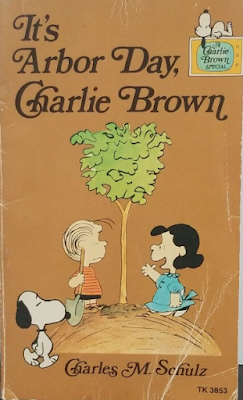
It's Arbor Day Charlie Brown - by Charles M. Schulz


My husband (James) was recently named to our town's Tree Committee (yes, that's a thing). Our adult child told him that there was a Peanuts television special about Arbor Day that he would probably be interested in. He found a copy for purchase on DVD and we await its arrival. Meanwhile he also found a used copy of the book version for purchase and had it sent to our house. (I also discovered that our local public library has a copy on DVD; I always check the library before buying.)

This full-color comic features Sally being humiliated when asked in class to tell what Arbor Day is and responds that it's the "day that all the ships come sailing into the arbor". Assigned to write a report about Arbor Day she seeks Linus' help who suggests a trip to the library where he's sure there are "some books about Arbor Day". What follows are several pages of images of Sally and Linus doing research at the library, as well as some shots of Snoopy and Woodstock laughing at a book on dog obedience training, and playing with the photocopier, which gets them kicked out.

I look forward to celebrating Arbor Day  is year on April 28. I guess that's what my elementary school was celebrating in the 70s when they used to give us saplings to take home and plant. Otherwise, I don't recall ever recognizing it.

Friday, September 2, 2022

Amelia Bedelia's First Library Card - by Herman Parish


September is Library Card Sign Up Month!

Something that will make me (and my library colleagues) cringe is hearing patrons say they want to "rent out" a book. We do understand that they want to borrow the book, or check it out, nevertheless we correct them. This isn't because we want to embarrass them, it is because we want to ensure that there are in fact no misunderstandings, since so many people also confuse the campus library with the campus bookstore (which does "rent out" books). And because some people actually do not understand that they can borrow the books for free from the library.

In this story Amelia Bedelia joins her class in a trip to the town library in order to get a library card and check out her first library book. And even though she uses the phrase "checking out" when referring to the book in her hand she discovers that in a library that means she wants to borrow the book to take home, not that she is simply looking at the book. The misunderstanding means she goes home with the wrong book. One misunderstanding leads to another, but in the end lovable Amelia Bedelia makes a friend in the librarian.


Wednesday, June 22, 2022

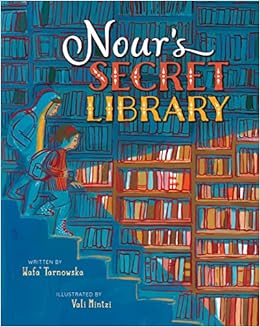
Nour's Secret Library - by Wafa' Tarnowska


Based on a true story of children in Syria rescuing books from bombed buildings during a war to create a library, cousins Nour and Amir sort books into categories, clean them, and build shelves from discarded wood to create a library for their neighbors. All found books became part of the library 
big books, small books, thin books and fat books. Some were in Arabic, while others were in foreign languages - English Armenian, Greek, French, even Hebrew and Syriac.
The library was always open for those who wanted to read or learn something new.
Rescuers borrowed medical books to learn about the human body and how to treat wounds. Teachers looked for ideas for home lessons. Even Nour's Baba borrowed cookbooks to learn how to make foreign pastries and cakes, looking forward to a day when he could once again try out new recipes. 

It was especially troubling for me to read this story of a hunger for knowledge in light of  all the stories I see about those who are attempting to restrict books in the United States. No book in Nour's secret library was deemed unworthy. The books in Nour and Amir's library brought hope to all.

Reading this children's book I was reminded of The Badass Librarians of Timbuktu. Save the books!

Wednesday, June 8, 2022

The Library Fish - by Alyssa Satin Capucilli


Library Fish loves greeting all the library visitors, and going to story hour, and taking adventures in the bookmobile. When a snow storm closes the library Library Fish learns the real magic of books as she escapes her fish bowl and takes off on some extraordinary adventures.

Saturday, April 2, 2022

Lailah's Lunchbox: A Ramadan Story - by Reem Faruqi


In honor of Ramadan which starts today, and National Library Week, which starts tomorrow, I read Lailah's Lunchbox. In this beautifully illustrated book young Lailah is excited to be fasting for the month of Ramadan for the first time. She is worried, though, that her classmates and teachers in Peachtree, Georgia won't understand why she isn't joining them at lunch. She decides to go to the library during her lunch period where she is greeted by an understanding librarian, Mrs. Carman, who is happy to share the time with her, and to help her gather her thoughts so she can best explain why she is fasting, and why Ramadan is a special time.


Tuesday, September 7, 2021

Thursday, January 21, 2021

Rufus M - by Eleanor Estes

Back in September I attended a webinar with the librarian's librarian Nancy Pearl. She was doing a virtual book tour for her most recent work The Writer's Library (which I have not yet read). She said something that I wish more people would take to heart: "Any book your haven't read is a new book". I have never understood the obsession some people have with buying some hot new book, as if there aren't literally millions of other things they could be reading while they wait for their turn on the waiting list at the library, or until the book is available in paperback. During the Q&A someone asked about library-centric books and it was here that I learned about Rufus M

Pearl specifically said that the first chapter was especially worthwhile for demonstrating the magic of getting a library card. Although the book was published in 1943 this was indeed a "new book" to me. And I imagine even almost 80 years after its first publication that the first chapter will still resonate with anyone who has earned the privilege of getting their first library card. I wonder how many people remember that moment? 

Rufus is tasked with making sure his hands are clean, and learning to write his name before he can get his own card and check out a book. The librarian makes clear both that she wants Rufus to have a card, and that having one is a serious responsibility. She is kind yet firm in her insistence that Rufus learn to sign his own name in order for him to get his own card. 

There is a bit of "shushing" action in this chapter as well. 

There are a dozen other episodic chapters in this work, the library is mentioned again in a few of them. This work will likely appeal to those who enjoy Beverly Cleary's works.


Nancy Pearl discusses her book The Writer's Library


Monday, September 28, 2020

George - by Alex Gino


Yesterday was the start of  banned books week, so I read a book that I've been meaning to read for a while. George is really the story of Melissa, a transgender girl. It ranks number five on the list of Top 100 Banned and Challenged books of the decade 2010-2019. According to the American Library Association reasons for challenges of this work include: a transgender character; because schools and libraries should not "put books in a child's hand that require discussion"; for sexual references; and for conflicting with a religious viewpoint and "traditional family structure". 

The narrator of the story uses George's birth name with feminine pronouns (she/her/hers) to tell her story. Only George's best friend Kelly knows that George is really a girl. Everyone else thinks she's a boy. A fourth grader, George really wants to the part of Charlotte in her class production of Charlotte's Web (a project in conjunction with the school-wide common read). Her teacher (Ms. Udell) thinks George is joking when she reads the spider's lines during her audition. "You know I can't very well cast you as Charlotte. I have too many girls who want the part. Besides, imagine how confused people would be" Ms. Udell tells a disappointed George (who absolutely does not want the part of Wilbur, or Templeton, either).

George keeps a collection of "girl" magazines hidden in a denim bag at the bottom of her closet, the way some might hide a pornography collection. She found her first magazine in the recycling bin of the library. The library is a space that George clearly knows well as it is described as a place that is close enough to her house that she passes by it on her bike on her way to Kelly's house. How lucky for her that she can so easily access this neighborhood treasure.

I'm looking forward to hearing the author speak during a Facebook live event on Wednesday. Gino has been outspoken in their defense of their book.

Lagniappe: This book not only mentioned libraries twice, it also had my favorite word: sesquipedalian - a word that describes itself.

Other books on the Top 100 list that treat the issue of gender identity include:
I am Jazz by Jazz Jennings and Jessical Herthel
Beyond Magenta: Transgender Teens Speak Out by Susan Kuklin
Jacob's New Dress by Sarah Hoffman
My Princess Boy by Cheryl Kilodavis