Showing posts with label northern california. Show all posts

Friday, July 7, 2023

Gender Queer: A Memoir - by Maia Kobabe


Note: The author of this work uses gender neutral Spivak Pronouns.

Topping the list of banned and challenged books for 2022 Kobabe's graphic memoir explores how e discovered eir identity as a nonbinary person starting as a toddler.

Although a late bloomer as a reader, as a teenager Kobabe discovered queer books at the library and began to read voraciously. E describes a feeling "as if lightning was coming from the pages...Electricity flowing directly into my palms" when reading gay sex scenes in the Fake Series of books by Sanami Matoh; and the Last Herald Mage Trilogy by Mercedes Lackey.

Like Alison Bechdel (who also wrote a queer graphic memor - Fun Home) Kobabe worked in eir college library, where e came out as bi-sexual for the first time. The college library is also a space where e tries sexting for the first time. Libraries are safe spaces to try new things.

As a cartoonist Kobabe taught one-day comics workshops to junior high students at local public libraries. Keenly aware of the current political climate, e ultimately decides not to share eir pronouns, nor share that e is nonbinary with the students. E questions this decision and wonders if e is doing a disservice to them, especially as e recognizes how much it would have meant to em if e had had a nonbinary or trans teacher in junior high. The importance of representation is a crucial theme of this work, and is one of the reasons censors want to keep others from reading it.

By far my favorite part of the book is a scene in which Kobabe meets eir cousin's new baby for the first time. Cousin Josh, and his wife, Faith ask what the baby should call his grown nonbinary relative. Kobabe responds "I don't know a good gender-neutral term for 'aunt'...Can I be his librarian? Or cartoonist?"

Find out more about this book at its author from the New York Times.


Thursday, December 6, 2018

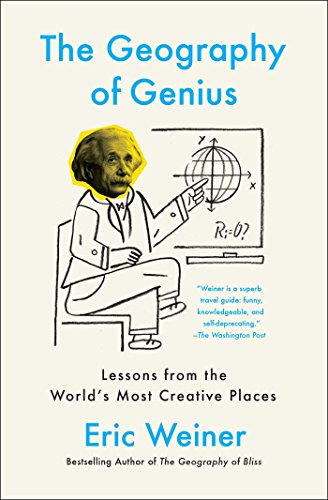
The Geography of Genius - by Eric Weiner


Nine years ago I embarked on a project of reading "Year Of" books. One of the books I read, together with my geographer husband, was Eric Weiner's Geography of Bliss in which the author sought out the world's happiest places. When we discovered that Weiner had written another geography book we downloaded it and listened to it together during our regular drives between Bridgewater and Fairhaven. In The Geography of Genius Weiner visits places that were once hotbeds of creativity, or in the case of Silicon Valley, still are.

Of course libraries are essential elements when discussing genius and Weiner mentions them no fewer than twenty times.

Twice he used the library as a metaphor:

  • In Athens, Greece he decides to take a walk, as was the wont of many of the great thinkers who hailed from that city. His host, Tony, "approves of walking". However, it appears to Weiner that "this approval does not extend beyond the realm of the theoretical as Tony's expanding belly "says more about the divide between ancient and modern Athens than a library's worth of books".
  • It seems that the stereotype of the shushing librarian will be around for quite some time. Weiner uses the image to explain that working in a quiet space may in fact not be conducive to creative thinking. And that it is in fact the moderate noise levels found in coffee houses that make them ideal places to incubate ideas.

Importantly, Weiner also points out that libraries are not just places for books, but for programs and as gathering centers as well when he sees people queuing for a lecture at the National Library in Edinburgh, Scotland.

Libraries weren't always a public resource. Early libraries were by membership or subscription only. Today public libraries are recognized as the People's University. Block printing during the Song Dynasty (969 to 1276 AD) in Hangzhou China brought information to the masses. "Soon, thousands of titles, on all sorts of topics, were published each year. One library alone, at the Imperial Palace, housed some eighty thousand scrolls."

In Calcutta he discusses colonization with this description of Job Charnock - a seventeenth-century English sea captain, who married an Indian woman.
He wore loose, baggy Kurtas, smoked a hookah...and drank the local libation, a potent moonshine called arrack. Job Charnock, founder of Calcutta, son a English aristocrats, proud servant of the queen, went native.
That might come as a surprise given our image of the British and their attempts to rule India without interacting with India.
Charnock was the exception to those who agreed with Lord Macaulay "a senior official in the Raj, who infamously said that a single shelf of a good European library was worth the whole native literature of India and Arabia."

The same type of European-superiority thinking is evident in Joshua Hammer's work The Bad-Ass Librarians of Timbuktu as well.

Throughout his travels the author sings the praises of several librarians who helped him along the way:
  • In Hangzhou, China a librarian named Norman delivers a difficult-to-find copy of the English translation of Brush Talks from Dream Brook by eleventh-century genius Shen Kuo to Weiner's hotel "with all the furtive intrigue of a drug deal or CIA drop".
  • During a visit to the archives Laurentian Library in Florence (designed by Michelangelo) he speaks with Dr. Shelia Baker who is excited about a recent discovery of a letter written by Galileo to a friend. She also explains that to those who lived in the 15th century a book cost as much in relative terms as a car does today. Books were status symbols. Scholars were people who owned many books (even if they never read them).
  • In the Silicon Valley Archives where he walks "into a majestic room, brimming with wooden cabinets and history" a librarian hands him a cardboard box filled with correspondence from Fred Terman's days at the Harvard Radio Research Laboratory during World War II.
  • And, finally, in the acknowledgements Weiner thanks Kathleen McNamara director of Georgetown University's Mortara Center for providing "that most valuable of gifts: a library card."
Smart people use libraries.

Monday, May 7, 2018

The Abortion: an historical romance 1966 - by Richard Brautigan


Earlier this year I posted a link to a list of 100 Must-Read Books about Libraries and Bookstores which included Brautigan's The Abortion. When I discovered that the Brautigan Library of Unpublished Manuscripts is a real place, and featured in Atlas Obscura I immediately requested the book from Inter-library loan. It is a rather quick read, and as the title suggests, it is a love story. The unnamed narrator is the librarian at this unusual library where people can drop off their unpublished works at any time of the day or night. The
library came into being because of an overwhelming need and desire for such a place. There just had to be a library like this. The desire brought into existence this library building which isn't very large...
The narrator lives in the library and never leaves the building, as he must always stay at his post in case someone rings the bell requesting a drop off. Authors and their books are listed in the Library Contents Ledger, and then authors are invited to place their book on any shelf they "fancy".
It doesn't matter where the book is placed because nobody ever checks them out and nobody ever comes here to read them. 
The narrator is not without company. His girlfriend, Vida, often stays with him at night. It is through this arrangement that Vida finds herself pregnant and begins to make plans for an abortion in Mexico, and the narrator prepares to leave the library for the first time since he took the job several years before in order to accompany her. He must find someone to watch the library, get several hundred dollars, make travel plans to fly to the border, make a hotel reservation, make a doctor's appointment, and return plans. All of which he does rather easily with the help of Foster, who had once made similar arrangements for a lady friend.

I have to admit that I was a bit jealous of the librarian in the story, who as Vida jokes, lives a hermit's life. Those who know me well know that I someday aspire to become a hermit. It seems that our narrator has the best of several worlds. He gets to be a hermit, and be a librarian, and have company when he wants. He does, however, return to the library after his excursion with Vida to an unexpected surprise.

A surreal read.

Friday, January 13, 2017

The Girls - by Emma Cline


Emma Cline's debut novel follows the story of fourteen-year old Evie Boyd during the summer of 1969. She is adjusting to her parents' divorce, and getting ready to go away to boarding school in the fall. Eschewing her best friend Connie and suburban life, she is drawn to a group of seemingly carefree girls she sees in a park and eventually follows them to the ranch where they live with their cult-leader, Russell. The ranch is a thrilling and dangerous place that draws Evie in by degrees. The summer culminates in a Helter Skelter-esque massacre. The story bounces between the events of the summer, and reflections of Evie as an adult.

This one almost didn't make the cut for this blog. The lone mention of a library comes on page 297 (of 355). It is, however, exactly the kind of thing that makes me reflect on how we see libraries. Evie accepts a ride from a college student while hitchhiking back to the ranch. She invites him to stay and look around. The not-yet-a-high-school girl showing the naive college boy the ropes makes for an awkward juxtaposition. Evie is aware of the power she has in the situation and susses it out
Tom was clearly uncomfortable. I was sure he was used to college girls with part-time jobs and library cards and split ends. Helen and Donna and Suzanne were raw, a sour note coming off them...I didn't want to notice the hesitation in Tom, the shade of cower whenever Donna addressed him directly.
Evie's simplification that decent people have library cards and dangerous people don't on one level fits in with the stereotype of libraries as "good" places - a place we should support. However, it is also true that there are those who see the libraries as dangerous as well. Providing the masses with books and ideas can only lead to trouble.

Monday, June 20, 2016

The Harder They Come - by T.C. Boyle


Sten Stenson, a Vietnam Veteran, is sure that some Mexican drug dealers have killed his friend Carey. He is devastated when he learns that his unstable son, Adam, was in fact the killer. Adam has become obsessed with John Colter, a legendary member of the Lewis and Clark team, turned mountain man. Adam begins to call himself Colter and becomes involved with Sara, a much older woman who has declared herself independent from the government and ignores state and federal laws. She refuses to wear seat belts, breaks into the pound where her dog is held, aids and abets Adam while he is on the lam, and skips her court date. When stopped by police she makes clear that she has "no contract" with the state of California. A person can do whatever she wants in her own personal car, or her own personal property. Her hostility toward the government makes it especially ironic that she uses her public library. She checked out two DVDs to watch with a friend she invited to dinner. That is the wonder of the public library, you can use the resources even if you don't support it. It is a crazy truth that if a person wanted to do research on how to organize a petition drive in order to shut down the public library, they could do it at the public library.

Friday, May 20, 2011

Field Days: A Year of Farming, Eating and Drinking Wine in California by Jonah Raskin


In 2009 I wrote a blog called "My Year of Reading 'Year of' Books" in which I read and wrote about books that were part of the stunt lit genre where authors spent a year making some change in their lives, and documenting it. For the most part, I really liked those books, and although my own "year of" project is over, I still look for books in this category. In the case of Field Days, the theme actually cross pollinates on three of my blogs. In addition to this one, my husband James wrote a post about it on our food blog "Una Nueva Receta Cada Semana". James and I read this one out loud to each other, we had started back in January and finally finished last night.

Raskin spent a year visitng farms, farmer's markets, wineries, and restaurants, mostly in Northern California, and spoke, and worked, with farmers, vintners, migrant workers, chefs and others who were part of the local/organic/slow food movement. He worked retail at the Red Barn Store at the Oak Hill Farm and also harvested crops. The pace of the book is slow, as it should be, and probably why we took so long to read it. We found reading this to be soothing.

Author Jack London figures in this book throughout and it is through him that we find our first library mention when we learn from "...Kevin Starr the California historian and for many years the California State Librarian [that] 'the Sonoma chapter of Jack London's life, his last chapter, dramatized a modality of California madness'". (p. 60).

The importance of libraries for research is highlighted in a passage about agribusiness in which Raskin writes of Carey McWilliams classic 1939 work Factories in the Field which "went so far as to denouce 'the rise of farm fascism'". The book was based on "his own observations of the horrendous labor conditions in the San Joaquin Valley in 1935 and on extensive library research". (p. 195)

Two mentions of "personal" libraries appear. One in the body of the work where Raskin describes the connection between food and sex in the books Consider the Oyster and The Gastronomical Me, both by M.F.K. Fisher which he says are "now a permanent part of [his] library" (p.154). The other personal library is noted in the acknowledgements "Don Emblem looked through his vast library and found books for me to read on the subject of farming and nature..."

Even with only these four brief notes about libraries Raskin shows that books (and librarians!) really are our friends.

More about the author at http://www.sonoma.edu/users/r/raskin/index.htm.