Showing posts with label Texas. Show all posts

Thursday, June 5, 2025

Mockingbird Summer - by Lynda Rutledge

 In 1964 Ms. Delacorte public librarian in High Cotton, Texas suggests newly-minted teenager Kate "Corky" Corcoran read To Kill a Mockingbird. Corky shares the book with her brother, Mack who has just completed his first year of college; and with her new friend, America who otherwise cannot use the library in the segregated town.  

Through the lenses of these characters we see how each creates their own meaning of Harper Lee's work. Corky's journey includes learning what the word "rape" means as well as a discovery that although the story took place three decades prior it really wasn't so long ago as the same battles were still being fought in the segregated south.

The Civil Rights bill forms a backdrop to the story and Corky's mother Belle is expecting to benefit herself from the legislation as it also includes rights for women. Belle is looking forward to taking a job at the public library, in defiance of her husband.

Tuesday, September 5, 2023

What You Wish For - by Katherine Center


When her former crush Duncan Campbell shows up as the new principal at librarian Samantha Casey's school she hardly recognizes the straight-laced stick-in-the-mud from the fun-loving goofball she knew four-years before. There was "nothing likable...to love". He was simply a "dickish boss". Well, you can guess how this plays out.

The story takes places in Texas at a private school where kids are voracious readers and check out 10 books at a time. Of course if it were a public school in Texas there would hardly be any books to check out of the library these days.

Principal Campbell has a Goldendoodle called Chuck Norris who he brings to campus for "security purposes". Chuck Norris turns out to be actually quite lovable, except for his nasty habit of eating books, which Duncan promises to pay for.

No big surprises in this one. A good end-of-summer read.


Friday, June 26, 2020

Teeth (the movie)


I know I watched this film about a chaste teenage girl who discovers that she has vagina dentata at least two times before, but those were obviously before I started this blog. I read something recently that indicated a library connection and so I put it back on my Netflix DVD list.

When Dawn (Jess Weixler) suspects something is different about her body she does what anyone in the 21st century would do and begins her research by conducting a web search. She types "female genital mutilations" into the search engine which lands her a screenful of results. However, unlike everyone else she doesn't just click on the top link, but rather selects the the trusty link from the public library "your source to information". It is not clear if the link is from the Austin (TX) public library where the story takes place. It seemed more to be a generic public library link. 

Definitely not a film for the squeamish. It will likely appeal to fans of Little Shop of Horrors.

Tuesday, May 7, 2019

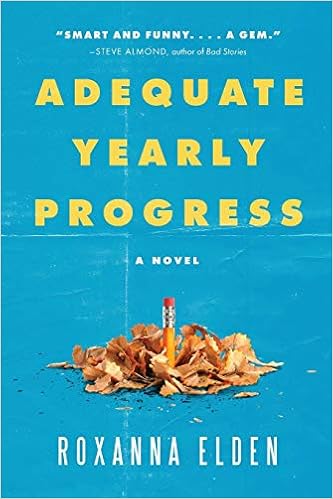
Adequate Yearly Progress-by Roxanna Elden


This satire about the fictitious Brae Hill Valley High School in Texas provides readers with a view of teachers' lives, both inside and outside the classroom. There are a lot of acronyms and, as one might expect from the title, there is much here about assessment, binders full of data, and standardized tests. It is somewhat prescient that this story about Texas' STARR assessment tests, and the real poet who couldn't answer the questions about her own poem has been making the rounds recently.

Brae Hill Valley has a media center "formerly known as the library". Its only use in this work is for a meeting of the Pre-Holiday Cross-Departmental Midyear-Assessment Data Chat ("PHCDMAC for short"). The only mention of the media specialist's (aka librarian's) work involves cutting out a laminated sign warning students to keep their distance from the creepy mechanical Santa Claus that was making its annual appearance from the school's supply room. Ah, well, at least BHVHS has a librarian. Many school districts find librarians to be easy targets when budgets are cut. This story from the Spokane (Washington) Spokesman-Review makes clear how little attention is actually paid to all the assessment data that educators are required to collect. Although there is a strong positive correlation between having school libraries with professional librarians and better student achievement librarian positions continue to be eliminated across the country.

Tuesday, June 19, 2018

Love Sugar Magic: A Dash of Trouble - by Anna Meriano


I found out about this brand new book from "A Mighty Girl" on my Facebook feed.When I read that it was about Día de los Muertos (Day of the Dead), and celebrated Mexican, Texan, and American cultures, and had a lesson in the importance of being bilingual I knew I had to read it. What luck that it was sitting on a shelf waiting for me in the Children's Fiction section of the very library where I work.

Leonora Logroño (Leo) is the youngest of five sisters. Her family owns a bakery and as everyone is busy preparing for Leo's favorite holiday, Día de los Muertos, it seems that they are hiding something from her. Maybe she should learn some more Spanish so they wouldn't be able to talk without her understanding. Beyond language abilities, though, Leo is sure that there is something else that everyone in her family knows, and she doesn't. When she discovers that she comes from a family of brujas (witches) Leo decides help her friend Caroline by deciphering a spell using her rudimentary Spanish-language skills and her decidedly untested magic only to find herself getting deeper and deeper into magical trouble as she attempts to undo her botched sorcery.

Of course it wouldn't have a place on my blog if it didn't include at least a mention of those most magical of places - libraries. The first place we find them is with the famous "going to the library" excuse in order to sneak out to do something else. There is also a classroom library, used as a decoy destination so that a note could be passed. Leo and Caroline do like to read though, and Leo wonders, while looking at Caroline's bookshelf, if Caroline might "reopen her lending library" now that she has moved back to Rose Hill.

The novel does also give a bit of a shout out to information literacy when Brent (the unfortunate object of Leo's failed hocus pocus) asks Leo if her "methods" had been "tested and "peer reviewed". Although I had to wonder how many sixth graders would know about the peer review process I had to smile at the passage.

In addition to being an avid reader, my other passion is cooking, so I was especially happy to see that I would be able to make use of this book on my other blog "Una Nueva Receta Cada Semana". I am looking forward to making "Leo's Lucky Pigs" (aka "Piggies", or "Puerquitos"); and "Pan de Muerto Mensajero" (Bread of the Dead) and documenting my experiences later this year.

A book for lovers of Harry Potter, the Spanish language, and baking. Looks like I hit the jackpot!

Thursday, August 3, 2017

Splendora - by Edward Swift


Originally published in 1978, Swift's tale of about the new librarian (Miss Jessie Gatewood) in a small east Texas town features an ensemble cast of quirky characters. When the enigmatic Miss Jessie arrives in Splendora from New Orleans to set up the town's new bookmobile  (really just "a battered-up school bus with shelves") women begin to imitate her Victorian style of dress and vie to become her new best friend. Miss Jessie has eyes for Brother Anthony Leggett, assistant pastor of the First Baptist Church. He is likewise smitten with the new librarian. Each, however, has a secret that they believe may keep them apart.

Beyond her wearing her hair in a loosely twisted bun, Miss Jessie goes all out in dressing the part of a librarian.
That morning she had dressed beyond her thirty-three years in order to meet the town's and the committee's approval. She was well aware that her hemline fell halfway below her knees and a little farther still for good measure. She was secure in her dress of white eyelet over mint green cut with leg-o'-mutton sleeves, a high neckline, and trimmed with white silk ribbons...Her friend Magnolia had designed the dress and had carefully chosen the accessories: white silk, sweet-scented gloves, flowers at her throat, a pocket watch on a hold chain around her neck, and a white sash tied about her waist giving to her dress a slightly blousy effect, so right for her role...from her elbow dangled a white linen bag...and on her wrist hung a beaded reticule inside which she carried a white lace handkerchief, her cosmetics, and a few cigarettes she had no intention of smoking in public. Her lace-up shoes with one-inch heels have her the feeling a a matron, and her gold wire-rimmed glasses and Gibson-girl hair were just the right touches...
This costume is important, especially considering her credentials are fabricated. She has no library degree or training, Nevertheless, she set to work
converting the school bus into a library on wheels. She designed shelves of various sizes and asked the Ag boys to construct them. She sewed gingham curtains with lace trim for all the windows and found space in the back for a small table and three chairs. Then she began stocking the shelves with every title available and ordered more with funds the county provided.
Miss Jessie, furthermore, makes a map of the county "and a list of all the communities and crossroads to be included on [her] stops" and types "hundreds of file cards" - these of course would be for the card catalog, which libraries in 1978 would most certainly still have been using.

I was most intrigued by Miss Jessie's concern over some donated works, many of which "she lamented, are not suitable as they contain nothing that will advance the mind." This kind of thinking among librarians - that we should be gatekeepers of information, rather than connecting people with whatever information they want - was more common in the mid 1800s  (according to Wayne Wiegand's A Part of Our Lives: A People's History of the American Public Library) than it is today, but certainly fit perfectly with Miss Jessie's Victorian ideals.

The rather Victorian courtship between the assistant pastor and the librarian was, of course, hot gossip for the town.
Chester Galloway saw them in his pasture and said that he did not think it looked too good for the assistant pastor and the town librarian to be entertaining themselves on the ground. His main concern was what the young people would think. But his wife, Verna, said that it looked perfectly all right as long as they were carrying a Bible. 
A quick check through spy glasses (and what's wrong with that?!) confirmed that the two were indeed using a Bible to hold down one corner of the blanket.

Their relationship takes some rather unexpected twists, especially when the town conspires to make it the focus of the annual Crepe Myrtle Pageant. Ultimately, the two find their own way, and more importantly, the town library finds a permanent home on the top floor of the newly renovated courthouse.

Wednesday, June 10, 2015

The Little Free Library Book - by Margret Aldrich


Although the idea of  the "take a book, leave a book" shelf has been around for a while in coffee shops, resorts, and other places (my own library has one for example) the Little Free Library Movement (LFL) is relatively new (2009). This network of boxes with free books set up in front yards, parks, and other public spaces has become a worldwide phenomenon and has helped to bring together neighbors, provided reading materials to impoverished areas, and given countless crafters and woodworkers an outlet for their talents. The Little Free Library Book tells the history of the movement, and includes many stories of individual LFLs with interviews of their stewards. Color photographs of the myriad LFL designs (which includes those designed to look like houses, churches, movie theaters, cars, and even a tardis enhance the enjoyment of reading about how they were built. Each LFL steward has his or her own reasons for starting and/or maintaining the library. All of the stories told in this book were inspiring.

I was especially interested to read the story of Texas' first LFL which was also the first one to be located inside of a school. Bilingual librarian (my favorite kind of librarian) Lisa Lopez started the LFL at the Zavala Elementary School in El Paso ("rated one of the most illiterate cities in the nation"). Lopez was determined to get books into the citizen's hands and to date her efforts have led to the establishment of over fifty LFLs in the city. She has gotten students at her own school excited about reading, and sharing books by decorating and maintaining Zavala Elementary School's own Little Free Library.

Stories about communities coming together to save their LFL were also part of this work. One story that went viral among the library set last year was that of nine-year-old Spencer Collins of Leawood, Kansas whose LFL was ordered taken down when it was determined that the freestanding structure violated the city code. Booing and hissing of the Leawood City Council was fast and furious, and the decision was ultimately overturned.

I was especially interested to read the story of Joceyln and Glenn Hale (Minneapolis, Minnesota) who learned to embrace all types of literature for their LFL. They originally saw their project as a way to share classic literature, but since users are invited to "leave a book" as well as "take a book" and the offerings soon included "bodice-ripping romances, marriage and fad diet advice, and dogmatic religious books". Their first response was to cull the books that did not meet their standards but they soon realized that what they were doing was banning books. Their LFL is now a place where all types of books are shared and enjoyed.

Truly an inspirational read that has me thinking about starting my own Little Free Library. I checked the LFL map and discovered a dearth of LFLs in my neck of the woods.

I did find an LFL in Marion, Massachusetts last fall (which appears to be gone now). Find out which book I selected from it here.

Lagniappe:
Sure to put a smile on my face is reading about another book I've already blogged about. In this case Aldrich refers to Laura Damon-Moore's book The Artist's Library: A Field Guide which I reviewed here earlier this year.

Monday, December 23, 2013

Love Overdue - by Pamela Morsi


I don't believe I have ever read a Harlequin Romance before. I rarely read romance novels, and I admit to becoming somewhat jaded about them during my long ago bookstore clerk days. The series romances would come in monthly installments, and then the same women (they were always women) would show up and buy the lot of them. I would hear them chattering while they waited in line about how they needed to get to the store the day they came out, lest they miss one. Occasionally, they would explain that such a calamity had befallen them at some point in the past, and they were not about to let it happen again. Even without reading these novels I sensed that they were all pretty much the same, and couldn't understand why missing one was such a big deal. I once made the mistake of suggesting to one of our customers that perhaps she could go to the library and read the books she was missing. No, this was not good enough because, she explained, she needed to own them.

So anyway, I read a review of Morsi's novel in one on the endless stream of trade magazines that comes across my desk, and just couldn't resist putting in an Interlibrary loan request for it. Just take a look at the cover! Look at those sensible shoes! I must admit that this was a fun mindless read. The story starts with librarian Dorothy Jarrow moving to Kansas with her little dog. The "Oz" allusions continue throughout without any subtlety. In fact, there is nothing subtle about this book. Morsi appears to have had a lot of fun playing with the stereotypes, which again, she didn't even try to pretend were anything else:

"...librarians were expected to be law-abiding, as well as sedate, slightly stuffy and incredibly sexless. D.J. was pretty certain she fit that bill perfectly."

It is suggested that the new librarian must be "a homely old maid, married to her cat." Disbelief is expressed when someone says that she actually "looks kind of pretty."

Despite the fact that she is young and "kind of pretty" she is also described as going for that "old maid look... [with a] stuffy business suit, gray on gray with her hair pulled back into a little bun like somebody's grandmother." Variations on this description pop up several more times throughout.

The book flashes back several times, however, to a Dorothy who is eight years younger, and enjoying spring break at South Padre Island, Texas. And it is here that we find out that the librarian is perhaps not as stuffy as she makes herself out to be. Will she ever remove those "bookworm" glasses and let her hair down again? The answer, of course, was not really a big surprise.

I will also say that despite having a rather stereotypical look about her, D.J. is portrayed as a very competent librarian - recognizing how she can better serve her community; figuring out how to rearrange the library for better light; and she of course believes that everyone, including children, should be able to select their own reading materials. She is anti-book banning, and anti-censorship.

One other thing I should point out is that this work not only has a librarian, but also a busybody Library Trustee whom D.J., for some reason, thinks should call her "Ms. Jarrow". Really? I'm a trustee, and we all use first names.

Although entirely predictable (really, there was not plot turn that I didn't see coming pages out) I have to admit to enjoying this one. This is not to say I'm about to start a romance book subscription, or wait in line at the bookstore once a month.

Friday, June 1, 2012

Going Bovine - by Libba Bray


One can only guess how much the author must love libraries, in order to have changed her name to something that looked, and sounded like the word. Born with Bray as her last name, she changed her first name from Martha, to Libba.

This book answers that age old question "What happens when a teenager afflicted with mad-cow disease, a hypochondriac dwarf, an enchanted garden gnome, and a Goth angel take a road trip in a quest to save the world?"

In his brain-sponge-ified delirium, 16-year old Cameron begins to lose some of his youthful cynicism, and starts to remember some better times, back when he didn't think his parents were useless, and when his twin sister, Jenna, was still his friend.

Recollections of libraries, of course, are good ones. As Cameron's mother reads Don Quixote to him in the hospital she recalls taking him to the library when he was little, when she'd let him pick out five books, and he could never wait to get home to read them. At first Cameron doesn't share this memory, but later it comes back to him.
Crystal clear I could see myself sitting in my mom's lap over near the water fountain, and she was reading some rhyming book about monsters to me. She had on sandals and she smelled good, like shampoo. And I was happy. How did I manage to forget that?
In what one might analogize as his "siren's song" Cameron and his friends get waylaid at CESSNAB (the Church of Everlasting Satisfaction and Snack 'N' Bowl) where everyone is happy. Well, everyone except Library Girl. Library Girl is fed up with stocking thousands of copies of Don't Hurt Your Happiness, and nothing else. As she explains to Cameron, Don Quixote is "complicated" and some readers "felt inadequate about not understanding it right away" which introduced "nonpositive feelings". Furthermore Catcher in the Rye  was "very angry, very negative" and included prostitutes and "bad words"; Lord of the Flies was "too violent"; and comic books were "scary," "dark" and the superheroes' "unattainable powers...might make kids feel bad about themselves". Even Winnie-the-Pooh was verboten. Library Girl does what any librarian worth her salt would do when faced with censorship: she starts a revolution - giving away forbidden reading materials, and taking over the CESSNAB airwaves. She is perhaps my favorite "library book" character so far.

This book is written for teenagers, and I wonder how many of them will understand the description of the "card-catalog-sized drawers" from whence Cameron's "magic screw" is delivered. For those who don't get it, see my Library Book post for a description and picture. Also see Dance of the Card Catalog.

An irreverent romp - I read this book at the suggestion of my sister, who knows that I like quirky things (and that I hate censorship).


More information at http:/www.libbabray.com/

but not, followthefeather.com