Showing posts with label librarians. Show all posts

Saturday, September 14, 2024

The Secret Lives of Booksellers and Librarians - by James Patterson and Matt Eversmann


Well, I could hardly resist this one!

This was the first James Patterson book I ever read. I do not know if I will read others, but I did thoroughly enjoy this one. I read this out loud to my Geographer husband and he couldn't help but make a map of all the places mentioned. The ones we've visited are in re(a)d - you see what I did there? 


On a recent trip to Maryland to visit family we took the opportunity to stop at Thunder Road Books (New Jersey) and RJ Julia Booksellers (Connecticut).

The best thing I learned from this was that the Barnes & Nobel store closest to our house allows dogs. What could we do but put our hound in the car and head over!


Here's our book-loving dog smiling in front of the David Sedaris display. She was named for his alter-ego in the Santaland Diaries

In a world of book banning gloom and doom the essays in this work bring a sense of joy. Each short essay profiles a different person who works in the world of books and loves recommending books to others. 

Friday, June 21, 2024

What You Are Looking For is in the Library - by Michiko Aoyama


Five people, each at a crossroads in life, find their way to the Community Library, a place none of them had given much thought to before. Tomoka, Ryo, Natsumi, Hiroya, and Masao discover that reference librarian Sayuri Komachi will not only find the books that will answer your question, she also finds books to answer the question you didn't know you had. The mysterious librarian also gives a bonus gift in the form of a felted trinket to each of the seekers. The description of Ms. Komachi provides an interesting take on the old librarian stereotype, and one that demonstrates a larger than life perspective

The librarian is huge...I mean, like, really huge. But huge as in big, not fat...she is wearing a beige apron over an off-white, loose-knit cardigan...Her hair is twisted into a small tight bun right on top of her head, and she has a cool kanzashi hairpin spiked through her bun with three white flower tassels hanging from it.

Natsumi is a parent to a young child (Futaba). She works at a publishing house and before her daughter was born she was an editor for a magazine called Mila. However, when she returned to work following a short maternity leave she was placed in the information resources department where her job was 

to retrieve data for employees upon request, and seek various permissions when required...also [writing] company profiles for the website and other PR material for external use

While she does not identify herself as a librarian, those of us who do the work know what she is. 

I was particularly intrigued by this passage regarding Natsumi's work

In my Mila days, I used to have no reservations about reading at my desk, since anything could be a potential source of ideas. But in Information Resources I hesitated to do any general reading. Just in case my colleagues might think I was slacking off.

It is not unusual for people to make comments about how great a librarian's job must be with "nothing to do all day but read". You can be sure this comment will raise some serious ire, followed by an explanation about how librarians have ABSOLUTELY NO TIME TO READ as we are much too busy answering reference questions, ordering books, unjamming printers, supervising clerks, resolving database and computer problems, and a myriad of other things. Here is my truth: sometimes I was busy, and sometimes I wasn't. As a public services academic librarian I was usually pretty busy teaching classes, and helping people with research during about eight months of the year. During the summer months though I read - a lot! Much of what I was reading was professional literature, or things relevant to my research interests, but sometimes I was just reading for fun. There seems to be way too much concern that a person might have "down time" at work. In library work, no matter what your role, I would argue that reading is the best use of such time because as Natsumi says "anything could be a potential source of ideas." Generally being a well-read person helped me to answer more than a few reference questions. 

Ms. Komachi is often found busy working on her felting. When Masao finds her doing this he "sense[s] anger in her expression and she seems unapproachable." Masao had misread the expression. In fact Ms. Komachi was quite ready to help. The question of approachability has come up a lot during my tenure in public service. As I said, down time is not unusual and it is unreasonable to think that we would sit doing nothing. I was often doing research when I wasn't directly teaching, or helping someone, but that didn't mean I wasn't available. 

Hiroya is a young man who is not sure where he fits in. He is described as a NEET (not in employment, education, or training). He enjoys manga and hopes to be an artist. Ms. Komachi mentions that he seems to know a lot about manga. He responds that his uncle used to own a manga café "a coffee shop with heaps of manga...They don't have private rooms, just tables where you can sit and order a drink, then read from the manga library in the shop."

Ms. Komachi is not the only library employee of course. All the characters also get help from Nozomi, a library assistant who aspires to be a librarian. She explains to Hiroya that "if you take a  library assistant training course...then work for three years, you can qualify for the librarian training course...you can also go to university to study". Hiroya is impressed that "becoming a librarian is harder than [he] thought." This is another thing that is not well understood among the general population. In fact most people who work in libraries are not librarians. Those who are at the desk checking out books, or who reshelve returned books, or process them to be made available, or work to keep the library clean, or run the in-house coffee shops, are not librarians. In most cases, in order to get work as a "librarian" one needs to have completed a Master's degree in Information and Library Science (MILS). Although sometimes those without the degree have the title, the MLIS is the usual and accepted credential needed for professional librarian work.

Ultimately Ms. Komachi is a binding force between the characters, each other, and their community.

A story about making meaning and finding your place. I read this one aloud to my husband. We both enjoyed it. 


Friday, March 1, 2024

Wednesday, February 14, 2024

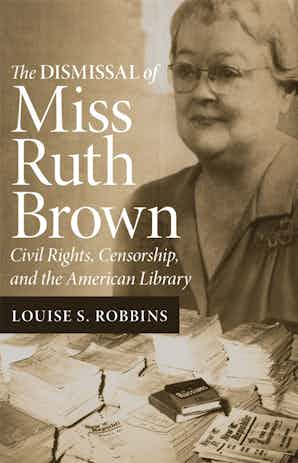
The Dismissal of Miss Ruth Brown - by Louise S. Robbins


Eight years ago I wrote about the film Storm Center. I recently learned that this film, produced at the height of McCarthyism, was loosely based on the case of Ruth Brown, who was fired from her job as librarian at the Bartlesville (Oklahoma) Public Library in 1950. Robbins' book even contains a rather thorough summary of the movie. Bette Davis (who played ousted librarian Alicia Hull) was questioned about taking the role by at least one parent, Anne Smart. 

Smart sent Davis a "report of the book controversy" she was causing in Marin County [California]...Her report depicted in "vivid detail...the type of material being given to our children in some schools. [The report]...made its way around the country for for several years [and contained] the names of authors "all extremely well listed as to their communist and/or communist front affiliations by various government investigating committees."

The more things change... 

Brown was an outspoken civil rights activist in her town. Her racial justice work during the height of McCarthyism made her an easy target. Charges that she was circulating "subversive" materials was a façade for the real reason of her dismissal.

The back cover blurb of this work (published in 2000) reads 

The fundamental issues of the Brown case make it especially pertinent today when differences - in race, gender, class, and national origin - are again feared and as challenges to materials in library collections again escalate. Ruth Brown's story helps us understand the matrix of personal, community, state, and national forces that can lead to censorship, intolerance, and the suppression of individual rights

This description is even more eerily prescient today. As are discussions in the book of neutrality, academic freedom, freedom of acquisition, freedom of access (especially to controversial materials) and the blatant sexism. 

Ruth Brown was one of the women, mostly white and middle-class, who made up 88.8 percent of the allied profession of librarianship in 1950. For a salary less than a man would receive, she organized and maintained a comfortable homelike space where people, especially young people, went for wholesome enlightenment (emphasis mine). The professional role of the librarian gave communities low-cost female employees (emphasis mine) to provide healthy recreational and informational reading while it extended the margins of the domestic sphere without exploding them. The librarian's role did not transgress boundaries as long as the homelike space and the materials and activities organized in it remained safe, comforting, and submissive to the prevailing ideology...

The more things change... 

The Library Bill of Rights was originally adopted by the American Library Association (ALA) in 1939 to ensure access to information (even what some might consider harmful or dangerous) to all. "The ALA articulated the importance of allowing citizens to decide for themselves what they should read, an idea Brown expressed in her interview with the city commission". This is a stark contrast to the description of the "stereotypical" librarian 

in Alice I. Byran's 1952 research report, The Public Librarian...[who] was "rather submissive in social situations" and lacked self confidence. "Indiscreet" was not part of the lexicon by which librarians, especially female librarians, were described. In fact female librarians have been characterized as discreet to a fault in book selection practices, "ruthless in their own censorship." Marjorie Fiske's 1959 classic , Book Selection and Censorship, depicted its mostly female subjects as anxious and fearful, avoiding challenges to library materials through self-censorship.

The more things change... 

 And on a final note, we see the same ideological concerns in libraries today as libraries in Montana and Georgia cut ties with the ALA over president Emily Drabinski's identity as a Marxist lesbian.

The more things change...

Tuesday, May 23, 2023

The Dissidents podcast - The Librarians are Not Okay

Last month I was invited to The Dissidents podcast to talk about libraries, librarians, and banned books. Click on the image below to listen. 


 The interview is about one and a half hours long. The short version is: Treat librarians with respect and don't ban books.


Friday, December 17, 2021

Melvil Dewey - by Fremont Rider

December 10 was Dewey Decimal System Day  The date was chosen to coincide with the birthday of the system's namesake Melvil Dewey. In honor of this day I checked out a biography of Dewey from the library where I work (which does not use the Dewey Decimal System). I noticed that his birthday is mentioned several times throughout the work, starting with the first page, and including the fact that he was appointed to the New York Board of Regents on December 10, 1889 (this was included without highlighting the fact that it was also his birthday). 

The book, simply titled Melvil Dewey, was published in 1944, and mostly has praise for the man we now recognize as sexist, racist, and anti-Semitic. Although there is some mention in the work of these latter two identities they are downplayed. His clear bias toward Christianity can be found in the Dewey Decimal Classification system itself. The 200 range of the system is where books on Religion are found. Christianity is covered in the range of 220-280, and "other religions" are relegated to only the 290s.  

His sexism is disguised in the book with passages such as this one: 

All through his life, women were more congenial intimates with him than men; he was more at ease with them; he worked more to more purpose with them; he played with them with greater zest. 

While he did admit women to the Columbia University, essentially forcing the University into co-education, when he started the Library School, we now know that his reasons were less than altruistic. While he believed that well-educated women would make jim-dandy librarians he also left a legacy of low pay as women "were also more likely to get sick or leave the profession to pursue 'home life'". Furthermore, male librarians deserved more pay than women because they "could also lift a heavy case, or climb a ladder....There are many used for which a stout corduroy is really worth more than the finest silk." (See the link at the end of the post for more information on this.)

About 20 years ago the then-president (a man) of my university actually told the librarians (all of whom at the time were women) at a meeting to discuss salaries that we knew when we went into a female-dominated profession that we would make less money - that it was "societal". And that, after all, he couldn't be expected to solve this "societal problem". Why he couldn't try to solve it on our campus is another question. That president's sexist legacy lives on here as well. Librarians continue to work a twelve-month contact for less money than our faculty colleagues who work a ten-month contract. 

Melvil Dewey was also obsessed with simplifying things, especially spelling. He learned and taught shorthand, and changed the spelling of his first name from Melville to Melvil. As well, he attempted to shorten his last name to "Dui". 

An example of his writing included in the work reads

In skool in Adams Center I rebeld agenst compound numbers. I told the teacher that jeometri taut us a strait lyn was the shortest distance between 2 points & that it was absurd to hav long mezur, surveyor's mezur & cloth mesur; also absurd to hav quarts & bushels of difernt syzes & to hav avoirdupois, troy & apothecari weits, with a pound of feathers hevier than a pound of gold. I spred out on my attik room table sheets of foolscap & desyded that the world needed just 1 mezur for length, 1 for capasiti & 1 for weit, & that they should all be in simpl decimals lyk our muni.

He very much liked the metric system and advocated for the United States to adopt it. I remember when I was in Junior High in the mid 70s that we had to learn the metric system in math class because it was coming to the United States, and soon! President Gerald Ford and after him President Jimmy Carter were going to make it happen. Then Ronald Reagan was elected and just like that people stopped talking about the metric system and we are left only in the company of Liberia and Myanmar as the only countries not to have adopted the metric system as the standard system of measure.

While we cannot deny the legacy Dewey has left on the library profession, we are also experiencing a reckoning of the damage his legacy has left. Two years ago the American Library Association changed the name of the Melvil Dewey Medal to the ALA Medal of Excellence. More about Dewey's sexism and racism can be found in this article from Slate.com. 

Friday, April 13, 2018

Library on Wheels - by Sharlee Glenn


This week (April 8-14) is National Library Week. Wednesday (April 11) was National Bookmobile Day. It was also the day that Glenn's book about the very first Bookmobile was published. I had pre-ordered it from Amazon, and it was shipped on Wednesday, arrived to Thursday, and read (by me) on Friday. Well researched and illustrated with historic photographs, letters, and other period artifacts, this book tells the story of Mary Lemist Titcomb, chief librarian of the Washington County (Maryland) Free Library from 1901-1931. Titcomb established several innovative library programs in the early 19th century, including instituting one of the first children's rooms, and delivering books and other library materials to schools. Not content with simply serving those who were able to come to the public library in Hagerstown (the county seat) Titcomb launched a story hour program for rural children, and set up book depositories in smaller towns, to ensure that access to books and reading was widespread. Realizing she was still not serving all residents, she commissioned the first bookmobile in the United States - a horse drawn wagon whose route included family farms and other isolated areas. The wagon was driven by the library's janitor, Joshua Thomas, who proclaimed himself to be a "Book Missionary" on the 1910 U.S. census.

My favorite part of this book has to be this bit from a newspaper article written about Ms. Titcomb for The (Hagerstown) Builder 
The hostess was most gracious, most charming. She wore a soft gray silk and a dainty slipper was visible. The hostile one saw it, saw too-could she believe it?-the feminine frivolity, a jeweled buckle. She heard too, the little woman discussing "Spring Fashions" vivaciously, knowingly, for Miss Titcomb is no mean authority on style and her dress, like her work, is always up-to-date.
It seems you can be fashionable while wearing sensible shoes.

For more books that feature bookmobiles (including another one about the very first bookmobile) you can see my previous posts here.

Sunday, January 7, 2018

Our Bodies, Our Shelves: A Collection of Library Humor - by Roz Warren


I read a review of this book a few years ago, and wrote it down on my list of potential reading. I decided it would be a good choice for a read aloud with my husband during our Christmas break. I checked it out at my local public library and we did enjoy reading it together, and the short essays were perfect for wrapping up an evening before bed. 

Warren's essays are funny, and also highlight some of the issues that librarians struggle with such as censorship, crappy wages, and patron privacy. None of these things is black and white, and there are, of course, fifty shades of grey in between.

Monday, April 24, 2017

The Bad Ass Librarians of Timbuktu - by Joshua Hammer


This was already on my must-read list when we received it as a gift from one of my husband's geography students. This tells the story of the rich history of literature in Africa - a history which contradicted the story told in 20th century Europe "that black Africans were illiterates with no history". Instead manuscripts from medieval times
proved the opposite-that a sophisticated, freethinking society had thrived south of the Sahara at a time when much of Europe was still mired in the Middle Ages
The work of scribes who copied texts at a rate of "150 lines of calligraphy per day" is described and their pay in gold nuggets or gold dust. The ancient texts were threatened several times over the centuries, including during the French occupation at the turn of the twentieth century. Over one hundred years later it was Al-Qaeda that nearly destroyed the literary treasure.

In the ensuing years many of the manuscripts had been hidden in homes, where they were deteriorating. Abdel Kader Haidara tracked down many of these manuscripts in the 1980s and convinced the owners to donate them to Mali's libraries where they could be preserved. By "2011 the Mamma Haidara Commemorative Library in Timbuktu was fast becoming one of the world's most innovative manuscript conservation centers and a symbol of Timbuktu's cultural renaisance". In 2012 Abdel Kader Haidara once again worked to save the treasures, as he organized people to smuggle the manuscripts out of Timbuktu where they could be safe from eradication. This tale is not just about librarians, but also about the common people who risked their own safety to move the books.

Controlling information is one way that those in power attempt to keep their authority. It is an old story. One we see throughout history, and just as relevant today as our own government attempts to vilify the press while spouting "alternative facts".

This could be hard to read at times as accounts of be-headings, kidnappings, and other senseless violence were part and parcel to the story. However, it is also a tale of hope and courage. All who understood that knowledge was worth preserving were the heroes of the story and serve as examples to those who may be despairing.


Tuesday, March 22, 2016

This Book is Overdue! How Librarians and Cybrarians Can Save us All- by Marilyn Johnson


Johnson is not a librarian, but according to her jacket-cover biography she "owns multiple library cards and uses them often." She certainly does a wonderful job of singing the praises of librarians as she travels to where the librarians are to find out what they do and what makes them tick. The copyright on this work is 2010, which doesn't seem that long ago, but reading this made me realize how fast things are changing. Johnson has an entire chapter on Second Life which was all the rage not so long ago, but now has only about a million users. She also has a chapter on librarian bloggers, (which I feel a bit meta blogging about) even as I also realize that blogs aren't exactly cutting edge any more either. But while our heads spin about the speed at which information moves and technology changes, the book also illustrates some things that never change. Johnson asks us to consider this
Did you ever? I mean, did you ever think that being a librarian meant dealing with poop? Talking about it finding little piles of it in the stacks, writing about it on the Web. I certainly never thought that I would have to write about it. In fact, one of the things that appealed to me about this book was the intellectual, cerebral, almost disembodied nature of the subject of librarians in the digital age...I imagined the wired world of information and literature, full of brilliant, helpful, visionary librarians...I didn't want to be sitting in a sticky chair thinking about poop.
I don't think poop was one of the topics we discussed in any of my classes in library school, but I certainly had to deal with it as a librarian at a public library. How someone could mistake the elevator for a restroom I'm not sure, but there you have it.

I am always interested when I find a connection between books. In the case of This Book is Overdue! the connection is with The Library Book. In her chapter entitled "Gotham City" Johnson provides a bit of the history of the planning and construction of the New York Public Library, referring to several of the people mentioned in Fiske's book.

It was lovely to read such a librarian-positive book by someone who is a not a librarian herself.

Wednesday, December 16, 2015

The Book of Speculation - by Ericka Swyler


Simon Watson, an about-to-be-unemployed librarian, discovers an eerie truth about his family when he gains possession of a mysterious book: all the women in his family die young, by drowning, always on July 24. With the help of a used book dealer, a deck of tarot cards, and some of his librarian friends, he races against the calendar to save his sister by researching his haunting genealogy, beginning with a circus menagerie in the 18th century. In chapters that alternate between Simon's story and that of his family history the pieces are put together.

As a librarian, Simon discusses his work, and tells of how people still use libraries, as well he throws in a few other clever references about libraries.

In Simon's tale we see


  • the quotidian work of "...stacking, sorting, scanning, cataloging, researching, letter and grant writing, fund begging, and book repairing"
  • the old-school research as Simon sits and looks up old obituaries on a microfiche reader
  • and the almost obsessive drive of librarians to help even those who might be less than deserving as his friend/acquaintance Liz Reed (what a great name for a librarian) agrees to do some research for him even though he admitted to "holding onto some material a little longer than [he] should have"

In a few places Simon makes use of the Dewey Decimal system as a way of identifying things, even going so far as to call it a language. And I loved the way he described his librarian girlfriend as using "library-perfect silent diction" when mouthing a question she didn't want overheard.

Libraries as sanctuaries is a common theme we see in library-related books. In this one it is quite literally so. Simon, his sister, and her tattooed boyfriend escape to the library and take refuge in the whaling archive when their home begins to crumble around them.

 Libraries really do save lives.


Tuesday, April 14, 2015

Midnight Library - by Kazuno Kohara (In Honor of National Library Worker's Day)


Number One on this list of Twelve Children's Picture Books with Non-Princess Female Protagonists is this empowering, and sweet, tale about a little librarian who runs a nighttime library for animals with the help of three owl assistants. She clearly has book knowledge as she helps Miss Wolf find a book that is not too sad, and also provides community space for a band of squirrels to practice their music, and finally assists a tortoise with getting his first library card and checking out a book. I was glad to find it on the shelf of the library in which I work. Definitely a "feel good" book for librarians of all ages.

Monday, April 13, 2015

Evil Librarian - by Michelle Knudson (In Honor of National Library Week)


I could hardly pass up reading this book when I saw a review for it recently. I found it shelved in the very library where I work, so I was able to check it out and start reading as soon as I knew about it. It was fun reading and I loved it when people asked me what I was reading, so I could show them the cover, and tell them I was reading a book about myself.  It always got a laugh. The book is a fun read, aimed at young adult readers. The story is of a demon high school librarian, Mr. Gabriel, and the student Cynthia (Cyn) who is his undoing. When Cyn discovers that Mr. Gabriel plans to take her best friend Annie into the demon realm and make her his bride she schemes with the handsome Ryan (star of the school musical) and Ms. Kràlovna - Mr. Gabriel's rival demon - to bring him down.

Mr. Gabriel may be evil, but he does bust a few stereotypes. He is charming and good-looking, and nothing like the school's "old" librarian
[w]ho was a perfectly nice-seeming middle-aged woman who could help you find whatever you needed for your paper of project or weekend reading but not someone who inspired breathless words or flushed faces or shining eyes
a young man who can charge the usually "still and slightly dusty" air of the library with a "strange energy".

There was an element of Buffy the Vampire Slayer in this one, with the twist of course that the librarian was the demon, rather than the demon fighter. Cyn, like Buffy, comes through as a heroine and, after a trip to the underworld, discovers that she doesn't have to passively wait for the boy she likes to make a move, a strong young woman makes the moves herself.

The author gives a shout out to librarians in her acknowledgements, and recognizes that they are not at all evil!

Tuesday, September 16, 2014

Escape from Mr. Lemoncello's Library - by Chris Grabenstein


The fictitious town of Alexandriaville, Ohio has been without a public library for twelve years. The old library had been "torn down to make room for an elevated parking garage...many said the Internet had rendered the 'old-fashioned' library obsolete." To celebrate the opening of the new town library (designed by famous game-maker, and most favorite native son, Mr. Luigi Lemoncello) all twelve-year olds are invited to enter a contest to be the first to get library cards and to spend the night at the library. Kyle Keeley along with eleven of his classmates win much more than they bargained for when they learn that getting out of the library will require them to use their library skills, game skills, and to cooperate with each other. 

Kyle and his friends learn that the library has a lot more to offer than shelves full of books. They archive local history, have community meeting spaces, games, and cool science-y stuff as well. They also have librarians who will help you find what you need (and in fact, I must point out that Grabenstein dedicated this book to "the late Jeanette P. Myers, and all the other librarians who help us find whatever we're looking for").

I loved that two of the characters (Miguel and Andrew) were aides in the school library, and I also liked that the team Kyle formed had more girls and than boys on it. So often in popular culture I notice that groups of friends have one token girl (think "Harry Potter") but this one had a nice mix, with everyone in the group able to contribute something, and everyone able to learn something as well. 

There were two cool librarians in this work: the town's new head librarian Dr. Yanina Zinchenko described as tall with a breathy voice "with just a hint of a Russian accent." The other is Mrs. Gail Tobin, librarian when young Luigi Lemoncello was a lad who "looked a little like Princess Leia...except she had an old-fashioned bubble-top hairdo, cat's-eye glasses, and a tweed jacket with patches on the elbows...she'd be a hundred and ten if she were still alive." She appears as a hologram to the winners of the contest and assists them in navigating the space.

The games conclude on Mr. Lemoncello's birthday who says "there's no place [he'd] rather be on [his] big day than inside a library, surrounded by books."

Rife with allusions to other books (both classic and more recent favorites) this work is a true celebration of everything that is fun about books, reading, libraries, and librarians. 


Wednesday, August 6, 2014

Sex Criminals (Volume 1) One Weird Thing - by Matt Fraction and Chip Zdarsky


I appreciate a book that recognizes that librarians are sexual beings. I also appreciate a book that recognizes the superhero status of librarians. In Sex Criminals authors Fraction and Zdarsky have created a librarian character (Suzie) whose superpowers are activated when she reaches orgasm. Suzie can make time stop whenever she comes. She meets her match in Jon, who has the same gift she does. The two decide to use their power to become modern day Robin Hoods - robbing from the rich (the evil banks) and giving to the poor (the about-to-be foreclosed library).

The authors clearly appreciate a good library (and a good librarian). And they make a bit of a dig at the woeful status of sex information a young person might discover at school. Remembering her quest for information when she discovers her special secret Suzie asks
Ever try to utilize the resources of the public school system to learn about sex? No wonder so many dumb kids get knocked up. Nobody knows anything and if they do, they're legally bound from telling you.
However, she "falls in love with libraries" when she gets the assistance she needs from a non-judgmental and super helpful public librarian. (This is clearly what inspired her to become a librarian herself).

There are five books in this series. Although I found this fun, I don't plan on reading the rest. I get the gist.

Tuesday, February 25, 2014

Dear Miss Breed - by Joanne Oppenheim


The internment of Japanese-American citizens during World War II is a chapter of United States history that some would prefer to pretend never happened. I remember finding out about this injustice as an adult, and wondering why it wasn't taught in any of my American History classes in school, or my class on Constitution, Citizenship and Public Issues (CCPI) - a required course for all High School Seniors in Maryland during the 1980s. It is especially baffling to me because while I was taking CCPI there were actually Congressional Hearings about the internment going on at the time. How could it not have been worthy of a class discussion?

In 1942, after the Japanese invasion of Peal Harbor San Diego Public Children's Librarian Clara Breed discovered that many of her most enthusiastic patrons, American children of Japanese descent, were going to be sent to "relocation centers" with their families. She asked them to write to her, providing them with penny postcardsasking that they let her know where they were and how they were doing. From this she began a correspondence with many of the children. She also provided them with books, toys, supplies, and material for making clothes.

Clara Breed saved the letters that the children sent her. In 1993 they were donated to the Japanese American National Museum (you can read some of the letters here), and they are the basis of this book.

The children tell stories of the substandard conditions to which they were subjected (for some their first stop after being evacuated from their comfortable middle class homes was a refurbished horse stable - still smelling of urine). Surrounded by barbed wires and armed guards the camps were poorly heated, and poorly equipped, making for an especially difficult adjustment. Even so, the children's letters are hopeful, and demonstrate strong spirits.

Also included in this work are excerpts from opinion pieces from newspapers at the time. The bigotry is clear. It is also true that some things don't change, although today we are more likely to read such comments as anonymous posts and "tweets".

This work is evidence of librarians' long-time commitment to social justice. One former correspondent explained when he was interviewed for the book that as a "neglected child" Miss Breed introduced him "to the magical world of books". Clara Breed championed the rights of an especially vulnerable population at a time when it was especially un-popular to do so. In an article written for the Horn Book magazine in 1943, Breed tells the story of her young friends. It is interesting to note the stereotypes, albeit positive ones, evident in her article, as well as the language that many will find rather politically incorrect for the 21st century.

I was especially interested to see one of the children wrote to Miss Breed about how much she enjoyed "playing library" and discovering that another one grew up to work in a library.

Interestingly, as I was finishing this book I found out about Allegiance a new musical currently being produced in New York that tells the story of the Japanese-American internment camps.


Friday, January 4, 2013

Quiet, Please: Dispatches from a Public Librarian - by Scott Douglas


Like Anne Miketa'a Library Diaries, Douglas' book is a series of essays about his work, co-workers, and the patrons at the public library where he is employed. Unlike Miketa's book, this one is funny and well-written. Rather than simply making fun of people and insulting them, Douglas reflects on what he learns from them, and how they help him grow, both professionally, and personally.

I probably could comment on something he says on just about every page, but in the interest of not making this the longest blog post ever, I make particular note of my favorite library topics:

On stereotypes
The Librarians who interviewed him for his first professional job "were distinctively librarian - large framed glasses, granny hairdos, and uptight frowns". This sentence refers the reader to one of Douglas's many footnotes which reads "the stereotypes about librarians are largely true." Sadly, I must concur. He goes on with these descriptions:

And,
"You say library (emphasis in original) and there's this iconoclastic image of an old-lady librarian telling people to be quiet and not to run." To be fair here, Douglas goes on to say how important "that iconoclastic lady" is to the library.

And,
'The librarian was the typical stereotypical librarian-ugly clunky glasses, hair in a tight bun, and clothing that could just as easily have been put on a man. She looked irritated when I asked her where I could plug in my laptop..."

He doesn't, however, cast any aspersions about himself being hip, even as a non-stereotypical young, straight, male librarian:
"I wasn't cool. I was a librarian, and not being cool was as cool as I'd ever get."

On critical thinking
As a university librarian I am often frustrated by the fact that we are supposed to teach students to be critical thinkers, but it seems we are not supposed to do it (think critically) ourselves. Administrators seem to just want us to do what we are told. Douglas makes a similar point when discussing his frustration with his courses in library school
I didn't think the school needed to get political and have faculty implement viewpoints, but I thought it was important to study the way media, both online and on TV, had radically changed the way people sought information. How can librarians teach others to think critically and objectively when they themselves are not doing it?
On censorship
The library banned MySpace.com when it became a nuisance.
It didn't take long for things to get out of hand....Teens started stealing library cards so they could get extra time [on the computer]; adults would constantly argue about why they deserved more hours; and even little fourth graders were asking older kids for advice on how to 'pimp out' their MySpace page....Ultimately, MySpace was blocked because it was slowing down the network. This wasn't the real reason. The real reason was because it was making all the librarians mad. Actually, the straw that broke the camel's back was when a manager saw a teen posting a photo of girl's nipple piercing [sic] to his page.
Popular online role playing games would meet a similar fate. When a "middle-aged mother of three kids" started spending all her time in the library playing a video game Douglas was told to
Find out what this game is and make...a list of why we should ban it. I want to get rid of that lady. If all she is doing is playing a video game then she doesn't need to be in the library
Once the website was blocked the woman stopped coming to the library, so did her children, who often came to the library to read books.

When Douglas got fed up with teens acting up in the library while he was "in charge" he banned them from using the internet unless they were doing homework. When a page points out to him that that's censorship, Douglas replies "there's a big difference between censorship and punishment". I often say that when someone says what they are doing is not censorship, you can be sure that it's censorship. I have to say that the burnt-out page saved the day on this one. He texted the library manager, who was on vacation, and tattled on Douglas, who was admonished by his manager to let the teens back on to the computers.

Last month when I blogged about The Librarian's Book of Quotes I noted the commentary I found most "thought provoking"

I have never met a public librarian who approved of
censorship or one who failed to practice it in some
measure.
--Leon Carnovsky, Library Quarterly 20 (1950)

Here, we see this in action.

On gender
When I was in library school, one of my assignments was to write about five famous librarians throughout history. I was very frustrated with the assignment, as I was determined to write only about women in this female-dominated profession, and as I was studying the early days of librarianship, I had to dig pretty deep to find someone who was not a man to write about. (Ultimately, I did succeed in my quest). Famous librarians that Douglas mentions about are:
Melvil Dewey (whom he does recognize as a "hater of women" as well as an "elitist racist dick")
John Cotton Dana
John J. Beckley
Charles Ammi Cutter

Famous women librarians are remarkably hard to find. Consider, for instance, the first hit I got when I "googled" "famous librarians". On this list of Top Twenty Five Most Famous Librarians in History, only seven are women.

I was particularly intrigued by this commentary about women in library history:
"One thing male librarians rejoiced at was the fact that they could save money by hiring women; at the time, [when children were finally allowed into libraries] women who did the same job as men at the library earned less."

"At the time"?! Give me a break! This is still true today. See the Library Journal Salary Survey.

And an interesting thing I learned from Douglas is that John Newberry's (for whom the Newberry Award is named) A Little Pretty Pocket Book is credited as being the first book in the genre of children's literature. I was surprised to learn that the book was actually marketed "with a ball for boys or a pincushion for girls". I recently read this article which looks at the gendering of toys in the 20th century. It seems we have come full circle.

And finally:
I added An Extremely Goofy Movie to my list of must-watch library movies based on Douglas's recommendation.

More on Scott Douglas at http://www.scottdouglas.org/index.htm


Thursday, January 3, 2013

The Librarian - by Larry Beinhart


Beware the librarian who knows too much! In this political thriller university librarian, David Goldberg, finds himself targeted by Homeland Security for information he allegedly learned by helping an eccentric billionaire archive his papers. He is framed for bestiality (of all things) and goes into hiding in order to save his own life.

This book reads like a handbook for buying an election. Big spenders, behind the scene's deals, and top secret documents combined with Beinhart's thinly veiled characters, and real-life events, made me feel almost as paranoid as the poor librarians who were being stalked (and murdered) in this work.

This book boasts at least four different kinds of libraries: the university library where Goldberg works; the Library of Congress; a community college library; and the private library of billionaire Bill Stowe described as
...wonderful, the literary portion of the dream that was the house. While we [the university library] were closing earlier and earlier and cutting Sundays and holidays and our walls were blank and barren and the steel shelves were unadorned and it all flickered under that shuttering light that flourescents put out, this had mahogany shelves and tungsten lighting and fine comfortable furniture. 
So clear here that rich people deserve good libraries, and the rest of us do not. This point is also made evident earlier in the story when Goldberg must fire one of his librarians. He tells her
The chancellor of the university has a privately funded study that he received from the Heritage Institute, on libraries...and it says that there are far too many physical volumes. That all this can be replaced, except for some rare volumes of historic value, perhaps, by a great cyber library, one library for all accessed from our home and office PCs. That would cut down on the need for almost all librarians, except for cyber ones and it would make all this space available...for classrooms or dorm rooms, which actually earn money.
Those who make these comments really make clear that they either don't understand, or don't care, that libraries are places where those who don't have homes, or offices, can get access to information.

In addition to Goldberg, there are several other librarians in this work. Bookish Elaina Whisthoven (the one who is fired) is described in a rather stereotypical way
Elaina Whisthoven loved books and presumed they would love her back and she wanted to serve humanity, so she became a librarian. She wore large glasses and had large curls that were always clean and always brushed and never styled. She lived like a nun  on her meager starting salary in a room she rented from a retired professor and his elderly wife...
Whereas, head librarian, Inga Lokisborg
with an accent as thick as hand-cut bread [is] a crone, judgmental, and by librarian standards, fierce. The lines on her face are like the fissures in layered shale, her eyes, overall, are the color of slate, but there are chips in them the color of bluestone...
She also has a surprising sexual secret.

Finally we learn briefly about hapless librarian Larry Berk "a wonderful man whom God has mistaken for Job."

There is a lot of commentary in this work about different kinds of information, and knowledge, and how it is used (or not) in order to create reality. This page-turning dark comedy will make anyone who reads it think twice about what they believe they know.

Tuesday, December 4, 2012

Librarian's Book of Quotes - edited by Tatyana Ekstrand

I recently became the owner of an iPad, and found this book while browsing my library's e-book collection in the hopes to teaching myself how to download them. I failed at the download, but was able to read this online. It was a quick read, but apparently I read it too fast because I was prompted twice to enter one of those codes to prove I was not a robot. My reading was interrupted by a message that the way I was reading was inconsistent with a human reader. What? Turning the pages one by one? I find it especially annoying, ironic, and rather post-modern, that I to had to prove to a machine that I was not a robot. Anyway, I finished the book despite this inconvenience. The book is not much more that what the title says it is. It is just over 100 pages of library-positive quotes from well-known celebrities, authors, United States presidents and first ladies, and some folks who are not so well known, or perhaps only well-known in library circles (e.g. Nancy Pearl "the librarian's librarian"; and Herbert S. White, Professor Emeritus of Library Science).

There were a lot of great quotes here. I added one to my Banned Books Week Guide. I've commented on some of my other favorites below.
--------------------------------------------------------------------------------------
News flash! When your teachers told you there was no such thing as a stupid question, they were lying. Garrison Keillor knows this, and recognizes librarians for putting up with it. He says:

Librarians . . . possess a vast store of politeness. These are
people who get asked regularly the dumbest questions
on God’s green earth. These people tolerate every kind of
crank and eccentric and mouth-breather there is.
--Garrison Keillor, A Prairie Home Companion,
13 December 1997
--------------------------------------------------------------------------------------
GraceAnne DeCandido expresses something that I find especially exhilarating about my job. A lot of our work is serendipity; we just never know when something we've learned will be useful to someone else.

One of the great joys of being a librarian is that it is the last
refuge of the renaissance person—everything you have ever
read or learned or picked up is likely to come in handy.
--GraceAnne A. DeCandido,
“Ten Graces For New Librarians”
--------------------------------------------------------------------------------------
Isn't seeing our name in print what we all hope for?

I always tell people that I became a writer not
because I went to school but because my mother took
me to the library. I wanted to become a writer so I
could see my name in the card catalog.
--Sandra Cisneros
----------------------------------------------------------------------------------
There were quotes from four different presidents, but I thought this one from First Lady Lady Bird Johnson, outshone all of those.

Perhaps no place in any community is so totally
democratic as the town library. The only entrance
requirement is interest.
--Lady Bird Johnson
--------------------------------------------------------------------------------------
Melvil Dewey did more than invent a decimal system for classifying books; he was also founder of the first Library School in the United States. His quote, which exalts women, belies that fact he wanted to populate his school with them because he knew they wouldn't be paid much. His legacy lives on today.

To my thinking, a great librarian
must have a clear head, a strong
hand, and above all, a great heart
. . . and i am inclined to think that
most of the men who achieve this
greatness will be women.
--Melvil Dewey, Library Journal, January 1899
------------------------------------------------------------------------------------
This was the only quote from an athlete I recognized.

I’m not comfortable being preachy, but more people need
to start spending as much time in the library as they do on
the basketball court.
--Kareem Abdul-Jabbar
-----------------------------------------------------------------------------------
This one, from a person I have not heard of, was the most thought-provoking

I have never met a public librarian who approved of
censorship or one who failed to practice it in some
measure.
--Leon Carnovsky, Library Quarterly 20 (1950)
-----------------------------------------------------------------------------------
For those who cannot afford to travel, the library card is more important than the passport.

The three most important documents a free society gives
are a birth certificate, a passport, and a library card.
--E. L. Doctorow, New York Times, 27 March 1994
---------------------------------------------------------------------------------
The book's editor ended with a few of her own quotes, this one made me smile.

Catalogers are some of the few
professionals who take pride in being anal.
--Tatyana Eckstrand
--------------------------------------------------------------------------------
One observation I made reading this was that however much librarianship is a female-dominated profession  (over 80% of librarians are women), the quotes in this work were, by and large, from men. At first I thought is was my imagination, but all sources were listed at the end of the book, so I counted them up. This was a count simply based on first names, so although it might not be completely accurate, even taking into account some guessing errors, the proportion of men to women represented is over three to one. I am not sure what to make of this. Do men really say more pithy things than women? Or, is it simply that, as a society, we still pay more attention to them. I remember doing some research in my own library school days, and reading about a librarian from the early 20th-century who pointed out that in her day, if they wanted to see anything accomplished, women just had to let men take the credit for everything. I frankly don't think we've come very far in the last 100 years.

Monday, April 30, 2012

Three Books by Pat Mora in Honor of El día de los niños/El día de los libros


Today is Children's (Book) Day. Sponsored each year on April 30 by the Association for Library Service to Children (ALSC, a division of the American Library Association) Children's Day ("Día") celebrates reading and multicultural children's literature. Although many other countries have been celebrating Children's Day since as early as 1925, it was not recognized in the United States until the 1990s, and even so, is not celebrated widely outside of libraries.

Children's author, Pat Mora, originally proposed linking Children's Day with literacy. Her brightly illustrated book Book Fiesta celebrates children, books, imagination, and reading, in two languages (English and Spanish). Children in the work read to each other in cars, planes, trains and "la biblioteca también" (the library too). This work was the 2010 the winner of the Pura Belpre Award.

Tomás  y la señora de la biblioteca (Tomas and the Library Lady) tells the true story of Tomas Rivera. Rivera grew up in a family of migrant workers and loved listening to his grandfather tell stories. When he discovers the public library his love for books and reading is fostered by the librarian. Eventually earning his Ph.D., Rivera became a leader in education. This is a truly an inspirational story about how librarians can change lives.

Sor Juana Ines was a mystic, nun, and poet who lived in Mexico during the 17th century. In Una biblioteca para Juana: el mundo de Sor Juana Inés, (A Library for Juana: the world of Sor Juana Ines) we learn about young Juana who was so fascinated with books and reading from a very young age, that she followed her sister to school before she was old enough, and told her mother that she wanted to attend the University in Mexico City when she grew up because "alli hay una universidad muy grande que tiene una biblioteca con miles de libros" (there is a great big university there that has a library with thousands of books). Unable to attend the university because only men could study there, she became the personal assistant of the viceroy where she had access to the palace library. Recognizing that becoming a nun was the only way for a woman of her time to continue studying she entered the convent where she built "una de las mas grandes bibliotecas de las Americas" (one of the largest libraries in the Americas). This book is a testament to the love of lifelong  learning.