Showing posts with label biography. Show all posts

Friday, December 17, 2021

Melvil Dewey - by Fremont Rider

December 10 was Dewey Decimal System Day  The date was chosen to coincide with the birthday of the system's namesake Melvil Dewey. In honor of this day I checked out a biography of Dewey from the library where I work (which does not use the Dewey Decimal System). I noticed that his birthday is mentioned several times throughout the work, starting with the first page, and including the fact that he was appointed to the New York Board of Regents on December 10, 1889 (this was included without highlighting the fact that it was also his birthday). 

The book, simply titled Melvil Dewey, was published in 1944, and mostly has praise for the man we now recognize as sexist, racist, and anti-Semitic. Although there is some mention in the work of these latter two identities they are downplayed. His clear bias toward Christianity can be found in the Dewey Decimal Classification system itself. The 200 range of the system is where books on Religion are found. Christianity is covered in the range of 220-280, and "other religions" are relegated to only the 290s.  

His sexism is disguised in the book with passages such as this one: 

All through his life, women were more congenial intimates with him than men; he was more at ease with them; he worked more to more purpose with them; he played with them with greater zest. 

While he did admit women to the Columbia University, essentially forcing the University into co-education, when he started the Library School, we now know that his reasons were less than altruistic. While he believed that well-educated women would make jim-dandy librarians he also left a legacy of low pay as women "were also more likely to get sick or leave the profession to pursue 'home life'". Furthermore, male librarians deserved more pay than women because they "could also lift a heavy case, or climb a ladder....There are many used for which a stout corduroy is really worth more than the finest silk." (See the link at the end of the post for more information on this.)

About 20 years ago the then-president (a man) of my university actually told the librarians (all of whom at the time were women) at a meeting to discuss salaries that we knew when we went into a female-dominated profession that we would make less money - that it was "societal". And that, after all, he couldn't be expected to solve this "societal problem". Why he couldn't try to solve it on our campus is another question. That president's sexist legacy lives on here as well. Librarians continue to work a twelve-month contact for less money than our faculty colleagues who work a ten-month contract. 

Melvil Dewey was also obsessed with simplifying things, especially spelling. He learned and taught shorthand, and changed the spelling of his first name from Melville to Melvil. As well, he attempted to shorten his last name to "Dui". 

An example of his writing included in the work reads

In skool in Adams Center I rebeld agenst compound numbers. I told the teacher that jeometri taut us a strait lyn was the shortest distance between 2 points & that it was absurd to hav long mezur, surveyor's mezur & cloth mesur; also absurd to hav quarts & bushels of difernt syzes & to hav avoirdupois, troy & apothecari weits, with a pound of feathers hevier than a pound of gold. I spred out on my attik room table sheets of foolscap & desyded that the world needed just 1 mezur for length, 1 for capasiti & 1 for weit, & that they should all be in simpl decimals lyk our muni.

He very much liked the metric system and advocated for the United States to adopt it. I remember when I was in Junior High in the mid 70s that we had to learn the metric system in math class because it was coming to the United States, and soon! President Gerald Ford and after him President Jimmy Carter were going to make it happen. Then Ronald Reagan was elected and just like that people stopped talking about the metric system and we are left only in the company of Liberia and Myanmar as the only countries not to have adopted the metric system as the standard system of measure.

While we cannot deny the legacy Dewey has left on the library profession, we are also experiencing a reckoning of the damage his legacy has left. Two years ago the American Library Association changed the name of the Melvil Dewey Medal to the ALA Medal of Excellence. More about Dewey's sexism and racism can be found in this article from Slate.com. 

Monday, August 30, 2021

Too Much and Never Enough - by Mary Trump

Beyond a "tell all" the forty-fifth president's niece provides a deep insider's knowledge of the Trump family through a psychological lens in this bestselling book. Not surprisingly, there was no mention of the young Trump family heading to the public library for story hour, in fact the only library mentioned is the one in "the House" (the residence where Donald and his four siblings grew up in Queens, New York). I probably wouldn't have bothered at all to create a blog about this except that the description of said library is so telling. About halfway through the book Mary provides this tidbit

When the family was together, we spent most of our time in the library, a room without books (emphasis mine) until Donald's ghostwritten The Art of the Deal was published in 1987. The bookshelves were used instead to display wedding photos and portraits.

Well there you have it. A whole room that could have been dedicated to books but wasn't. I must say, I'm not surprised.


Tuesday, July 20, 2021

Miss Moore Thought Otherwise: How Anne Carroll Moore Created Libraries for Children


At the turn of the 20th century a young woman named Anne Carroll Moore enrolled in library school and got a job at the Pratt Free Library in New York City. When Moore was growing up children were restricted from using libraries. "People didn't think reading was very important for children - especially not girls." However, Miss Moore thought otherwise. After she was put in charge of all of the children's sections in New York City's thirty-six branches Moore was tasked with designing the Children's room at the new grand library that was to be built at Fifth Avenue and Forty-Second Street. The Children's room was designed especially with children in mind with special furniture, bright colors, and artwork and "new children's books in many languages". Once the room was built music programs, author talks, and other special events kept the children coming back. Her ideas have been adopted in libraries around the world.

A beautifully illustrated work.

Wednesday, April 7, 2021

Ready to Fly: How Sylvia Townsend Became the Bookmobile Ballerina - by Lea Lyon and A. LaFaye

This week is National Library Week and today is National Bookmobile Day. Ready to Fly tells the story of Sylvia Townsend who grew up in a segregated America in the 1950s. She desperately wanted to take ballet lessons, but her family could not afford them so when the bookmobile rolls into her town she asks the librarian to help her find books on ballet. She checks out new books each time the bookmobile comes and helps the other girls in her neighborhood to learn ballet too. Young Sylvia learns to dance so well that a teacher offers to pay for her ballet lessons. However, her dreams are almost crushed when she is denied a place in the "whites only" classes. Ready to give up she is given another chance to take classes when she and her friends perform in the school talent show and learn that a famous dance instructor was in the audience. 

Wednesday, May 1, 2019

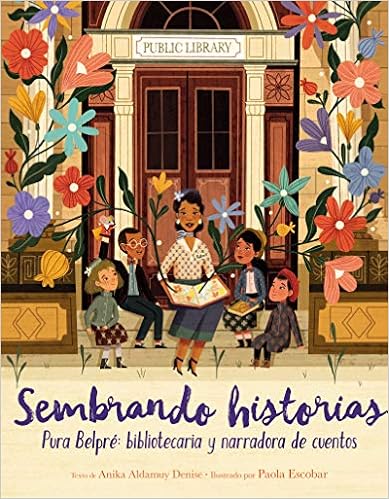
Sembrando historias: Pura Belpre: bibliotecaria y narradora de cuentos - por Anika Aldamuy Denise


In honor of Children's Book Week (this week) and Día de los libros/ Día de los niños (yesterday) a Spanish-language book about Pura Belpré - the first Spanish-speaking librarian in New York City. This beautifully illustrated work tells of Belpré's arrival in Manhattan from her native Puerto Rico. After she got a job at the New York Public Library she lamented that there were no books with the stories she grew up with on the shelves, so she wrote her own collection and created puppets to illustrate the stories during story time.

This book is available in English as Planting Stories: The Life of Librarian and Storyteller Pura Belpré. 

See also The Storyteller's Candle/La velita de los cuentos.

Monday, June 25, 2018

Sonia Sotomayor: A Judge Grows in the Bronx=Sonia Sotomayor: la juez que creció en el Bronx - by Jonah Winter


If there is one thing I love more than a "library" book, it's a bilingual library book! Beautifully illustrated by Edel Rodriguez this biography of Supreme Court Justice Sonia Sotomayor recounts her life growing up in the public housing projects of New York, to her acceptance at Princeton University, and on to becoming a federal judge, and ultimately her nomination and confirmation onto the Nation's highest court. The book is written in parallel English and Spanish text, and of course mentions the importance of libraries (twice!) in Sotomayor's journey to the Supreme Court. The Author's Note on the back cover provides some additional information about Sotomayor, including her birthday - June 25, 1954. Since I happened read this book only a few days before her 64th birthday I decided to publish this post to coincide with it. Happy Birthday Sonia!

Friday, April 13, 2018

Library on Wheels - by Sharlee Glenn


This week (April 8-14) is National Library Week. Wednesday (April 11) was National Bookmobile Day. It was also the day that Glenn's book about the very first Bookmobile was published. I had pre-ordered it from Amazon, and it was shipped on Wednesday, arrived to Thursday, and read (by me) on Friday. Well researched and illustrated with historic photographs, letters, and other period artifacts, this book tells the story of Mary Lemist Titcomb, chief librarian of the Washington County (Maryland) Free Library from 1901-1931. Titcomb established several innovative library programs in the early 19th century, including instituting one of the first children's rooms, and delivering books and other library materials to schools. Not content with simply serving those who were able to come to the public library in Hagerstown (the county seat) Titcomb launched a story hour program for rural children, and set up book depositories in smaller towns, to ensure that access to books and reading was widespread. Realizing she was still not serving all residents, she commissioned the first bookmobile in the United States - a horse drawn wagon whose route included family farms and other isolated areas. The wagon was driven by the library's janitor, Joshua Thomas, who proclaimed himself to be a "Book Missionary" on the 1910 U.S. census.

My favorite part of this book has to be this bit from a newspaper article written about Ms. Titcomb for The (Hagerstown) Builder 
The hostess was most gracious, most charming. She wore a soft gray silk and a dainty slipper was visible. The hostile one saw it, saw too-could she believe it?-the feminine frivolity, a jeweled buckle. She heard too, the little woman discussing "Spring Fashions" vivaciously, knowingly, for Miss Titcomb is no mean authority on style and her dress, like her work, is always up-to-date.
It seems you can be fashionable while wearing sensible shoes.

For more books that feature bookmobiles (including another one about the very first bookmobile) you can see my previous posts here.

Thursday, April 12, 2018

Educated - by Tara Westover


Raised and home-schooled by survivalist parents in the Idaho mountains Tara Westover rejected her family's admonishments not to go to college and enrolled in Brigham Young University (BYU) before she turned 18. Ultimately she becomes a Cambridge-educated PhD, but not without painfully examining her role in the family. Her father's conspiracy theories about universities and the Illuminati were made known to her long before she thought about going to college herself. Her mother had taken charge of her children's homeschooling, which mostly consisted of letting them learn what they wanted when they wanted, and included occasional trips to "the Carnegie library in the center of town".

Westover recognized that she was one of the least disciplined of her siblings when it came to "doing school" which gave her a lot of reason to doubt her abilities when she arrived at BYU. Her misgivings were magnified when she discovered that her classmates had an understanding of US culture and history that she did not share. Her realization that everyone else knew what the Holocaust was, for instance, caused her not only embarrassment, but also opened her eyes to the fact that her peers shared a collective knowledge that she was missing. She did not even know what she did not know.

If Westover had anxieties about her place at BYU they were only compounded when she arrived at Cambridge. Upon her arrival on campus she and her denizens were invited to take a tour of the chapel, including the roof. She describes the experience of watching her classmates, and her professor fight the wind on top of the building as they cling to the wall while she climbs higher. Finally explaining to her professor that "she'd roofed [her] share of hay sheds" and that
The wind is just wind. You could withstand these gusts on the ground, so you can withstand them in the air. There is no difference. Except the difference you make in your head...I'm just standing...You are all trying to compensate...You've made yourselves vulnerable. If you could just control your panic, this wind would be nothing.
Even this insight though, was accompanied by apprehension
I wanted the mind of a scholar, but it seemed that Dr. Kerry saw in me the mind of a roofer. The other students belonged in a library; I belonged on a crane.
Her ultimate success in earning her PhD demonstrates that she certainly did belong in a library, and the final third of the book (from the time she lands in Cambridge for the first time) is scattered with references to using it. This stands in stark contrast to the first 200 (plus) pages, where there is only one.

Sunday, April 30, 2017

The Storyteller's Candle/La velita de los cuentos - by/por Lucia González


¡Feliz Día de los niños / Día de los libros! Children's Day/Book Day (or more simply Día) is celebrated every year on April 30 to celebrate multicultural books for children and to encourage literacy. The celebration was started in 1996 by children's author Pat Mora whose work I have written about before (see my previous posts about Pat Mora and Día here and here). 

This year in honor of Día I read a bilingual book about a bilingual librarian, Pura Belpré, the first Latina librarian in New York City. The Storyteller's Candle/La velita de los cuentos tells the story of how those who migrated to Manhattan's Barrio from Puerto Rico during the Great Depression found a welcoming library when they discovered that a Spanish-speaking librarian had been hired. Belpré made clear the message that libraries were for everyone by not only ensuring that reading materials in English and Spanish were available to the new arrivals, she also planned story hours, and celebrations that honored their language and traditions.The beautiful illustrations enhance this story about the joy and warmth of family and community. 

Belpré's memory is honored each year with the awarding of the Pura Belpré Award to a Latinx author and illustrator "whose book best portrays, affirms, and celebrates the Latino cultural experience in an outstanding work of literature for children and youth."

Monday, April 14, 2014

Judy Blume's Story - by Betsy Lee


A favorite author among young people for over 40 years, Judy Blume is this year's Honorary Chair for National Library Week (April 13-19, 2014). The beloved author is not only a life-long library user, and advocate for libraries, she is crusader against censorship. This isn't surprising, as her books are perennials on the list of Most Frequently Challenged books. Her best-selling novel for young adults Are You There God? It's Me, Margaret was targeted almost immediately upon its publication. It seemed fitting that I read Blume's biography for Young Adults in honor of National Library Week. Evidence of her love of libraries can be found throughout. As well it is easy to see where her battle against book banning began
Not everybody liked Margaret Judy gave three copies of the book tor Randy's and Larry's [Blume's children] elementary school, but they never appeared on the library shelf. The principal wouldn't allow them because the book dealt with menstruation. Schools in other cities also banned the book. "I was angry beyond words" says Judy.
This reaction was a steep contrast to the reception her first book, The One in the Middle is a Green Kangaroo, received. "She sent a copy of the book to Randy's third grade class, and Randy's classmates sent Judy cards telling her how much they enjoyed it. 'I felt like a celebrity,' Judy remembers."