Showing posts with label segregation. Show all posts

Thursday, June 5, 2025

Mockingbird Summer - by Lynda Rutledge

 In 1964 Ms. Delacorte public librarian in High Cotton, Texas suggests newly-minted teenager Kate "Corky" Corcoran read To Kill a Mockingbird. Corky shares the book with her brother, Mack who has just completed his first year of college; and with her new friend, America who otherwise cannot use the library in the segregated town.  

Through the lenses of these characters we see how each creates their own meaning of Harper Lee's work. Corky's journey includes learning what the word "rape" means as well as a discovery that although the story took place three decades prior it really wasn't so long ago as the same battles were still being fought in the segregated south.

The Civil Rights bill forms a backdrop to the story and Corky's mother Belle is expecting to benefit herself from the legislation as it also includes rights for women. Belle is looking forward to taking a job at the public library, in defiance of her husband.

Wednesday, February 14, 2024

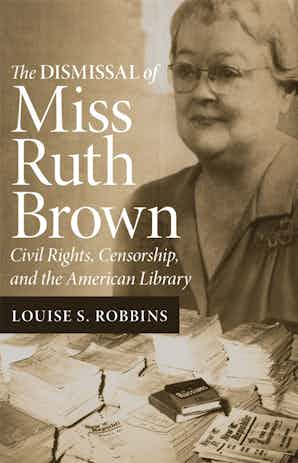
The Dismissal of Miss Ruth Brown - by Louise S. Robbins


Eight years ago I wrote about the film Storm Center. I recently learned that this film, produced at the height of McCarthyism, was loosely based on the case of Ruth Brown, who was fired from her job as librarian at the Bartlesville (Oklahoma) Public Library in 1950. Robbins' book even contains a rather thorough summary of the movie. Bette Davis (who played ousted librarian Alicia Hull) was questioned about taking the role by at least one parent, Anne Smart. 

Smart sent Davis a "report of the book controversy" she was causing in Marin County [California]...Her report depicted in "vivid detail...the type of material being given to our children in some schools. [The report]...made its way around the country for for several years [and contained] the names of authors "all extremely well listed as to their communist and/or communist front affiliations by various government investigating committees."

The more things change... 

Brown was an outspoken civil rights activist in her town. Her racial justice work during the height of McCarthyism made her an easy target. Charges that she was circulating "subversive" materials was a façade for the real reason of her dismissal.

The back cover blurb of this work (published in 2000) reads 

The fundamental issues of the Brown case make it especially pertinent today when differences - in race, gender, class, and national origin - are again feared and as challenges to materials in library collections again escalate. Ruth Brown's story helps us understand the matrix of personal, community, state, and national forces that can lead to censorship, intolerance, and the suppression of individual rights

This description is even more eerily prescient today. As are discussions in the book of neutrality, academic freedom, freedom of acquisition, freedom of access (especially to controversial materials) and the blatant sexism. 

Ruth Brown was one of the women, mostly white and middle-class, who made up 88.8 percent of the allied profession of librarianship in 1950. For a salary less than a man would receive, she organized and maintained a comfortable homelike space where people, especially young people, went for wholesome enlightenment (emphasis mine). The professional role of the librarian gave communities low-cost female employees (emphasis mine) to provide healthy recreational and informational reading while it extended the margins of the domestic sphere without exploding them. The librarian's role did not transgress boundaries as long as the homelike space and the materials and activities organized in it remained safe, comforting, and submissive to the prevailing ideology...

The more things change... 

The Library Bill of Rights was originally adopted by the American Library Association (ALA) in 1939 to ensure access to information (even what some might consider harmful or dangerous) to all. "The ALA articulated the importance of allowing citizens to decide for themselves what they should read, an idea Brown expressed in her interview with the city commission". This is a stark contrast to the description of the "stereotypical" librarian 

in Alice I. Byran's 1952 research report, The Public Librarian...[who] was "rather submissive in social situations" and lacked self confidence. "Indiscreet" was not part of the lexicon by which librarians, especially female librarians, were described. In fact female librarians have been characterized as discreet to a fault in book selection practices, "ruthless in their own censorship." Marjorie Fiske's 1959 classic , Book Selection and Censorship, depicted its mostly female subjects as anxious and fearful, avoiding challenges to library materials through self-censorship.

The more things change... 

 And on a final note, we see the same ideological concerns in libraries today as libraries in Montana and Georgia cut ties with the ALA over president Emily Drabinski's identity as a Marxist lesbian.

The more things change...

Saturday, August 28, 2021

A Ride to Remember: A Civil Rights Story - by Sharon Langley and Amy Nathan


When I was very young my family and I enjoyed visits to Gwynn Oak Amusement Park in Baltimore, Maryland. Hurricane Agnes destroyed the park in 1972 and it was not rebuilt. Rather than an amusement park, it now is a park of the type one might go for a picnic, or to fly a kite. 

Gwynn Oak Park opened in 1893 and like many amusement parks at the time it was segregated.I was unaware that the park had not been desegregated until 1963 when I heard about this book and attended a webinar about it last year. You can watch the webinar here.

My parents moved to Baltimore from the midwest in January of 1962 and started their family. My older sister was born in late September of the same year which made this story, about a girl who was 11 months old on August 28, 1963, especially relevant for me. Sharon Langley was the first African American to ride the Carousel at Gwynn Oak Park on the day it was desegregated. 

Langley explains segregation in this work via a conversation between herself and her parents about her family's role in desegregation.
For a long time, black and white kids couldn't do many things together. They couldn't go to the same schools or to the same restaurants and libraries or even sit together at the movies. It was the law.
    "Why didn't somebody do something about those kinds of laws?" I asked.
    "They did," said Mama.
    "We did," said Daddy.
    Many people - both blacks and whites - knew that segregation was unfair and just plain wrong.
    Some people said, Just wait. Times will change.
    But others said, Why wait? What's wrong with now? They held protests at restaurants, stores, and movie theaters. They tried to get officials and courts to make new laws to create a better city - a place that would welcome and include all people.
    By the time I was born, some unfair laws had changed in Baltimore. Kids could go to the same schools and libraries, restaurants, and some movie theaters, too - no matter the color of their skin. "But the amusement park just wouldn't budge," said Daddy. 

Beautifully illustrated by Coretta Scott King Award winner Floyd Cooper this book tells a story of segregation and desegregation appropriate for young readers.

Wednesday, April 7, 2021

Ready to Fly: How Sylvia Townsend Became the Bookmobile Ballerina - by Lea Lyon and A. LaFaye

This week is National Library Week and today is National Bookmobile Day. Ready to Fly tells the story of Sylvia Townsend who grew up in a segregated America in the 1950s. She desperately wanted to take ballet lessons, but her family could not afford them so when the bookmobile rolls into her town she asks the librarian to help her find books on ballet. She checks out new books each time the bookmobile comes and helps the other girls in her neighborhood to learn ballet too. Young Sylvia learns to dance so well that a teacher offers to pay for her ballet lessons. However, her dreams are almost crushed when she is denied a place in the "whites only" classes. Ready to give up she is given another chance to take classes when she and her friends perform in the school talent show and learn that a famous dance instructor was in the audience. 

Tuesday, March 30, 2021

Steeped in the Blood of Racism: Black Power, Law and Order, and the 1970 Shootings at Jackson State College - by Nancy Bristow

Just after midnight on May 15, 1970 two young black men, James Green and Phillip Gibbs, were killed by police fire on the Jackson State College campus in Mississippi. Several other students were wounded and a women's dorm at the historically black college was left riddled with bullet holes. 

While often likened to the killings at Kent State University (see my post on When Truth Mattered by Robert Giles) on May 4 of the same year, the shootings at Jackson State were not the result of a Vietnam War protest, 

but rather another chapter in the long history of state violence against African Americans, a story inseparable from their identities as students attending a black college in the capital city of the nation's most racially repressive state.

 Roy Wilkins the national director of the NAACP stated in 1963 that 

There is no state with a record which approaches that of Mississippi in inhumanity, murder, brutality, and racial hatred. [It was] absolutely at the bottom of the list.

Despite the passage of the Civil Rights Act six years before the shootings little had changed in Mississippi. And at Jackson State where "the administration, controlled by the state's all-white Board of Trustees of Institutions of Higher Learning, worked hard to keep the campus quiescent" even as a growing number of students and faculty were starting to protest. 

While there was local and national coverage of the event at the time, including reports in the New York Times, the Los Angeles Times, and even an article in Playboy magazine the tragedy has largely been forgotten since, even as the shootings at Kent State University which happened less than two weeks earlier are remembered each year on its anniversary. There are other parallels with the Kent State shooting, including false reports of rock throwing and sniper fire before police opened fire.

Bristow's book places the shootings within the historical context of a state founded on enslavement, racism, segregation, and white supremacy.

Of particular interest to this blogger was that in 1961 students from another historically black institution, Tougaloo College "attempted to desegregate the downtown's white library with a 'study-in'" as part of a protest of the city's Civil War Centennial celebration.

The students began by visiting the local black library to request volumes they knew the branch did not hold before entering the white library to request those same books. The police were quick to arrive, arresting nine students...They spent the night in the city jail before being released on bail...On the evening following the "study-in" youth from around the city protested the arrest of the group they dubbed the "Tougaloo Nine". At Jackson State College perhaps as many as 800 students gathered outside the campus library...President Reddix attempted to disperse the students and was undone when they resisted. Eventually he was seen just "snatching students at random and shoving them toward a [campus] policeman or deal with orders to expel them".

Documents about the shootings can be found at the College archives, and on display at the library, but "they do not captivate attention as they once did". Even annual memorial events draw low attendance. Although largely forgotten by society at large, the victims still remember. They remember the loss of friends and family, and they live with their own wounds both physical and psychological. There was no justice for the victims of the Jackson State shootings. There were no indictments against any member of law enforcement present that night, and a civil case brought by five of the victims and their families found for the defendants. Although the decision was appealed and a three judge panel found that "the barrage of gunfire far exceeded the response that was appropriate" it was further determined that "despite their guilt, the state and local governments, their officials, and their law enforcement personnel were insulated by 'sovereign immunity', the doctrine protecting the state and its representatives from suits or any penalties that could result". This same doctrine is still in place today and what still allows law enforcement to murder people of color with impunity.

Sunday, January 15, 2017

Hidden Figures - the movie


I don't often go to the theater to see a movie. I prefer to wait until they are available streaming or on DVD so I can watch them in my living room and enjoy reasonably priced snacks from my own kitchen and bathroom breaks whenever they are needed. Yesterday I made a rare exception and went to see Hidden Figures at the local cinema. This film based on the true story of African-American women who worked for NASA during the 1960s lives up to all the hype and was well worth the price of admission. I can also only assume that the racism and sexism we see in the film has a Hollywood sugar-coating and that it was much worse than what is portrayed in the film. 

One thing we don't see is any of the trailers for the film is a pivotal library scene. Dorothy Vaughn (Octavia Spencer) is thrown out of the public library for daring to look for a book in the "white" section when she realizes what she needs is not available in the "colored" area. Once she is back on the bus with her two sons she pulls out a library book on Fortran from under her coat. When one of her sons asks if she "took" it Vaughn explains that she pays taxes like everyone else, and that you can't "take" what you already paid for. She uses the book to secretly learn to program the new room-sized IBM mainframe computer that has recently arrived at NASA that will surely put her and many of her denizens out of a job. By learning the computer language she not only changes her own destiny, but that of dozens of other women, both black and white, who work for the space program. This episode is one of many in the film that reminds us that what is legal is not necessarily right, and what is illegal is not necessarily wrong. Powerful lessons that are still relevant today.

Update July 26, 2024:
Today I discovered that this post is cited in The Reel Librarians blog!