Showing posts with label nature. Show all posts

Tuesday, December 10, 2024

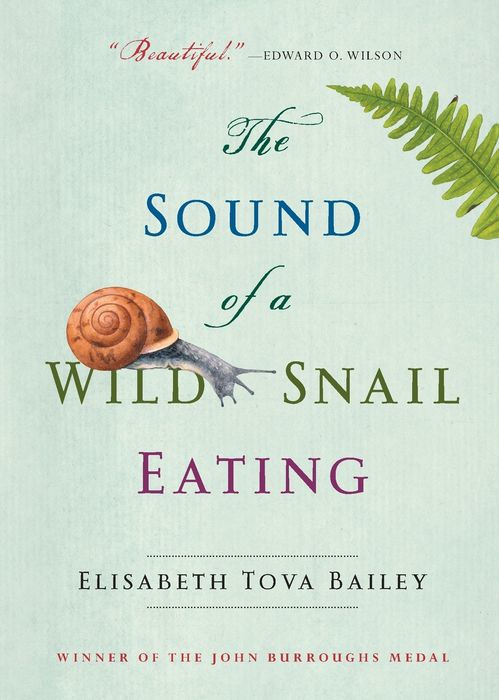
The Sound of a Wild Snail Eating - by Elisabeth Tova Bailey


This book was recommended to me by my son as I was recovering from a recent illness. The author recounts one-year of a decades long illness in which she was unable to even sit up on her own. She finds solace with a snail who lives in a terrarium next to her bed. 

She specifically states that at the worst of her illness she was not able to even read to herself, and that the library was a place (among others) that she could not go. As she recovers a bit she can sit up enough to read again and requests "through interlibrary loan the twelve-volume compendium The Mollusca which covers the entire phylum of mollusks".

A quick, yet meditative read.

Thursday, February 16, 2023

Bay Country: Reflections on the Chesapeake - by Tom Horton


The New York Times pull quote on the cover of this work states that "Fans of Aldo Leopold, John McPhee, and Sigur Olson won't be disappointed...Mr. Horton displays a stunning command of the language." I will admit to not having ever heard of Sigurd Olson; however, I have read two of McPhee's books (one for my Celebrating the States project some years ago), and more I recently blogged about Leopold's Sand County Almanac . I agree that like McPhee and Leopold, Horton has a "stunning command of the language". Furthermore, as in Leopold's work, libraries in Horton's book are used metaphorically, as a way to understand (read) nature. 

The roots of corn we seldom notice, but ought to heed; for they speak as eloquently as the golden ears and luxuriant foliage topside, but a different message indeed. Pull up a stalk sometime and the first thing that will strike you is how easy it was to do, and how scanty are the underpinnings of so statuesque a plant. Pushing up its glossy green regimens across a thousand square miles of Maryland, this giant, wild grass, bred into the aristocrat of cultivated cereals, epitomizes the pride and problems of our agriculture - and of more than agriculture - I venture there is more profound social commentary in a cornfield than in some libraries, if one is willing to dig for it.

With a coring device [scientists] extract gray-brown cylinders from the bay's bottom, a distance down through the muck of several feet, but a journey back through time of a thousand years. Grain by grain, layer by layer, a few micrometers a year, the sediments washing off the 64,000-square-mile watershed that extends from New York to West Virginia have compiled a rich natural historical library, awaiting only a generations of readers skilled enough to translate it.

...public commitment to restoring the bay is running at an all-time high. Throughout the watershed, people and their elected leaders are gabbling excitedly about the prospects, as a flock of geese gets raucous just before lifting off for new feeding grounds. The challenge is infectious, the script outline looks promising; but just as yet the library at the bottom of the bay reads caution. 

Horton's soothing prose made this love letter to the Chesapeake Bay (and all of Maryland) a perfect read aloud for this Marylander and her husband. The book was originally published in 1987, the year we were married - in Maryland!

Thursday, December 8, 2022

Cape Cod - by Henry David Thoreau

Thoreau spent a year on Walden Pond; however, he spent only a week visiting Cape Cod in October 1849 before writing this book (although he does mention three visits in total). He traveled from shoulder to fist, back before there was a canal that cut the town of Onset off from the rest of the Cape and before the Cape was such the destination that it is today. He talks to many locals during his travels.

In Pond Village he talks to some blackfish fishermen.  

the Social Whale, Globicephalus Melas of De Kay; called also Black Whale-fish, Howling Whale, Bottlehead, etc.

he learns that these whales are valuable for their oil and that whole schools of them have been caught and then sold for thousands of dollars.

In the Naturalists' Library, it is said that, in the winter of 1809-10, one thousand one hundred and ten "approached the shore of Hralfiord, Iceland, and were captured". 

When Thoreau got to Provincetown he took a"little steamer" back to Boston and describes the scene at the wharf

I see a great many barrels and fig-drums, - piles of wood for unbrella-sticks, - blocks of granite and ice, - great heaps of goods, and the means of packing and conveying them, - much wrapping-paper and twine, - many crakes and hogsheads and truck, - and that is Boston. The more barrels, the more Boston. The museums and scientific societies and libraries are accidental.  
I found this book on one of the many bookshelves in my house, although I believe my husband had read it before, it was previously unread by me. It is available for free through Project Gutenberg.

Monday, January 27, 2020

Falter: Has the Human Game Begun to Play Itself Out - by Bill McKibben


Some might call this book alarmist, but since McKibben called it on global warming back in 1989 when he wrote The End of Nature I'm not going to ignore his warnings here. Exploring Artificial Intelligence (AI), biotech, the billionaire class, and genetic engineering McKibben looks at how these things are part of a symbiotic relationship leading to a dystopic end of life as we know it. He pulls no punches as calls the villians out by name.

Writer Ayn Rand, author of The Fountainhead, and Atlas Shrugged and a darling of conservatives, is given a fair bit of print in this work. McKibben points out that
The cult of Ayn Rand extends far beyond the richest and most powerful. When the Modern Library asked readers in 1998 to catalogue the greatest books of the twentieth century...Atlas Shrugged and The Fountainhead were ranked one and two. Plenty of readers might have agreed with Barack Obama, who described Rand's work as "one of those things that a lot of us, when we were 17 or 18 and feeling misunderstood, we'd pick up". But plenty of others have never put her down. One biographer described her as "the ultimate gateway drug to life on the right." 
We may be able to take some solace that three of Rand's titles also show up on Goodreads list of Books You're Ashamed to Admit You Read.

Friday, April 7, 2017

Quabbin: The Accidental Wilderness - by Thomas Conuel


In 1946 the Massachusetts towns of Dana, Enfield, Greenwich, and Prescott, along with six villages were flooded to create the Quabbin Resevoir in order to provide fresh water to Boston. The inhabitants of the towns were relocated, as were cemeteries and some buildings. 

Conuel's book tells some of the history of the towns and how the reservoir was created, and also tells of the beautiful wilderness that stands today with wildlife including bobcats and bald eagles. This slim work is rife with historic photographs providing a glimpse into the life of central Massachusetts at the turn of the 20th century as well as pictures of flora and fauna found at the Quabbin Resevoir. The book was first published in 1981, and I imagine that even since the 1990 revision I read climate change has brought about some additional transformations to the area.

One cannot write a book such as this without some assistance from archivists, historical societies, and librarians. Conuel found a gold-mine of information in Warren "Bud" Doubleday, a former resident of one of the flooded towns. He was referred to Doubleday by a librarian in New Salem. He also acknowledges Audrey Druckert, the official librarian of the historical society, an expert in wild plants and conservator of "a collection of tapes...as close to a complete oral history of the valley before the reservoir was built as exists anywhere."

This book has been sitting on my shelf for a long time. I finally read it as part of Book Riot's 2017 Read Harder Challenge  which includes a call to "Read a book that is set within 100 miles of your location" (among 23 others).