In a library research scene reminiscent of Margot Kidder's in The Amityville Horror our heroines Nancy Wheeler (Natalia Dyer) and Robin (Maya Hawke) review some old tabloid newspapers on microfilm surrounding the Creel murders. The possibility of a house possessed by demons further analogizes the classic horror film. See also Stranger Things 2 Episode 3 "The Pollywog".
Wednesday, July 27, 2022
Thursday, January 20, 2022
Picket Fences (the television show) "Elective Conduct" Season 3 Episode 6
The third season begins with the fictitious town of Rome, Wisconsin receiving a federal court order to desegregate its schools via the forced bussing of Black students from the (not fictitious) city of Green Bay. The (mostly) white residents of Rome face their prejudices, and liberal-minded Mayor pro tem Jill Brock calls in the local police in an attempt to stop the students from getting off the bus. Her plan is thwarted with a countermove by the National Guard (a la Little Rock). The story arc exploring race and racism continues for several episodes.
Episode 6 opens with fifth-grade students reading their reports for Multicultural Awareness Day. The teacher is cringe-ily dressed in stereotypical Native American garb and a girl reads her report indicating that Chinese people in the United States are best known for their restaurants, and are "good fighters". The Mayor's son Zachary reads his report on "Why White Kids Should Help Black Kids", citing academic achievement gaps, and indicating that these gaps are because of small brains that only think about sex. He is cut off by said cringe-worthy teacher, taken to the principal's office, and suspended.
It turns out that he does have citations for his assertions. The achievement gap statistics came from the Educational Testing Service, and the information about brain size came from the eleventh edition of the Encyclopedia Britannica.
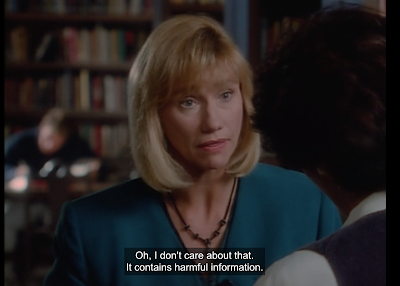
Cut to Jill Brock in a library speaking to the librarian (in what appears to be the public library). Brock has the offending volume of the Britannica in her hand, reads from it, and asks why it is in the library. The librarian explains that the 1911 edition is a "classic" and that "museums would kill for this set". Jill insists that it be removed because it "contains racial material". The librarian counters by suggesting that by those standards Mark Twain should be removed as well. She actually uses the N-word (on what at the time of original airing would have been network television). Brock is able to get her son reinstated by demonstrating that the information came from a book in the library. She also gives him a good "talking to".
Wow. A lot to unpack here.
Let's start with the fact that the mayor wanted the book removed because it contained "racial material". Books about race, or written by people of color are being especially targeted in the United States today. Challenges are coming from the left and the right. And we are seeing classics such as To Kill A Mockingbird being questioned. Learning to question what we read in books is essential to a good education. We cannot question what we aren't allowed to see, however.
Deselection (or "weeding") of materials is part of the professional work of librarians. Libraries should have living collection development policies which outline what kind of materials will be held in the library, as well as what will not. Additionally, the policy should explain when/how/what kind of materials will be removed. Reasons for pulling books are myriad and include that they might be out of date, however, that is not the only consideration. Some works are classics, or perhaps are kept because they have value to historians. There is a lot that can be done with a challenged book between outright removal and leaving it on open stacks to be found by impressionable fifth graders who have not received appropriate research guidance. For instance, the encyclopedia set in question might be moved to a special collections room where it is accessible to scholars, but not necessarily to elementary school students, or it could simply be moved to a higher shelf, where it can't be reached by children without assistance, while keeping a current set in a more accessible place. What shouldn't be done, though, is for the Mayor to come barging in, insisting that a book be removed without input of the library board and without any kind of public hearing.
I will say this for young Zachary - I liked that he clearly used at least two sources and synthesized them. He also had full citations, such that his mother was able to find the exact quote in question. That's what citations are for.
Tuesday, April 21, 2020
Veronica Mars - great detective, lousy librarian
I missed the Veronica Mars television series when it first aired from 2004-2007. I doubt I even knew it existed. Back then, before there was streaming television, people had to subscribe to a cable service if they wanted to watch TV, and my husband and I refused to pay for it. The only thing we watched on the boob tube were videos available at our local Blockbuster video store. We now subscribe to Netflix and Hulu which is how I was able to binge watch this smart, sassy show about a young woman who works for her father - a Private Detective. The first two seasons we see Veronica as a high school student. In season three she is a freshman at the fictional Hearst College where she gets a job at the college library. She is disappointed at this appointment, as she feels it is inferior to working for the school newspaper, and her letdown is evident in the crappy way she answers questions. She often appears annoyed, and waves people off to the stacks rather than attempting to do a proper reference interview. Worst of all, she closes the reference desk when her boyfriend shows up so she can go bone him on the ninth floor.
The recently-made fourth season features a grown up Veronica still working with her father at his Detective agency. It also features a reference librarian from the Hearst College library. The librarian has a bit part, and is unimpressed when Veronica points out that she, herself, used to work in the library. Maybe the librarian knew her then, and was aware that she wasn't the best student worker they'd ever had.
Anyway, despite the obvious drawbacks I enjoyed this series. Veronica seriously kicks butt.
Wednesday, March 6, 2019
The Umbrella Academy (the television series)
When the surviving children of Reginald Hargreeves reunite for his funeral they discover that the apocalypse is nigh. While attempting to save the world they discover secrets that threaten much more than family unity.
While it is made clear that scenes that take place in the present day do indeed transpire in 2019, it is a parallel world of 2019 than the one viewers know. It is a world with no cell phones; one in which our superheroes must use their wired house phone, or find a pay telephone when not at home, in order to communicate with one another when they are not together. It is likewise a world without Google. A world in which if one wants to find out about their sister's new suitor, for instance, one would have to go to the public library and use the newspaper on microfiche to find out more about him. An excellent use of library resources. There is one other scene over the 10 episodes that takes place in the public library, one in which a couple of judgmental librarians wonder where the parents of the drunk teenager are.
A wonderful cast and a good story with some truly unexpected twists and surprises.
Wednesday, November 15, 2017
Stranger Things 2 - Episode 3 (The Pollywog)
Back in 1984 you couldn't just Google how to take care of a pollywog, or for that matter, shine your iphone's supernatural creature identification app at unknown beings to find out more about them. You had to go to the library. And look things up in books.
"Mr. Henderson, you know the rules. Five at a time." says the unnamed librarian when young Dustin attempts to check out five books, although Miss Librarian Lady knows he already has five books out. Dustin strategically tries to appeal to her sense of discovery, but she will have none of that. Five. At. A. Time. She emphasizes. The whole stereotypical exchange is so hokey we can almost forgive the cliche solution Dustin comes up with when he points to something behind Miss Librarian Lady and gasps "what the hell...", and then runs out with the five books. Does he ever return the stolen books? We may never know.
Tuesday, February 28, 2017
Mary Hartman, Mary Hartman - the television show, Season one episodes 1-9
The show is really quite sophisticated in its humor, and without a laugh track the audience is left on its own to figure out what is funny. Exaggerations and stereotypes comprise much of the farce. Re-watching the show now, four decades since it first aired, I commented to my husband that the sets look less like they were created in the '70s and more like they were created in the '90s to look like the '70s. That's quite a trick! Librarian stereotypes are, of course, some of my favorite things to write about, and this show managed to represent two different librarian clichés over two episodes. Episode five ends with our heroine receiving a phone call from a short, bespectacled, older, bun-headed, shusher-type (Iris Korn) informing her that the books she wanted had come in. She goes on to read the titles out loud, all of which fall along the lines of 'Your Orgasm and You', and other sexual self-help titles. The start of the following episode finds Mary arriving at the library to find a rather effeminate male librarian (Ken Olfson) behind the desk. She asks to speak to the "lady librarian" but is informed that she has left. While Mary pretends that the stack of martial aids that were set aside are not really for her, the librarian pretends that he simply cannot check them out to her since they were set aside for someone else. Ultimately Mary manages to wrest the books away from the library and bring them home, where they almost become another character in the story. Mary's husband Tom (Greg Mullavey) is embarrassed when a friend from work notices the books in the kitchen. Tom confronts Mary about them, and is incensed when she doesn't immediately return them from whence they came.
There is practically enough material here to write an entire Master's Degree thesis.
There are two more discs of episodes coming to my mailbox from Netflix. If there is any more drama about libraries or library books you will find out here.
Stay tuned...
Thursday, January 5, 2017
What if the Gilmore Girls were librarians?
Tuesday, March 22, 2016
Desk Set - the Movie
In this most classic of all library films Katharine Hepburn plays Bunny Watson - head reference librarian at a television network. Watson has a keen wit, a sharp mind, a green thumb, a super-cool apartment, and a tosser of a boyfriend (Mike Cutler, played by Gig Young). Spencer Tracy plays Richard Sumner, who keeps hanging around the library and measuring everything. Watson and her three co-workers Peg Costello (Joan Blondell); Sylvia Blair (Dina Merrill); and Ruthie Saylor (Sue Randall, a.k.a. Miss Landers for any Leave It to Beaver fans) are wary and wonder if they will be losing their jobs to a computer, even though they are fully (and accurately) aware that computers cannot replace librarians! This film was made before I was born, but the same questions are relevant. Computers may not take up entire rooms any more, and they may have more information than ever, but it still takes people to provide the information, and to evaluate it. Fortunately Sumner understands that the computer only supplements the work of the librarian. In fact. he points out that their time will be freed up to do real research, and that there will be more work than ever. Again, this point is still relevant today. Just because people can Google for themselves what the Seven Wonders of the World are, doesn't mean librarians don't have real work to do. It has shifted. We do more research and teaching, and less helping people with crossword puzzles.
This film passes the Bechdel test in spades. It was refreshing to see a film about women lifting each other up, both professionally and personally, although I do admit to being a bit let down by the end of the film when the (woman) computer programmer came in and everyone ganged up on her.
No stereotypes here. These librarians were smart, fetching, stylish, and clearly had off-screen sex lives. Gold stars all around.