Thursday, January 5, 2017

What if the Gilmore Girls were librarians?

This is all because of Logan. 

My husband (James) and I finished binge watching all seven seasons of Gilmore Girls over the weekend and started on the new retread. After watching the first episode -"Winter" - I said to James that if I were in charge of the new mini-series I would have had Logan have a complete change of heart, and he would be a social worker. Then I thought a bit more about it and said "no, better yet, a librarian". Then we started joking about what kind of librarian all the characters would be. From there it just got out of hand. So grab a cup of (fair-trade, organic) coffee (in a ceramic mug) and join me in a re-imagined Stars Hollow where everyone finds their true calling in library work. 

Lorelei  is the community program director of Stars Hollow Public Library (SHPL). As a single parent she is keenly aware "that it takes a village". Parents of young children are especially grateful for her free daytime programs where they can take a break from endless mind-numbing games of Candyland, and talk to some other adults. Her annual Banned Books Week display and reading is anticipated more than the town's annual Winter Carnival.

Rory is a research librarian at National Public Radio. She loves hobnobbing with the national personalities and really can't  tell you how much she wishes that the Organization would just stop taking donations from the Koch brothers. For goodness sake she'd rather take money from the Huntzberger Group!

Jess received the prestigious Dorothy and Lewis B. Cullman Center for Scholars and Writers fellowship from at the New York Public Library.

Luke and Dean are in charge of Library maintenance at SHPL. Dean is fantasy fodder for the bubble gum brigade at Stars Hollow Middle School (and that includes the gay captain of its football team - thank goodness it is finally safe to be out in Stars Hollow!) making the teen center at the library the place where all the cool kids go after school. Luke keeps the coffee maker in the break room filled and takes special joy in reminding patrons who are talking on their cell phones to "take it outside". He also gives cooking lessons at the library on Saturday afternoons. Reliable as ever, there is never a burnt out bulb in the stacks, or an un-shoveled walk after a snow.

Sookie found her passion in food research and got a job as a reference librarian at The Culinary Institute of America. She is royally peeved that the Institute's homepage does not include a direct link to the library, but will continue to fight the good fight on that front. She commutes to work from her home on Long Island, where Jackson maintains a lovely garden and runs an heirloom seed library.

Emily runs a homework helper volunteer program at the Nantucket Atheneum. She thinks some of the children must speak Portuguese, but can't be sure. She understands them anyway.

Lane and Zack finally extricated themselves from Mrs. Kim's control by moving the family to Cleveland to be curators at the Rock and Roll Hall of Fame. They are currently creating a special exhibit of 70s rock star jumpsuits - an idea given to them by a 50-something librarian who thoroughly enjoyed her visit to the museum earlier this year.

Paris writes and maintains the pamphlet collection at Planned Parenthood. Her attention to detail and medical expertise assure that only the most current, accurate, and medically-based information is available at all times.

Doyle works as an archivist at the New York Times. 

Miss Patty and Babette maintain a Little Free Library adjacent to the town gazebo.

Logan is a systems librarian at Bunker Hill Community College. He had a spiritual reawakening and a realization that he was just a blond jackass after all after his last business deal was such a disaster it caused the lay off of over 1,000 workers. He had to take out a loan to pay for is Master's degree in Information and Library Science because even his father had had enough of his shenanigans. He is a better person for it though, and is glad to provide service with his signature smile.

Marty is the director at the Bunker Hill Community College library and Logan's boss (an irony not lost on Logan, believe you me). They both still carry a torch for Rory, but she is having none of it. Occasionally Marty and Logan will have a cry over some beers together.

In a twist that surprised even them, Kirk and Lulu became nudists and moved to to Kisamee, Florida where they work at the American Nudist Research Library.

April won the student worker of the year award at the MIT's Dewey library.

Michel and Caesar both volunteer two evenings a week at the New Haven Free Public Library. Michel teaches French for travelers and gets a truly perverse pleasure in telling Emily's former cronies from the DAR that he can't understand a thing they say. Caesar teaches English citizenship classes. Whenever one of his students passes the citizenship test he celebrates by making them his famous chilaquiles.

Taylor is archiving the town's historical documents. Every scrap of paper is sacred and must be cataloged, digitized and, preserved in acid-free archival boxes. He is all about acid-free now.

Richard left a colossal amount money to the Chilton prep school library. The will stipulated that they money be used to update the collections, and that the librarian had to be the highest paid member of the faculty and, of course, that the library be renamed in Rory's honor.

I understand that Paul also got a library job... now if I could just remember where?


A special thanks to James for being my Muse on this one, and for helping me to flesh out some of these ideas.


Wednesday, January 4, 2017

My Brave Book of Firsts


I found out about this book from "A Mighty Girl" on my Facebook feed. I was drawn to it for several reasons: first, it is a book about firsts - something my friend Jenny has made me realize are to be celebrated no matter what age you are; second, it is a "year of" book; third, and most importantly, it addresses the excitement of getting a first library card, and checking out a book for the first time. 


Sunday, January 1, 2017

The Brief Wondrous Life of Oscar Wao - by Junot Díaz


To wrap up 2016 I re-visited an old favorite. I first read this about 10 years ago when I assigned it to students in my First Year Seminar. I had not read it since, although I did read Díaz's two other books Drown, and This is How You Lose Her. And I did have the chance to meet the author in the meantime - in fact I got to introduce him when he spoke at our campus in 2008! There is movement afoot to bring him back to Bridgewater so it seemed like a good time to re-read this novel.

Oscar de Leon (aka Oscar Wao) is a Domincan living in New Jersey He is also a big nerd. Fat and homely he does not fit in with the rest of the kids in his neighborhood, and not surprisingly, does not do so well with women. He does, however, love to read and spends a lot of time at the library.
Oscar had always been a young nerd - the kind of kid who read Tom Swift, who loved comic books and watched Ultraman - but by high school his commitment to the Genres had become absolute. Back when the rest of us were learning to play wallball and pitch quarters and drive our older brothers' cars and sneak dead soldiers from under our parents' eyes, he was gorging himself on a steady stream of Lovecraft, Wells, Burroughs, Howard, Alexander Herbert, Asimov, Bova, and Heinlein, and even the Old Ones who were already beginning to fade...(It was his good fortune that the libraries of Paterson were so underfunded that they still kept a lot of the previous generation's nerdery in circulation.)
 This may be the first time I've seen a lack of library resources referred to as a stroke of luck.

The narrator, Yunior, takes on Oscar as a bit of a project as a favor to Oscar's sister (Lola). They are college roommates and Yunior attempts to get Oscar to diet and exercise, and to act like more of a Domincano. Yunior mentions using the library a few times himself - once because he had nothing better to do, and once to hit on another student at his college library.

 The author makes heavy use of footnotes, which often provide historical context and are an important part of the story. They are not to be ignored and are written in the same engaging style as the rest of the book. I knew better than to skip them, and was rewarded with not only a better understanding of the story, but also it was where we learn that Lola ("a reader too") always supported her brother's sci-fi mania by "bringing him books from her own school, which had a better library."

The action in this book alternates between New Jersey and the Dominican Republic. There is a fair amount of Spanish language woven into the dialogue. Those who have heard or used Spanglish will recognize the natural use of the language in this work.

It was serendipitous that a friend posted this video on her Facebook page just as I was finishing this work. It explains why the Spanish words and phrases used in the novel are not italicized, but simply embedded into the rest of the text.

Tuesday, December 13, 2016

Beyond Words: What Animals Think and Feel - by Carl Safina


It has been five years since I posted my rave review about Safina's The View from Lazy Point. Like Rachel Carson, Safina writes science for all. His delightful prose is accessible, witty, and smart leaving one with a true sense of wonder. This passage about humans discovering the use of tools by chimpanzees provides a clear window onto his clever writing style
In 1960, Jane Goodall rocked the world with "news" that chimps were using twigs - in other words, tools - to extract termites. Up to that moment, scientists had believed that only humans made any tools, and that tools "made us human." But - wait a minute! In 1844, a missionary to Liberia named Thomas Savage wrote that wild chimpanzees crack nuts "with stones precisely in the manner of human beings." Science did not rediscover the missionary's position for more than a century.
I began reading this book in August on the ferry from New Bedford, Massachusetts to Nantucket on our way to hear Safina give a talk about his work with elephants. 

Both the book and his presentation discussed the question of anthropomorphism (the attribution of human emotions to other animals). Throughout much of the twentieth century scientists only observed and reported on the behavior of animals, but did not seek to understand why they (the animals) might do something, or how they might feel about it. In fact, scientists who suggested that animals might have reasoning skills were considered un-academic. Safina, however, pointed out in his talk that "it is not scientific to not be open". And explains in the book " that [b]y banning what was considered anthropomorphic, the behavorists perpetuated the opposite error that only humans are conscious and can feel anything". Safina simply asks animals the question "Who are you?". The answers, however, are complex.

It took me several months to get through this book because although I read it in small chunks there was always so much to digest. It certainly had me re-examining my own belief that animals don't reason. A belief, no doubt, instilled in me by the fact that I grew up in the 70s and 80s, when behaviorism was the science of the day and so any education I received would have reflected that. I was especially thrown by this explanation about the care of baby turtles
in 2014...scientists announce[d] their discovery that hatchlings and adults of a species of river turtle vocalize to one another, using eleven types of calls. The scientists observed that the calls functioned "to congregate hatchlings with adults for mass migration." Had you asked me before I read that, I (and most turtle experts) would have told you-wrongly-that no turtles provide parental care, at all. 
The passage made me recall the lesson in my second grade science class in which we learned about how turtles laid their eggs, covered them up, and then left the babies to their own devices when they hatched to find their way to the water. I remember a few years later pointing out to our music teacher when she taught us a song about a mother turtle taking care of her baby that such a thing would never happen.

Safina wraps up this section with a quote from his neighbor J.P. Badkin: "if you're not careful, you can learn something every day." 

This is sure to become my new librarian mantra.

Scarce on any actual libraries (the only mention of the word is in a discussion of a the vast scope of elephant noises, which he refers to as a "sound library") Safina's work is included on this blog not so much for this one library metaphor but because the book demonstrates Safina's love of lifelong learning. As a librarian my hope for everyone with whom I interact is that they, too, will develop such a passion.


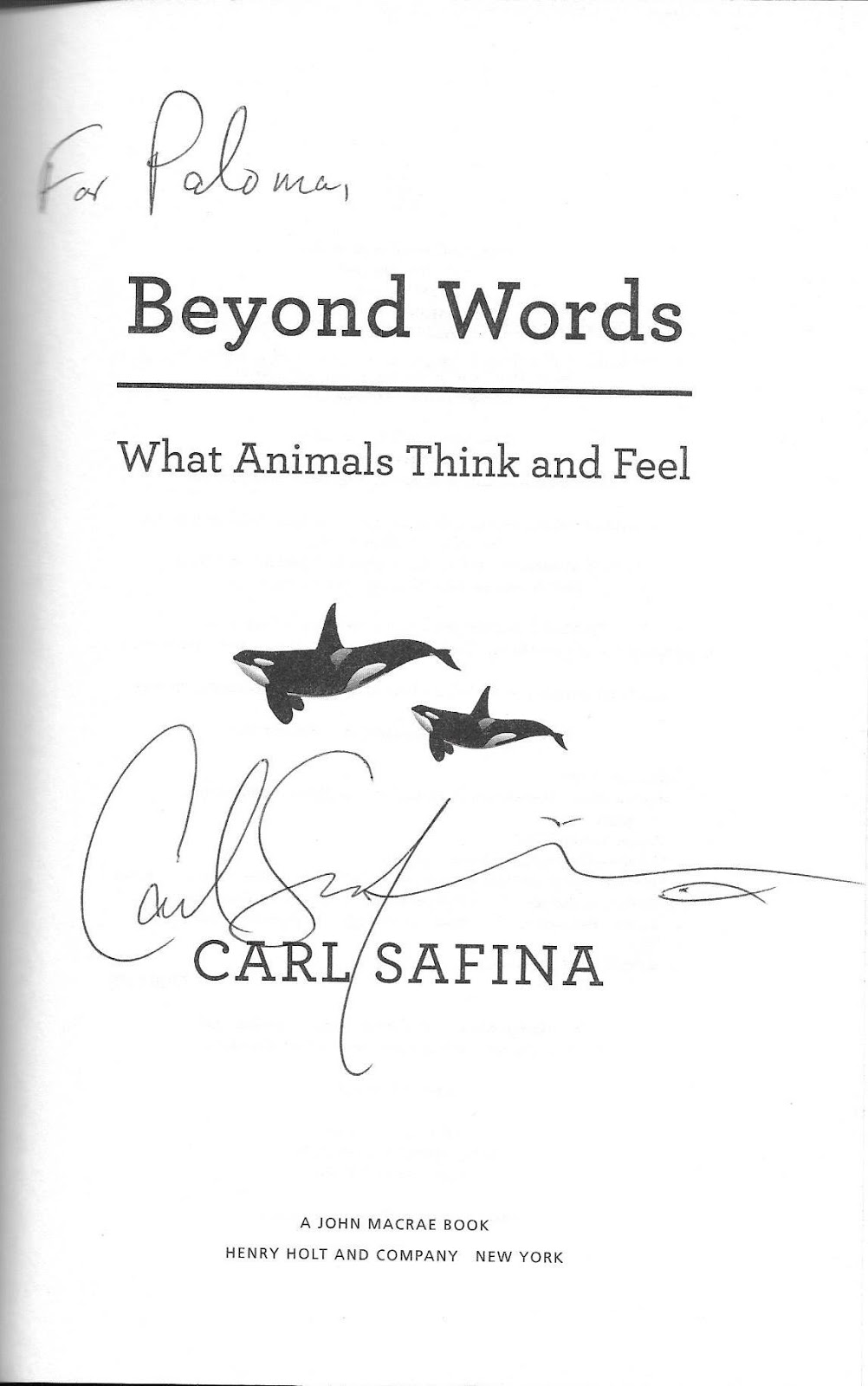
We were able to have our copy of the book signed by the author when we attended his presentation on Nantucket.

Safina's Ted Talk "What are Animals Thinking and Feeling" can be found here:

Tuesday, December 6, 2016

Committed - by Elizabeth Gilbert


When I searched the web for images of the book cover to use here I found some that were different than the edition I read. This happens occasionally, and normally I don't worry about finding an exact match, but in this case I did because the subtitles on the covers were different. It appears that later editions had the subtitle "A Love Story" whereas this one is a decidedly less romantic "A Skeptic Makes Peace with Marriage". Having gone through a difficult divorce (which you can read all about in Gilbert's phenomenal bestseller Eat, Pray, Love) the author is indeed pretty skeptical about marriage, as is her boyfriend, Felipe, for reasons similar to Gilbert's own. The two are essentially "sentenced" to matrimony when Felipe has some serious problems with the U.S. immigration service. It is made clear to the happily unmarried couple that Felipe (a Brazilian-born Australian citizen) will be unable to return to the country without a fiancé visa. During the long wait it takes to obtain the visa Gilbert explores her feelings and does some research on the meaning of marriage across time and space.

This memoir is bookended (so to speak) with two nearly identical library metaphors. Near the start of the story Gilbert and Felipe arrive at the Dallas/Fort Worth airport together after a trip abroad. Gilbert "passed through immigration first, moving easily through the line of ...fellow American citizens." Meanwhile she waited for Felipe to get through his much longer line. When he finally had his turn with the immigration official she watched as "he studied Felipe's bible-thick Australian passport, scrutinizing every page, every mark, every hologram" growing ever more apprehensive as she waited for the anticipated "thick, solid, librarian-like thunk of a welcoming visa-entry stamp. But it never came." And it is therefore, with some relief at the end of the book that Felipe finally hears "that satisfying librarian-like thunk in his passport."

Of course since I look for libraries in books this use of the metaphor would pique my interest more than some other readers. A "thunk" can be a sound for a lot of things, perhaps some rather unpleasant - the thunk of a jail cell closing behind you, or the thunk of a head hitting the floor, for instance. But here it is used as a reassuring sound - a sound you might expect to hear in a library, a place where one feels safe. And I do think that Gilbert and Felipe ultimately feel safe together in their marriage.

Tuesday, November 29, 2016

She's Come Undone - by Wally Lamb


This is the second book I've selected from the Little Free Library on Washington Street in Fairhaven, Massachusetts. It turns out both were choices from Oprah's Book Club. I never participated in Oprah's book club, but back in my public library days I was always aware of what her picks were because people would start calling the library as soon as they were announced to find out if we had them. Anyway, I enjoyed both books I chose (the other was Where the Heart Is by Billie Letts).

In this coming-of-age novel young Delores Price faces a tragedy that eventually tears her family apart. After her parents divorce she is sent to live with her grandmother while her mother recuperates from a mental breakdown, and Delores' life begins a downward spiral. She is obese, and essentially friendless when she leaves for college where more torment awaits her. After several years in a psychiatric ward she tries to strike out on her own, but her pain has not been fully explored or healed.

The copyright on this book is 1992, and the story follows Delores from her childhood in the 1950s through adulthood. All the action takes place before the time of Google, indeed, personal computers were virtually unknown to the characters in this work. Of course that means that they had to go to the library to find things out. Delores is a prolific library user. This is especially evident when she mentions that her school guidance counselor, Mr. Pucci, saw her though "$230 worth of unreturned library books". She doesn't get much better at returning books as an adult.When she takes the feminist classic Our Bodies Ourselves out of the Montpelier (VT) public library she apparently ignores the overdue notices that "begin to appear" along with her bills in the mail.

She takes advantage of the Providence (RI) Public Library's vast collection of telephone books from around the country ("thousands and thousands of pounds of tissue paper pages") to find the address of someone she's been stalking. I guess this is one library service that is no longer needed. Who uses phone books anymore? And it is so much easier to stalk people online as well.

And finally, a first. This is the first book I've blogged about a book that mentioned a hospital library.

The writing is first-rate, and despite Delores' deep cynicism she is someone the reader wants to cheer for. The book really isn't as depressing as my post might make it sound. It has some truly sweet spots.

Monday, November 14, 2016

A Field Guide to Lies: Critical Thinking in the Information Age - by Daniel J. Levitin


I downloaded this e-book after watching this short interview with the author. Levitan has a lot to say about information literacy and includes chapters on understanding numbers, graphs, and statistics (and how all can be used to deceive); and how to think critically and logically so as to avoid being duped. Crucially, he discusses the importance of doing our own research in order to verify claims we've heard
Time spent evaluating claims is not just time well spent, it should be considered part of an implicit bargain we've all made. Information gathering and research that used to take anywhere from hours to weeks now takes just seconds. We've saved incalculable numbers of hours of trips to libraries and far-flung archives, or hunting through thick books for the one passage that will answer our questions. The implicit bargain that we all need to make explicit is that we will use just some [emphasis in original] of that time we saved in information acquisition to perform proper information verification.
Levitan also makes clear the importance of librarians in the information age. He specifically mentions asking a librarian for assistance in finding the origin of a quote often misattributed to Mark Twain ("It ain't what you don't know that gets you into trouble. It's what you know for sure that just ain't so."). He tells of consulting expert research librarian Gretchen Lieb at Vassar who explained the difficulty in tracking it down explaining that "Quotations are tricky things. They're the literary equivalent of statistics, really, in terms of lies, damn lies, etc." The quote in question most likely originated with humorist Josh Billings.

Levitan also explains about the scientific process, and what peer-review entails. Further he explains that it is becoming more difficult to tell which journals are reputable with the "proliferation of open-access journals that will print anything for a fee, in a parallel world of pseudo-academia". He goes on to say that "Reference librarians can help you distinguish the two" and specifically gives a shout out to Jeffrey Beall, a research librarian at the University of Colorado, Denver who has created a "blacklist" of disreputable journals.

This book was especially useful for me as I am currently researching how to teach students how best to evaluate websites and other open-access sources. In fact, I would recommend this book to all budding researchers (and I know a few experienced ones who might benefit from it as well). It is written clearly with just enough illustrations and was well worth the time I spent reading it.