Monday, October 24, 2022

The Book of Form and Emptiness - by Ruth Ozeki

Please note: Because I listened to this book, there may be misspellings in character names, and quotes may not be exactly as written in the print version.

There are too many levels of meta in this one for me to follow them all. The book, in addition to narrating the lives of the characters, is also narrating itself.  

A host of rich characters populates this book: these include Corey, a children's librarian; Annabelle, a would-be librarian who had to leave library school when she became pregnant; Benny, Annabelle's son - a truant who hears voices and uses the local public library to hide out; Aikon a decluttering guru and bestselling author; and a band of colorful library patrons. 

After Annabelle's husband, Kenji, dies in a freak accident she has a hard time coping with raising her son, doing her job clipping news stories for clients, and running her home. As she begins to hoard, Benny struggles with his own mental illness and he begins to have auditory hallucinations. He and his mother share a love for libraries and both find refuge in their local public library. 

I listened to this book on audio, and there was so much in it, I will limit myself here to commenting only on the notes I made while listening.

I start with my favorite quote from the book. Librarian Corey shows up to help Annabelle clear out her house wearing a shirt that reads: "Librarian - because bad-ass motherfucker isn't an official job title".

As she attempts to console Annabelle, who is feeling completely overwhelmed and begins to sob, Corey "shushes" her. As a librarian she, of course, knows from shushing.

The books in the library calmed the voices in Benny's head. Books are described as sacred, and the libraries as temples. Stopping at the library on the way back from a psychiatrist appointment was a treat.

In an attempt to "liberate" the voices from his body, Benny injures himself with a thumbtack. Thumbtacks are described as dangerous, but not as dangerous as books. This was especially striking to me as I consider the new age of book banning that we are currently experiencing. Although I cannot recall the exact context of this description of dangerous books in Ozeki's work, it is appropriate to say that some believe that the ideas found in books are more dangerous than any of the myriad real life-threatening dangers we face daily.

Although Annabelle didn't finish library school, she clearly has a librarian's keen sense for finding elusive information. When Benny disappears she is aware that he may be with his friend who calls herself The Aleph. Searching Aleph alone wasn't enough to find her. Annabelle knew to search for "The Aleph". 

The Aleph is an artist who specializes in snow globes. The best one she makes is one for Benny that features a library scene with books and letters floating in the water.

The question "What is real?" is at the center of this work. It is a question Benny explores at the behest of The B-Man one of the eccentric patrons of the public library. It is what makes this work so meta. Is the book narrating itself, or is it Benny's head? 

Thursday, October 20, 2022

A Sand County Almanac - by Aldo Leopold


I'd been meaning to read this for a long time. It had been just sitting there on my shelf for ever so long. My husband read it decades ago, and although my intentions were always there, there was always something else I wanted to read. Now its time has finally come.

This was really a mood piece. The nature descriptions were soothing and poetic. I felt much like I was simply floating in a dream, awakened now and then by the word "library". Often this is used metaphorically. Leopold understands that landscapes, like so many things can be "read".

The autobiography of an old board is a kind of literature not yet taught on campuses, but any riverbank farm is a library where he who hammers or saws may read at will. Come high water, there is always an accession of new books.
...he who owns a veteran bur oak owns more than a tree. He owns a historical library, and a reserved seat in the theater of evolution.
        A farmer and his son are out in the yard, pulling a crosscut saw through the innards of an ancient cottonwood. The tree is so large and so old that only a foot of blade is left to pull on.                Time was when that tree was a buoy in the prairie sea. George Rogers Clark may have camped under it; buffalo may have nooned in its shade, switching flies. Every spring it roosted fluttering pigeons. It is the best historical library short of the State College, but once a year it sheds cotton on the farmer's window screens. 
    This state of doubt about the fundamentals of human population behavior lends exceptional value, to the only available analogue: the higher animals. [Paul] Errington, among others, has pointed out the cultural value of these animal analogues. For centuries this rich library of knowledge has been inaccessible to us because we did not know when or how to look for it. Ecology is now teaching us to search in animal populations for analogies to our own problems.
Perhaps, though, my favorite was this:
If I were to tell a preacher of an adjoining church that the road crew had been burning history books in his cemetery, under the guise of mowing weeds, he would be amazed and uncomprehending. How could a weed be a book?
Librarians know well that books themselves can be weeds. Our shelves are gardens, and outdated books are removed in order to make our gardens grow.

Literacy can take many forms. The ability to read, and interpret the printed word is but one. The ability to read and interpret our surroundings is another. It is a literacy that even when this book was written over 70 years ago we were losing. We have lost more ground since.

Like Rachel Carson's Silent Spring and Robin Wall Kimmerer's Braiding Sweetgrass, this work uses exquisite prose to explain science to the layperson.

Monday, September 19, 2022

Banned Books Week - The New American Censors

The American Library Association recognizes Banned Books Week each September to celebrate our freedom to read. This year, however, the “celebration” is more strained than usual, as teachers and librarians across the United States are facing unprecedented attacks and threats for selecting books that represent the diverse experiences of the communities they serve. Our First Amendment rights are under attack as never before by censors and politicians who wish to limit our ability to choose reading material for ourselves.

In the decades since the American Library Association has been keeping track of book challenges there were typically several hundred reports. In 2021 there were over 1500 book challenges in the United States. And challenges in 2022 may well outpace those of 2021.

Although a minority of the population, these new censors are well organized and have shown up at school and library board meetings not only demanding that books be removed, but also starting recall campaigns against board members. Rather than challenging individual titles, censors are requesting the removal of categories of books. Lists of “offensive” books are shared among the censors so that often the complainants have never read, or even heard of the books prior to filing the challenge. Librarians and teachers have been targeted on social media with misinformation campaigns that have falsely called them pedophiles, and “groomers” for keeping books on sex education, and those with LGBTQ themes on the shelves. Tactics involving reading out-of-context passages aloud at board meetings, insisting that the books are obscene or pornographic have become commonplace. As well,  some citizens have filed police reports against librarians,  calling for their arrest. Books by and about people of color are also being targeted as “woke” and “divisive”.


More information about books that have been targeted, organizations that are fighting for your right to read, and how you can help can be found on my Banned Books Week guide


Friday, September 2, 2022

Amelia Bedelia's First Library Card - by Herman Parish


September is Library Card Sign Up Month!

Something that will make me (and my library colleagues) cringe is hearing patrons say they want to "rent out" a book. We do understand that they want to borrow the book, or check it out, nevertheless we correct them. This isn't because we want to embarrass them, it is because we want to ensure that there are in fact no misunderstandings, since so many people also confuse the campus library with the campus bookstore (which does "rent out" books). And because some people actually do not understand that they can borrow the books for free from the library.

In this story Amelia Bedelia joins her class in a trip to the town library in order to get a library card and check out her first library book. And even though she uses the phrase "checking out" when referring to the book in her hand she discovers that in a library that means she wants to borrow the book to take home, not that she is simply looking at the book. The misunderstanding means she goes home with the wrong book. One misunderstanding leads to another, but in the end lovable Amelia Bedelia makes a friend in the librarian.


Monday, August 8, 2022

The Life and Times of the Thunderbolt Kid - by Bill Bryson


While on a short vacation in Niantic, Connecticut friends introduced us to The Book Barn  - a delightful (and huge) used bookstore with books for every interest. I walked out with six books, and my husband left with five, all for about $50!

Bryson's memoir about growing up in the 1950s was the perfect beach vacation read. Light and funny it also mentions libraries about half a dozen times. 

When he failed to produce a signed permission slip in order to go on a school field trip he spent the day in the the school library which he 

actually didn't mind at all. It's not as if I were missing a trip to the Grand Canyon or Cape Canaveral. This was Des Moines. There were only two places schools went on trips in Des Moines-to the Wonder Bread Factory...and the museum of the Iowa State Historical Society, the world's quietest and and most uneventful building...

We can deduce from this that the library was not a quiet and uneventful place. Apparently young Bill Bryson understood that the library was full of adventure! 

His parents, who were "affectionate...in a slightly vague and distracted way" sometimes went to the movies together, or to the library. I have always held that libraries are good places for dates. There are often programs, lectures, or book discussions to attend together. Or a couple could simply go and pick out a book to read together.

Bryson spent much of his childhood obsessing on how and where he could see naked women. One place was his

father's small private library of girlie magazines in a secret place known only to him, me, and 111 of my closest friends.
However, for a real live experience he set his sights on the strippers' tent at the Iowa State Fair where the twelve year old was denied entry because one needed to be thirteen to enter. So the following year he
assembled every piece of ID I could find-school reports, birth certificate, library card, faded membership card from the Sky King Fan club...

only to be thwarted once again when the minimum age for entry was changed to fourteen.

He laments that his old elementary school "lost its wonderful gym and auditorium...to make way for a library and art room...". Myself, I'd much rather be in a library (or an art room for that matter) than a gym. 

On the very next page of the book he laments the loss of the "enormous photo library" housed at the Des Moines Register and Tribune newspapers. He is (rightly) surprised and disappointed to discover that they were all destroyed and "recycled for the silver in the paper".

Bryson writes of one bit of urban lore that he, like most people, have no reason not to believe, although it is utterly false. As an information literacy specialist I feel I must set the record straight on the subliminal advertising study in Ft. Lee, New Jersey in which

patrons were shown a film in which two clipped phrases -"Drink Coca-Cola" and "Hungry? Eat Popcorn" - were flashed on the screen for 1/3000 of a second every five seconds, much too fast to be consciously noted, buy subsconsciously influential, or so it seemed, for sales of Coke went up 57.7 percent and popcorn by nearly 20 percent during the period.

Life magazine is cited as the source of this information (although a full citation with volume, issue, date, etc. is not provided). In fact, it turns out the data from the experiment was never able to be repeated, and some question whether the experiment even ever took place at all. Nevertheless the legend will not die. More information about the Subliminal Advertising study can be found on Snopes.com.

I did find the rather elusive Life magazine article. Those who want to look it up will find it in the March 31, 1958 issue (v. 44 no. 13) pp. 102-114. It's called "'Hidden Sell' Technique is almost Here".

Tuesday, August 2, 2022

Deceived by the Gargoyles - by Lillian Lark


August is Read-a-Romance month. As a genre, I rarely read romances, but when I do they feature a librarian. Lucky for me this list of 10 Romances about Magical Librarian Love from Book Riot appeared on my Facebook feed in late June. I selected Deceived by the Gargoyles because the description indicated it was a polyamory romance, and not having read any such before, I was intrigued.

Grace is a witch who works in a library archive for both magical and non-magical artifacts. Grace's special magic allows her to "read" feelings and emotions via paper (especially books). She is also looking for love.

After some unsatisfactory dates she heads to a matchmaker (Rose) who suggests that Grace consider dating a "non-witch". Grace is open to this and answers that "the type of paranormal shouldn't matter." She is sent on a date to meet Elliott, who appears human (wearing a "glamour") when they meet, but who is actually a gargoyle. Elliott, is gracious and offers to get his car so Grace doesn't have to walk to the nearby restaurant in her "sexy" high-heeled shoes. As sensible-shoe-wearer myself I immediately questioned Grace's choice of footwear. What kind of librarian is she, anyway? In any case, however gracious, Elliott hadn't been completely honest with Rose when asking for a match. While Grace was expecting to be matched with someone single, Elliott, in fact, already had two (2!) other mates (Broderick and Alasdair), both male, and both gargoyles. They all lived together with the rest of their clan in Bramblewick Manor.

After a bit of getting to know each other, some confessions, a lot of sex, and a lot more sex, and the gifting of an entire library in their home to Grace - a la Beauty and the Beast(s) - they all fall in love and live happily ever after.

Broderick appeals to Grace's intellectual curiosity in order to entice her to try some new things with him
You're a librarian who has knowledge sitting before you. I'd think you'd...jump on the opportunity to explore.
Among the gargoyles Grace has the hardest time connecting with Alasdair, who had never been with a woman before. They initially find kinship through reading together. Alasdair suggests that Grace select a book that she would like for him to read to her on her Kindle. Together they discover a special intimacy through this otherwise chaste act. 

Reading together is one of the things that my husband and I have been doing consistently since we started dating 37 years ago. Sometimes we read books, other times magazine or newspaper articles (or Dear Abby). Deliberately making and spending this time together gives us a chance to slow down, and take a break from whatever else is happening. We often laugh together, or chance upon a new topic of conversation.

The crazy four-way sex in this work was more than I'd expected, even knowing that it was a polyamorous romance. Much as I'm all for life-long learning, I won't be reading the rest of the series.

Monday, August 1, 2022

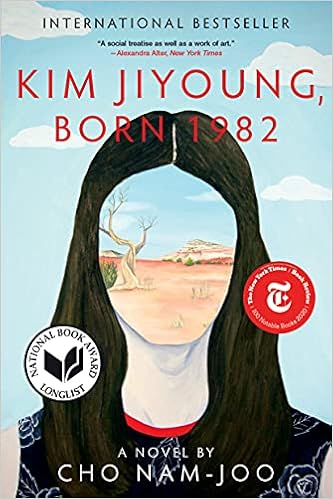
Kim Jiyoung: Born 1982 - by Cho Nam-Joo


This short novel explores the universal expectation that women sidestep their own desires in favor of men's wishes. Girls may be denied educational opportunities in favor of their brothers getting better opportunities. Men are praised for the work women do (both at home and in the office). Women are expected to do errands at their workplace that men are not asked to do.  Husbands continue with careers while wives quit or go to part-time work when children arrive. Sexual harassment is also a theme of this work.

Libraries get two nods in this book. Jiyoung studies with her boyfriend at the university library, and at a client dinner for Jiyoung's division (where she was plied with beer) her division head, after drunkenly making inappropriate comments to her 
hired himself a chauffer over the phone..."My daughter attends university right here. She was studying late at the library and wants me to come pick her up because she's scared to go home by herself".
A worthwhile read for Women in Translation Month, or any month.