Tuesday, March 8, 2022

The Yellow House - by Sarah M. Broom


My husband and I attended Broom's virtual session last year at Boston University's Anti-Racist Book Festival. We had not heard of her before, but she piqued our interest, and we ordered the book on Audible and listened to it together. The Yellow House is a memoir not only about the specific house in New Orleans where the author grew up, it is a book about our relationships with the places that form us. 

The youngest of twelve children, Sarah was born into the Yellow House where she lived with many of her siblings, although some of the oldest never lived there. The Yellow House was located in New Orleans Eastpart of the city's Ninth Ward. Hurricane Katrina was the second Hurricane the author, and the Yellow House experienced. As a baby Broom and her family were evacuated when Hurricane Betsy rampaged their home in 1965.

Although her school libraries get barely a passing mention, as a college student at the University of North Texas (where the "cost of [her] ignorance about college was high") she was
ravenous about learning, nearly living at the Willis Library where [she] spent seven or eight hours at a time hunched in a cubicle reading books about subjects fellow students seemed already to know.
After graduation, and a Master's degree from the University of California, Berkeley, Broom moved to New York to take a job with O Magazine. There she met Samantha Power, author of A Problem from Hell at an author event at the New York Public Library. Power convinces Broom to go to Burundi (a small African country mostly known as a neighbor to Rwanda). 

Bloom eventually makes her way back to New Orleans where she researches the history of the (now destroyed) yellow house at the New Orleans Public Library. 
To find the history of the Yellow House, I had to search original deeds, chains of titles, successions. I stalked the Conveyance Office, the Office of Vital Records, the Real Estate and Records Office in city hall, the Notarial Archives, and libraries. The search was full of cross-referencing and confusion.

I arrived many mornings at the main branch of the New Orleans Public Library in the business district, just across from city hall, and waited in line for the doors to open. If you didn't know better, you'd think the city was full of people eager to read, but actually the line was full of homeless people who had slept outdoors and were trying to get to the bathrooms. 
Broom goes on to describe posted rules of using the library that include the following "disallowed" behaviors: stalking patrons; using or exchanging drugs; bathing; shaving, washing up, or washing clothes in bathroom sinks; bad smells; oblivious  transmission of germs or excessive coughing; preaching or forcing your ideas on others. Also disallowed: weapons and shopping carts. "Most of these things still happened anyway...The library staff spent much of the time policing, which made it hard to get research assistance". 

Any library worker in public service can relate to this. Too much of our time is devoted to policing behavior. Many administrators, as well as library users, are unable to understand our work as anything beyond study hall monitors. We actually would prefer to help people with research rather than spending our time explaining how to use a photocopier, refilling printer paper, or (most recently) incessantly reminding people to wear their masks above their nose.

Find out more about Sarah Broom at https://www.sarahmbroom.com/

Thursday, January 20, 2022

Picket Fences (the television show) "Elective Conduct" Season 3 Episode 6


My husband and I were happy to discover that all four seasons of the 1990s television show Picket Fences were available through Hulu. We remembered this thought-provoking, quirky drama series fondly. While we are enjoying re-watching, we were not especially surprised to discover that not all of the stories aged well, and we are  having very different conversations about the show than we did 30 years ago.

The third season begins with the fictitious town of Rome, Wisconsin receiving a federal court order to desegregate its schools via the forced bussing of  Black students from the (not fictitious) city of Green Bay. The (mostly) white residents of Rome face their prejudices, and liberal-minded Mayor pro tem Jill Brock calls in the local police in an attempt to stop the students from getting off the bus. Her plan is thwarted with a countermove by the National Guard (a la Little Rock). The story arc exploring race and racism continues for several episodes.

Episode 6 opens with fifth-grade students reading their reports for Multicultural Awareness Day. The teacher is cringe-ily dressed in stereotypical Native American garb and a girl reads her report indicating that Chinese people in the United States are best known for their restaurants, and are "good fighters". The Mayor's son Zachary reads his report on "Why White Kids Should Help Black Kids", citing academic achievement gaps, and indicating that these gaps are because of small brains that only think about sex. He is cut off by said cringe-worthy teacher, taken to the principal's office, and suspended. 

It turns out that he does have citations for his assertions. The achievement gap statistics came from the Educational Testing Service, and the information about brain size came from the eleventh edition of the Encyclopedia Britannica

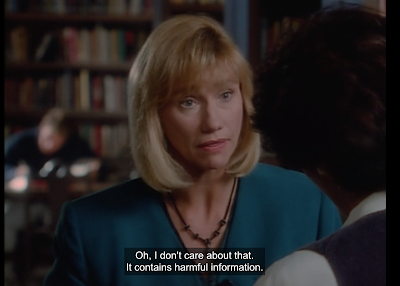
Cut to Jill Brock in a library speaking to the librarian (in what appears to be the public library). Brock has the offending volume of the Britannica in her hand, reads from it, and asks why it is in the library. The librarian explains that the 1911 edition is a "classic" and that "museums would kill for this set". Jill insists that it be removed because it "contains racial material". The librarian counters by suggesting that by those standards Mark Twain should be removed as well. She actually uses the N-word (on what at the time of original airing would have been network television).  Brock is able to get her son reinstated by demonstrating that the information came from a book in the library. She also gives him a good "talking to".

Wow. A lot to unpack here.

Let's start with the fact that the mayor wanted the book removed because it contained "racial material". Books about race, or written by people of color are being especially targeted in the United States today. Challenges are coming from the left and the right. And we are seeing classics such as To Kill A Mockingbird being questioned. Learning to question what we read in books is essential to a good education. We cannot question what we aren't allowed to see, however.

Deselection (or "weeding") of materials is part of the professional work of librarians. Libraries should have living collection development policies which outline what kind of materials will be held in the library, as well as what will not. Additionally, the policy should explain when/how/what kind of materials will be removed. Reasons for pulling books are myriad and include that they might be out of date, however, that is not the only consideration. Some works are classics, or perhaps are kept because they have value to historians. There is a lot that can be done with a challenged book between outright removal and leaving it on open stacks to be found by impressionable fifth graders who have not received appropriate research guidance. For instance, the encyclopedia set in question might be moved to a special collections room where it is accessible to scholars, but not necessarily to elementary school students, or it could simply be moved to a higher shelf, where it can't be reached by children without assistance, while keeping a current set in a more accessible place. What shouldn't be done, though, is for the Mayor to come barging in, insisting that a book be removed without input of the library board and without any kind of public hearing.

I will say this for young Zachary - I liked that he clearly used at least two sources and synthesized them. He also had full citations, such that his mother was able to find the exact quote in question. That's what citations are for.

Thursday, January 13, 2022

Feminists Among Us: Resistance and Advocacy in Library Leadership - edited by Shirley Lew and Baharak Yousefi

I spotted this collection of essays on the New Books shelf at the library as I was looking for something to read over the holidays. While this wasn't really light reading, it was the only book I finished of the three I checked out. The other two were novels that just didn't keep my interest.

The essays in this book explore leadership, feminism, racism, sexism, diversity, and intersectionality (among other things) within the library profession. It is most definitely an academic book, written primarily for other academic librarians

Of course it is no surprise to those of us in librarianship that "white heterosexual men in feminized professions...benefit from 'the assumption that they are better suited than women for leadership positions'". However, as Maura Smale quotes Chris Bourg out in the first essay "Always a Novice" 

If all of you who don't want to play politics, who don't want power & influence to change your values, and who want to have a healthy work life balance shy away from leadership positions; it might mean that you are leaving the leadership of our profession in the hands of those who aren't concerned about those things.

It is a truth that men tend to get the leadership positions in libraries. My own library just hired a white male as our new Dean. In collective memory of the university "white male" describes every library leader we have ever had. 

 "Isn't feminist leadership just about being a decent human being" is the question explored in the final essay "Feminist Praxis in Library Leadership". While the question may seem simplistic it spiraled into quite a lengthy essay. Through targeted interviews with eleven library leaders the authors asked six open-ended questions

  • What is feminism?
  • What is leadership?
  • What are some examples of your feminist leadership actions?
  • How are you addressing issues of diversity and inclusion?
  • What do you read that informs your feminism and/or your leadership?
  • What other related topics would you like to tell us about?

From there three more questions emerged

  • What does being a feminist mean to you?
  • What makes leadership feminist?
  • What tips or advice do you have for others looking to activate their feminism at work?
Readers are provided with some perceptive answers to these questions.

A timely work.

Monday, December 20, 2021

Idiocracy - the movie


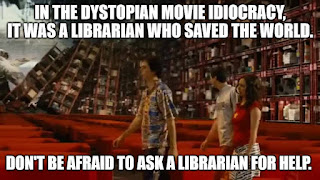
I learned about this film through the Librarian Memes Facebook Group. I also learned that it was available to watch for free on YouTube - albeit with ads, which I very much try to avoid. I bit the bullet though and my husband and I watched (with the occasional short interruptions). This film stars Luke Wilson as Joe Bauers (the librarian) and Maya Rudolph as Rita (a sex worker). Joe and Rita agree to be part of a top secret military experiment on suspended animation. Scheduled to be awakened after one year, instead they wake up 500 years later, to a world where these two rather average people are the smartest in the country. 

A few comments about this work:

  • It miserably fails the Bechdel Test.

  • Joe's title as a librarian is questionable - he works in a library which means he may or may not be a librarian. According to his supervisor he doesn't do anything but sit on his ass. Library stereotypes will live forever.

  • While Joe is given the title as the smartest person on earth when he wakes up, I expect it was actually Rita. Joe takes an IQ test which Rita is never given the chance to do. But, anyway, he must be smarter, right? Because he's a man, right? 


Friday, December 17, 2021

Melvil Dewey - by Fremont Rider

December 10 was Dewey Decimal System Day  The date was chosen to coincide with the birthday of the system's namesake Melvil Dewey. In honor of this day I checked out a biography of Dewey from the library where I work (which does not use the Dewey Decimal System). I noticed that his birthday is mentioned several times throughout the work, starting with the first page, and including the fact that he was appointed to the New York Board of Regents on December 10, 1889 (this was included without highlighting the fact that it was also his birthday). 

The book, simply titled Melvil Dewey, was published in 1944, and mostly has praise for the man we now recognize as sexist, racist, and anti-Semitic. Although there is some mention in the work of these latter two identities they are downplayed. His clear bias toward Christianity can be found in the Dewey Decimal Classification system itself. The 200 range of the system is where books on Religion are found. Christianity is covered in the range of 220-280, and "other religions" are relegated to only the 290s.  

His sexism is disguised in the book with passages such as this one: 

All through his life, women were more congenial intimates with him than men; he was more at ease with them; he worked more to more purpose with them; he played with them with greater zest. 

While he did admit women to the Columbia University, essentially forcing the University into co-education, when he started the Library School, we now know that his reasons were less than altruistic. While he believed that well-educated women would make jim-dandy librarians he also left a legacy of low pay as women "were also more likely to get sick or leave the profession to pursue 'home life'". Furthermore, male librarians deserved more pay than women because they "could also lift a heavy case, or climb a ladder....There are many used for which a stout corduroy is really worth more than the finest silk." (See the link at the end of the post for more information on this.)

About 20 years ago the then-president (a man) of my university actually told the librarians (all of whom at the time were women) at a meeting to discuss salaries that we knew when we went into a female-dominated profession that we would make less money - that it was "societal". And that, after all, he couldn't be expected to solve this "societal problem". Why he couldn't try to solve it on our campus is another question. That president's sexist legacy lives on here as well. Librarians continue to work a twelve-month contact for less money than our faculty colleagues who work a ten-month contract. 

Melvil Dewey was also obsessed with simplifying things, especially spelling. He learned and taught shorthand, and changed the spelling of his first name from Melville to Melvil. As well, he attempted to shorten his last name to "Dui". 

An example of his writing included in the work reads

In skool in Adams Center I rebeld agenst compound numbers. I told the teacher that jeometri taut us a strait lyn was the shortest distance between 2 points & that it was absurd to hav long mezur, surveyor's mezur & cloth mesur; also absurd to hav quarts & bushels of difernt syzes & to hav avoirdupois, troy & apothecari weits, with a pound of feathers hevier than a pound of gold. I spred out on my attik room table sheets of foolscap & desyded that the world needed just 1 mezur for length, 1 for capasiti & 1 for weit, & that they should all be in simpl decimals lyk our muni.

He very much liked the metric system and advocated for the United States to adopt it. I remember when I was in Junior High in the mid 70s that we had to learn the metric system in math class because it was coming to the United States, and soon! President Gerald Ford and after him President Jimmy Carter were going to make it happen. Then Ronald Reagan was elected and just like that people stopped talking about the metric system and we are left only in the company of Liberia and Myanmar as the only countries not to have adopted the metric system as the standard system of measure.

While we cannot deny the legacy Dewey has left on the library profession, we are also experiencing a reckoning of the damage his legacy has left. Two years ago the American Library Association changed the name of the Melvil Dewey Medal to the ALA Medal of Excellence. More about Dewey's sexism and racism can be found in this article from Slate.com. 

Thursday, December 9, 2021

The Time of Green Magic - by Hilary McKay

When Abi's father remarries and they move, along with her new step-mother and step-brothers, to a tall, narrow, ivy-covered house with colored glass in the windows, and an arched front door with a lantern "straight out of Narnia" her grandmother in Jamaica tells her "So much ivy, so much news! What a time of green magic". Abi and her new siblings soon discover that there is magic in the house as they begin to experience things they are reading in books. Abi gets wet reading about a raft, and animals from the stories begin to appear. 

Abi seeks the help of her father, Theo, a nurse to find out if books can be magic.

'At the hospital', said Abi, 'do people ever come in because of books?'

'They'd be disappointed if they did,' said Theo. 'We're a bloodbath-and-counseling service, not a library. We've got a few kids' picture books and Willy-the-mop keeps a stack of newspapers for emergency puddles, but that's about it.'

'Yes, but do people ever come in because they've had accidents with books?'

'Ah...Right, got you! Yes. Yes they do. Books are dangerous things'.

And Theo goes on to explain how people hurt themselves by reading while walking, or dropping books on their toes, or getting locked into libraries after they close and "get injured breaking their way out". Frustrated, Abi tries harder to explain that she is more interested in magic. Theo then describes how children have hurt themselves by "trying to get through the backs of wardrobes...or "running trolleys into brick walls..."Sitting on broomsticks and launching themselves out of bedroom windows! Bothering dragons!"

Of course books are magic. But are they dangerous? Current events would tell us that they are. Right now, all over the country organized groups are attempting to have whole categories of books removed from school libraries. Books with LGBTQ themes or race or racism are being especially targeted. It is important to note, however, that these attacks are coming from the left and the right. It seems that the word "harmful" has become a catch-all term for any book that someone doesn't like, and is afraid that someone else might.

Although this was about the magic of books there was only one  other place, near the very end of the story, where a library was mentioned. Abi's stepbrother Max goes to the library to find a book that he hopes will help recreate some of the magic he had experienced with their French nanny. 

I found this one in a Little Free Library. It was a quick fun read.  

Wednesday, December 8, 2021

America for Beginners - by Leah Franqui

Recently widowed Mrs. Pavil Sengupta of Kolkata, India decides to venture out of her bubble and travel to the United States in search of answers about her deceased gay son Rahi. She employs the First Class India USA Destination Tour Company to hire her a tour guide (Satya) and a traveling companion (Rebecca) for her trip. The three set off on a cross-country trip and learn not only about the United States, but some things about themselves as well.

One of the stops on their trip was the Corning Museum of Glass in New York. Mrs. Sengupta asks her guides if  there were "many places like this...places where things can be studied"? To which Rebecca responds "Oh, yeah. Tons. My dad always said growing up he learned more in museums and libraries than anywhere else".

Mrs. Sengupta does make a stop in a library at the end of her trip, at UC Berkeley, where she reverently "touched the pages of [Rahi's] thesis, printed, bound, and carefully stored in the university library".

I marked one other passage of this book while I was reading it, although it had nothing to do with libraries. This is my only book blog, so I have no where to vent on this particular topic but here: 

During a regrettable night of drinking in New Orleans' French Quarter Rebecca refuses "to have sex in a public bathroom for reasons of hygiene, good taste, and physical comfort." I have noticed recently that a public bathroom sex scene seems to be de rigueur in twenty-first century television and movies. Every time it happens I roll my eyes and make a snide comment to my husband about "here we go again". For the exact reasons that Rebecca gives, I am having a hard time believing it is as common as pop culture might lead us to believe. I can only hope that this tired trope, along with  "making up your bed to look like you're sleeping in it", and "crawling through an air duct to escape a locked room", has a  screen time to real life ratio of something like a bajillion to one.