Tuesday, April 18, 2023

Over the Edge - the movie


Sometime in the mid 2000s my town decided that the public library wasn't important enough to fund. It closed completely for a few weeks, and then reopened for about 15 hours a week. I can't remember how long that went on, but I believe within a year the library was back to (almost) its previous level of service. It is now open six days (55.5 hours) a week. During the period that it was closed the town powers-that-be also determined that shutting down the town skateboard park was advisable, leaving not much to do in the center of town. Not surprisingly (to me anyway) within the next few weeks the local paper reported on a mini crime wave of petty theft and vandalism in town. Of course public safety had been spared when the town voted on the budget, which turned out to be a good thing since it was then needed more than ever (can you hear my sarcasm here). To those who would defund libraries and recreation in order to ensure funding of public safety I say this: libraries are public safety, as are recreation centers and parks. 

This 1979 film (Matt Dillon's debut) illustrates what happens when a town decides that business is more important than pleasure. Teens in New Granada have nowhere to go after school except a sad little recreation center located inside a depressing-looking quonset hut. Exactly one adult runs the place. Business owners (and police) determine that the rec center isn't good "optics" when investors for a new Industrial Park come to town and ask to have it shut down for the day. When the director refuses she is fired and the center is shut down for good. The restless teens turn to sex, drugs, rock 'n' roll, and increased vandalism of public and private property to fill their free time. Tragedy strikes when a fourteen-year-old boy (played by Dillon) is killed by the sheriff. Things go from bad to worse from there. There is some indication that the film is based on real events, but it is unclear exactly where, when, or how much.

The film features a 1970s PSA in which students are admonished not to destroy things. Within the PSA is a scene in which some students vandalize a library (among other things). This presaged the decimation of the New Granada Junior High School library (among other things) by the town's (now very angry) teens.

I remember watching this film on cable television sometime in the early 1980s. I don't think I'd seen it since. Talking about it with my husband afterward we discussed that while the motivations of the adults (and the children) were clear, the film really only scratched the surface of any of the characters' feelings. It really missed an opportunity for insight, but at least there was a lot of blowing things up.

Thursday, April 13, 2023

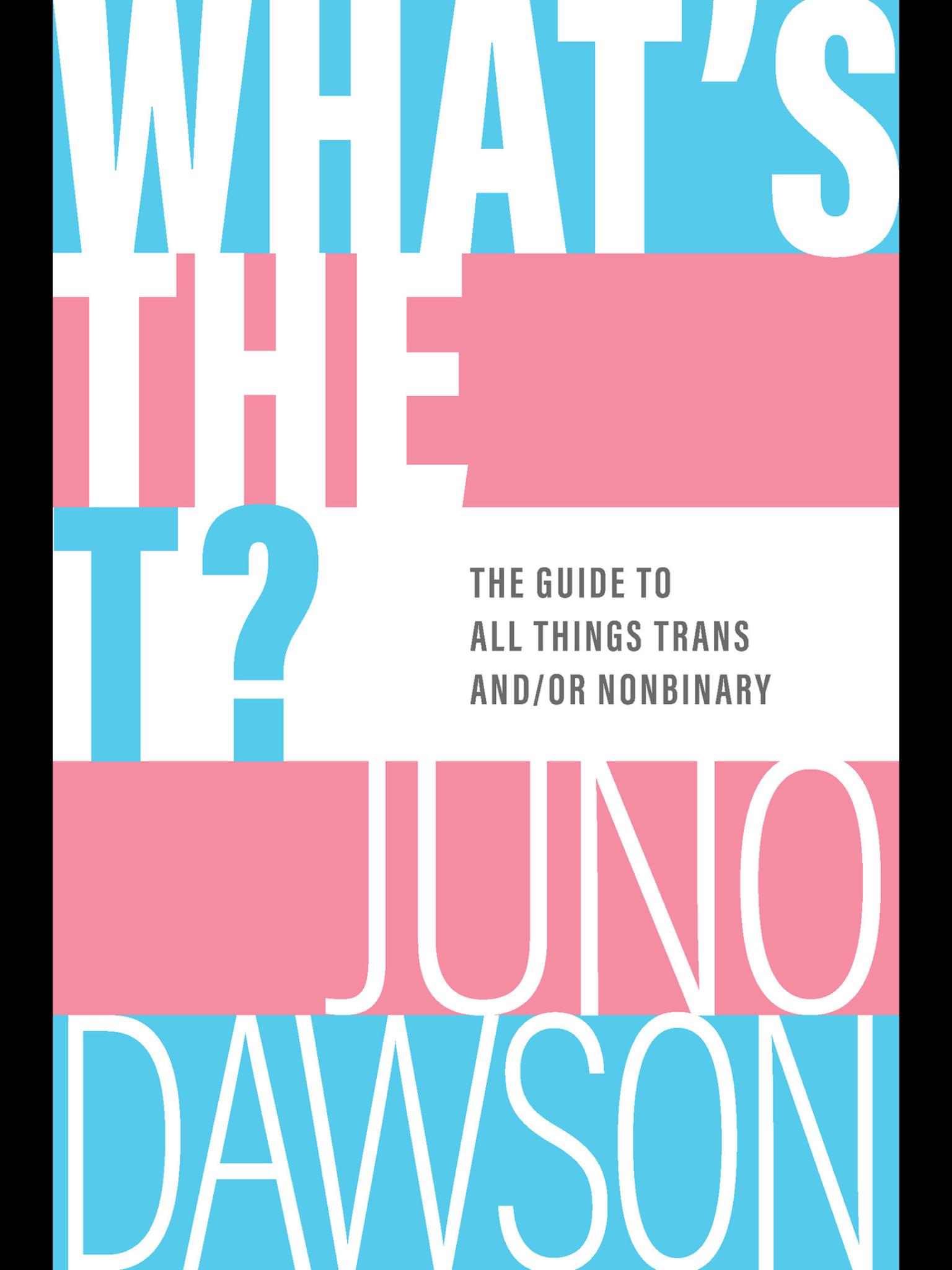
What's the T? The Guide to All Things Trans and/or NonBinary - by Juno Dawson

Juno Dawson's book This Book is Gay is often in the news as it is frequently challenged and appears on lists of banned books. I imagine we will be hearing more about this work as well in the coming months. Dawson, a trans woman, speaks frankly of her own experience while offering support and advice to other trans and nonbinary folx.

While her intended audience is other trans, gender queer, or questioning people she also speaks to cisgender people, and has a specific chapter for people like me "Advice for Parents and Caregivers". She offers that each reader has their own purpose for reading her book and provides a list of possible reasons why one might have picked it up including (among others) that "Maybe it's in your school library and it has a nice cover". 


In her chapter "Doctor! Doctor! I Think I'm Transgender!" she offers some advice to young trans and nonbinary people seeking treatment

For people under eighteen, I always think the first port of call is an adult you trust. This could be a teacher, librarian, school counselor or family doctor.

I hope that everyone knows that librarians will provide information on any topic without judgement, and that every young person knows a librarian whom they trust. However, in today's political climate that includes a rash of anti-trans legislation, book challenges that seek to remove all LGBTQ literature from school and libraries  ("nice covers" not withstanding), and the targeting of educators (including school librarians) who provide such information, I am afraid that finding such trusted adults and reliable information will be more difficult than ever. 

Dawson reminds readers that trans people have always been part of our history and suggests that we learn their stories. "When transphobic people accuse you of being 'trendy' or act like being trans is something new, be ready to open the library. Reading is what? Fundamental".

Wednesday, March 15, 2023

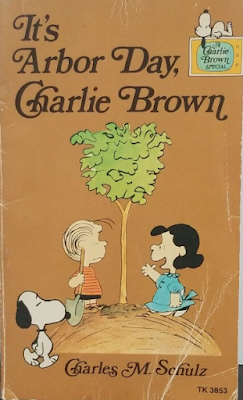
It's Arbor Day Charlie Brown - by Charles M. Schulz


My husband (James) was recently named to our town's Tree Committee (yes, that's a thing). Our adult child told him that there was a Peanuts television special about Arbor Day that he would probably be interested in. He found a copy for purchase on DVD and we await its arrival. Meanwhile he also found a used copy of the book version for purchase and had it sent to our house. (I also discovered that our local public library has a copy on DVD; I always check the library before buying.)

This full-color comic features Sally being humiliated when asked in class to tell what Arbor Day is and responds that it's the "day that all the ships come sailing into the arbor". Assigned to write a report about Arbor Day she seeks Linus' help who suggests a trip to the library where he's sure there are "some books about Arbor Day". What follows are several pages of images of Sally and Linus doing research at the library, as well as some shots of Snoopy and Woodstock laughing at a book on dog obedience training, and playing with the photocopier, which gets them kicked out.

I look forward to celebrating Arbor Day  is year on April 28. I guess that's what my elementary school was celebrating in the 70s when they used to give us saplings to take home and plant. Otherwise, I don't recall ever recognizing it.

Monday, March 13, 2023

Project Hail Mary - by Andy Weir

Dr. Ryland Grace wakes up from a coma not remembering who or where he is. He is able to surmise that he is on a space ship, but does not know why. As his memory gradually returns he realizes that his job is to save Earth, and all the Earthlings on it. As he continues his journey he meets an alien space ship and befriends Rocky, a spider-like alien, whose planet is likewise doomed unless he and Grace can figure out how to communicate and cooperate in vanquishing the dreaded Astrophage that threatens both of their planets.

In order to save the world the astronauts had a wealth of information at their disposal, namely the entirety of the Library of Congress in digital format! Rather than trying to guess what might be needed the powers that be determined that everything would be available to the heroes, copyright be damned! Good thing, too, because Grace made good use of it.

Science fiction as a genre is not something I typically seek out, although a perusal through my blog indicates that I have, in fact, read a fair amount of it. I would probably not have read Project Hail Mary had it not been the One Book One Community pick for Bridgewater this spring. James and I listened to the audio version, narrated by Ray Porter who was one of the best voice actors I've heard in the myriad books I've listened to. 

Thursday, February 16, 2023

Bay Country: Reflections on the Chesapeake - by Tom Horton


The New York Times pull quote on the cover of this work states that "Fans of Aldo Leopold, John McPhee, and Sigur Olson won't be disappointed...Mr. Horton displays a stunning command of the language." I will admit to not having ever heard of Sigurd Olson; however, I have read two of McPhee's books (one for my Celebrating the States project some years ago), and more I recently blogged about Leopold's A Sand County Almanac . I agree that like McPhee and Leopold, Horton has a "stunning command of the language". Furthermore, as in Leopold's work, libraries in Horton's book are used metaphorically, as a way to understand (read) nature. 

The roots of corn we seldom notice, but ought to heed; for they speak as eloquently as the golden ears and luxuriant foliage topside, but a different message indeed. Pull up a stalk sometime and the first thing that will strike you is how easy it was to do, and how scanty are the underpinnings of so statuesque a plant. Pushing up its glossy green regimens across a thousand square miles of Maryland, this giant, wild grass, bred into the aristocrat of cultivated cereals, epitomizes the pride and problems of our agriculture - and of more than agriculture - I venture there is more profound social commentary in a cornfield than in some libraries, if one is willing to dig for it.

With a coring device [scientists] extract gray-brown cylinders from the bay's bottom, a distance down through the muck of several feet, but a journey back through time of a thousand years. Grain by grain, layer by layer, a few micrometers a year, the sediments washing off the 64,000-square-mile watershed that extends from New York to West Virginia have compiled a rich natural historical library, awaiting only a generations of readers skilled enough to translate it.

...public commitment to restoring the bay is running at an all-time high. Throughout the watershed, people and their elected leaders are gabbling excitedly about the prospects, as a flock of geese gets raucous just before lifting off for new feeding grounds. The challenge is infectious, the script outline looks promising; but just as yet the library at the bottom of the bay reads caution. 

Horton's soothing prose made this love letter to the Chesapeake Bay (and all of Maryland) a perfect read aloud for this Marylander and her husband. The book was originally published in 1987, the year we were married - in Maryland!

Friday, February 3, 2023

The Librarian of Auschwitz - by Antonio Iturbe

People like to share memes with me about book collecting and book hoarding. These are meant to be humorous, but I generally don't find them especially funny. I do have quite a few books in my house, but I do not let them take over. I often read books from the library and then return them, or when I buy them I have a "one in, one out" policy. Purged books go to free book shelves, or are donated to libraries. They are shared. Books are meant to be read and shared, not simply put on display. I thought a lot about all of this as I read The Librarian of Auschwitz. This novel is based on the real story of Dita Kraus who, along with her family was sent to the family camp at Auschwitz-Birknenau during the Holocaust. Although she was only 14 years old Dita was asked to be the clandestine librarian at the clandestine school run by fellow prisoner Fredy Hirsch. She took on the task although the punishment for keeping the books would surely have been death had she been discovered. The eight tattered books entrusted to Dita's care were shared among the classes at the school, and otherwise hidden beneath a floor board. All the books had value, even the Russian grammar book, written in Cyrillic which no one in the camp read.

Early in the book the forbidden works are described as dangerous although they do not have "a sharp point, a blade or heavy end". 

Throughout history all dictators, tyrants, and oppressors, whatever their ideology - whether Aryan, black, oriental, Arab, Slav or any other racial background; whether defenders of popular revolutions, or the privileges of upper classes, or God's mandate, or martial law - have had one thing in common: the vicious persecution of books. Books are extremely dangerous; they make people think.

Even among the prisoners there was concern about what was to be found in some of the books. Fredy Hirsch tried to warn Dita off reading The Good Soldier Svejk, telling her that it was "not appropriate for children, especially girls". To which our heroine responds "Do you honestly believe that after observing on a daily basis the dozens of people entering the gas chambers...[that] what I read in a novel might shock me?". The same book is demonized by some other prisoners, and again Dita puts them in their place.

Reading this in light of the unprecedented book-banning that we are seeing in the United States today makes it especially chilling. Concerns about what someone might find in a book seem rather ridiculous in a country where children are gunned down in their classrooms and by police. 

In addition to the eight books, the school also runs a "library on legs". Similar to the human books in Ray Bradbury's Fahrenheit 451, people who have memorized stories share them verbally.

Before being sent to the Auschwitz Dita and her family were first sent to the ghetto in TerezĂ­n, a place with a library-on-wheels, a trolley pushed through the streets which was generally "warmly welcomed" although the "books were often stolen, and not always so they could be read. They were also used as toilet paper or as fuel for the stoves".

One of the books entrusted to Dita is H.G. Wells The Time Machine. Dita determines that Wells was right, time machines do exist, in the form of books. Furthermore, she realizes that books can take us "much farther than any pair of shoes".


Tuesday, January 24, 2023

Carry On - by Rainbow Rowell

I've read a lot of reviews of books by Rainbow Rowell, but until now I had not read any of her books, so when I saw this one at a Little Free Library at a neighbor's house I picked it up. 

As I started to read it, I thought it was simply a Harry Potter clone (a story about an orphan who doesn't know he's a wizard, who goes to a school for magical folks) but I figured there was probably more to it than that and did a bit of research. I learned that this is in fact some metafiction on Rowell's part. She explains how she came to write the book in an author's note at the end of the book. She begins her note with the following information

If you've read my book Fangirl, you know Simon Snow began as a fictional character in that novel.

A fictional-fictional character. Kind of an amalgam and descendant of a hundred other fictional Chosen Ones.

In Fangirl, Simon is the hero of a series of children's adventure novels written by Gemma T. Leslie - and the subject of much fanfiction written by the main character, Cath.

Rowell goes on to say that while she was able to let go of Cath and her world, she could not let go of Simon Snow, so she wrote her own story about him. 

And so I read the story on its own terms.

When Simon Snow returns to Watford for his final year of school he discovers that his nemesis (and roommate) Baz is missing. Baz's mother was once the headmistress of Watford, but was killed when Baz was very young. The ghost of Baz's mother comes looking for him in his dorm room, but finds only Simon and so she leaves a message with him asking that Baz avenge her death. When Baz does return he and Simon make a truce in order to work together to find the killer (and the expected love story ensues). Meanwhile the entire magic world is fighting an enigmatic monster called the Humdrum who is creating "dead zones" across Great Britain where magic does not work. The Mage (current headmaster at Watford) is spearheading the fight by conducting warrant-less searches of wizard homes, raiding their personal libraries looking for information to find out who is working with the Humdrum. (Books are referred to as "treasures".) The Mage insists that those who have "nothing to hide" have nothing to worry about. Baz is worried because he knows that his family keeps "banned books and dark objects". The Mage banned some books (and words!) after Baz's mother died. Simon's friend Penny is likewise concerned about what the Mage and his goons might find at her family's house. Simon insists that her family wouldn't have anything, but Penny isn't sure.

You know my mum. 'Information wants to be free.' 'There's no such thing as a bad thought.' Our library is practically as big as Watford's and better stocked. If you wanted to find something dangerous there, I'm sure you could. 

Baz notices that the books in his mother's library are out of order. This is concerning because his mother always had them sorted by subject. Baz "was always allowed to touch her books...to read any book, as long as [he] put it back in its place and promised to ask in something confused or frightened him". Well, imagine that. Rather than censoring what he could read, Baz's mother "parented" him instead.  

In addition to their home libraries Simon and his classmates use the school library regularly. This despite that fact that "most of the magickal books have been removed from the Watford library. It is not okay, however, that Simon "snuck a few bound volumes  [of The Magickal Record - "the closest thing magicians have to a newspaper...out of the library", even if he does believe his reasons are valid.